Added value: the gap between what inputs cost and what customers pay
Definition
Added value: The difference between the selling price of a product and the cost of the bought-in materials used to make it.
Example
added value=selling price−cost of bought-in materials
\text{added value} = \text{selling price} - \text{cost of bought-in materials}
added value=selling price−cost of bought-in materials
A coffee shop pays 40p for the beans, milk and cup that go into a flat white, and sells it for £3.20.
added value=£3.20−£0.40=£2.80 \text{added value} = \pounds 3.20 - \pounds 0.40 = \pounds 2.80 added value=£3.20−£0.40=£2.80That £2.80 per cup is what the business has to put towards wages, rent, energy and profit.
- The figure only means something once you set it against the shop's other costs.
- Selling 200 cups a day gives 200×£2.80=£560200 \times \pounds 2.80 = \pounds 560200×£2.80=£560, which covers £400 of daily staff, rent and energy costs, but 120 cups gives only £336 and the same £2.80 per cup now leaves a loss.
- Every business has to add value, because charging more than the materials cost is its only source of money for everything else it has to pay for.
Common Mistake
- Added value is not profit, because wages, rent, energy and marketing all still have to come out of it.
- In the coffee example £2.80 of added value per cup shrinks to 80p of profit per cup once those costs are paid.
- Only deduct the bought-in materials when you calculate added value, never the wages or rent.
How a business increases added value
- There are only two levers: raise the selling price customers accept, or cut the cost of the bought-in materials.
- Lifting the flat white from £3.20 to £3.50 raises added value to £3.10, while negotiating the ingredients down from 40p to 30p raises it to £2.90 without changing the price on the board.
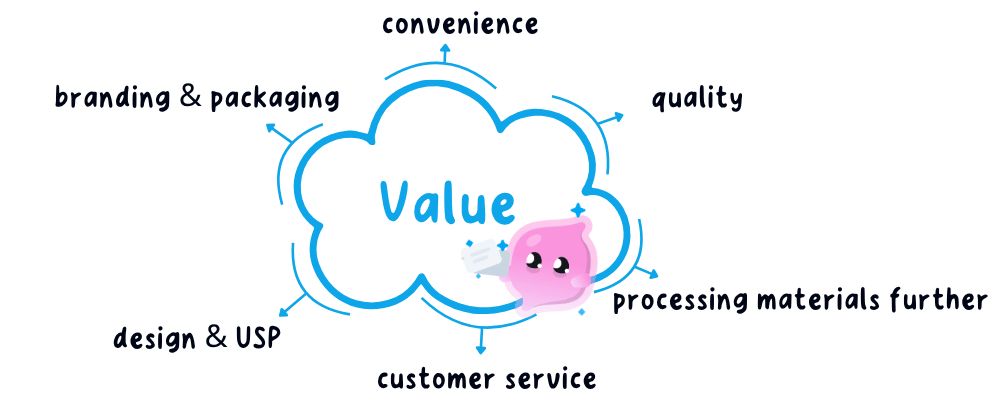
- Branding and packaging: a name customers trust and presentation that looks premium let a business charge more than an unbranded rival selling almost the same thing.
- Convenience: a supermarket sells a whole pineapple for £1 and a pot of pre-cut chunks for £2 even though the pot holds less fruit, because customers pay for the time saved.
- Quality: better ingredients, materials or workmanship justify a higher price and bring customers back.
- Design and a unique selling point: distinctive styling or a feature no rival offers stops customers comparing on price alone, which is how Apple charges a premium for phones built from similar components to its rivals.
- Customer service: helpful staff, free fitting or a long guarantee are worth paying extra for and cost little per sale.
- Processing materials further: turning flour into bread, or bread into a filled sandwich, adds value at every stage.
Example
- Greggs buys flour, meat and packaging as raw materials, then bakes, fills and brands the finished sausage roll before selling it in its own shops.
- The same flour is worth far more once it has been processed, packaged and sold under a name customers already recognise, so processing and branding are working together on the same product.
Limits and risks in each route
- Raising the price can lose customers, and a coffee shop with three rivals on the same street loses trade quickly while one inside a station loses very few sales.
- Cutting the cost of materials can cut quality, which damages the reputation the higher price depended on.
- Cheaper beans save 10p a cup, but a customer who stops coming back costs the shop £2.80 every time.
- The methods themselves cost money, so added value per unit can rise while profit does not, because branding needs advertising and design needs designers and neither counts as a bought-in material.
- A business with low added value per unit has to sell in large volumes to survive, while high added value supports a bigger margin on fewer sales.
Exam technique
- Write the formula as selling price minus the cost of bought-in materials, because a vague "price minus costs" is not the same thing.
- The commonest slip here is subtracting all the costs instead of only the bought-in materials, which turns added value into profit.
- A bare figure such as £2.80 says nothing on its own, so add what that £2.80 still has to cover.
- Asked how a business could add value, pick one method and apply it to the actual product in the question rather than listing them all.
Self review
- Define added value and state the formula.
- A sandwich costs 60p in ingredients and sells for £2.90: calculate the added value per sandwich.
- Why is added value not the same as profit?
- Name four methods of increasing added value and give an example of one.
- Give one risk of raising the price and one risk of buying cheaper materials.