Income statement: what it shows and what you are asked to do with it
Definition
Income statement: A financial statement showing a business's revenue, costs and the profit it made over a period of trading, usually one year.
- It covers a period of trading, usually a full year, so it reports performance over time rather than the position on one day.
- It works downwards from revenue, taking off one group of costs at a time, until it reaches the profit that belongs to the owners.
- Limited companies must publish theirs each year, which is how lenders, investors and the tax authority judge the business.
Note
Constructing an income statement is not assessed by Cambridge, so you will always be given one and asked to read it or to calculate from it.
A simple income statement
- Hillcrest Cycles is a bike shop, and these are the figures from its income statements for two successive years.
| £ | 2025 | 2026 |
|---|---|---|
| Revenue | 250,000 | 264,000 |
| Cost of sales | 150,000 | 171,600 |
| Gross profit | 100,000 | 92,400 |
| Expenses | 70,000 | 74,000 |
| Profit | 30,000 | 18,400 |
| Dividends paid | 10,000 | 10,000 |
| Retained profit | 20,000 | 8,400 |
Working down the statement
Definition
Cost of sales: The direct cost of the goods a business actually sold in the period, such as the materials used or the stock bought for resale.
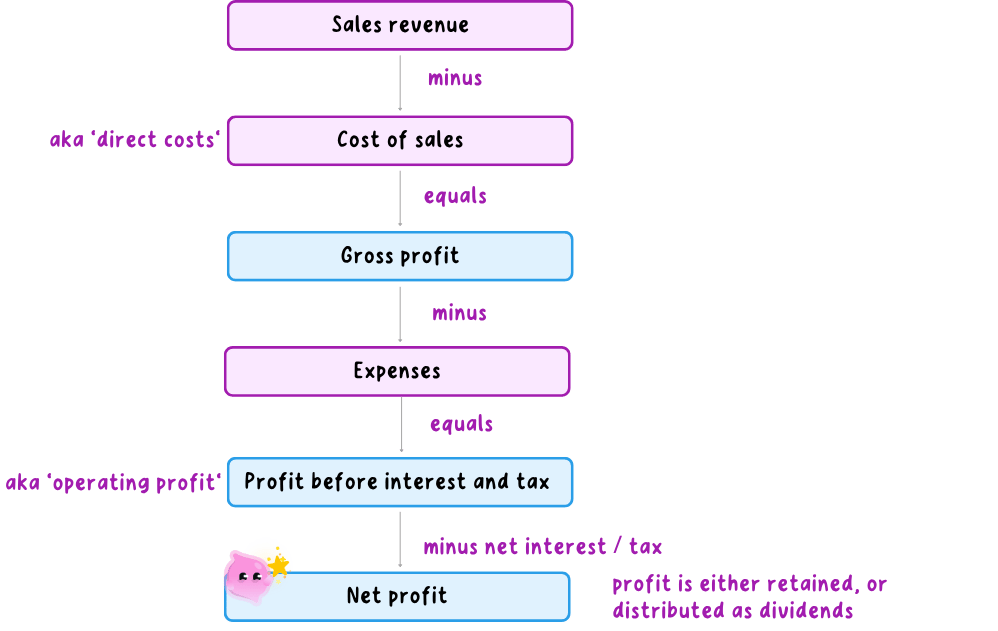
Gross profit: The profit made on trading alone, found by taking the cost of sales away from revenue, before any expenses are deducted.
- Revenue is the value of everything sold in the year, before any cost is taken off.
- Cost of sales counts only the direct cost of the goods actually sold, which for Hillcrest is the price it paid for the bikes on its shop floor.
- Taking one from the other gives gross profit=revenue−cost of sales\text{gross profit} = \text{revenue} - \text{cost of sales}gross profit=revenue−cost of sales, so 2025 shows £250,000−£150,000=£100,000£250{,}000 - £150{,}000 = £100{,}000£250,000−£150,000=£100,000.
- Expenses are the indirect running costs that are not attached to any single sale, such as rent, staff salaries, insurance, advertising and energy.
- Deducting them gives profit=gross profit−expenses\text{profit} = \text{gross profit} - \text{expenses}profit=gross profit−expenses, so 2025 shows £100,000−£70,000=£30,000£100{,}000 - £70{,}000 = £30{,}000£100,000−£70,000=£30,000.
- After the owners take £10,000 in dividends, £30,000−£10,000=£20,000£30{,}000 - £10{,}000 = £20{,}000£30,000−£10,000=£20,000 of retained profit stays in the business as an internal source of finance.
Reading the change from one year to the next
- Revenue rose by £264,000−£250,000=£14,000£264{,}000 - £250{,}000 = £14{,}000£264,000−£250,000=£14,000 in 2026, yet gross profit fell from £100,000 to £92,400.
- The reason sits in the line above, because cost of sales rose by £171,600−£150,000=£21,600£171{,}600 - £150{,}000 = £21{,}600£171,600−£150,000=£21,600, far faster than revenue.
- Falling gross profit on rising revenue always points at the margin on each sale, so Hillcrest is either paying its suppliers more or discounting bikes to win customers.
- Expenses added another £4,000, and the two changes together cut profit from £30,000 to £18,400.
- With the dividend held at £10,000, retained profit drops to £18,400−£10,000=£8,400£18{,}400 - £10{,}000 = £8{,}400£18,400−£10,000=£8,400, leaving far less internal finance for next year.
- The owners now face a real choice between cutting their own payout and borrowing to fund the next shop refit.
Common Mistake
- Gross profit and profit are different lines, and using one word for both is the error this topic is built to catch.
- A rising revenue figure on its own proves nothing, because the cost of sales beneath it may have risen faster.
- The statement says nothing about cash, so a business reporting £18,400 of profit can still be overdrawn at the bank.
Using the statement in decisions
- A falling gross profit points managers at their suppliers, so Hillcrest can negotiate a bulk discount, switch supplier or raise its prices.
- Each of those has a cost, since a new supplier may be less reliable and a higher price may send customers to a rival shop.
- A weak profit line with a healthy gross profit points instead at the expenses, so the response is cheaper premises or a smaller advertising budget.
- Cutting advertising is the classic false economy, because the saving shows up this year and the lost sales show up next year.
- Comparing two branches' statements shows which one to expand and which to close, using profit rather than revenue as the test.
- Lenders read the profit line to judge whether the business can afford repayments, and investors read the retained profit line to see what is being reinvested.
- Measuring the size of profit against revenue or against capital employed is done with ratios, which are covered in the analysis of accounts.
Self review
- State the formula for gross profit and the formula for profit.
- Revenue is £264,000 and cost of sales is £171,600, so what is gross profit?
- Which line of the statement is used to pay dividends, and what is left called?
- Why can gross profit fall in a year when revenue rises?
- Give one decision an owner might take after seeing expenses rise by £4,000.