Single Circulation in a Fish
Definition
Single circulation
A circulatory system in which the blood passes through the heart once for each complete circuit of the body, as in a fish.
- A fish has a single circulation, so the blood passes through the heart only once for each complete circuit of the body.
- The fish heart has just one atrium and one ventricle, so it acts as a single pump.
- The heart pumps deoxygenated blood to the gills.
- At the gills the blood gains oxygen and loses carbon dioxide.
- The oxygenated blood flows straight on from the gills to the rest of the body, without returning to the heart first.
- After giving up its oxygen to the tissues, the deoxygenated blood returns to the heart to complete the single loop.
- Because the blood is not re-pressurised after the gills, it leaves them at low pressure and travels slowly to the organs.
Note
The gills contain many narrow capillaries, which lower the blood pressure before the blood reaches the body.
Double Circulation in a Mammal
Definition
Double circulation
A circulatory system in which blood passes through the heart twice for each circuit of the body: once to the lungs and once to the rest of the body.
- A mammal has a double circulation, so blood passes through the heart twice for each full circuit.
- The pulmonary circulation carries deoxygenated blood from the heart to the lungs and back.
- The systemic circulation carries oxygenated blood from the heart to the body and back.
- The right side of the heart drives the pulmonary circulation and the left side drives the systemic circulation.
Example
Follow one red blood cell: body, right side of the heart, lungs, left side of the heart, then the body again.
Blood Is Re-Pressurised at the Heart
- After picking up oxygen at the lungs, the blood returns to the heart before going to the body.
- The muscular left side of the heart raises the blood to a high pressure again.
- This high pressure pushes the blood quickly to the organs of the body.
- In a single circulation the blood cannot be re-pressurised, so it flows on slowly after the gills.
Note
Passing through the narrow capillaries of the gills or lungs causes a large drop in blood pressure.
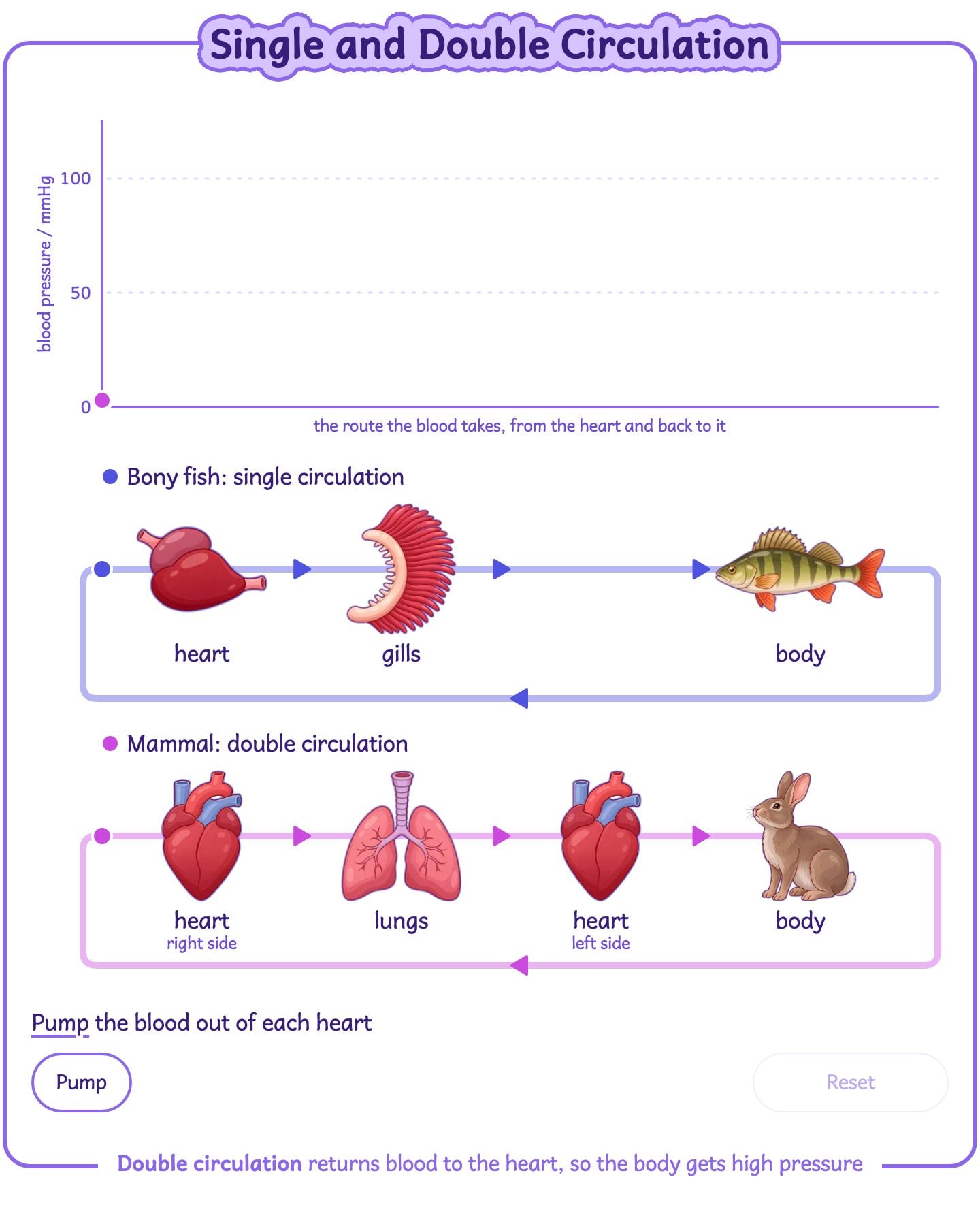
Follow the blood around both loops and notice that it returns to the heart to regain pressure.
Advantages of a Double Circulation
- Because the blood is re-pressurised, it reaches the body tissues quickly and at high pressure.
- Oxygen and glucose are therefore delivered rapidly, and wastes are removed rapidly.
- Oxygenated and deoxygenated blood are kept fully separate, so the body receives fully oxygenated blood.
- This supports a high rate of respiration, which active, warm-blooded mammals need to release energy quickly.
Self review
- How many times does blood pass through the heart in one circuit of a single circulation?
- Name the two circuits of a mammalian double circulation.
- Why can a double circulation deliver blood to the body at high pressure?
- Give two advantages of a double circulation over a single circulation.