What changes a population's size
Definition
Limiting factor
A factor, such as shortage of food, water or space, that stops a population growing any larger or slows the rate of a process.
- A population grows when births outnumber deaths, and shrinks when deaths outnumber births.
- The rate of population growth is affected by food supply, competition, predation and disease.
- When one of these works against the population, it acts as a limiting factor that slows growth.
How each factor limits growth
- A shortage of food or space means not every individual can survive, so growth slows.
- Competition between members of the population increases as numbers rise.
- More predators and the faster spread of disease in a crowded population also reduce numbers.
The sigmoid growth curve
Definition
Exponential growth
A phase of very rapid population growth in which numbers increase faster and faster because resources are plentiful and few factors limit the population.
- In an environment with limited resources, population growth follows an S-shaped (sigmoid) curve.
- The curve has four phases: the lag phase, the exponential (log) phase, the stationary phase and the death phase.
- You should be able to identify each phase on a graph of population size against time.
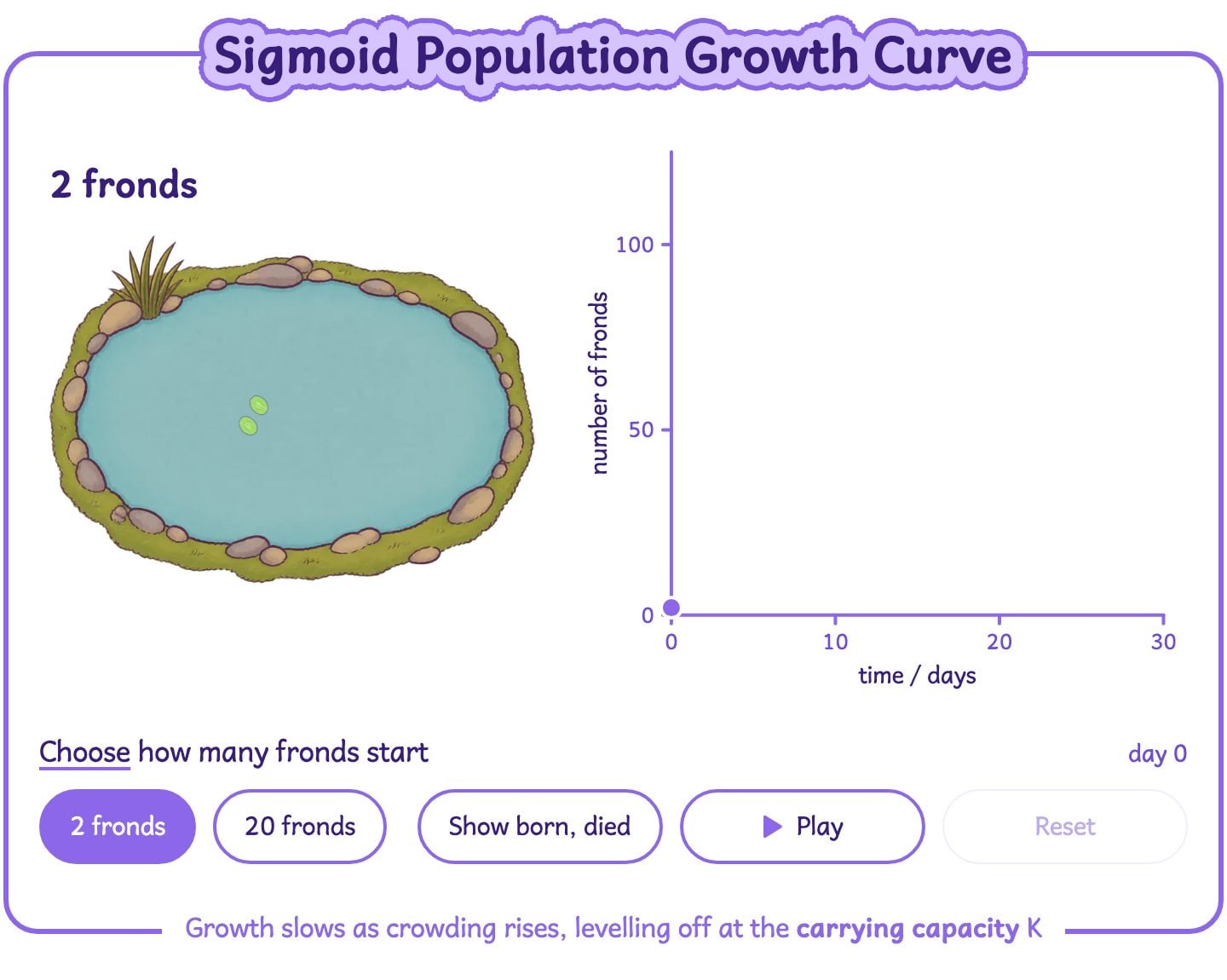
Follow the curve through its phases and notice where growth slows and levels off.
The four phases
- In the lag phase, numbers grow slowly while organisms settle in and begin to reproduce.
- In the exponential (log) phase, numbers grow very rapidly because resources are plentiful.
- In the stationary phase, births and deaths are balanced, so numbers stay roughly constant.
- In the death phase, deaths outnumber births and the population falls.
Self review
- Name the four factors that affect the rate of population growth.
- What shape is the growth curve of a population with limited resources?
- In which phase does the population grow most rapidly?
- What is happening to births and deaths during the stationary phase?