Food chains
Food chain
A diagram that shows the transfer of energy from one organism to the next, beginning with a producer.
- A food chain shows the transfer of energy from one organism to the next, always beginning with a producer.
- Each arrow points in the direction the energy flows, from the organism that is eaten to the organism that eats it.
- To construct a food chain, write the producer first, then link each organism to the one that feeds on it.
Grass to grasshopper to frog to snake is a food chain that begins with the producer, grass.
Producers
Producer
An organism that makes its own organic nutrients, usually using energy from sunlight, through photosynthesis.
- A producer makes its own organic nutrients, usually using energy from sunlight through photosynthesis.
- Producers are almost always green plants or algae, and they always form the start of a food chain.
- They store the trapped energy as chemical energy that every consumer above them depends on.
Consumers
Consumer
An organism that gets its energy by feeding on other organisms.
- A consumer is an organism that gets its energy by feeding on other organisms.
- Consumers are classed as primary, secondary, tertiary or quaternary according to their position in the food chain.
- A primary consumer eats the producer, a secondary consumer eats the primary consumer, and a tertiary consumer eats the secondary consumer.
In grass to rabbit to fox, the rabbit is the primary consumer and the fox is the secondary consumer.
Herbivores
Herbivore
An animal that gets its energy by eating plants.
- A herbivore is an animal that gets its energy by eating plants.
- Because they feed directly on producers, herbivores are always primary consumers.
- A rabbit, a cow and a caterpillar are all herbivores.
Carnivores
Carnivore
An animal that gets its energy by eating other animals.
- A carnivore is an animal that gets its energy by eating other animals.
- Carnivores are secondary, tertiary or quaternary consumers, depending on where they feed in the chain.
- A carnivore that hunts and kills other animals is a predator, and the animals it eats are its prey.
Food webs
Food web
A network of interconnected food chains showing how energy and biomass pass through a community.
- A food web is a network of interconnected food chains in a habitat.
- It shows that most organisms eat more than one type of food and are eaten by more than one predator.
- A food web gives a more realistic picture of feeding relationships than a single food chain.
A fox that eats both rabbits and mice links two separate food chains together into one web.
Reading a food web
- To interpret a food web, follow the arrows to see how energy passes from one organism to the next.
- If one organism is removed, trace the arrows to work out which populations would rise or fall.
- Removing a predator often lets its prey increase, which can then reduce the numbers of the prey's own food.
- Which way do the arrows point in a food chain?
- Describe a producer in one sentence.
- What is a primary consumer?
- Why does a food web show feeding relationships better than a single food chain?
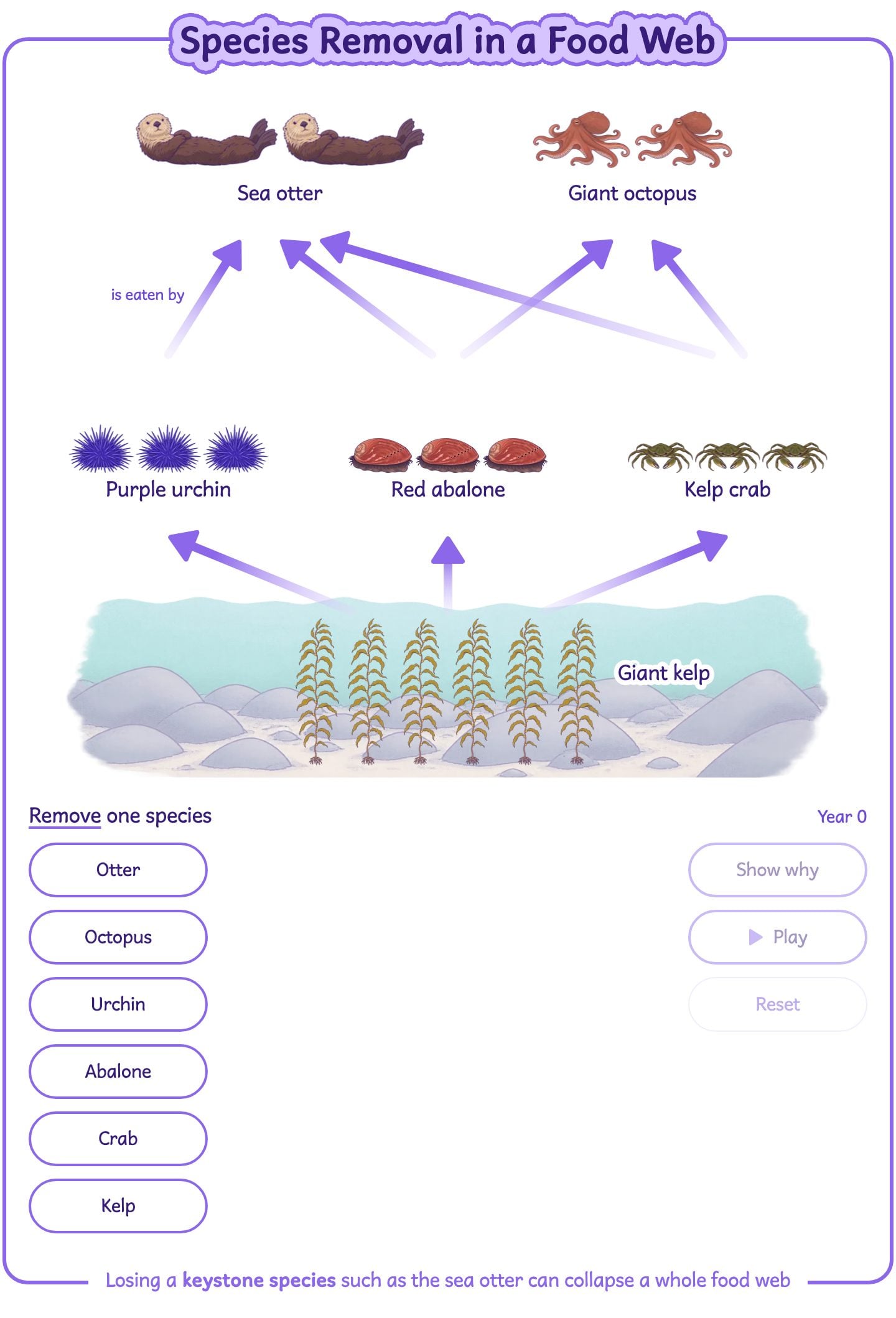
Remove one species and watch how the other populations in the food web are affected.