Gene mutation changes the DNA base sequence
Mutation
A mutation is a random change in the base sequence of DNA that can produce a new characteristic, such as resistance to an antibiotic.
- A gene mutation is a random change in the base sequence of DNA.
- The order of bases in a gene codes for the order of amino acids in a protein, so a change in the bases can change the amino acid sequence.
- A different amino acid sequence can change the way the protein folds, altering its shape and so how well it works.
- Because the change creates a base sequence that did not exist before, a gene mutation produces a new allele.
All of this article is Supplement content, examined only on the Extended papers (Paper 2 and Paper 4).
Sources of genetic variation in populations
Random fertilisation
The random fusion of any male gamete with any female gamete during sexual reproduction, producing new combinations of alleles in the offspring.
- Four processes together produce the genetic variation found in a population.
- Mutation
- Creates brand-new alleles, and is the only process that makes alleles that never existed before.
- Meiosis
- Produces gametes that are genetically different, by mixing the parent's alleles into new combinations.
- Random mating
- Any individual can breed with any other, so alleles are combined in many different ways across the population.
- Random fertilisation
- Any male gamete can fuse with any female gamete, giving new combinations of alleles in the offspring.
Only mutation makes new alleles; meiosis, random mating and random fertilisation shuffle existing alleles into new combinations.
New alleles versus new combinations
Allele
An alternative form of a gene.
- Only mutation produces a new allele that has never existed before.
- Meiosis, random mating and random fertilisation do not make new alleles; they combine existing alleles in new ways.
- Together these processes keep a population's genetic variation high, which is the raw material for natural selection.
Mutations happen at random: they are not produced because an organism needs them.
- What is a gene mutation, in terms of DNA?
- State the four sources of genetic variation in a population.
- Which of these is the only source of new alleles?
- How do meiosis and random fertilisation increase variation if they do not make new alleles?
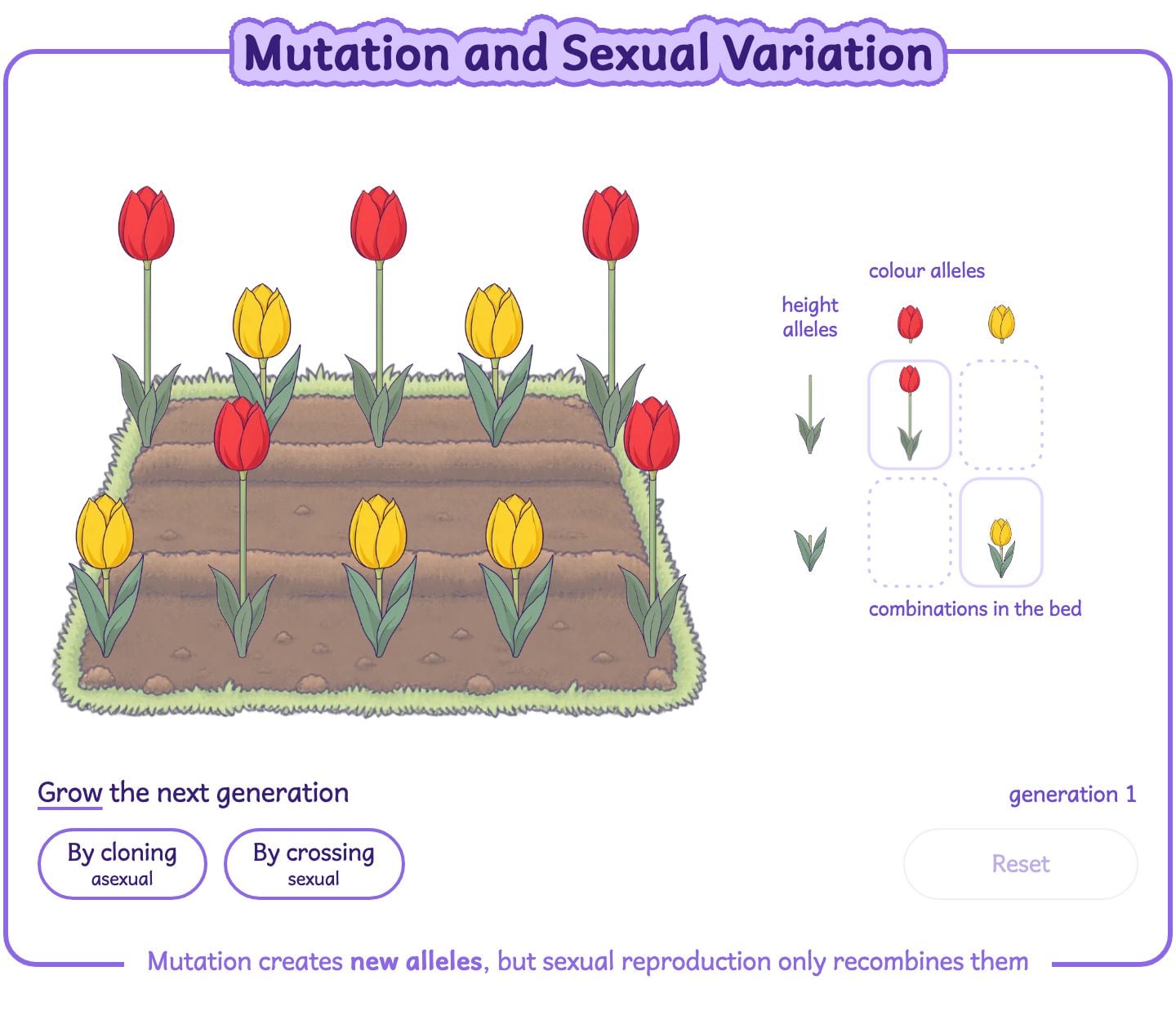
Compare mutation, which makes new alleles, with sexual reproduction, which only shuffles the alleles that exist.