Variation within a species
Variation
Variation is the differences in characteristics between individuals of the same species.
- Variation is the differences in the characteristics between individuals of the same species.
- No two members of a species are exactly alike, except for identical twins and organisms produced by asexual reproduction.
- A characteristic can be sorted in two ways: by what causes it and by the pattern it shows across a population.
- By pattern, a characteristic shows either continuous variation, a smooth range, or discontinuous variation, a few separate groups.
Every inherited characteristic varies either as a smooth range or as a small number of distinct groups.
Continuous variation
Continuous variation
Variation that produces a range of phenotypes between two extremes, with no distinct groups, such as body length or body mass.
- Continuous variation produces a range of phenotypes between two extremes, with every value in between represented.
- The characteristic is measured and given a value with units, so the data is quantitative.
- The values grade smoothly into one another, so there are many intermediates and no separate categories.
- Examples include body length (height) and body mass in humans, and the length of leaves on a tree.
In a large group of students, height runs smoothly from the shortest to the tallest with every height in between, so you cannot sort people into a few neat height groups.
Discontinuous variation
Discontinuous variation
Variation that produces a limited number of distinct phenotypes with no intermediates, such as ABO blood group.
- Discontinuous variation produces a limited number of distinct phenotypes with no intermediates.
- Each individual fits into one clear category, and cannot be part way between two groups.
- The characteristic is counted into categories rather than measured, so the data is qualitative.
- Examples include ABO blood group (A, B, AB or O), seed shape in peas (round or wrinkled) and seed colour in peas (yellow or green).
Your ABO blood group is A, B, AB or O, and there is no group half way between A and B.
What causes each type
Phenotype
The observable features of an organism.
- An individual's phenotype is produced by its genes, its environment, or the two acting together.
- Discontinuous variation is usually caused by genes only, so the environment has little or no effect on which category an individual is in.
- Continuous variation is caused by both genes and the environment acting together.
- For example, your genes set a potential height, but your diet and health while growing decide the height you actually reach.
Do not assume every difference you can see is inherited: ask whether it would change if the individual had grown up somewhere else, and if it would, the environment is involved.
- What is meant by variation?
- Give one example of a continuously varying characteristic and one of a discontinuously varying characteristic.
- Is ABO blood group measured or counted?
- State the cause of discontinuous variation and the cause of continuous variation.
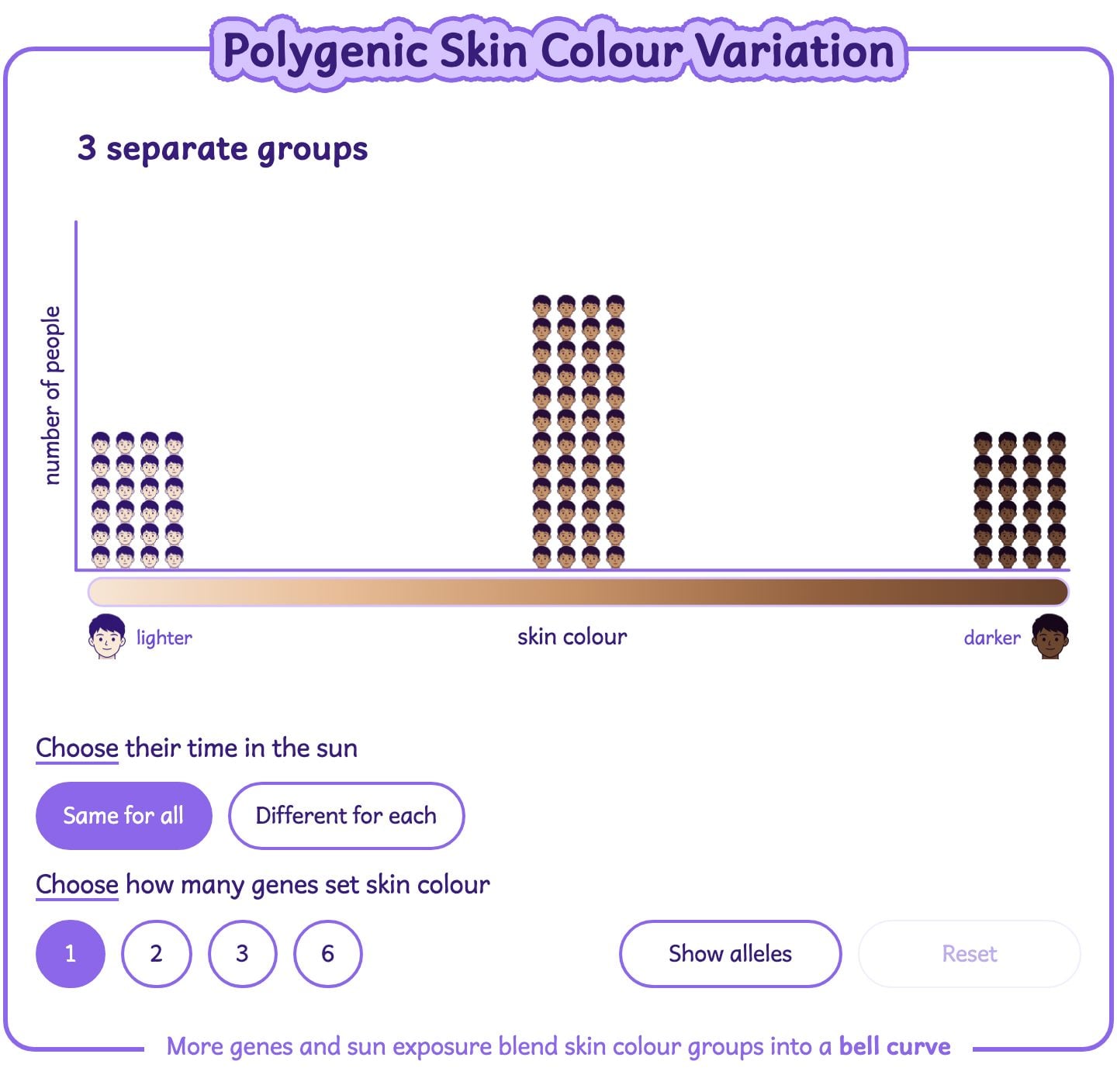
Change the number of genes and sun exposure and watch the groups blend into a continuous range.