What mitosis is
Definition
Mitosis
A type of nuclear division that produces two genetically identical diploid daughter cells.
- Mitosis is a type of nuclear division, in which the nucleus of a cell divides.
- It produces two new cells, called daughter cells.
- The two daughter cells are genetically identical to each other and to the parent cell.
- Each daughter cell is diploid, keeping the full set of chromosomes.
Note
- Mitosis is Supplement content, assessed only on the Extended papers (Papers 2 and 4).
- You do not need the named stages of mitosis for 0610, but you should be able to outline the process below.
Chromosomes are copied before mitosis
Definition
Chromosome
A thread-like structure in the nucleus, made of one long molecule of DNA that carries many genes.
- Before a cell divides by mitosis, it copies its chromosomes exactly, a process called replication.
- Each chromosome becomes two identical copies, joined together.
- This copying happens before mitosis begins.
- Because the chromosomes are copied first, both daughter cells can receive one complete, identical set.
Hint
Copying the DNA exactly is the reason the two daughter cells end up genetically identical.
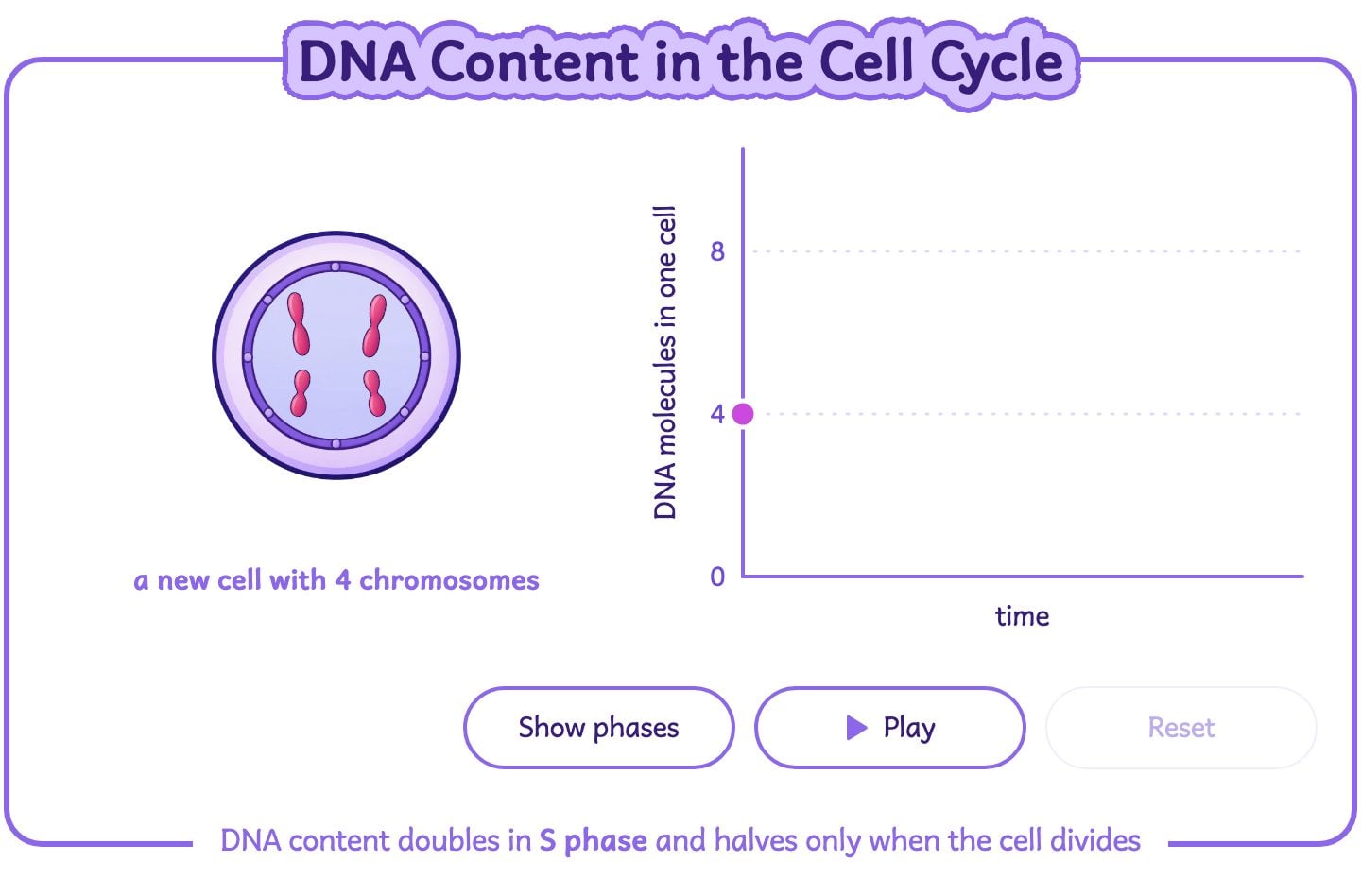
Follow the DNA content and notice that it doubles when chromosomes are copied, then halves at division.
How mitosis happens
- The cell starts with each chromosome already copied into two identical copies joined together.
- The copied chromosomes line up across the middle of the cell.
- The two copies of each chromosome are then pulled apart to opposite ends of the cell.
- This gives each end of the cell one complete, identical set of chromosomes.
- A new nucleus forms at each end, and the cytoplasm then divides to make two separate daughter cells.
Note
The chromosomes are separated whole, so each new cell gets a full copy of every chromosome, not half of one.
What mitosis is used for
- Growth: mitosis increases the number of cells, letting an organism grow larger.
- Repair of damaged tissues: mitosis makes new cells to heal an injury, such as a cut in the skin.
- Replacement of cells: mitosis replaces cells that are constantly worn out, such as skin and red blood cells.
- Asexual reproduction: mitosis produces offspring that are genetically identical to the single parent.
Self review
- What type of division is mitosis, and what does it produce?
- What must happen to the chromosomes before mitosis, and why?
- Outline what happens to the copied chromosomes during mitosis.
- How do the daughter cells compare with the parent cell?
- Give the four roles of mitosis.