RNA and how it differs from DNA
Definition
RNA
A single-stranded molecule that carries the genetic code and contains the base uracil (U) in place of the thymine (T) found in DNA.
- RNA is a molecule that carries the genetic code inside the cell, and it is similar to DNA.
- RNA is a single strand, while DNA is a double strand twisted into a double helix.
- RNA contains the base uracil (U) in place of the thymine (T) found in DNA.
- The type of RNA that carries a copy of a gene is messenger RNA (mRNA).
Note
This is Supplement content, assessed only on the Extended papers (Papers 2 and 4).
Making the mRNA copy
Definition
Messenger RNA (mRNA)
A molecule that carries a copy of a gene from the nucleus to the cytoplasm.
- The gene that codes for the protein stays in the nucleus.
- An enzyme called RNA polymerase makes an mRNA copy of the gene.
- This mRNA is like a single strand of the gene, but with the base U in place of T.
- The mRNA copy then leaves the nucleus and travels through the cytoplasm to a ribosome.
Building the protein at the ribosome
Definition
Ribosome
The structure in the cytoplasm where amino acids are assembled into a protein.
- At the ribosome, the mRNA is read in groups of three bases.
- Each group of three bases is called a triplet, or codon, and codes for one amino acid.
- The ribosome joins the amino acids together in the order set by the codons, building the protein.
- This order is specific to each protein, and is determined by the order of bases on the mRNA.
- A different sequence of amino acids gives the protein a different shape.
Self review
- What is RNA, and how does it differ from DNA?
- Which enzyme makes the mRNA copy of a gene, and where does this happen?
- What is a triplet (codon), and what does it code for?
- How does the mRNA travel from the gene to the ribosome?
- What decides the order of amino acids in the finished protein?
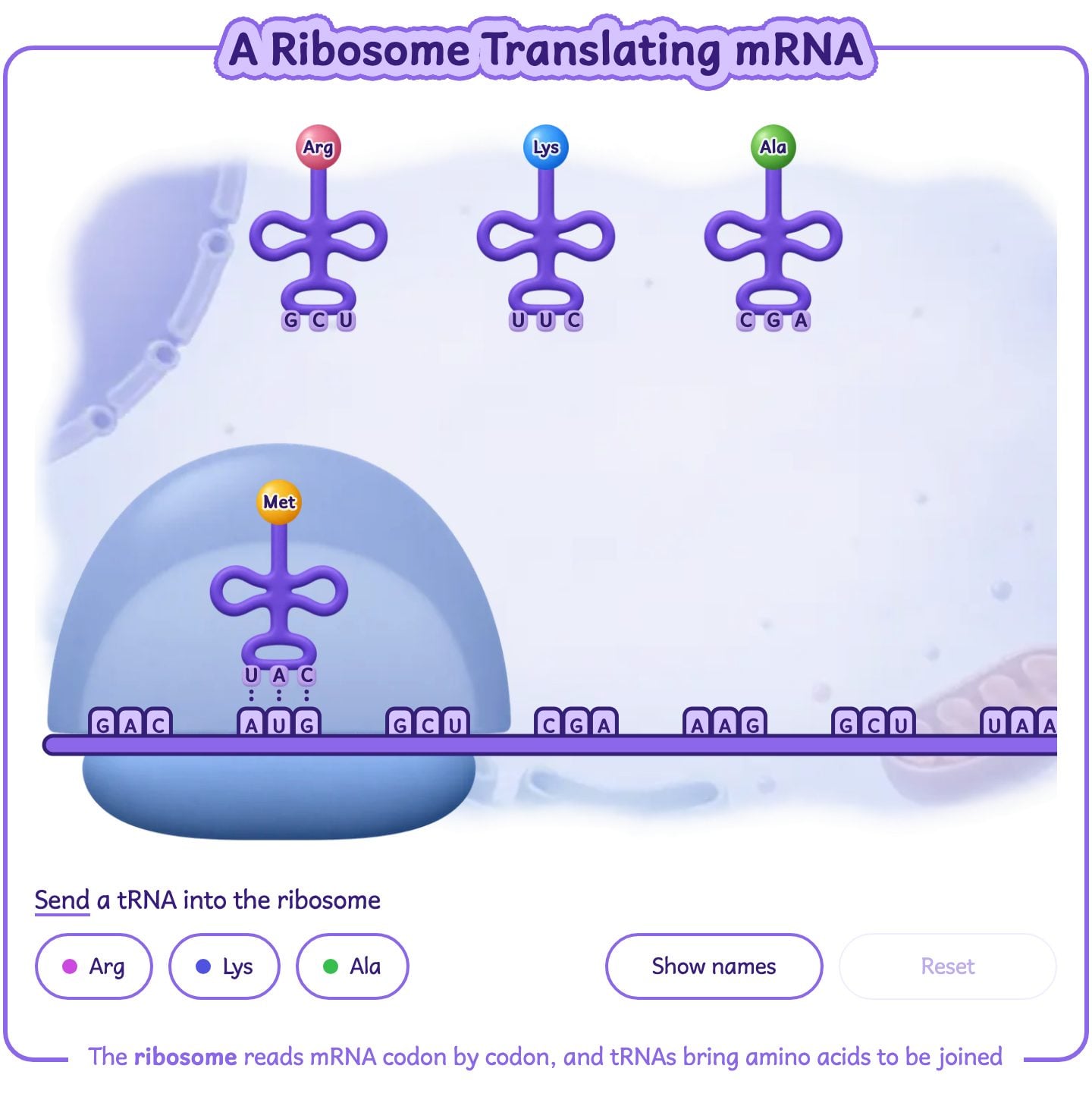
Watch the ribosome read the mRNA and join amino acids into a chain.