What a Synapse Is
Definition
Synapse
The tiny gap between two neurones, where the impulse is passed on by chemicals called neurotransmitters.
- A synapse is a junction between two neurones.
- The two neurones do not touch; a tiny synaptic gap separates them.
- At a synapse the impulse is passed on by a chemical, not by electricity.
Note
The basic idea of a synapse as a junction is Core; the detailed structure, events and one-way rule below are Supplement (Extended).
The Structure of a Synapse
Definition
Neurotransmitter
A chemical released at a synapse that diffuses across the gap and passes the impulse to the next neurone.
- The end of the first neurone contains tiny sacs called vesicles.
- Each vesicle holds molecules of a chemical called a neurotransmitter.
- Between the two neurones lies the synaptic gap.
- The membrane of the next neurone carries receptor proteins shaped to fit the neurotransmitter.
How an Impulse Crosses a Synapse
- An impulse arrives and stimulates the vesicles to release neurotransmitter into the synaptic gap.
- The neurotransmitter molecules diffuse across the gap.
- They bind to the receptor proteins on the next neurone.
- This stimulates a new impulse in the next neurone.
Note
The chemical is released on one side and detected on the other, so the message is carried across the gap by diffusion.
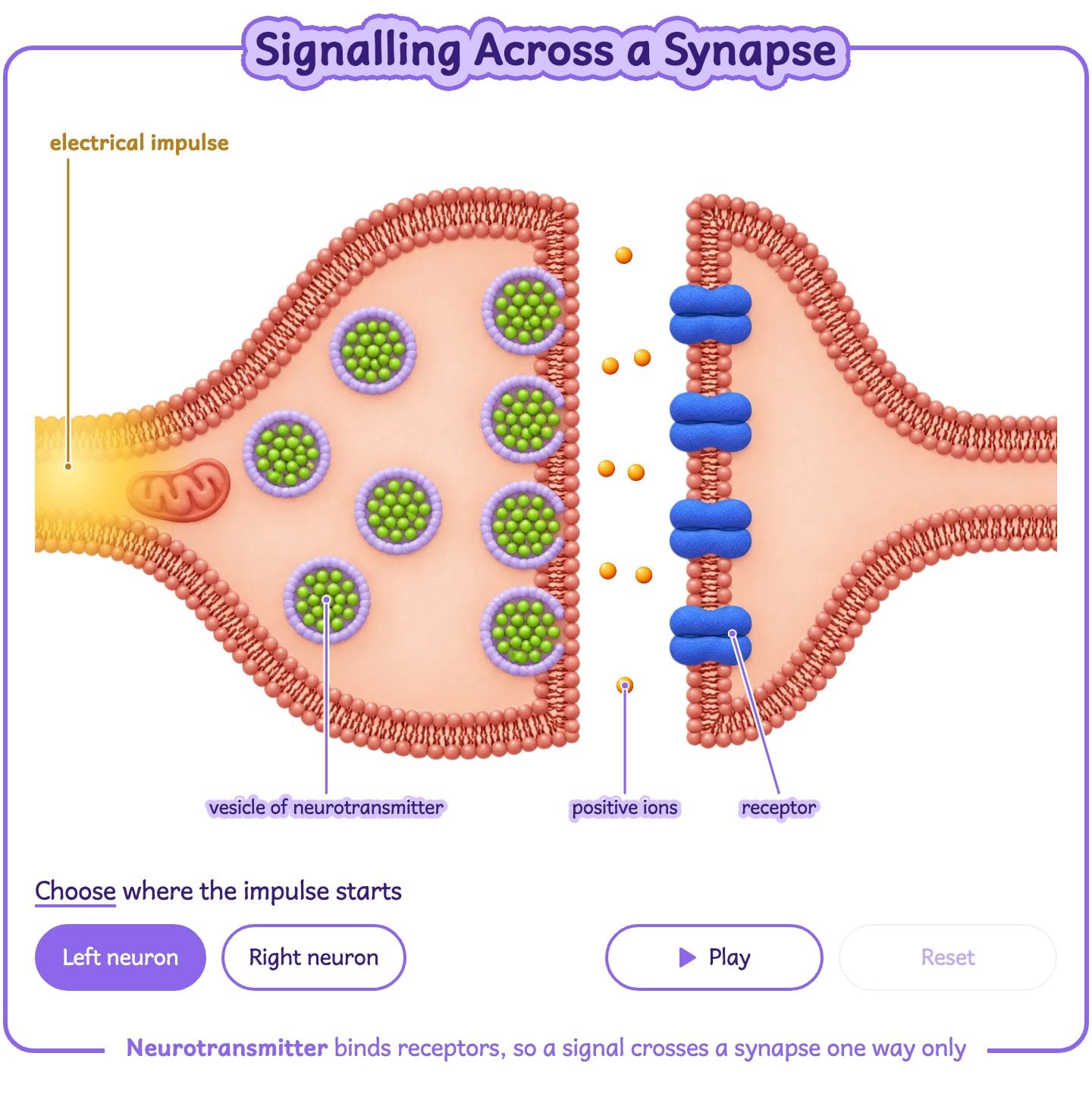
Send a signal and watch the transmitter cross the gap and bind receptors, working in one direction only.
Why Synapses Work in One Direction
- Only the first neurone can release neurotransmitter, and only the second neurone has the receptor proteins.
- So an impulse can only pass one way across a synapse.
- This ensures impulses travel in one direction only through the nervous system.
Common Mistake
A synapse only works one way, so an impulse cannot travel backwards from the second neurone to the first.
Why This Matters
- One-way transmission keeps impulses following the correct pathway, such as a reflex arc.
- It also lets the nervous system control which neurones are stimulated and when.
Self review
- What is a synapse?
- Name the structures found at a synapse.
- Describe how a neurotransmitter carries the impulse across the gap.
- Why can an impulse only travel one way across a synapse?
- What kind of movement carries the neurotransmitter across the gap?