Why Inspired and Expired Air Differ
- The differences between inspired and expired air are caused by aerobic respiration in the body's cells.
- In respiration, cells use glucose and oxygen to release energy, and produce carbon dioxide and water.
- The word equation is: glucose+oxygen→carbon dioxide+water\text{glucose} + \text{oxygen} \rightarrow \text{carbon dioxide} + \text{water}glucose+oxygen→carbon dioxide+water.
- The balanced symbol equation is: C6H12O6+6O2→6CO2+6H2OC_6H_{12}O_6 + 6O_2 \rightarrow 6CO_2 + 6H_2OC6H12O6+6O2→6CO2+6H2O.
- Because cells use oxygen, it diffuses from the alveoli into the blood, so expired air contains less oxygen.
- Because cells make carbon dioxide, it diffuses from the blood into the alveoli, so expired air contains more carbon dioxide.
- Water made in respiration, and water evaporating from the moist airways, means expired air contains more water vapour.
- Expired air is also warmer, because it is heated to body temperature inside the lungs.
Note
This is Supplement (Extended) content in Cambridge IGCSE Biology (0610), Topic 11: Gas exchange in humans.
How Activity Changes Breathing
Definition
Breathing rate
The number of breaths taken each minute.
- During physical activity, muscles respire faster to release the energy needed for movement.
- Faster respiration produces more carbon dioxide, which passes into the blood.
- This raises the carbon dioxide concentration in the blood.
- The brain detects the increased carbon dioxide concentration in the blood.
- The brain then sends signals that increase the rate and depth of breathing.
- Faster, deeper breathing removes the extra carbon dioxide and takes in the extra oxygen the muscles need.
- After activity, breathing stays raised until the carbon dioxide concentration returns to normal.
Common Mistake
The brain responds mainly to a rise in carbon dioxide in the blood, not to a fall in oxygen.
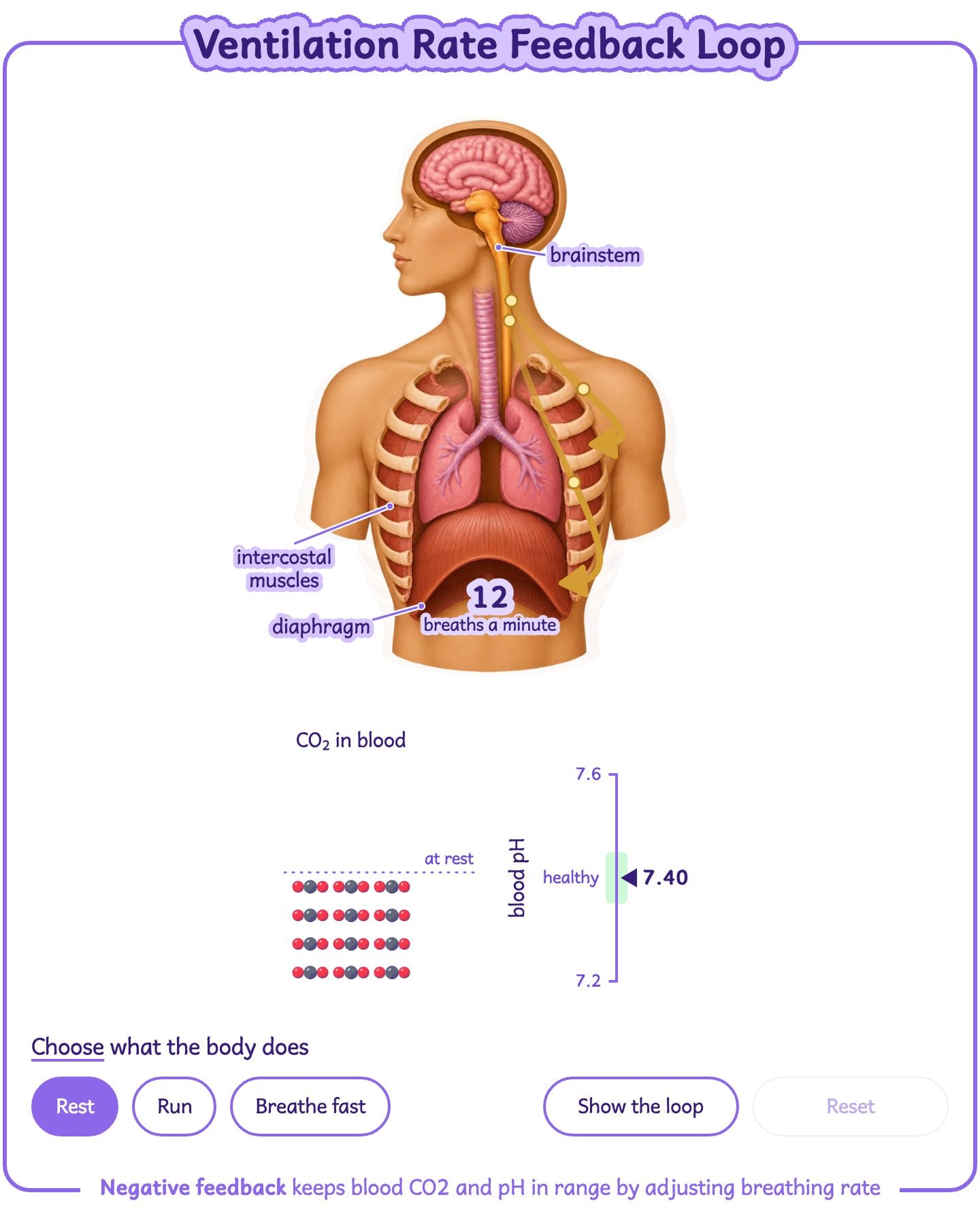
Change the activity level and watch breathing rate respond to keep carbon dioxide in balance.
Keeping the Airways Clean
Definition
Goblet cell
A cell in the lining of the airways that secretes mucus.
Definition
Mucus
A sticky fluid that lines the airways and traps pathogens and dust particles from the air breathed in.
Definition
Ciliated cell
A cell with tiny hair-like cilia on its surface that sweep mucus and trapped particles towards the throat.
- The airways are lined with goblet cells and ciliated cells that protect the lungs.
- Goblet cells secrete mucus, a sticky fluid, onto the lining of the airways.
- The mucus traps pathogens such as bacteria and viruses, along with dust and other particles in the air breathed in.
- Ciliated cells have tiny hair-like cilia on their surface.
- The cilia beat and sweep the mucus upwards towards the throat.
- The mucus is then swallowed, so the trapped pathogens and particles are removed and destroyed in the stomach.
- This stops particles and pathogens reaching the alveoli, where they could cause infection or damage.
Self review
- Use respiration to explain why expired air contains less oxygen and more carbon dioxide.
- Give the balanced symbol equation for aerobic respiration.
- What change in the blood is detected by the brain during exercise?
- How does the brain change breathing in response to that change?
- Explain how goblet cells and ciliated cells work together to protect the lungs.