Inspired and Expired Air
Definition
Inspiration
Breathing in; the diaphragm and intercostal muscles contract to increase the volume of the chest and draw air into the lungs.
Definition
Expiration
Breathing out; the diaphragm and intercostal muscles relax so the volume of the chest decreases and air is pushed out of the lungs.
- Inspired air is the air breathed in, which is ordinary atmospheric air.
- Expired air is the air breathed out, after gas exchange has taken place in the alveoli.
- The two differ because, in the alveoli, oxygen is taken into the blood and carbon dioxide is added to the air.
- Water also evaporates from the moist alveoli into the air, so expired air is more humid.
Note
This is Core content in Cambridge IGCSE Biology (0610), Topic 11: Gas exchange in humans.
Oxygen and Carbon Dioxide
- Inspired air contains about 21%21\%21% oxygen, while expired air contains only about 16%16\%16%.
- Oxygen falls because some of it diffuses into the blood at the alveoli to be used by the body's cells.
- Inspired air contains about 0.04%0.04\%0.04% carbon dioxide, while expired air contains about 4%4\%4%.
- Carbon dioxide rises because the body's cells produce it and it diffuses from the blood into the alveoli.
Exam technique
Expired air still contains plenty of oxygen (about 16%16\%16%), which is why rescue breaths can work.
Water Vapour and Temperature
- Expired air contains more water vapour than inspired air.
- This extra water evaporates from the moist linings of the alveoli and airways.
- Expired air is also warmer, close to body temperature of about 37 ∘C37\,^{\circ}\text{C}37∘C, because it is heated inside the body.
- The amount of nitrogen does not change, as nitrogen is not used or produced in the body.
Common Mistake
Do not say the body “removes all the oxygen”; only about a quarter of the oxygen breathed in is actually absorbed.
Breathing Rate and Depth
Definition
Breathing rate
The number of breaths taken each minute.
- Breathing rate is the number of breaths taken each minute.
- The depth of breathing is the volume of air moved in or out with each breath.
- At rest, breathing is slow and shallow, because the body needs little oxygen.
- During physical activity, breathing becomes faster and deeper, moving much more air through the lungs each minute.
Practical
Investigating the Effect of Exercise on Breathing
- Sit still for a few minutes, then count the number of breaths per minute at rest.
- Repeat the resting count three times and work out a mean, so the resting value is reliable.
- Carry out a set exercise, such as step-ups or gentle jogging, for a fixed time such as three minutes.
- Immediately afterwards, count the breaths per minute again, and record it.
- Keep counting the rate every minute until it returns to the resting value, to measure recovery.
- Keep the test fair by using the same person, the same type of exercise and the same duration each time.
- Safety: choose an activity suitable for the person, and stop if they feel unwell.
- The result shows breathing rate and depth rise sharply during activity and slowly fall back to rest afterwards.
Why Breathing Changes with Activity
- During activity, the muscles work harder and respire faster to release energy.
- Respiring muscles need more oxygen and produce more carbon dioxide.
- Breathing faster and deeper supplies the extra oxygen and removes the extra carbon dioxide.
- The detailed control of this change, through carbon dioxide detected by the brain, is covered in the Extended article 11.1.4.
Self review
- Give the approximate percentage of oxygen in inspired air and in expired air.
- Why does expired air contain more carbon dioxide than inspired air?
- Name two other ways expired air differs from inspired air.
- What is meant by the depth of breathing?
- Describe how you would measure the effect of exercise on breathing rate fairly.
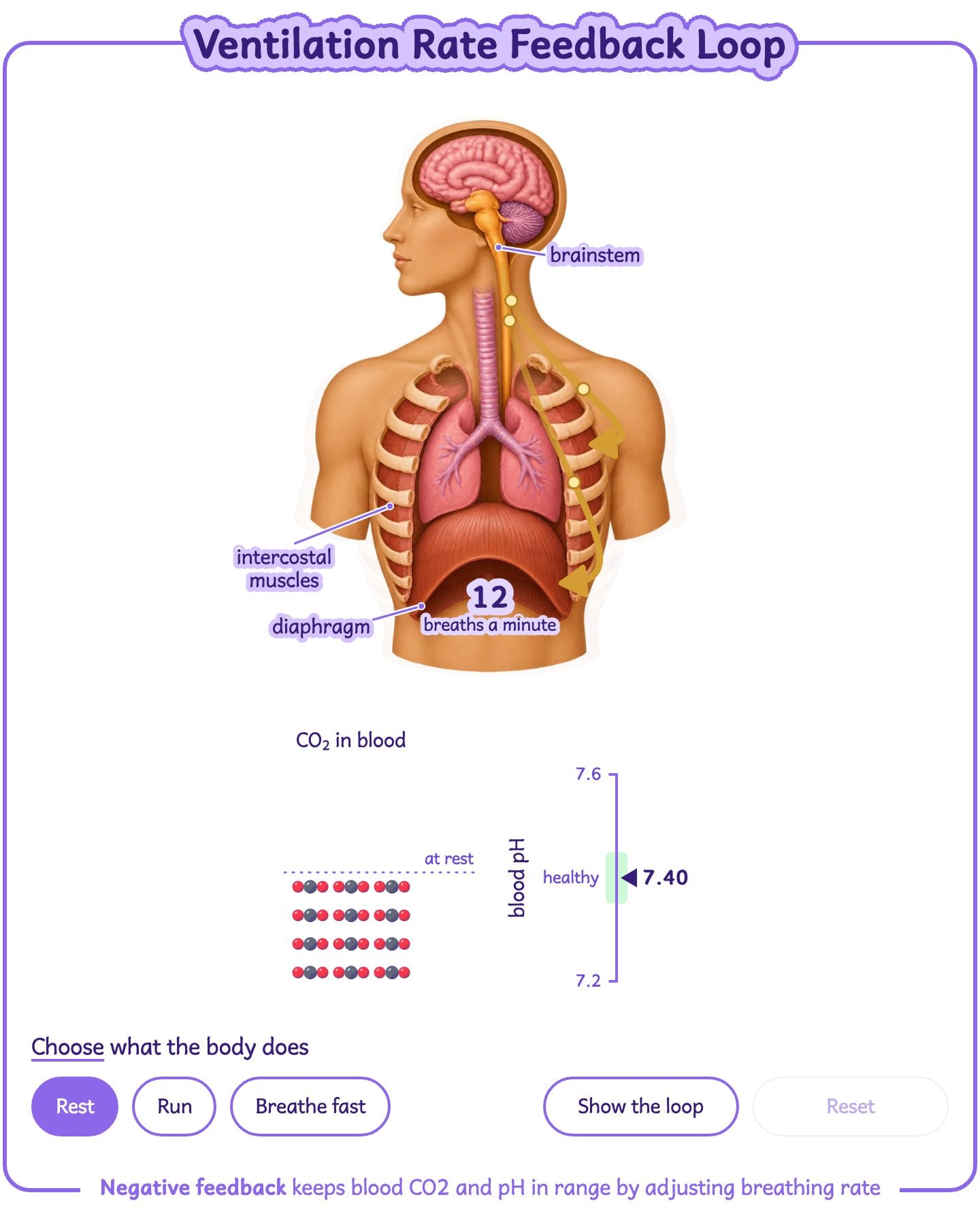
Change the activity level and watch breathing rate adjust to the carbon dioxide in the blood.