How vaccination works
Vaccine
A substance containing dead or inactive forms of a pathogen, or its antigens, that is given to make a person immune to a disease.
- A vaccine containing weakened pathogens or their antigens is put into the body.
- The antigens stimulate an immune response, in which lymphocytes produce antibodies against them.
- Memory cells are also made, and these stay in the body.
- The memory cells give long-term immunity, so if the real pathogen infects you, antibodies are made quickly and you do not become ill.
This article is Supplement material, examined only on the Extended papers (Paper 2 and Paper 4).
Vaccination and herd immunity
Herd immunity
When enough of a population is immune to a disease that it cannot spread easily, which protects even those who are not immune.
- A vaccinated person cannot be infected, so the pathogen cannot reproduce and spread from them.
- If most of a population is vaccinated, the pathogen finds very few hosts and its spread is controlled.
- This is herd immunity, which protects even people who are not vaccinated, such as newborn babies.
Vaccinating enough people breaks the chain of transmission, so a disease can almost disappear from a population.
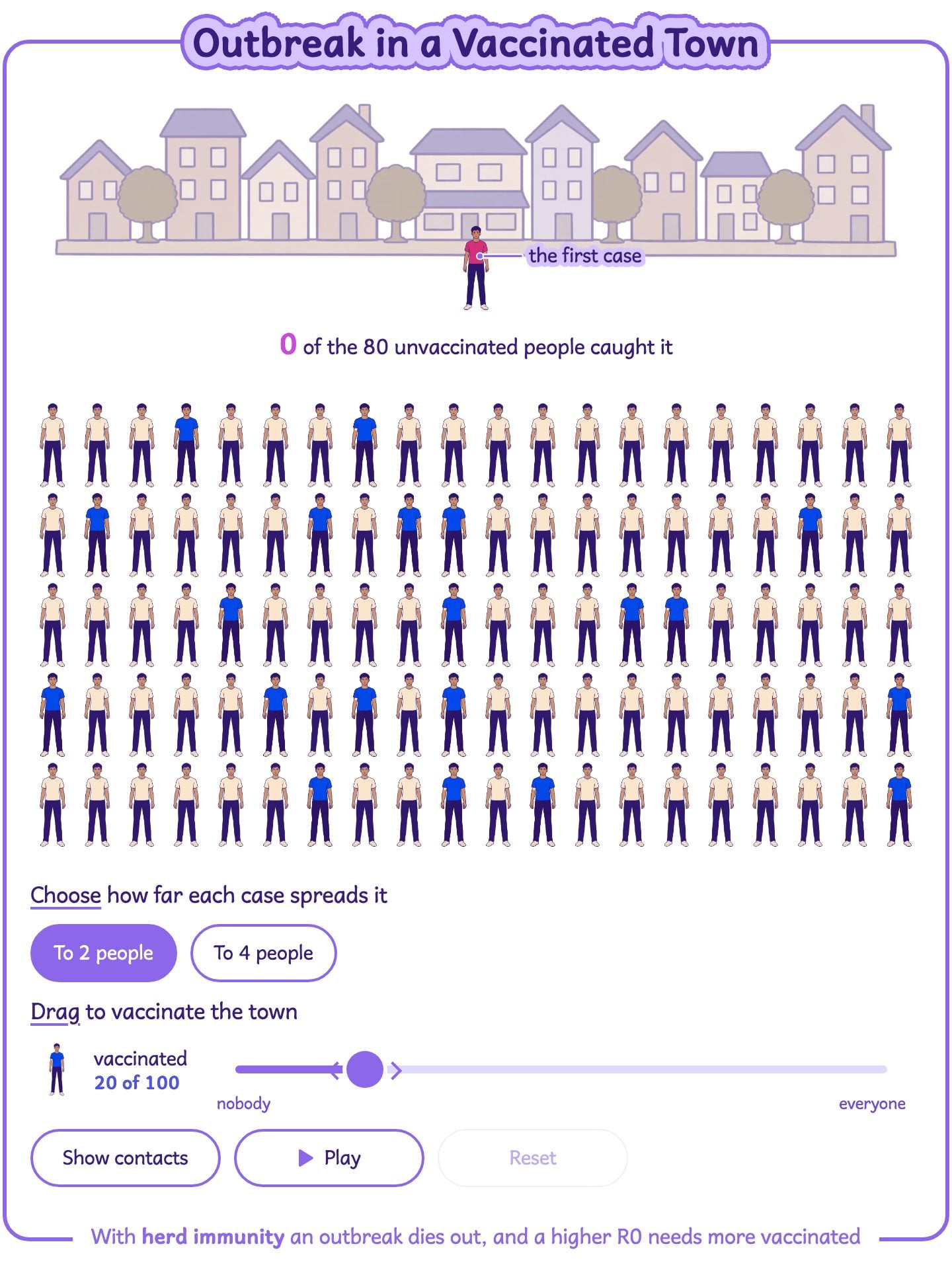
Raise the share of vaccinated people and watch whether the outbreak spreads or dies out.
Passive immunity
Passive immunity
Short-term protection from ready-made antibodies received from another source, such as across the placenta or in breast milk, with no memory cells made.
- Passive immunity is protection from ready-made antibodies received from another individual, rather than antibodies you make yourself.
- Antibodies pass from a mother to her baby across the placenta before birth and in breast milk after birth.
- No memory cells are made, so passive immunity is short-term and fades once the antibodies are broken down.
- Do not muddle passive immunity with active immunity.
- In passive immunity the antibodies come from someone else and no memory cells are made, so the protection lasts only a short time.
Why breast-feeding matters
Antibody
A protein made by lymphocytes that binds to a specific antigen, marking the pathogen for destruction.
- A newborn baby cannot yet make enough of its own antibodies.
- Breast milk, especially the first milk called colostrum, is rich in the mother's antibodies.
- These antibodies give the baby passive immunity in its first months, protecting it until its own immune system can take over.
- Outline the three main steps of vaccination.
- Why do memory cells give long-term immunity?
- What is herd immunity?
- Give two differences between passive immunity and active immunity.
- Why is breast-feeding important for a newborn baby's protection?