What active immunity is
Active immunity
Long-lasting protection that comes from the body making its own antibodies after meeting a pathogen, through infection or vaccination.
- Active immunity is protection against a pathogen that comes from your own body making antibodies.
- It is gained in two ways: after you have been infected by a pathogen, or after vaccination.
- Because the body makes the antibodies itself, active immunity is usually long-lasting.
Everything in this article is Supplement material, examined only on the Extended papers (Paper 2 and Paper 4).
Antigens
Antigen
A molecule on the surface of a pathogen that the immune system recognises as foreign.
- An antigen is a molecule, usually on the surface of a pathogen, that the body recognises as foreign.
- Each type of pathogen carries its own antigens, which have their own specific shapes.
- Your lymphocytes recognise these antigens as not belonging to your body, which triggers an immune response.
Because every pathogen has different antigens, the body must make a different antibody for each one.
Antibodies
Antibody
A protein made by lymphocytes that binds to a specific antigen, marking the pathogen for destruction.
- Antibodies are proteins made by white blood cells called lymphocytes.
- An antibody binds to the antigen on a pathogen.
- This either destroys the pathogen directly or marks it so that phagocytes engulf and digest it.
Some antibodies act as antitoxins, binding to and neutralising the toxins that pathogens release.
How you become immune
Memory cell
A white blood cell that stays in the body after an infection so the body can respond faster and more strongly if the same pathogen returns.
- The first time a pathogen infects you, lymphocytes take time to make the right antibody, so you may become ill.
- After the infection, some lymphocytes remain as memory cells.
- If the same pathogen returns, memory cells make the correct antibody quickly and in large amounts, so you do not become ill.
- This is why active immunity, whether gained by infection or by vaccination, protects you against that pathogen in the future.
- What is active immunity?
- In which two ways can active immunity be gained?
- What is an antigen, and where is it found?
- Describe two ways in which an antibody helps to destroy a pathogen.
- Why do you not become ill the second time the same pathogen infects you?
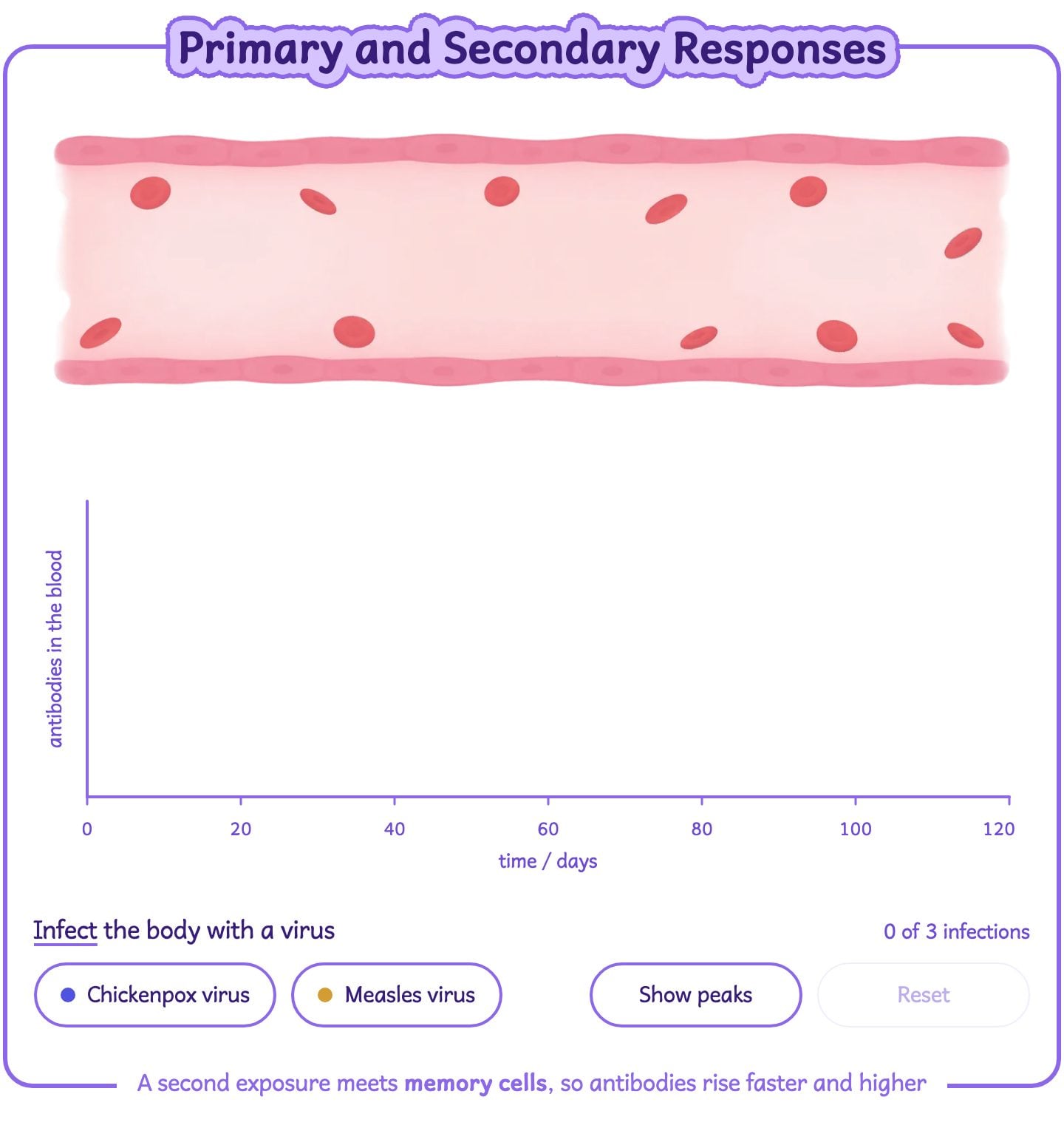
Compare the first and second exposures and notice how memory cells make the response faster and bigger.