Classification and evolutionary relationships
Common ancestor
An earlier species from which two or more later species have evolved.
- Modern classification systems aim to reflect the evolutionary relationships between organisms, not just their outward similarities.
- Two species are placed in the same group when they have evolved from a shared common ancestor.
- Organisms that descend from a more recent common ancestor are more closely related to one another.
- Because the groups mirror ancestry, the finished classification shows how living things have evolved over time, rather than simply how alike they look today.
Grouping organisms by shared ancestry means every group represents one branch of the evolutionary tree, so the classification records how species are related rather than cataloguing how they appear.
DNA base sequences as evidence
DNA base sequence
The order of bases along a molecule of DNA, which differs between species and is used to compare how closely they are related.
- The characteristics of every organism are controlled by the sequence of bases in its DNA.
- DNA is copied and passed from parents to offspring during reproduction, so members of one species share very similar base sequences.
- Because related species inherit their DNA from the same ancestors, the sequence of bases in DNA is used as a means of classification.
- Comparing base sequences is more reliable than comparing appearance, because unrelated organisms can look alike yet carry very different DNA.
Two birds may look almost identical, yet comparing their DNA base sequences can reveal large differences that place them in separate groups.
Comparing DNA to judge relatedness
- The number of differences between the base sequences of two species shows how closely they are related.
- Species that share a more recent common ancestor have base sequences that are more similar, because less time has passed for changes to build up.
- Species that share only a distant common ancestor have more differences in their base sequences.
- So fewer base differences indicate a closer relationship, while many differences indicate a distant one.
In data questions, link the size of the difference to time: the fewer the base differences between two species, the more recently they shared a common ancestor and the more closely they are related.
- What do modern classification systems aim to reflect?
- Which molecule's base sequence is compared to classify organisms?
- How do the base sequences of two closely related species compare?
- What does a large number of base differences between two species tell you?
- Why is DNA evidence more reliable than physical appearance for classification?
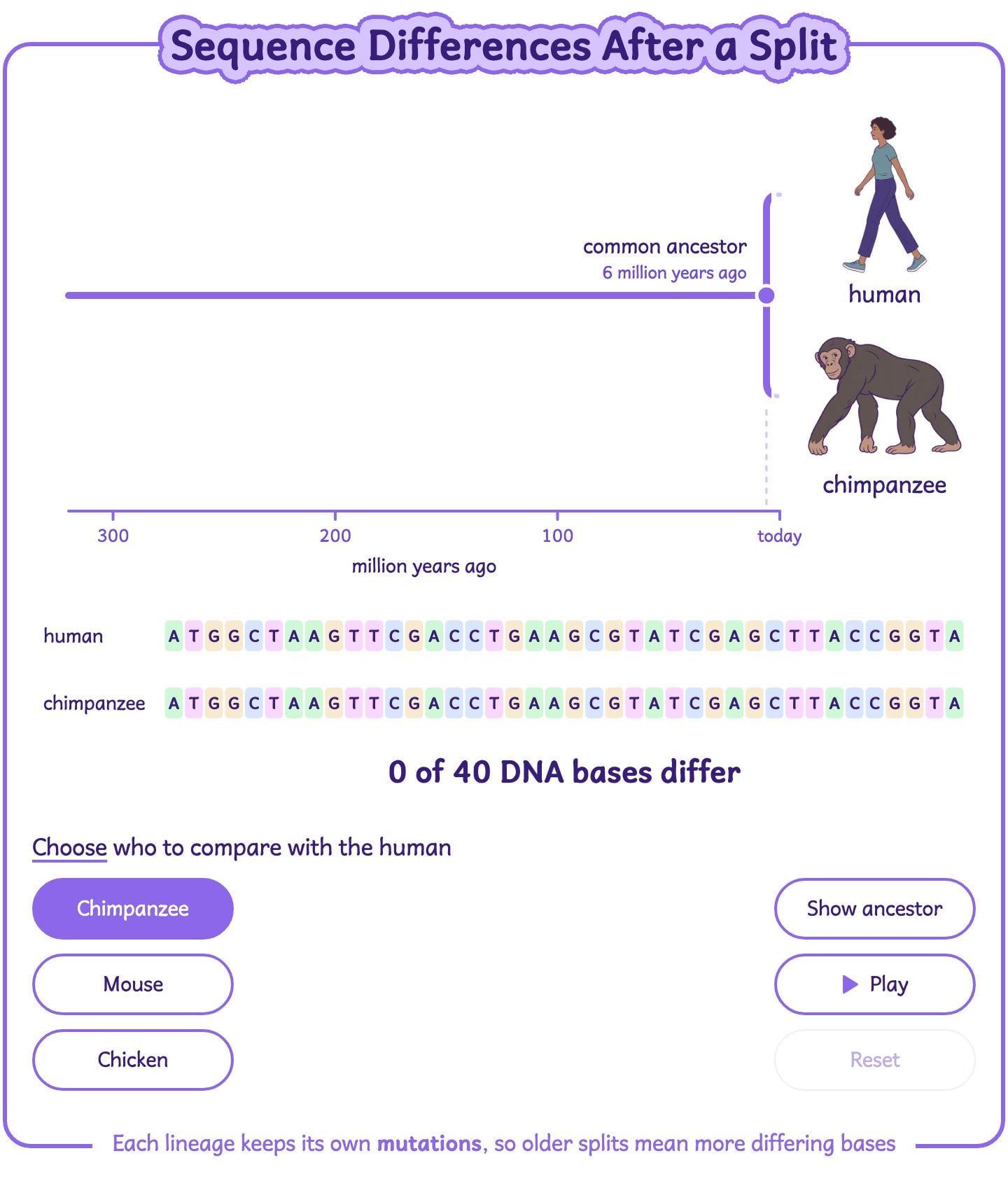
Compare the base sequences and notice that species which split longer ago have more differences.