

What you'll learn
- How to represent forces using arrows with size and direction.
- How to find a resultant force using scale vector diagrams.
- How to draw and interpret free body force diagrams.
- How friction causes unwanted energy transfer, and how lubrication reduces it.
The vector-diagram and free-body-diagram skills in this section are Higher Tier only in Edexcel Combined Science. The lubrication idea is for everyone.
Forces are vectors
A force is a push or pull on an object. Forces are measured in newtons, N.
Forces can change an object’s speed, direction, or shape. To understand what several forces do together, you must think about both their size and their direction.
Vector
A vector is a quantity with both size and direction. Force is a vector, so a 10 N force to the right is different from a 10 N force to the left.
In diagrams, a force is shown by an arrow:
- the arrow’s length represents the size of the force
- the arrow’s direction shows the direction of the force
- the label gives the force name or size, such as “friction 20 N”
Forgetting direction
Do not just add force sizes like ordinary numbers. A 30 N force right and a 30 N force left cancel, giving a resultant of 0 N — not 60 N.
Resultant force
When several forces act on an object, their overall effect is called the resultant force. You may also see this called the net force.
Resultant force
The resultant force is the single force that has the same effect as all the forces acting on an object combined.
If forces act along the same straight line, you can often add or subtract them directly.
For example:
- 50 N right and 20 N right give 70 N right
- 50 N right and 20 N left give 30 N right
- 50 N right and 50 N left give 0 N
What the resultant tells you
If the resultant force is not zero, the object’s motion changes. If the resultant force is zero, the forces are balanced.
Vector diagrams using scale drawings
When forces act at angles to each other, you can use a scale drawing. The Edexcel spec expects scale drawings here, not trigonometry.
A scale might be:
- 1 cm represents 10 N
- 2 cm represents 50 N
- 1 cm represents 5 N
Choose a scale that makes the arrows large enough to measure accurately, but small enough to fit on the page.
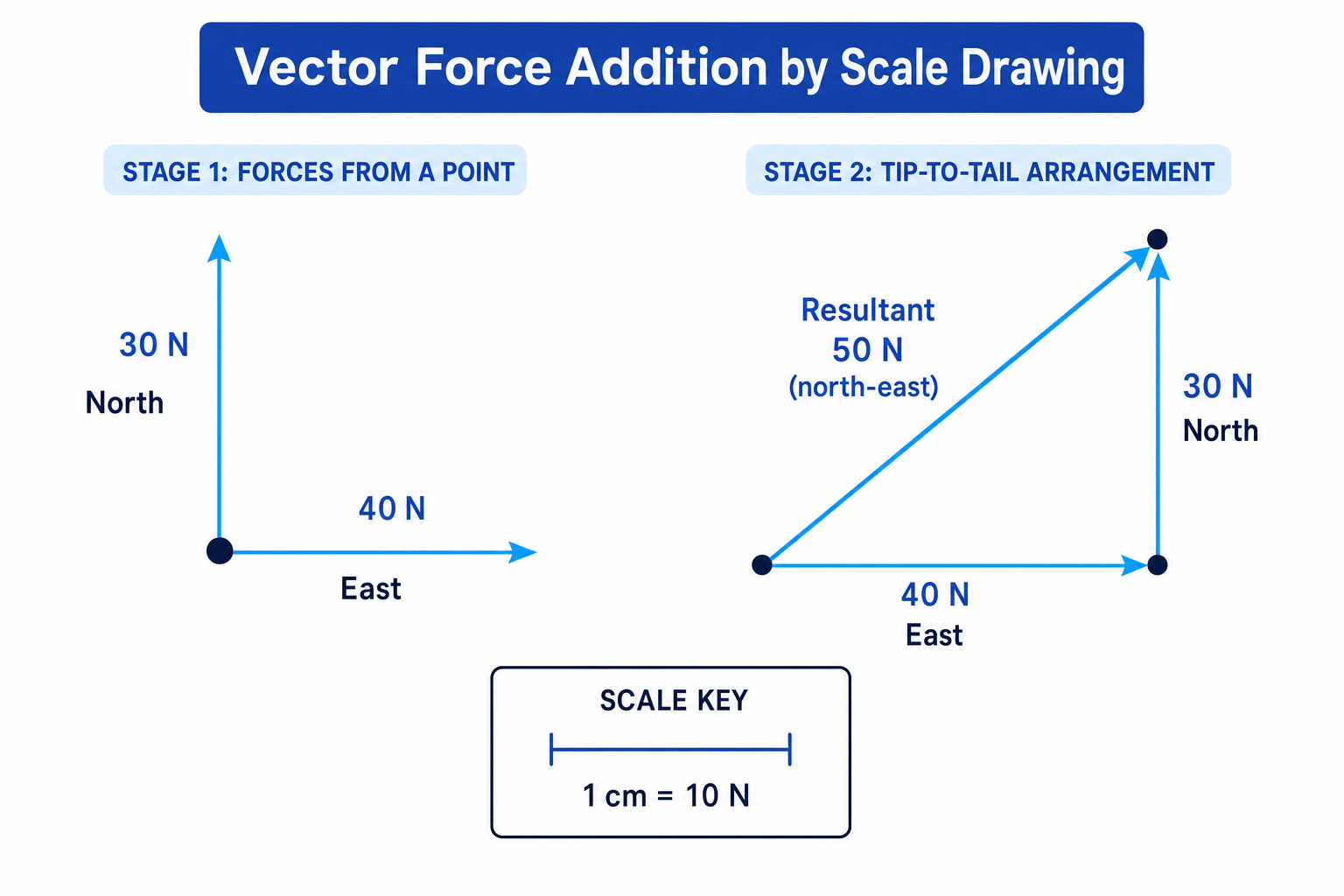
To add force vectors, use the tip-to-tail method:
- Draw the first force arrow to scale.
- From the tip of that arrow, draw the next force arrow to scale.
- Draw the resultant from the start of the first arrow to the end of the final arrow.
- Measure the resultant arrow and convert it using your scale.
Finding a resultant and balancing force
A ring is pulled by a 40 N force east and a 30 N force north. Use a scale of 1 cm = 10 N.
- Draw the 40 N force as a 4 cm arrow to the right, because 1 cm represents 10 N.
- From the tip of that arrow, draw the 30 N force as a 3 cm arrow upwards.
- Draw the resultant from the start point to the final tip. Measuring the diagram gives 5 cm, so the resultant is 50 N.
- The direction of the resultant is north-east. To keep the ring in equilibrium, a third force would need to be 50 N in the opposite direction, south-west.
Equilibrium and balanced forces
An object is in equilibrium when the resultant force on it is zero.
Equilibrium
An object is in equilibrium when all the forces acting on it are balanced, so the resultant force is 0 N.
Equilibrium does not always mean “not moving”. It means the object is not changing its motion.
So an object in equilibrium could be:
- stationary
- moving at a constant speed in a straight line
Balanced forces check
If a vector diagram forms a closed shape when the arrows are placed tip-to-tail, the resultant is zero. That means the object is in equilibrium.
Resolving forces into components
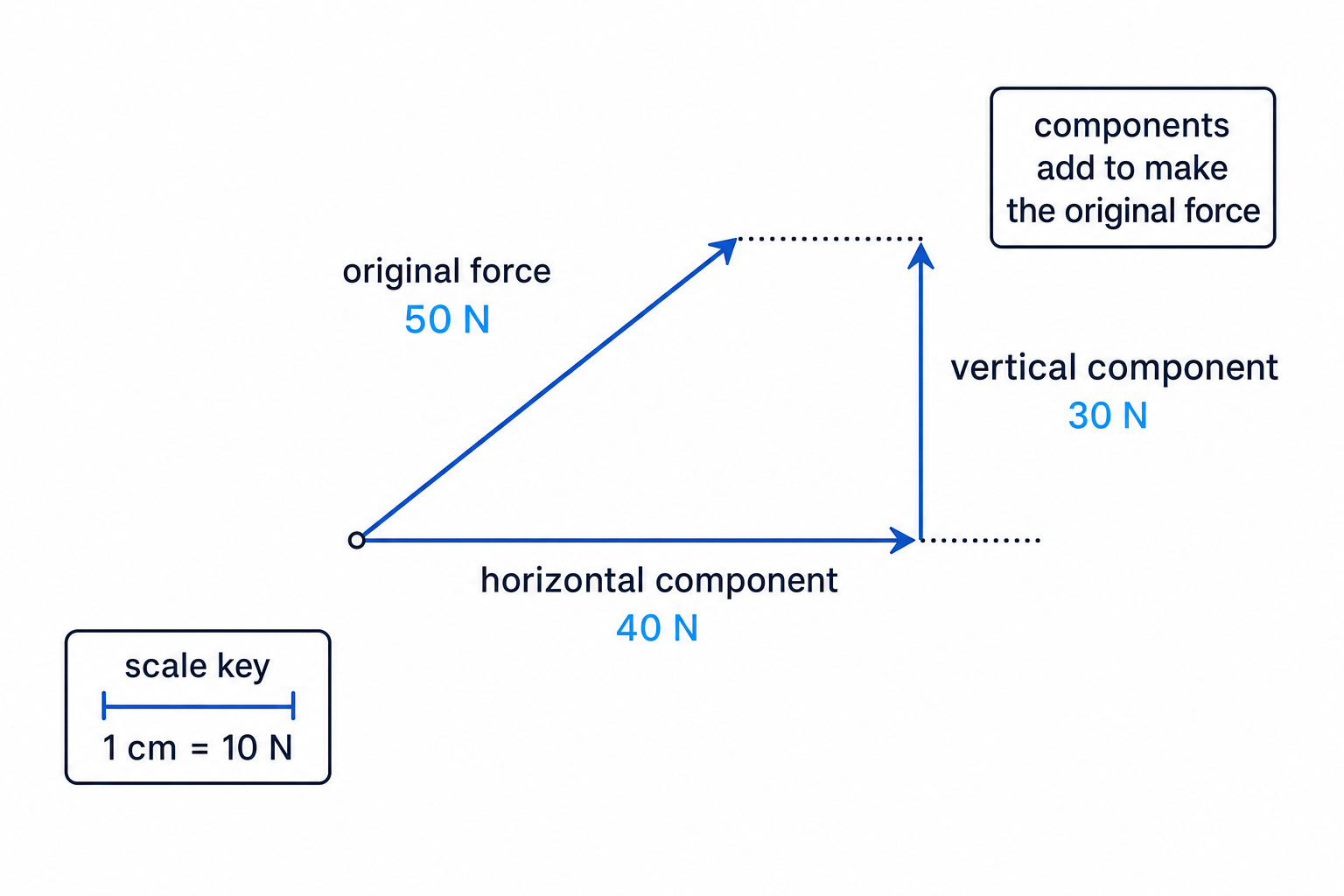
Sometimes one force acts at an angle. You can replace it with two forces at right angles to each other. These are called components.
Resolution of forces
Resolving a force means splitting one force into component forces that have the same combined effect as the original force.
At GCSE, you usually resolve into:
- a horizontal component and a vertical component, or
- a component parallel to a surface and a component perpendicular to a surface
The component arrows should add tip-to-tail to make the original force.
Resolving a diagonal force
A 50 N force acts diagonally up and to the right. A scale drawing uses 1 cm = 10 N.
- Draw the original 50 N force as a 5 cm diagonal arrow in the correct direction.
- Draw a horizontal line from the start of the arrow and a vertical line up to the arrow tip, making a right-angled triangle.
- Measure the horizontal component. If it is 4 cm, the horizontal component is 40 N to the right.
- Measure the vertical component. If it is 3 cm, the vertical component is 30 N upwards.
Free body force diagrams
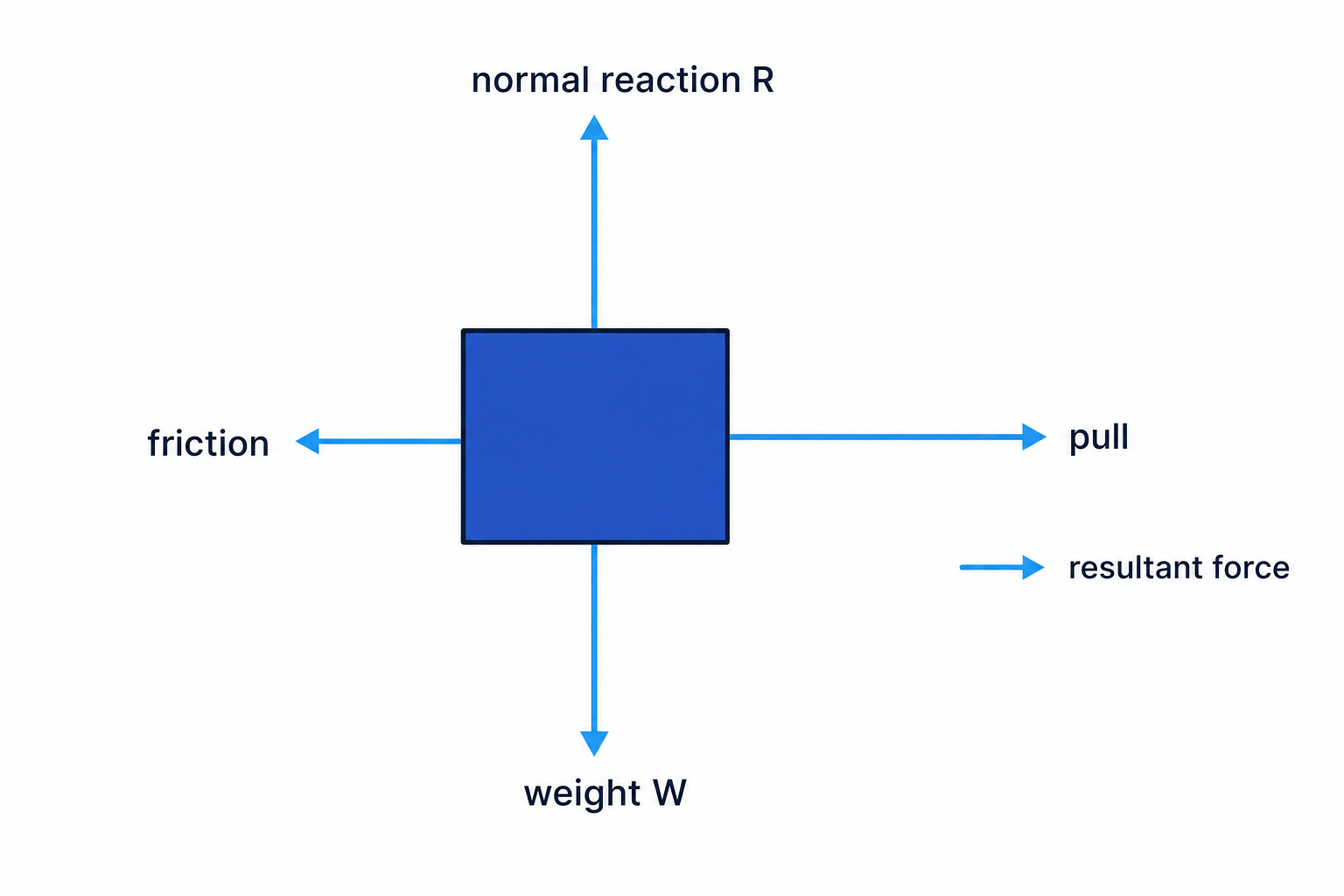
A free body force diagram shows the forces acting on one chosen object. The object is usually drawn as a simple box or dot.
Free body force diagram
A free body force diagram is a simplified diagram showing all the external forces acting on a single object or system.
A system is the object or group of objects you choose to study. For example, you could treat “the cyclist and bicycle together” as one system.
Common forces include:
- weight: the force of gravity on an object, acting downwards
- normal reaction: the contact force from a surface, acting perpendicular to the surface
- friction: a contact force that opposes relative motion between surfaces
- air resistance or drag: a friction-like force from moving through air or a fluid
- tension: a pulling force in a rope, string, or cable
- thrust or driving force: a force that pushes an object forwards
Drawing the wrong forces
A free body diagram shows forces acting on the object, not forces the object exerts on other things. For a box on the floor, draw the floor pushing up on the box, not the box pushing down on the floor.
Using a free body diagram
A box is pulled along a rough floor. The pull is 120 N to the right, friction is 45 N to the left, weight is 600 N downwards, and the normal reaction is 600 N upwards.
- Compare the vertical forces: 600 N down and 600 N up are equal and opposite, so the vertical resultant is 0 N.
- Compare the horizontal forces. The pull is larger than friction, so the resultant is to the right.
- Subtract the opposing horizontal forces:
- The box has a resultant force of 75 N to the right, so its motion changes in that direction.
Friction and unwanted energy transfer
Friction acts when surfaces rub, or try to rub, against each other. It usually acts in the opposite direction to the motion or the attempted motion.
Friction can be useful: you need it to walk, brake, and grip objects. But in machines, friction is often unwanted.
When moving parts rub together, work is done against friction. Energy is transferred from the kinetic store of the moving parts to the thermal stores of the surroundings. In everyday language, the parts heat up. Some energy may also be transferred by sound.
Lubrication
Lubrication means adding a substance such as oil or grease between surfaces to reduce friction.
A lubricant forms a thin layer between surfaces. This helps to separate tiny bumps on the surfaces, so they do not catch on each other as much.
This reduces:
- friction
- heating
- wear and damage
- unwanted energy transfer to thermal stores
Explaining lubrication in a machine
A bicycle chain becomes warm and wears away if it is used without oil.
- The metal surfaces in the chain rub against each other, so friction acts between them.
- Work is done against friction, transferring energy from the kinetic store of the moving chain to thermal stores of the chain and surroundings.
- Oil acts as a lubricant by forming a layer between the metal surfaces, reducing friction.
- Less energy is transferred by heating, so the chain moves more smoothly and wears away more slowly.
Friction can adjust
If an object is being pushed but has not started moving, friction may increase to balance the push up to a limit. Once the push is large enough, the object starts to slide.
In the exam
- For vector diagrams, state your scale clearly and use a ruler. Measure the resultant from the start point to the final tip.
- For free body diagrams, choose one object or system and draw only the forces acting on it.
- For balanced-force questions, say the resultant force is 0 N and link this to no change in motion.
- For lubrication questions, mention reduced friction and reduced unwanted energy transfer to thermal stores.
Check yourself
- What does it mean if the arrows in a tip-to-tail vector diagram form a closed shape?
- In a free body diagram of a falling ball, which forces might act on the ball?
- How does oil reduce unwanted energy transfer in a machine?
