

What you'll learn
- How to calculate momentum using mass and velocity.
- Why momentum has direction, so signs matter in collisions.
- What conservation of momentum means in a closed system.
- How trolley collision data can support the conservation rule.
This part of Forces is Higher Tier only in Combined Science. It can feel a bit more abstract at first, but the method is mostly careful bookkeeping: calculate momenta, keep directions, then compare totals.
Before momentum: mass, velocity and direction
Mass is the amount of matter in an object, measured in kilograms, kg.
Speed tells you how fast something is moving. Velocity tells you speed in a particular direction, measured in metres per second, m/s.
A quantity with size and direction is called a vector. Velocity is a vector. Momentum also turns out to be a vector, so direction matters.
For one-dimensional collision questions, choose one direction as positive. For example:
- right is positive, so right-moving velocities are positive
- left is negative, so left-moving velocities are negative
This does not mean the object has “less” momentum. A negative sign just shows the direction.
Momentum of a moving object
Momentum is a property of moving objects. A heavy object, or a fast object, has more momentum than a light or slow object.
Momentum
Momentum is defined by the equation p=mvp = mvp=mv, where ppp is momentum in kg m/s, mmm is mass in kg, and vvv is velocity in m/s.
The equation is:
p=mvp = mvp=mvMomentum is measured in kilogram metre per second, written as kg m/s.
If an object is stationary, its velocity is zero, so its momentum is also zero.
Calculating momentum
A 60 g tennis ball moves to the right at 20 m/s. Calculate its momentum.
- Convert the mass into kilograms because the equation needs kg: 60 g = 0.060 kg. The velocity is to the right, so take v=20v = 20v=20 m/s.
- Substitute into p=mvp = mvp=mv: p=0.060×20p = 0.060 \times 20p=0.060×20.
- Calculate and include the direction: p=1.2 kg m/sp = 1.2\ \text{kg m/s}p=1.2 kg m/s to the right.
Rearranging p = mv
If you need the velocity, use v=pmv = \frac{p}{m}v=mp. If you need the mass, use m=pvm = \frac{p}{v}m=vp. Always check that mass is in kg before substituting.
Momentum has direction
Because momentum depends on velocity, it has the same direction as the velocity.
This is especially important when objects are moving in opposite directions. You must add momenta using signs, not just add the sizes.
For a system of objects:
ptotal=pA+pB+any other momentap_{\text{total}} = p_A + p_B + \text{any other momenta}ptotal=pA+pB+any other momentaIf one momentum is negative, it can partly cancel a positive momentum.
Adding momentum in opposite directions
A 3.0 kg trolley moves right at 2.0 m/s. A 2.0 kg trolley moves left at 1.0 m/s. Calculate the total momentum.
- Choose right as positive. The first trolley has vA=2.0v_A = 2.0vA=2.0 m/s, and the second has vB=−1.0v_B = -1.0vB=−1.0 m/s.
- Calculate each momentum: pA=3.0×2.0=6.0 kg m/sp_A = 3.0 \times 2.0 = 6.0\ \text{kg m/s}pA=3.0×2.0=6.0 kg m/s and pB=2.0×(−1.0)=−2.0 kg m/sp_B = 2.0 \times (-1.0) = -2.0\ \text{kg m/s}pB=2.0×(−1.0)=−2.0 kg m/s.
- Add the momenta: ptotal=6.0+(−2.0)=4.0 kg m/sp_{\text{total}} = 6.0 + (-2.0) = 4.0\ \text{kg m/s}ptotal=6.0+(−2.0)=4.0 kg m/s. The answer is positive, so the total momentum is 4.0 kg m/s to the right.
Using speed when direction matters
Speed has no direction. In momentum questions involving collisions, use velocity and include negative signs for motion opposite your chosen positive direction.
Conservation of momentum
To conserve something means the total amount stays the same.
In momentum questions, you usually look at an event, such as a collision between two trolleys.
Closed system
A closed system is a group of objects where no resultant external force acts during the event. Momentum is not transferred to or from the surroundings.
Conservation of momentum
In a closed system, the total momentum before an event is equal to the total momentum after the event.
During a collision, the objects push on each other. These pushes transfer momentum between the objects, but if the system is closed, the total momentum of all the objects stays the same.
The diagram below shows how to set up a collision using initial velocities and final velocities. Some questions use uuu for initial velocity and vvv for final velocity.
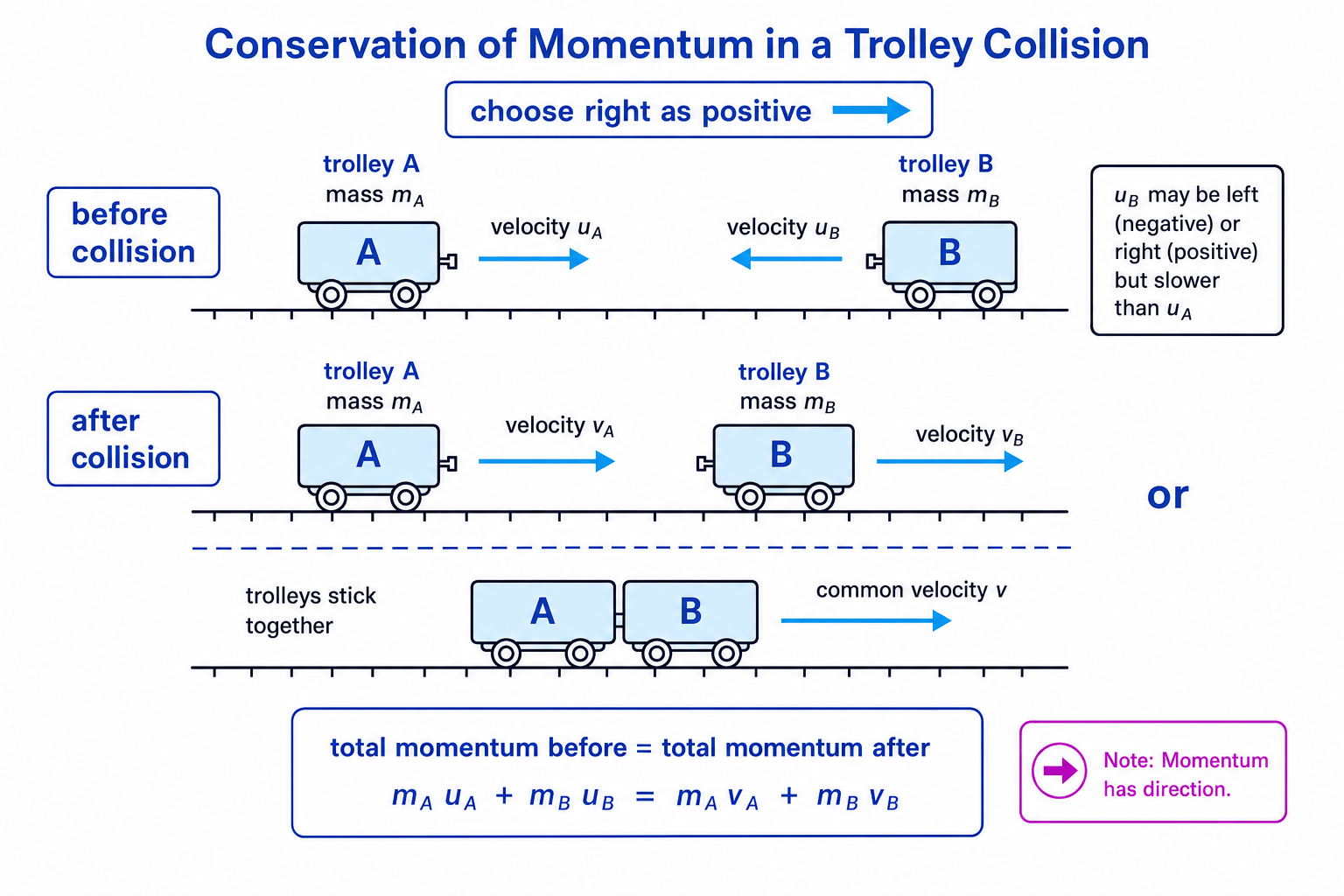
For two objects A and B:
mAuA+mBuB=mAvA+mBvBm_A u_A + m_B u_B = m_A v_A + m_B v_BmAuA+mBuB=mAvA+mBvBwhere uAu_AuA and uBu_BuB are velocities before the collision, and vAv_AvA and vBv_BvB are velocities after the collision.
If the objects stick together after the collision, they share one final velocity:
mAuA+mBuB=(mA+mB)vm_A u_A + m_B u_B = (m_A + m_B)vmAuA+mBuB=(mA+mB)vTrolleys sticking together
A 2.0 kg trolley moves right at 3.0 m/s and collides with a stationary 1.0 kg trolley. They stick together. Calculate their common velocity after the collision.
- Choose right as positive and calculate total momentum before: pbefore=2.0×3.0+1.0×0=6.0 kg m/sp_{\text{before}} = 2.0 \times 3.0 + 1.0 \times 0 = 6.0\ \text{kg m/s}pbefore=2.0×3.0+1.0×0=6.0 kg m/s.
- Use conservation of momentum. After the collision, the combined mass is 3.0 kg, so pafter=3.0vp_{\text{after}} = 3.0vpafter=3.0v.
- Set before equal to after and solve: 6.0=3.0v6.0 = 3.0v6.0=3.0v, so v=2.0v = 2.0v=2.0 m/s. The joined trolleys move right at 2.0 m/s.
Momentum is not kinetic energy
In a closed collision, total momentum is conserved. Kinetic energy does not have to be conserved; some energy may be transferred to thermal stores and sound, especially when objects stick together.
Investigating collisions with trolleys
In the lab, you can investigate conservation of momentum using trolleys on a track.
You can measure velocity using:
- light gates: sensors that time how long a card blocks a beam
- data loggers: devices that record measurements automatically
- ticker timers: devices that mark dots on tape at equal time intervals
A typical method is:
- Measure each trolley’s mass using a balance.
- Use light gates, data loggers or ticker timers to measure velocities before and after the collision.
- Calculate total momentum before the collision.
- Calculate total momentum after the collision.
- Compare the two totals.
If the system is close to closed, the totals should be very similar.
Using light-gate data
Two 0.50 kg trolleys collide and stick together. Trolley A has a 0.10 m card and passes through a light gate before the collision in 0.20 s. Trolley B is stationary. After the collision, the joined trolleys pass through a light gate in 0.40 s.
- Use v=length of cardtime blocking gatev = \frac{\text{length of card}}{\text{time blocking gate}}v=time blocking gatelength of card. Before the collision, trolley A has v=0.100.20=0.50v = \frac{0.10}{0.20} = 0.50v=0.200.10=0.50 m/s. After the collision, the joined trolleys have v=0.100.40=0.25v = \frac{0.10}{0.40} = 0.25v=0.400.10=0.25 m/s.
- Calculate the total momentum before: pbefore=0.50×0.50+0.50×0=0.25 kg m/sp_{\text{before}} = 0.50 \times 0.50 + 0.50 \times 0 = 0.25\ \text{kg m/s}pbefore=0.50×0.50+0.50×0=0.25 kg m/s.
- Calculate the total momentum after: pafter=(0.50+0.50)×0.25=0.25 kg m/sp_{\text{after}} = (0.50 + 0.50) \times 0.25 = 0.25\ \text{kg m/s}pafter=(0.50+0.50)×0.25=0.25 kg m/s. The matching totals support conservation of momentum.
Real experiments are not perfectly closed
Friction, air resistance and a track that is not level are external effects. In real data, the before and after momenta may be close rather than exactly equal.
Using momentum as a model
A model is a simplified way of representing a situation so you can make predictions.
Momentum is a useful model for collisions because you do not need to describe every tiny detail of the crash. You can compare total momentum before and after the event.
For exam questions, the usual idea is:
total momentum before=total momentum after\text{total momentum before} = \text{total momentum after}total momentum before=total momentum afterThen you substitute the given masses and velocities, keeping signs for direction.
In the exam
- Choose a positive direction first, then give every velocity the correct sign.
- Calculate total momentum before and total momentum after; do not assume each individual object keeps the same momentum.
- Convert units before using equations: mass in kg, velocity in m/s, momentum in kg m/s.
Check yourself
- Why can a small fast object have the same momentum as a large slow object?
- If right is positive, what sign should you give to the velocity of an object moving left?
- In a closed collision, what quantity is equal before and after the event?
