What you'll learn
- How density links the mass and volume of a material.
- How to draw and interpret particle diagrams for solids, liquids and gases.
- How to measure density for regular solids, irregular solids and liquids.
- Why changes of state are physical changes and why mass is conserved.
The starting point: matter and particles
Matter is anything that has mass and takes up space. A material is the type of matter an object is made from, such as aluminium, glass or water.
Mass is the amount of matter in an object, measured in kilograms (kg). Volume is the amount of space something takes up, measured in cubic metres (m³).
In this topic, we use a model to explain what matter is like on a tiny scale.
The particle model
The particle model says that substances are made from tiny particles. These particles may be atoms or molecules. A molecule is a group of atoms joined together.
A model is a simplified picture of reality. Particle diagrams are not drawn to scale, but they help you explain solids, liquids, gases and density.
Density: mass packed into volume
Some materials feel “heavy for their size” because a lot of mass is packed into a small volume. That idea is called density.
Density
Density is the mass per unit volume of a material. It tells you how much mass there is in each cubic metre of the material.
The equation is:
ρ=mV\rho = \frac{m}{V}ρ=Vmwhere:
- ρ\rhoρ is density, measured in kg/m³
- mmm is mass, measured in kg
- VVV is volume, measured in m³
You may also need to rearrange it:
- to find mass: m=ρVm = \rho Vm=ρV
- to find volume: V=mρV = \frac{m}{\rho}V=ρm
Calculating density of a cuboid
A cuboid has mass 540 g and dimensions 10 cm by 5.0 cm by 3.0 cm. Find its density in kg/m³.
- Convert the measurements to SI units because the answer is wanted in kg/m³: m=0.540 kgm = 0.540\ \text{kg}m=0.540 kg, L=0.100 mL = 0.100\ \text{m}L=0.100 m, W=0.050 mW = 0.050\ \text{m}W=0.050 m and H=0.030 mH = 0.030\ \text{m}H=0.030 m.
- Calculate the volume using the cuboid formula: V=L×W×H=0.100 m×0.050 m×0.030 m=1.50×10⁻⁴ m3V = L \times W \times H = 0.100\ \text{m} \times 0.050\ \text{m} \times 0.030\ \text{m} = 1.50 \times 10^{-4}\ \text{m}^3V=L×W×H=0.100 m×0.050 m×0.030 m=1.50×10⁻⁴ m3.
- Substitute into the density equation: ρ=0.540 kg1.50×10−4 m3=3600 kg/m3\rho = \frac{0.540\ \text{kg}}{1.50 \times 10^{-4}\ \text{m}^3} = 3600\ \text{kg/m}^3ρ=1.50×10−4 m30.540 kg=3600 kg/m3.
- The cuboid’s density is 3600 kg/m³.
Mixing units
If mass is in grams and volume is in cm³, your density will be in g/cm³. If the question wants kg/m³, convert to kilograms and cubic metres before substituting.
Solids, liquids and gases in the particle model
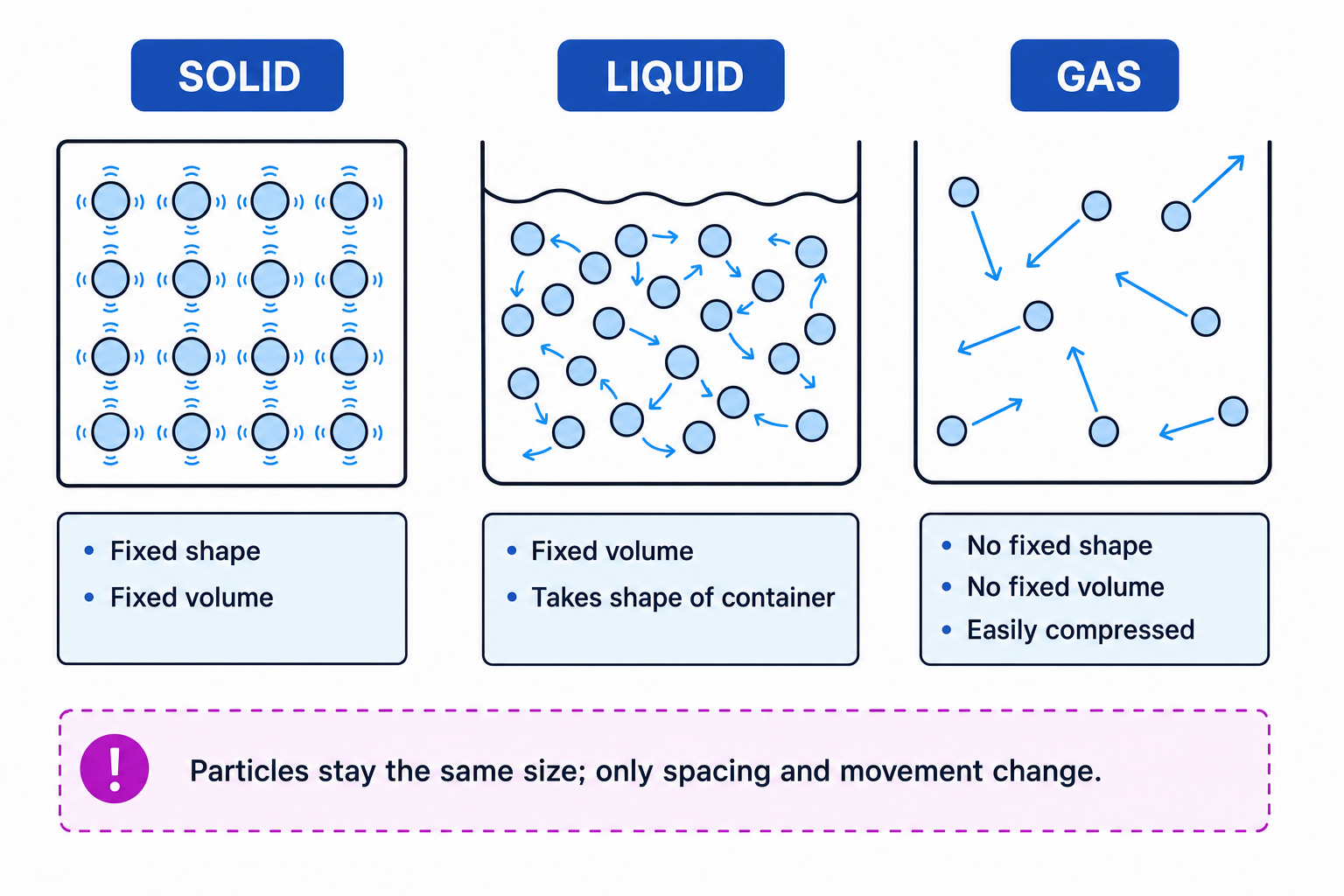
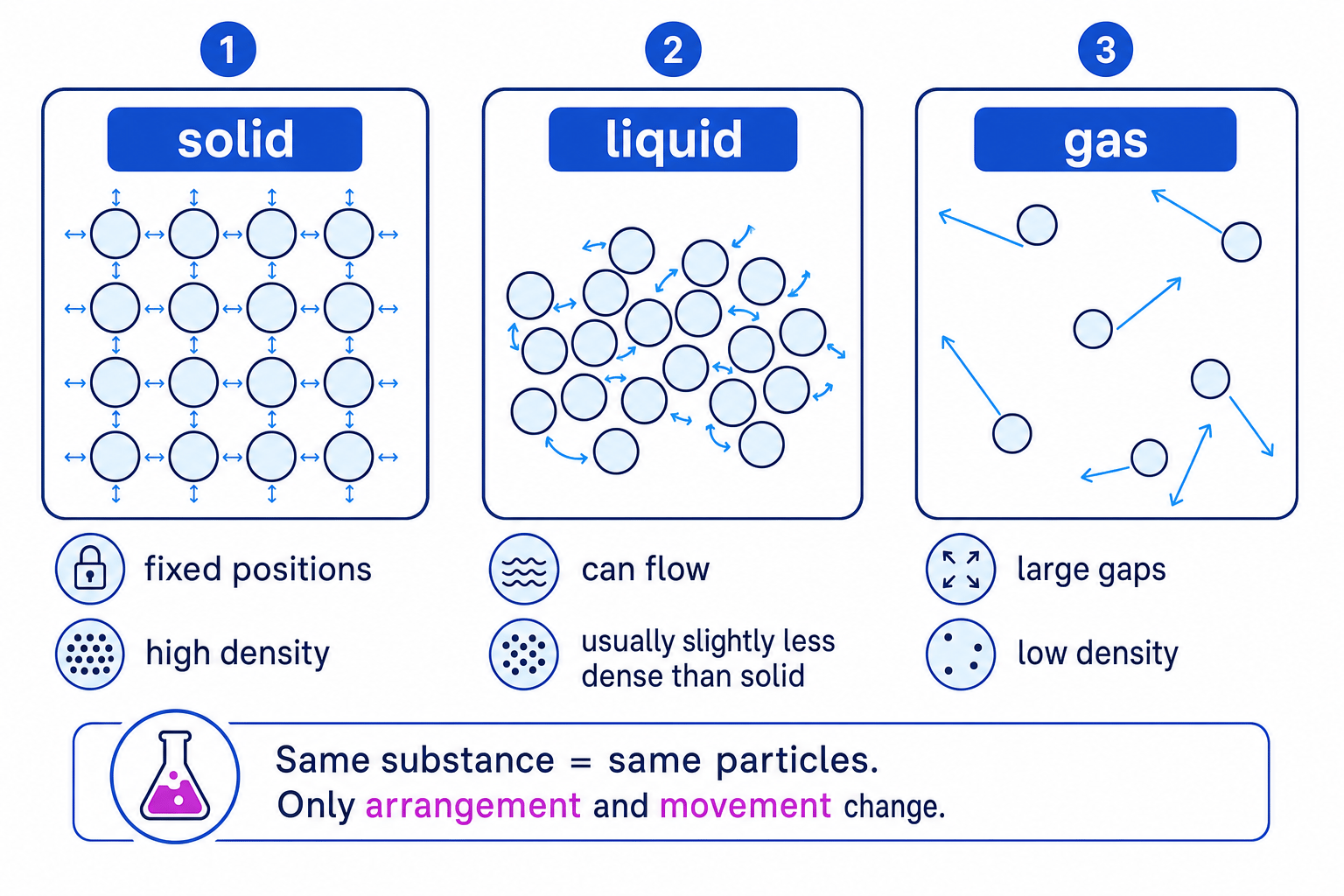
A state of matter is a physical form a substance can be in: solid, liquid or gas. The same substance has the same particles in each state. What changes is the arrangement of the particles and how they move.
The diagram shows the main particle-model differences between solids, liquids and gases.
Solid
In a solid, particles are very close together in a regular arrangement. They cannot move from place to place, but they do vibrate, meaning they move back and forth around fixed positions.
Solids usually have a fixed shape and fixed volume.
Liquid
In a liquid, particles are still close together, but they are arranged randomly. They can move around each other, so a liquid can flow and take the shape of its container.
Liquids have a fixed volume, but not a fixed shape.
Gas
In a gas, particles are far apart and move quickly in random directions. There are large gaps between the particles, so gases can be compressed much more easily than solids or liquids.
Gases do not have a fixed shape or fixed volume.
Particles and density
For the same substance, gases are much less dense than liquids or solids because the particles are much further apart. The particles themselves have not become lighter or smaller.
Explaining why a gas is less dense
Explain why a gas usually has a much lower density than the same substance as a liquid.
- Compare equal masses of the substance, so the total mass of particles is the same in both samples.
- In the gas, the particles are much further apart, so the same mass takes up a much larger volume.
- Since ρ=mV\rho = \frac{m}{V}ρ=Vm, a larger VVV with the same mmm gives a smaller ρ\rhoρ, so the gas has lower density.
Changing the particles
Do not say the particles get bigger in a gas or smaller in a solid. In a change of state, the particles stay the same; their spacing and movement change.
Required practical activity 17: measuring density
For density practicals, the plan is always:
- measure the mass
- measure or calculate the volume
- use ρ=mV\rho = \frac{m}{V}ρ=Vm
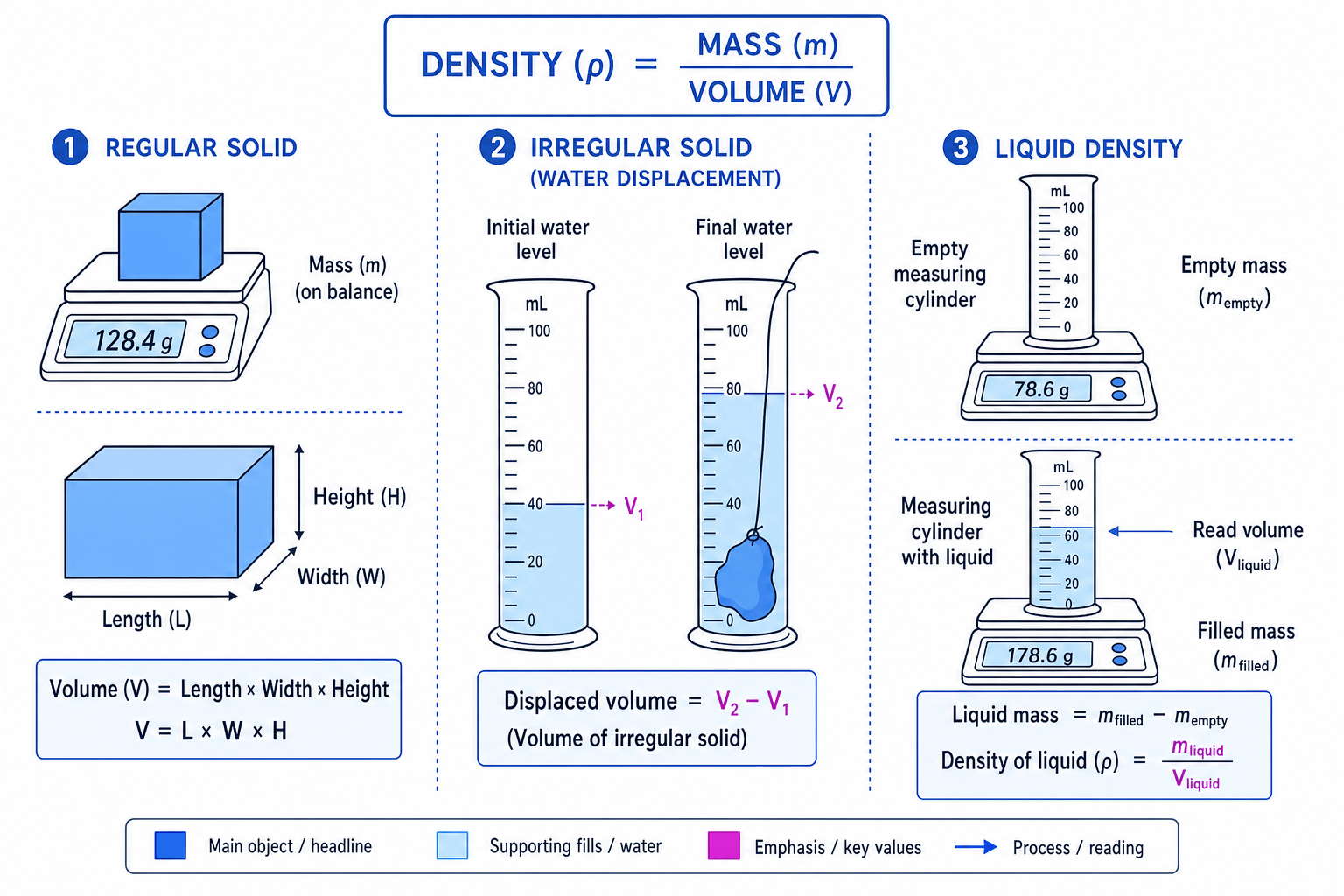
The diagram summarises the three methods you need for regular solids, irregular solids and liquids.
Required practical activity 17
You must be able to describe how to determine density using suitable apparatus, including a balance, ruler, Vernier callipers or micrometer, and a displacement method for irregular objects.
Regular solid objects
A regular solid has a simple shape, such as a cube or cuboid.
Measure its mass using a balance. Then measure its dimensions. For a cuboid:
V=L×W×HV = L \times W \times HV=L×W×HA ruler is suitable for larger objects. Vernier callipers or a micrometer can measure smaller dimensions more precisely. Resolution means the smallest scale division an instrument can reliably show.
Irregular solid objects
An irregular solid does not have a simple shape, so you cannot easily calculate its volume from dimensions.
Use displacement: when the object is fully submerged in water, it pushes aside a volume of water equal to its own volume.
If a measuring cylinder shows an initial volume V1V_1V1 and a final volume V2V_2V2, then:
Vobject=V2−V1V_{\text{object}} = V_2 - V_1Vobject=V2−V1A measuring cylinder may read in mL or cm³. These are equal-sized volume units: 1 mL is the same volume as 1 cm³.
Using water displacement
An irregular metal object has mass 0.078 kg. It is placed in water, and the reading rises from 46 cm³ to 56 cm³. Calculate its density in kg/m³.
- Find the displaced volume: V=56 cm3−46 cm3=10 cm3V = 56\ \text{cm}^3 - 46\ \text{cm}^3 = 10\ \text{cm}^3V=56 cm3−46 cm3=10 cm3.
- Convert the volume to cubic metres: 10 cm3=10×10−6 m3=1.0×10⁻⁵ m310\ \text{cm}^3 = 10 \times 10^{-6}\ \text{m}^3 = 1.0 \times 10^{-5}\ \text{m}^310 cm3=10×10−6 m3=1.0×10⁻⁵ m3.
- Substitute into the density equation: ρ=0.078 kg1.0×10−5 m3=7800 kg/m3\rho = \frac{0.078\ \text{kg}}{1.0 \times 10^{-5}\ \text{m}^3} = 7800\ \text{kg/m}^3ρ=1.0×10−5 m30.078 kg=7800 kg/m3.
Liquids
To find the density of a liquid:
- Measure the mass of an empty measuring cylinder.
- Add the liquid and measure the new mass.
- Subtract to find the mass of the liquid: mliquid=mfilled−memptym_{\text{liquid}} = m_{\text{filled}} - m_{\text{empty}}mliquid=mfilled−mempty.
- Read the volume of the liquid from the measuring cylinder.
- Calculate density using ρ=mV\rho = \frac{m}{V}ρ=Vm.
Practical accuracy
Read the bottom of the meniscus at eye level, make sure irregular objects are fully submerged, and check there are no trapped air bubbles on the object.
Changes of state
A change of state happens when a substance changes between solid, liquid and gas.
Change of state
A change of state is a physical change where a substance changes state, such as from solid to liquid or liquid to gas, without making a new substance.
The key changes are:
| Change | From | To |
|---|---|---|
| Melting | Solid | Liquid |
| Freezing | Liquid | Solid |
| Boiling | Liquid | Gas throughout the liquid |
| Evaporation | Liquid | Gas from the surface |
| Condensing | Gas | Liquid |
| Sublimation | Solid | Gas directly |
Boiling and evaporation both change liquid to gas. The difference is that boiling happens throughout the liquid at its boiling point, while evaporation happens from the surface and can happen below the boiling point.
Conservation of mass during state changes
Conservation of mass
Conservation of mass means the total mass stays the same before and after a change, as long as no particles enter or leave the system.
When a substance melts, freezes, boils, evaporates, condenses or sublimates, its particles are not destroyed. They are just arranged differently and moving differently.
This means mass is conserved in a closed system. A closed system is a setup where no matter can enter or leave.
Conserving mass during evaporation
A sealed container holds 0.120 kg of liquid. After heating, 0.035 kg of it is vapour. What mass of liquid remains, and what is the total mass in the container?
- Treat the sealed container as a closed system, so the total mass stays 0.120 kg0.120\ \text{kg}0.120 kg.
- Calculate the remaining liquid: mliquid=0.120 kg−0.035 kg=0.085 kgm_{\text{liquid}} = 0.120\ \text{kg} - 0.035\ \text{kg} = 0.085\ \text{kg}mliquid=0.120 kg−0.035 kg=0.085 kg.
- Add the two parts to check conservation: 0.085 kg+0.035 kg=0.120 kg0.085\ \text{kg} + 0.035\ \text{kg} = 0.120\ \text{kg}0.085 kg+0.035 kg=0.120 kg, so no mass has been destroyed.
Thinking mass disappears
If water boils in an open beaker, the measured mass of the beaker may decrease because water vapour escapes into the air. The mass has not vanished; it has left the container.
Physical changes, not chemical changes
A physical change changes the form or arrangement of a substance, but does not make a new substance. A chemical change makes new substances with different properties.
Changes of state are physical changes. If the change is reversed, the material recovers its original properties. For example, liquid water can freeze into ice and then melt back into liquid water.
Reversible properties
In a change of state, the substance is still the same substance. Its state, volume and density may change, but its particles are not replaced by new particles.
In the exam
- For density calculations, write the equation, convert units if needed, then substitute values with units.
- For particle explanations, link particle spacing to volume and density; do not say the particles change size.
- For changes of state, state that mass is conserved in a closed system and that the change is physical because no new substance is made.
Check yourself
- How would you calculate the density of a cuboid if you knew its mass, length, width and height?
- How can water displacement be used to find the volume of an irregular stone?
- Why does a gas usually have a much lower density than the same substance as a liquid?