What you'll learn
- How the periodic table is arranged using atomic number and electron arrangement.
- Why elements in the same group have similar chemical properties.
- How Mendeleev developed the periodic table using predictions and evidence.
- How to predict patterns in metals, non-metals, Group 0, Group 1 and Group 7.
The big idea: atoms, electrons and position
Before the periodic table makes sense, you need one key idea from atomic structure: atoms contain protons, neutrons and electrons. The protons are in the nucleus, and the electrons are arranged in shells around the nucleus.
Atomic number
The atomic number is the number of protons in the nucleus of an atom. In a neutral atom, it is also equal to the number of electrons.
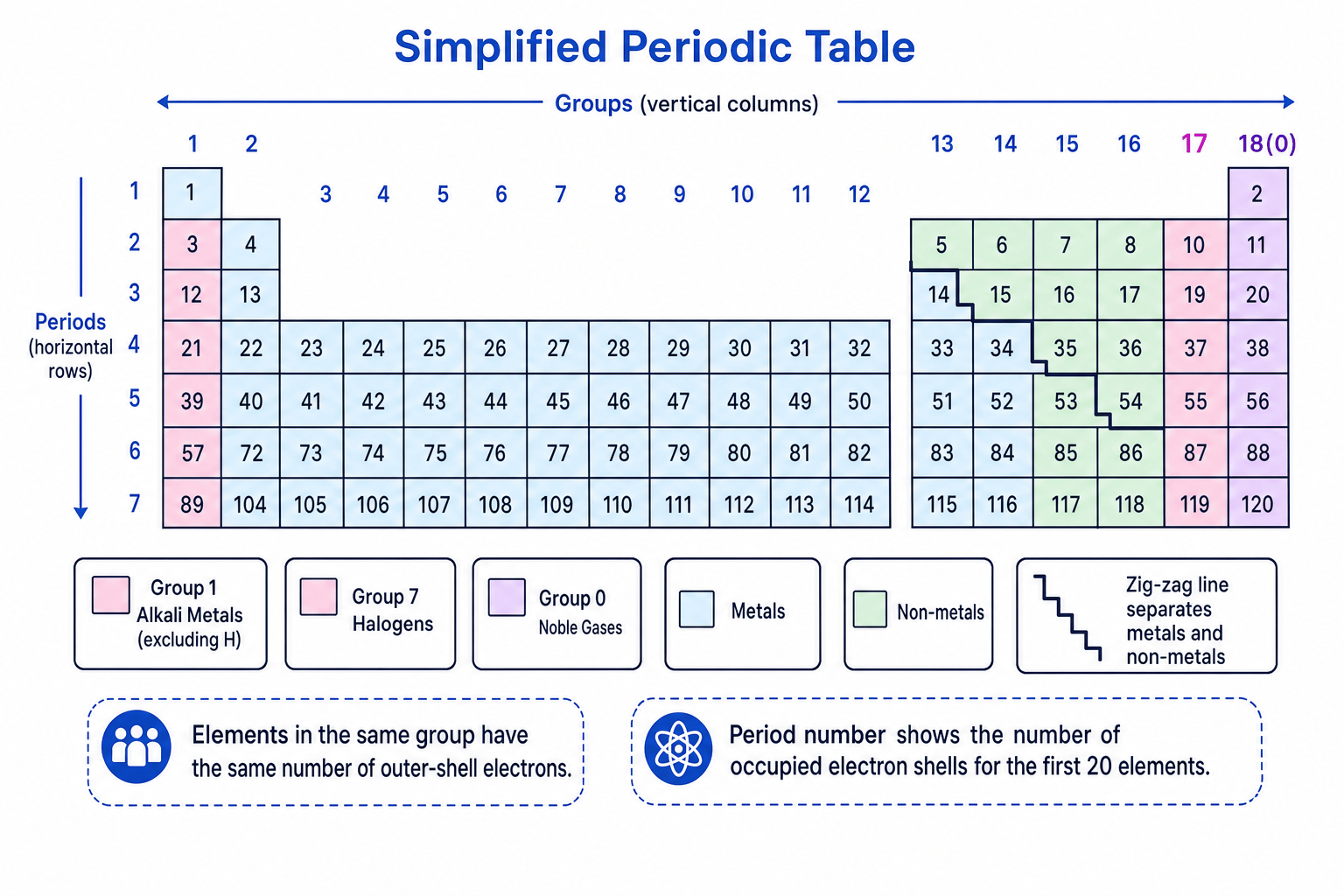
The periodic table is arranged in order of increasing atomic number. That means hydrogen has atomic number 1, helium has atomic number 2, lithium has atomic number 3, and so on.
Elements are also arranged so that elements with similar properties are in the same vertical columns, called groups.
Group and period
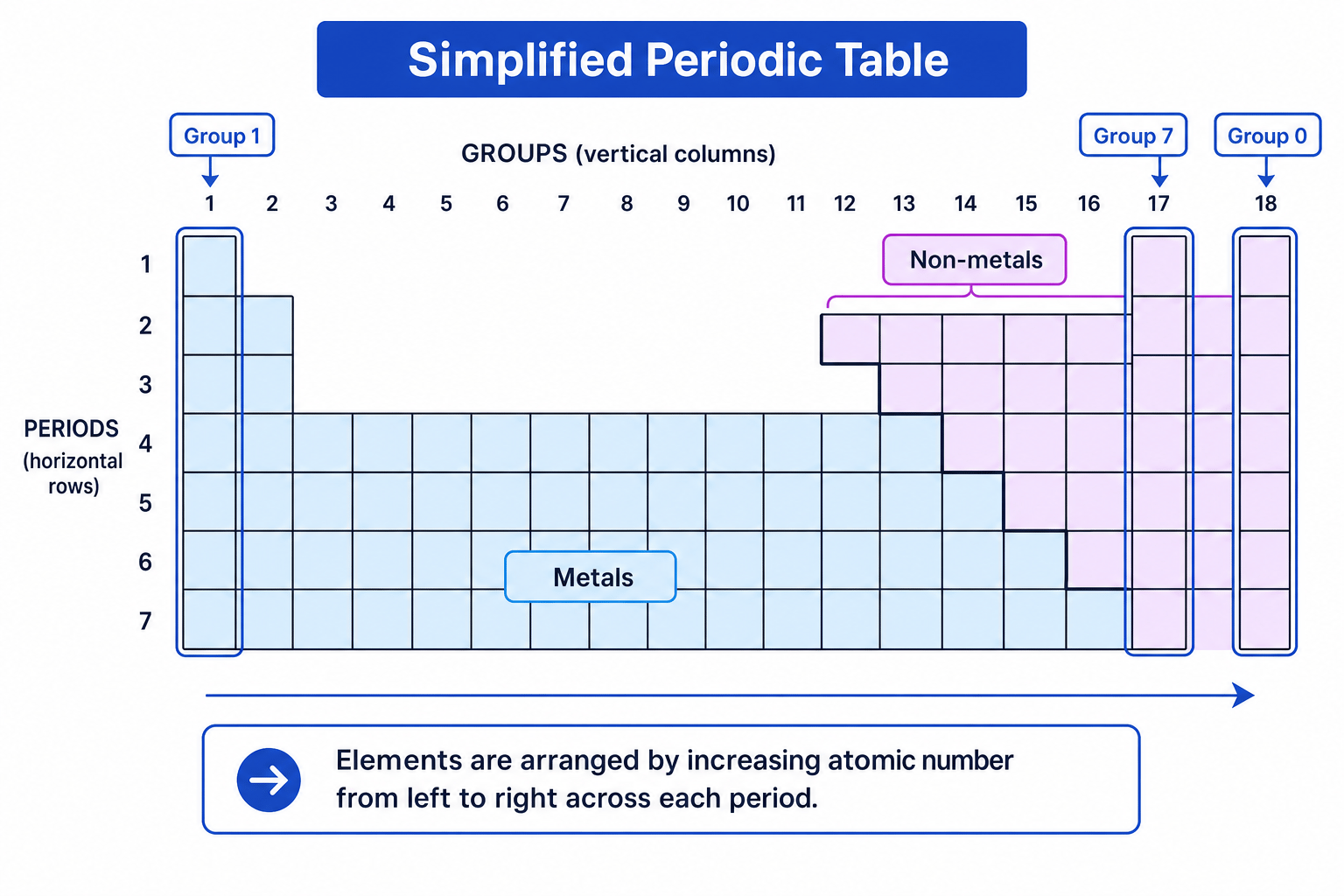
A group is a vertical column in the periodic table. A period is a horizontal row.
The table is called periodic because similar properties repeat at regular intervals as atomic number increases.
The diagram below shows the key layout ideas you need.
Groups and outer-shell electrons
The most important link is:
Same group, same outer electrons
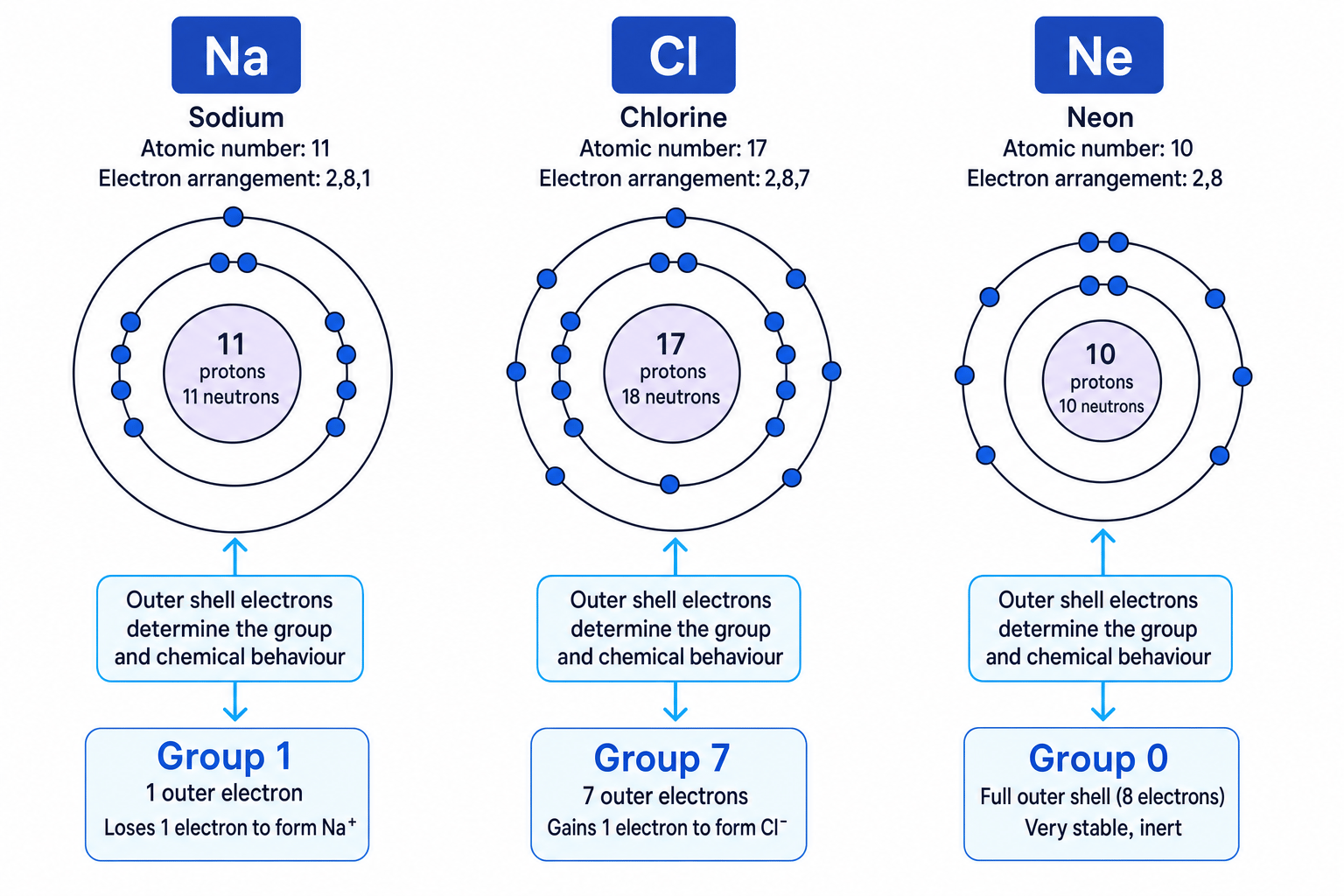
Elements in the same group have the same number of electrons in their outer shell, so they have similar chemical properties.
The outer shell is the furthest occupied electron shell from the nucleus. Chemical reactions usually involve atoms losing, gaining or sharing outer-shell electrons, so the number of outer electrons strongly affects reactivity.
For many GCSE questions involving the first 20 elements:
- Group 1 elements have 1 electron in their outer shell.
- Group 7 elements have 7 electrons in their outer shell.
- Group 0 elements have full outer shells.
Linking electron arrangement to position
An element has atomic number 12. Predict its electron arrangement and position.
- Atomic number 12 means a neutral atom has 12 electrons.
- Fill the shells in order for GCSE: first shell holds 2, second shell holds 8, then the remaining 2 go in the third shell. The electron arrangement is 2,8,2.
- The atom has 2 electrons in its outer shell, so it is in Group 2.
- It has electrons in 3 occupied shells, so it is in Period 3.
Mixing up group and period
The group tells you the number of outer-shell electrons for many main-group elements. The period tells you the number of occupied electron shells.
How the periodic table developed
Early scientists tried to classify elements before protons, neutrons and electrons had been discovered. They often arranged elements in order of atomic weight.
Atomic weight
In the historical context, atomic weight meant the relative mass of atoms compared with other atoms. Modern GCSE chemistry usually uses relative atomic mass instead.
The problem was that strict atomic-weight order sometimes put elements into the wrong groups. Their chemical properties did not match the elements around them. Early tables were also incomplete because many elements had not yet been discovered.
Dmitri Mendeleev improved the table in two clever ways:
- He left gaps for elements he thought had not been discovered yet.
- He sometimes changed the order based on atomic weights so that elements with similar properties stayed in the same group.
Later, elements were discovered that fitted his gaps and had properties close to his predictions. This supported his version of the periodic table.
Why Mendeleev’s table was accepted
Mendeleev’s predictions were tested when new elements were discovered. Because their properties matched his predictions, the evidence supported his scientific idea.
Knowledge of isotopes later explained why atomic-weight order was not always perfect.
Isotopes
Isotopes are atoms of the same element with the same number of protons but different numbers of neutrons.
Because isotopes affect the average relative atomic mass, arranging by mass can sometimes appear to put elements in the “wrong” order. Arranging by atomic number solves this problem because atomic number depends only on the number of protons.
Metals and non-metals
Most elements are metals. Metals are found on the left and towards the bottom of the periodic table. Non-metals are found towards the right and top.
Metal and non-metal
A metal is an element that reacts to form positive ions. A non-metal does not form positive ions.
A positive ion forms when an atom loses electrons. Because electrons are negatively charged, losing them leaves the atom with more positive charge than negative charge.
Metals tend to:
- form positive ions by losing electrons
- conduct electricity and thermal energy
- be shiny when freshly cut
- be malleable, meaning they can be hammered or bent into shape
Non-metals tend to:
- form negative ions or share electrons
- be poor conductors, except graphite
- have lower melting and boiling points than many metals
- be dull and brittle when solid
Explaining why sodium forms a positive ion
Sodium has electron arrangement 2,8,1. Explain why it forms Na⁺.
- Sodium has 1 electron in its outer shell, so it can reach a stable arrangement by losing that outer electron.
- After losing 1 electron, sodium has 11 protons but only 10 electrons.
- The overall charge is therefore 1 positive, so the ion is Na⁺.
Group 0: the noble gases
Group 0 elements are called the noble gases. They include helium, neon, argon, krypton, xenon and radon.
Noble gases
The noble gases are the Group 0 elements. They are very unreactive because their atoms have stable outer electron shells.
The noble gases do not easily form molecules. They usually exist as separate atoms because their outer shells are already stable.
Most noble gases have 8 electrons in their outer shell. The exception is helium, which has only 2 electrons, because its first shell is full with 2 electrons.
Going down Group 0, the boiling points increase as relative atomic mass increases. This means the gases become easier to condense into liquids as you move down the group.
Predicting a noble gas boiling point trend
Neon boils at about −246 °C and argon boils at about −186 °C. Krypton is below argon in Group 0. Predict whether krypton has a higher or lower boiling point than argon.
- In Group 0, boiling point increases going down the group.
- Krypton is below argon, so krypton has a higher relative atomic mass.
- Krypton should therefore have a higher boiling point than argon.
Group 1: the alkali metals
Group 1 elements are called the alkali metals. They include lithium, sodium and potassium.
Alkali metals
The alkali metals are the Group 1 metals. They have 1 electron in their outer shell and form alkaline solutions when they react with water.
Because Group 1 atoms have 1 outer electron, they react by losing that electron to form positive ions with a 1+ charge. For example, sodium forms Na⁺.
Going down Group 1, the elements become more reactive. The outer electron is further from the nucleus and more shielded by inner shells, so it is lost more easily.
Reactions with water
Group 1 metals react with water to form a metal hydroxide and hydrogen gas.
Lithium:
2Li(s) + 2H₂O(l) → 2LiOH(aq) + H₂(g)
Sodium:
2Na(s) + 2H₂O(l) → 2NaOH(aq) + H₂(g)
Potassium:
2K(s) + 2H₂O(l) → 2KOH(aq) + H₂(g)
The reactions get more vigorous from lithium to sodium to potassium.
Reactions with oxygen and chlorine
With oxygen, Group 1 metals form metal oxides, often seen as a tarnish or as products when the metal burns.
4Li(s) + O₂(g) → 2Li₂O(s)
4Na(s) + O₂(g) → 2Na₂O(s)
With chlorine, Group 1 metals form white metal chlorides.
2Na(s) + Cl₂(g) → 2NaCl(s)
2K(s) + Cl₂(g) → 2KCl(s)
Predicting Group 1 reactivity
Predict whether potassium or sodium reacts more vigorously with water.
- Sodium and potassium are both in Group 1, so both have 1 outer electron and react by losing it.
- Potassium is below sodium in Group 1, so its outer electron is further from the nucleus and more easily lost.
- Potassium is therefore more reactive and reacts more vigorously with water.
Group 1 trend
For Group 1, reactivity increases as you go down the group: lithium < sodium < potassium.
Group 7: the halogens
Group 7 elements are called the halogens. They include fluorine, chlorine, bromine and iodine.
Halogens
The halogens are Group 7 non-metals. Their atoms have 7 electrons in their outer shell.
Halogens exist as molecules made of pairs of atoms. These are called diatomic molecules. For example, chlorine is Cl₂, bromine is Br₂ and iodine is I₂.
Halogens react by gaining 1 electron to form negative ions with a 1− charge. For example, chlorine forms Cl⁻.
Going down Group 7:
- relative molecular mass increases
- melting point increases
- boiling point increases
- reactivity decreases
The reactivity decreases because the outer shell is further from the nucleus, so it is harder for the atom to attract and gain an extra electron.
Compounds made by halogens
With metals, halogens form ionic compounds called metal halides. For example:
2Na(s) + Cl₂(g) → 2NaCl(s)
With non-metals, halogens form covalent molecular compounds. For example, hydrogen and chlorine form hydrogen chloride:
H₂(g) + Cl₂(g) → 2HCl(g)
Halogen displacement reactions
A more reactive halogen can displace a less reactive halogen from an aqueous solution of its salt.
Displacement reaction
A displacement reaction happens when a more reactive element takes the place of a less reactive element in a compound.
For the common Group 7 elements, the reactivity order is:
fluorine > chlorine > bromine > iodine
So chlorine can displace bromine or iodine, but iodine cannot displace chlorine or bromine.
Example:
Cl₂(aq) + 2KBr(aq) → 2KCl(aq) + Br₂(aq)
Here, chlorine displaces bromine from potassium bromide solution.
Predicting a halogen displacement reaction
Predict whether bromine reacts with potassium iodide solution.
- Compare the halogens: bromine is above iodine in Group 7.
- Reactivity in Group 7 decreases going down the group, so bromine is more reactive than iodine.
- A more reactive halogen displaces a less reactive halogen from its salt solution, so bromine displaces iodine.
- The reaction is: Br₂(aq) + 2KI(aq) → 2KBr(aq) + I₂(aq)
Getting the Group 7 trend backwards
Group 1 gets more reactive down the group, but Group 7 gets less reactive down the group. This is because Group 1 metals lose electrons, while Group 7 halogens gain electrons.
In practical work, halogen displacement can be tested by mixing small volumes of halogen solution with halide salt solutions, often in a spotting tile or test tubes, and observing colour changes.
In the exam
- Link properties to outer-shell electrons whenever a question asks “explain why elements in a group behave similarly”.
- For trends, state the direction clearly: Group 1 reactivity increases down the group; Group 7 reactivity decreases down the group; Group 0 boiling points increase down the group.
- In displacement questions, compare reactivity first, then decide whether a reaction happens, then write the product if needed.
Check yourself
- Why did Mendeleev leave gaps in his periodic table?
- What does the group number tell you about the outer electrons of Group 1 and Group 7 elements?
- Why can chlorine displace bromine from potassium bromide solution, but bromine cannot displace chlorine from potassium chloride solution?