Revision notes for OCR GCSE Psychology Theories and Explanations of Memory. Open the guide for explanations and worked examples. Written against the OCR GCSE Psychology (J203) specification, so the content matches what's examinable rather than general Psychology background.
Theories and Explanations of Memory
What you'll learn
- How the Multi-store Model of memory explains memory as three separate stores.
- How duration, capacity and encoding differ in sensory, short-term and long-term memory.
- How reconstructive memory uses schemas, expectations and experience.
- How the core studies by Wilson, Kopelman and Kapur (2008) and Braun, Ellis and Loftus (2002) support and challenge these explanations.
Before the theories: what is memory?
Memory is not just “remembering stuff”. Psychologists usually break it into three linked processes.
Definition
Memory
Memory is the ability to encode, store and retrieve information.
- Encoding means changing information into a form the brain can use.
- Storage means keeping information over time.
- Retrieval means accessing stored information when it is needed.
A theory of memory tries to explain how information gets in, how it is kept, and why it is sometimes forgotten or changed.
The Multi-store Model of Memory
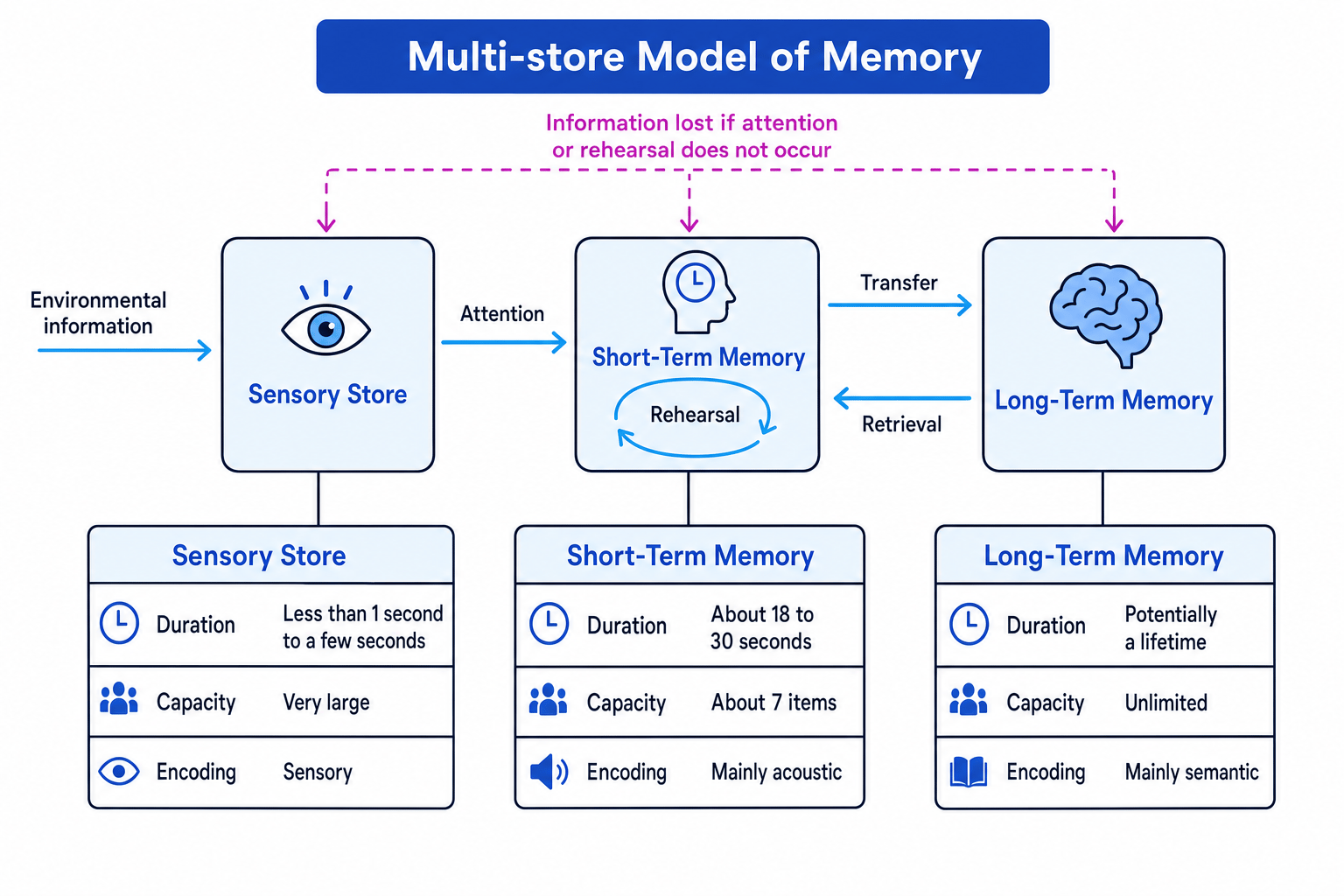
The Multi-store Model of memory is a cognitive explanation first associated with Atkinson and Shiffrin. It suggests memory is made of separate stores, and information moves between them in a fairly fixed sequence.
Definition
Multi-store Model
The Multi-store Model explains memory as three separate stores: the sensory store, short-term memory and long-term memory.
Information first enters through the senses, then moves to short-term memory if you pay attention to it. If it is rehearsed, it may transfer into long-term memory. When you need it later, it is retrieved back into short-term memory.
The sensory store
The sensory store holds information from the senses, such as sights, sounds and smells.
It has a very large capacity, because you are constantly taking in huge amounts of sensory information. However, its duration is extremely short: usually less than a second to a few seconds. Its encoding is sensory, meaning information is stored in the form it arrived in, such as visual or auditory information.
Most sensory information disappears unless you pay attention to it.
Short-term memory
Short-term memory, often shortened to STM, is the store for information you are currently aware of.
STM has a limited capacity of about seven items. Its duration is about 18–30 seconds if the information is not rehearsed. Its main type of encoding is acoustic, meaning it often stores information based on sound.
For example, if you repeat a phone number in your head, you are using STM.
Long-term memory
Long-term memory, often shortened to LTM, stores information for much longer periods.
LTM has a potentially unlimited capacity and can last for a lifetime. Its main type of encoding is semantic, meaning information is usually stored according to meaning.
This includes facts, personal memories, skills and knowledge.
Key Idea
The three stores are different
For GCSE, remember that the stores differ in three main ways: duration is how long information lasts, capacity is how much can be held, and encoding is the form information takes.
Example
Applying the Multi-store Model
A student hears a new locker code and repeats it several times before using it later in the week.
- The sounds of the code first enter the sensory store, but they would fade quickly unless the student pays attention.
- Attention moves the code into short-term memory, where it is held briefly and mainly encoded acoustically as the student repeats the sounds.
- Rehearsal increases the chance that the code transfers into long-term memory, so it can be retrieved later when the student needs to open the locker.
Criticisms of the Multi-store Model
The Multi-store Model is useful because it gives a clear, simple explanation of how information can move through memory.
However, it has some important weaknesses.
Rehearsal versus meaning
The model suggests that rehearsal is the main way information transfers from STM to LTM.
Definition
Rehearsal
Rehearsal means mentally repeating information to keep it in short-term memory and help it transfer to long-term memory.
A criticism is that rehearsal is not always enough. Information is often remembered better when it is meaningful, not just repeated. For example, you may remember a story from years ago because it mattered to you, even if you never rehearsed it.
Common Mistake
Thinking repetition always creates long-term memory
Repetition can help, but GCSE answers should also mention that meaning can be more important than simple rehearsal.
Too simple
The model treats STM and LTM as single stores. In real life, memory seems more complex. For example, someone might lose personal memories but still remember how to play a musical instrument. This suggests long-term memory may have different types.
Core study: Wilson, Kopelman and Kapur (2008)
The OCR specification links the Multi-store Model to an example of the impact of neurological damage on behaviour: the case of Clive Wearing.
Definition
Neurological damage
Neurological damage means damage to the brain or nervous system which affects behaviour, thoughts, emotions or abilities.
Clive Wearing was a musician who developed severe amnesia after a brain infection damaged areas involved in memory, including parts linked to the formation of long-term memories.
What happened?
Clive had very severe anterograde amnesia, meaning he struggled to form new long-term memories after the damage. He also had retrograde amnesia, meaning he lost many memories from before the damage.
He repeatedly felt as if he had just become conscious for the first time. However, he could still do some things, such as play music and recognise his wife emotionally.
Method and findings
Wilson, Kopelman and Kapur (2008) used a detailed case study approach. They drew on observations, interviews, memory assessments and records of Clive’s behaviour over time.
They found that his memory loss was highly persistent. His behaviour showed the impact of brain damage: repeated diary entries, repeated greetings and difficulty maintaining awareness of the recent past.
What does it show?
The study supports the idea that memory depends on brain systems, and that damage can severely disrupt the transfer or formation of long-term memories.
It also challenges a simple version of the Multi-store Model, because not all long-term memory was equally damaged. Clive’s musical skill was partly preserved, suggesting LTM is not just one single store.
Key Idea
Clive Wearing and memory stores
Clive Wearing is useful AO3 evidence because he supports the idea that memory has separate systems, but also challenges the idea that long-term memory is one simple store.
Evaluation and ethics
A strength is that this case study gives rich, detailed evidence about real memory loss. It has high real-world value because it helps psychologists understand amnesia and brain injury.
A weakness is that one unusual case cannot easily be generalised to everyone. Clive’s damage and life history were unique.
Ethically, researchers studying a vulnerable person must consider the British Psychological Society Code of Ethics and Conduct, including informed consent, protection from psychological harm, right to withdraw, confidentiality and debriefing. Because Clive’s ability to consent may have been affected, researchers would need to be especially careful and involve appropriate carers or representatives.
The Theory of Reconstructive Memory
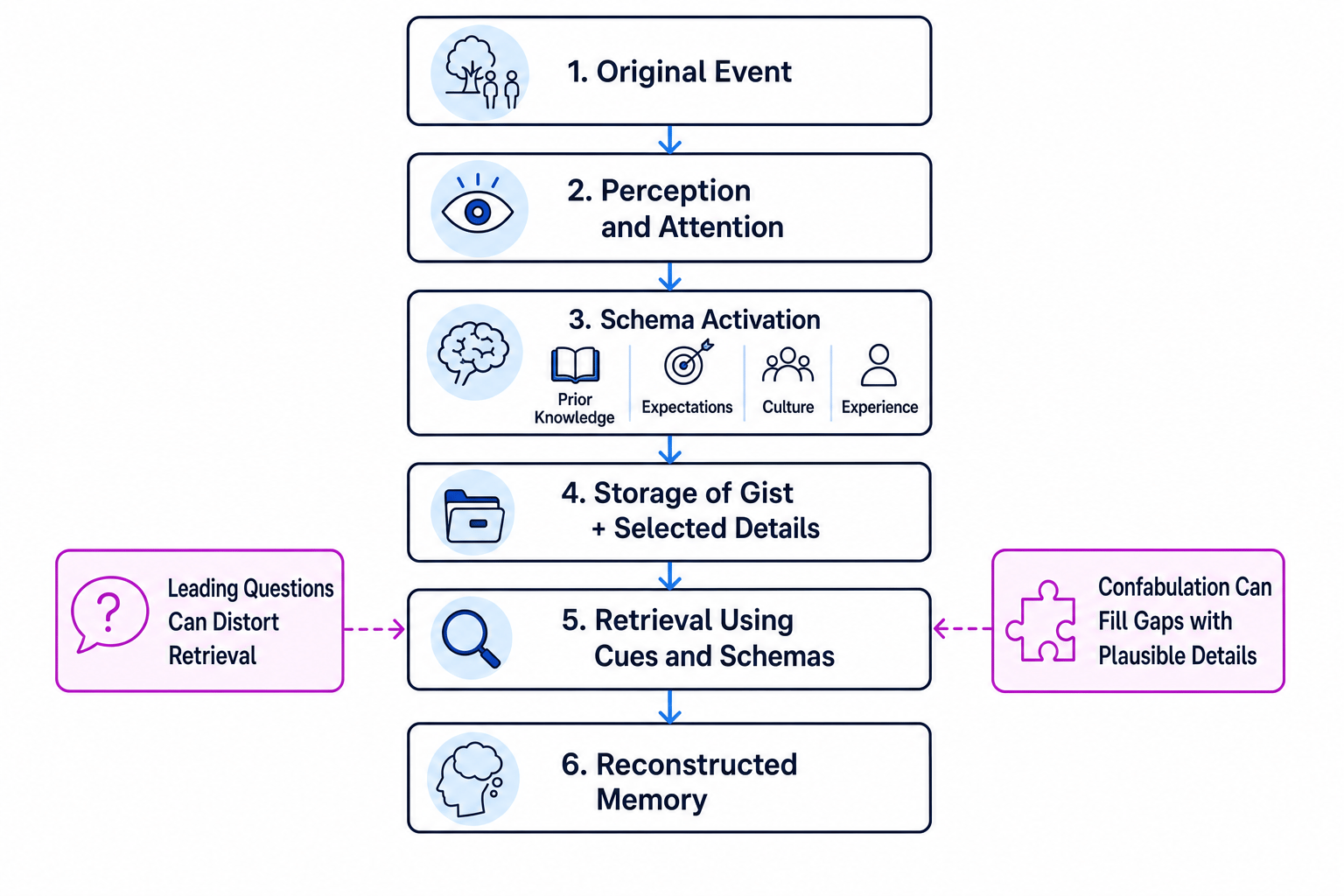
The Theory of Reconstructive Memory says remembering is not like replaying a video. Instead, memory is actively rebuilt each time we recall it.
Definition
Reconstructive memory
Reconstructive memory is the idea that recall is an active process where memories are rebuilt using stored information, expectations and prior experience.
This theory is strongly linked with Bartlett’s ideas about schemas.
Definition
Schema
A schema is a mental framework of knowledge and expectations built from past experience.
Schemas help you make sense of the world quickly. For example, your schema of a classroom may include desks, chairs, a teacher and a board. If you later try to remember a classroom, you may accidentally include details that fit your schema even if they were not actually there.
Experience and expectation
Your experience affects what you notice and remember. Your expectations affect how you interpret unclear information.
This means two people can witness the same event but remember it differently. Their memories may be shaped by what they already believe, what they expected to happen, and what feels normal to them.
Confabulation
Definition
Confabulation
Confabulation is when a person fills gaps in memory with details that seem plausible, without deliberately lying.
In reconstructive memory, confabulation happens because the brain tries to create a complete, sensible memory, even when some details are missing.
Distortion and leading questions
A leading question is a question worded in a way that suggests a particular answer.
For example, asking “How fast was the car going when it smashed into the wall?” may create a stronger impression than asking “How fast was the car going when it hit the wall?”
This can cause distortion, where the remembered version of events changes.
Example
Identifying schema and leading-question effects
A witness sees a minor car accident. Later, they are asked, “Did you see the broken glass after the car smashed into the other vehicle?” There was no broken glass.
- The word “smashed” suggests a more severe crash, so the question is leading rather than neutral.
- The witness’s schema of a serious car crash may include broken glass, loud noise and damage.
- At recall, the witness may reconstruct the memory using the question and their schema, leading to a distorted memory of seeing glass.
Core study: Braun, Ellis and Loftus (2002)
Braun, Ellis and Loftus (2002) investigated whether advertising could change people’s memories of their past.
Background and aim
The study was based on the idea that suggestion can create false or distorted memories. The researchers wanted to see whether an advert could make people believe they had experienced something in childhood.
Method
This was a laboratory-style study using advertising materials and questionnaires. Participants were exposed to adverts about Disney. Some adverts suggested an impossible childhood experience, such as meeting Bugs Bunny at a Disney location, even though Bugs Bunny is not a Disney character.
Participants later answered questions about their childhood memories.
Results and conclusions
Participants exposed to the misleading advertising were more likely to report memories of the suggested event. Some gave extra details, making the false memory seem more real.
The researchers concluded that advertising can influence autobiographical memory. This supports reconstructive memory because it shows that later information can alter how people remember the past.
Evaluation and ethics
A strength is that the study used controlled materials, so researchers could investigate the effect of misleading information. It also has real-world application for advertising and eyewitness memory.
A weakness is that the situation was artificial. Reading an advert and completing questionnaires may not be the same as forming memories in everyday life. The sample may also not represent all age groups or cultures.
Ethically, the study involved deception, because participants were exposed to misleading information. This means debriefing was important. Researchers also needed informed consent, the right to withdraw, confidentiality and protection from harm.
Criticisms of reconstructive memory
Reconstructive memory is useful because it explains why eyewitnesses can be confident but still inaccurate. It also explains why leading questions, stereotypes and expectations can alter recall.
However, it may overemphasise errors. Many memories are accurate enough for everyday life. If memory were always heavily distorted, we would struggle to function.
Reductionism and holism
Definition
Reductionism and holism
Reductionism means explaining complex behaviour using simpler parts. Holism means explaining behaviour by looking at the whole person and wider context.
Reconstructive memory can be seen as holistic because it considers experience, expectation, culture and context. This is broader than only focusing on memory stores.
However, it can still be criticised as reductionist if it explains memory mainly through schemas and does not fully include biological factors, emotion or social pressure.
Tip
AO3 comparison
A strong comparison is: the Multi-store Model is clearer and easier to test, but reconstructive memory may explain real-life memory errors better.
Exam technique
In the exam
- For the Multi-store Model, always cover structure and process: sensory store → STM → LTM, with attention, rehearsal and retrieval.
- When evaluating, include the key criticism of rehearsal versus meaning, and use Clive Wearing to show both support and challenge.
- For reconstructive memory, apply the terms schema, confabulation, distortion and leading question to the scenario, not just as definitions.
Self review
Check yourself
- What are the differences between sensory store, short-term memory and long-term memory in duration, capacity and encoding?
- How does Clive Wearing’s case support and challenge the Multi-store Model?
- How can schemas and leading questions change a person’s memory of an event?
Memory
Guide 2 of 3
You've reached the end
Test yourself on this topic, or move on to the next guide.
How was this guide?