Revision notes for OCR GCSE Psychology Techniques Used for Recall. Open the guide for explanations and worked examples. Written against the OCR GCSE Psychology (J203) specification, so the content matches what's examinable rather than general Psychology background.
Techniques Used for Recall
What you'll learn
- How recall depends on encoding information and later retrieving it.
- How advertisers use cues, repetition, avoiding overload, and autobiographical advertising to improve memory.
- How neuropsychology measures different memory functions, including the Wechsler Memory Scale.
- How to evaluate these applications using strengths, weaknesses, ethics and debates.
Start point: what is recall?
In the Memory topic, you have already met the idea that memory involves encoding, storage and retrieval.
- Encoding means putting information into memory.
- Storage means keeping information over time.
- Retrieval means getting stored information back out.
Definition
Recall
Recall is retrieving information from memory without having the full answer in front of you. For example, remembering the name of a brand when you are in a shop is recall.
This matters in advertising because companies do not just want you to see an advert. They want you to remember the product later, especially when you are choosing what to buy.
Techniques used in advertisements
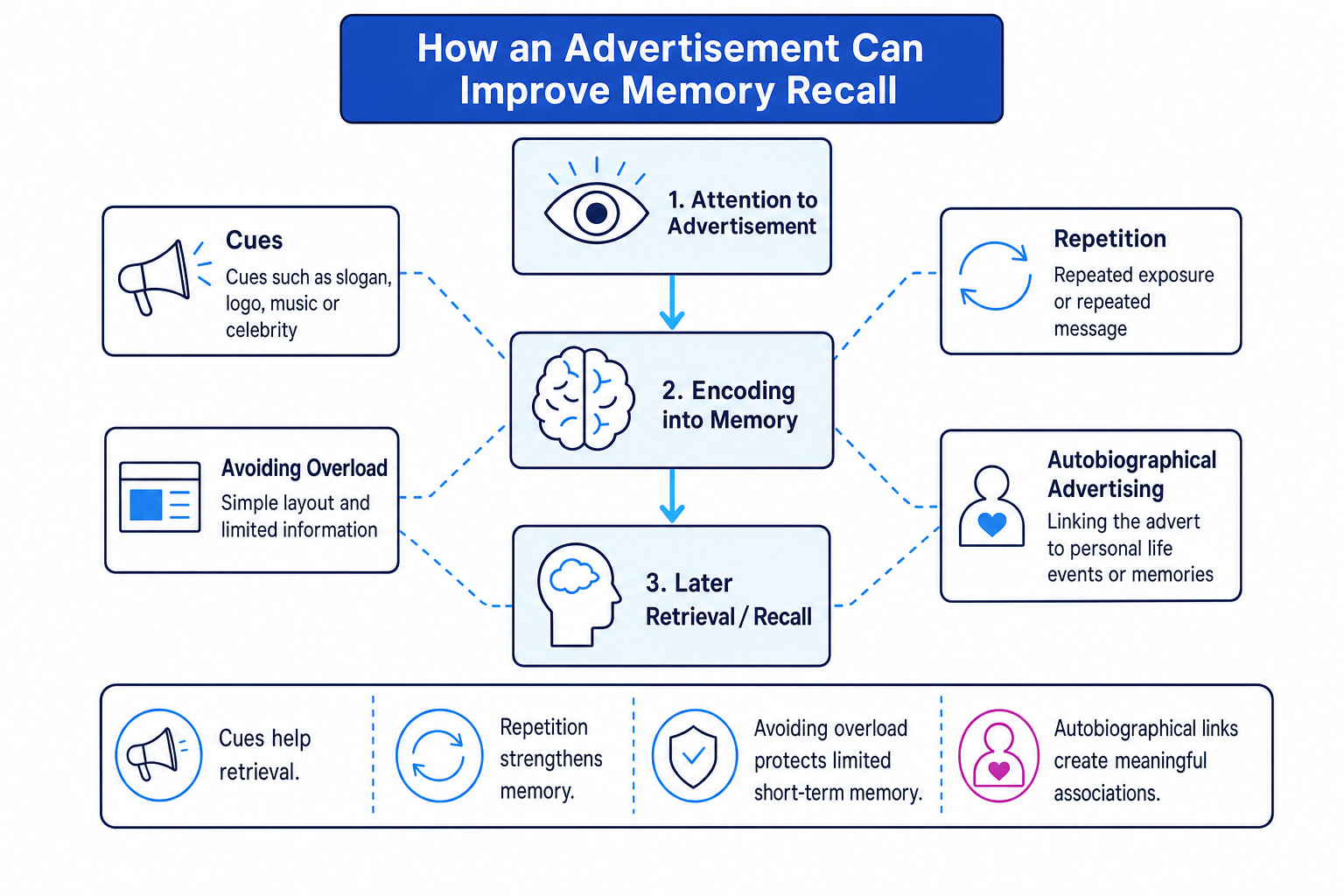
Advertisers can design messages to make recall more likely. The OCR specification focuses on four techniques:
- using cues
- using repetition
- avoiding overload
- using autobiographical advertising
These techniques are based on the cognitive idea that memory is affected by how information is encoded and what helps retrieval later.
Key Idea
The main advertising idea
A memorable advert usually makes the information easy to encode, gives you retrieval cues, repeats the message, and links the product to something personally meaningful.
Cues: giving memory a trigger
A cue is a prompt that helps you retrieve information from memory. In advertising, cues can include:
- a slogan
- a logo
- a jingle or song
- a celebrity
- a colour scheme
- a repeated image or catchphrase
For example, if you hear a short tune and immediately think of a brand, the tune is acting as a retrieval cue.
Cues work best when they are present during encoding and can be encountered again during retrieval. If you see a logo in an advert and then see the same logo in a supermarket, it may help you remember the advert and the product.
Repetition: strengthening the memory trace
Repetition means presenting the same information more than once. In adverts, this might mean repeating:
- the brand name
- the slogan
- the key benefit of the product
- the advert itself across TV, social media and posters
Repetition can strengthen the association between the cue and the product. For example, if an advert repeats the phrase “fresh every morning” several times, you may later connect that phrase with the brand.
However, repetition is not magic. If an advert is repeated too often, people may become irritated or stop paying attention.
Common Mistake
Thinking repetition always helps
Repetition can improve recall, but only if the audience still attends to the advert. Too much repetition can cause boredom, irritation or “switching off”.
Avoiding overload: keeping memory demands manageable
Overload happens when too much information is presented at once, making it difficult to process and remember. This links to the idea that short-term or working memory has a limited capacity.
An advert may cause overload if it includes:
- too much text
- too many product claims
- fast speech
- lots of competing images
- several messages at the same time
To avoid overload, an advert should usually focus on one clear message. For example, instead of listing ten benefits of a shampoo, it might focus on one memorable idea: “shiny hair in one wash.”
Tip
A simple AO2 check
If a scenario describes an advert with lots of information, tiny text, fast speech or many claims, you can apply avoiding overload by suggesting a simpler layout and one main message.
Autobiographical advertising: linking the advert to your life
Autobiographical memory is memory for events from your own life, such as birthdays, holidays, school experiences or family routines.
Autobiographical advertising tries to link a product with personal memories. It might use:
- childhood scenes
- family celebrations
- school memories
- holidays
- “remember when…” wording
- nostalgic music or images
This can make an advert powerful because personal memories are meaningful. If an advert makes you connect a product with your own past, you may recall it more easily.
A key study here is Braun, Ellis and Loftus (2002), often linked with autobiographical advertising. Participants were exposed to advertising-style material about Disneyland. Some were later more likely to report memories of meeting Bugs Bunny at Disneyland, even though Bugs Bunny is not a Disney character. This suggests advertising can influence autobiographical memory and even contribute to false memories.
Example
Improving an advert for recall
A new advert for a breakfast bar includes twelve health claims, a tiny logo at the end, no slogan, and is only shown once. How could it be improved?
- Reduce the memory load by cutting the twelve claims down to one clear message, such as “slow-release energy for school mornings.” This avoids overload and makes the central idea easier to encode.
- Add a strong retrieval cue by creating a short slogan or jingle that includes the brand name. This gives the audience something to recognise later in a shop.
- Use repetition strategically by repeating the brand name and slogan at the start and end of the advert, and by showing the advert across more than one platform.
- Add an autobiographical link by showing a familiar morning routine, such as packing a school bag or eating breakfast before a busy day. This connects the product with personal experience.
Evaluating advertising techniques
Advertising techniques have clear strengths. They are practical applications of memory research and can be tested by measuring whether people remember a brand after seeing an advert. They also make sense from a cognitive approach because they focus on attention, encoding and retrieval.
But there are weaknesses too. People differ in age, interests, culture, past experience and motivation, so the same advert will not work equally well for everyone. Also, remembering an advert does not always mean someone will buy the product.
There are ethical issues as well. The British Psychological Society’s Code of Ethics and Conduct includes principles such as informed consent, protection from harm, right to withdraw, confidentiality and debriefing. In real advertising, people are not usually “debriefed” about how memory techniques are being used. Autobiographical advertising can be especially concerning if it encourages distorted or false memories.
This links to the freewill/determinism debate. Advertising does not completely control people, but it can influence choices by shaping what they remember and how they feel about products.
Neuropsychology and memory measurement
Definition
Neuropsychology
Neuropsychology is the study of how the brain is linked to psychological functions such as memory, language, attention and problem-solving.
The development of neuropsychology helped psychologists realise that memory is not just one single ability. A person may have strong memory in one area but weak memory in another.
For example, someone might remember skills well but struggle to remember new personal events. This fits with case-study evidence such as Wilson, Kopelman and Kapur (2008), who studied severe amnesia and showed that different aspects of memory can be affected in different ways. This is important because it supports the idea that memory has different functions, not one single “memory score.”
Neuropsychological assessment can be used after brain injury, illness or suspected memory problems. It can help identify strengths and difficulties, plan support, and track change over time.
The Wechsler Memory Scale
The Wechsler Memory Scale, often shortened to WMS, is a standardised test used to assess memory. It is part of the development of neuropsychology because it provides a structured way to measure different memory functions.
Standardised means the test is given and scored in a consistent way, so a person’s performance can be compared with typical scores for people of a similar age.
The WMS can include tasks involving:
- remembering stories or spoken information
- remembering word pairs
- recalling visual designs
- comparing immediate recall with delayed recall
- assessing working memory, such as holding and manipulating information for a short time
The important point is that the WMS gives a profile of memory abilities. It is not just a simple pass or fail.
Example
Interpreting a memory profile
A patient scores within the typical range on immediate verbal recall and visual recall, but scores much lower on delayed recall after a time gap. What does this suggest?
- Compare the memory functions by separating immediate recall from delayed recall. The immediate scores suggest the person can take in and reproduce information straight away.
- Identify the weaker function by focusing on the much lower delayed recall score. This suggests the main difficulty is keeping or retrieving information after time has passed.
- Apply the finding carefully by suggesting support such as reminders, diaries or cues, rather than claiming the person has “no memory.” The profile shows a specific difficulty, not a total loss of memory.
Tip
Think profile, not pass/fail
For the WMS, remember that neuropsychologists look for patterns across different memory functions, such as verbal, visual, immediate, delayed and working memory.
Evaluating the Wechsler Memory Scale and neuropsychology
A strength of the WMS is that it is standardised, so it is more objective than simply asking someone whether they think their memory is good. It can help clinicians compare different memory functions and plan rehabilitation.
Another strength is real-world usefulness. Neuropsychological tests can help people after brain injury or illness by identifying what kind of support they need.
However, there are limitations. Test performance can be affected by tiredness, anxiety, language, education or cultural background. A person might perform badly because they are stressed, not because their memory system is damaged.
The WMS also cannot, by itself, prove exactly which part of the brain is damaged. It is usually used alongside other evidence, such as interviews, medical history and brain scans.
Common Mistake
Treating the WMS as a brain scan
The Wechsler Memory Scale measures memory performance. It does not directly show brain structure, so it cannot locate brain damage on its own.
This topic also links to the reductionism/holism debate. Neuropsychological tests are reductionist because they break memory into separate functions and scores. This is useful for measurement, but a holistic view reminds us that memory in everyday life is affected by emotion, motivation, environment and personal meaning.
Ethics in memory research and assessment
When psychologists study memory or test memory, they must consider ethics.
For research such as Braun, Ellis and Loftus (2002), deception and false memory are important issues. Participants may not realise their memories are being influenced, so debriefing is especially important.
For neuropsychological assessment, patients may be vulnerable because of brain injury, illness or memory problems. Psychologists must protect them from psychological harm, keep results confidential, gain appropriate consent, and allow withdrawal where possible.
Exam technique
In the exam
- For AO1, name the technique clearly: cue, repetition, avoiding overload, autobiographical advertising, neuropsychology or Wechsler Memory Scale.
- For AO2, apply the idea to the scenario: explain exactly how the advert or memory test would affect encoding, retrieval or measurement.
- For AO3, add a balanced point: usefulness, individual differences, ethics, reductionism/holism, or the risk of false memories.
Self review
Check yourself
- How could a slogan or jingle act as a retrieval cue in an advert?
- Why might too much information in an advert reduce recall?
- What does the Wechsler Memory Scale measure that a simple “good or bad memory” judgement would miss?
Memory
Guide 3 of 3
You've reached the end
Test yourself on this topic, or move on to the next guide.
How was this guide?