Revision notes for OCR GCSE Psychology Theories and Explanations of Dreaming. Open the guide for explanations and worked examples. Written against the OCR GCSE Psychology (J203) specification, so the content matches what's examinable rather than general Psychology background.
Theories and Explanations of Dreaming
What you'll learn
- What psychologists mean by dreaming, and why REM sleep matters.
- How Freud’s theory explains dreams as disguised wish fulfilment.
- How Activation Synthesis Theory explains dreams using brain activity during sleep.
- How to evaluate the two prescribed studies: Freud (1918) and Williams et al. (1992).
1. The nature of dreaming
A dream is a sequence of images, thoughts, emotions or sensations that happens during sleep. Dreams can feel realistic, but they often include bizarreness: strange changes, impossible events, unusual combinations, or sudden jumps in time and place.
Dreaming can happen in different stages of sleep, but it is especially linked with REM sleep.
Definition
REM sleep
REM sleep means rapid eye movement sleep. During REM, the eyes move quickly under the eyelids, the brain is very active, and the body is mostly still. Vivid dreams are most likely to be reported after REM sleep.
The two theories in this section ask different questions:
- Freud asks: What hidden meaning might the dream have?
- Activation Synthesis Theory asks: How does the sleeping brain create the dream experience?
2. Freud’s Theory of Dreaming
Freud’s theory is a psychodynamic explanation. This means it focuses on hidden mental processes, especially conflict inside the mind. In GCSE Psychology, the key prescribed study is Freud (1918): the dream analysis case study of “The Wolfman”.
Freud believed dreams are not random. He argued that dreams express unconscious wishes, but in a disguised form so they are less threatening to the dreamer.
Definition
Freud's key terms
- The unconscious mind is the part of the mind containing thoughts, wishes and memories you are not aware of.
- Repression is when the mind pushes threatening or upsetting thoughts into the unconscious.
- Wish fulfilment means a dream allows an unconscious desire to be expressed.
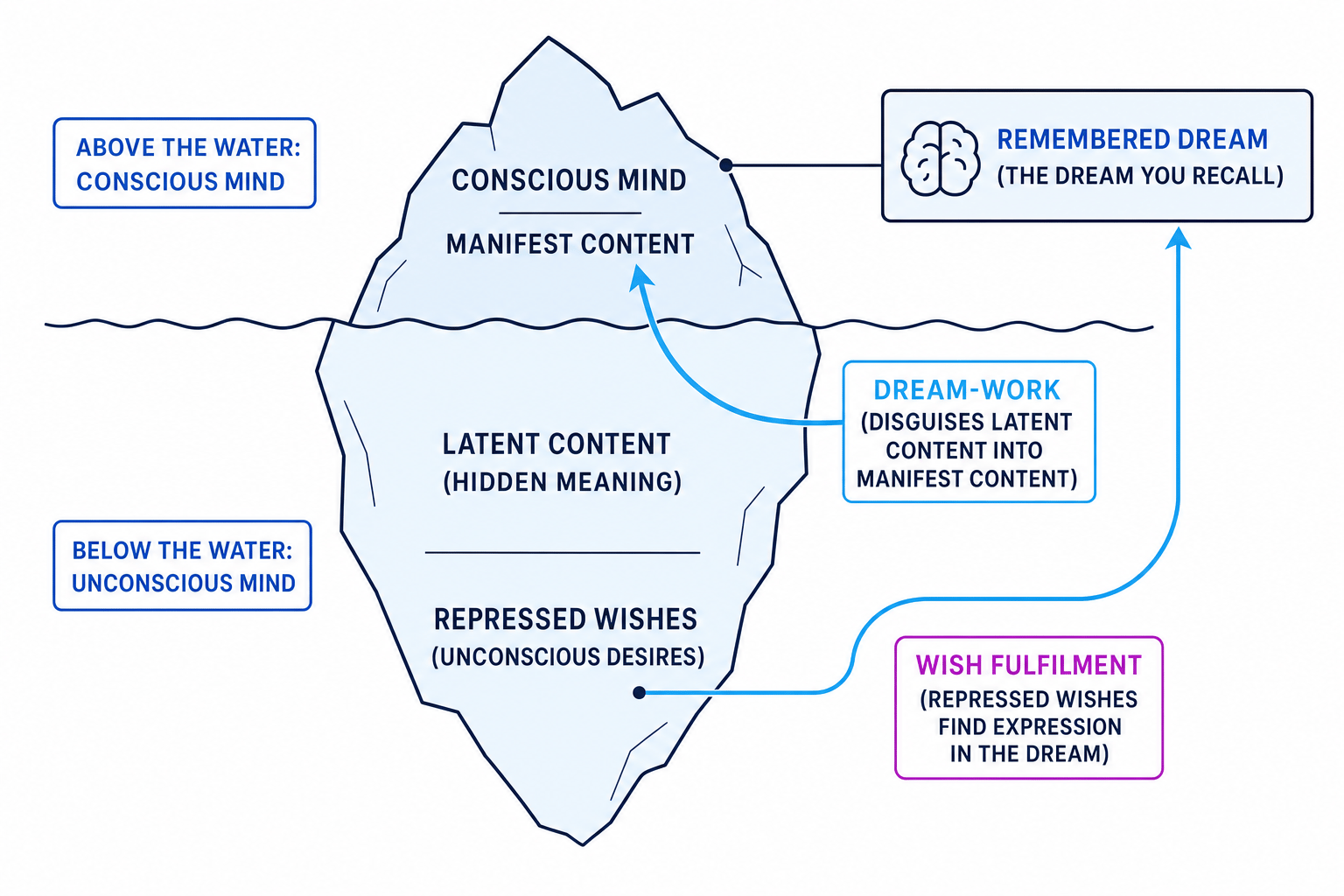
- Manifest content is the dream as the person remembers it.
- Latent content is the hidden meaning behind the dream.
Freud argued that the mind uses dream-work to turn the unacceptable latent content into the safer manifest content. So, a dream about being chased might not literally be about being chased; Freud might interpret it as a disguised sign of anxiety, conflict or desire.
Key Idea
Freud's main claim
For Freud, a dream is meaningful: the remembered dream is a disguised version of hidden unconscious wishes.
Applying Freud’s theory
Example
Interpreting manifest and latent content
A student dreams that they win a huge trophy the night after losing an important competition.
- Identify the manifest content: the remembered dream is winning a trophy.
- Infer a possible latent content: the hidden meaning could be a strong wish to succeed or to undo the disappointment of losing.
- Link it to wish fulfilment: the dream allows the student to experience success in a disguised, imaginary form.
- Add repression if appropriate: if the student feels embarrassed about jealousy or failure, those feelings may be pushed into the unconscious and appear indirectly in the dream.
Common Mistake
Manifest does not mean meaningful
Do not say the manifest content is the hidden meaning. Manifest content is what the person reports; latent content is Freud’s interpretation of what it really represents.
3. Freud (1918): The Wolfman study
Background
Freud analysed a patient known as The Wolfman, whose real name was Sergei Pankejeff. The case is in the individual differences core area because it focuses deeply on one person’s unusual experiences, symptoms and childhood memories.
The Wolfman reported a childhood dream in which several white wolves were sitting in a tree and staring at him. Freud believed this dream revealed unconscious conflict.
Method and procedure
This was a case study, meaning an in-depth investigation of one individual. Freud used dream analysis as part of psychoanalysis. The main data were qualitative, meaning they were detailed words and descriptions rather than numbers.
Freud asked the Wolfman about his dreams, childhood experiences, fears and personal associations. Freud then interpreted the dream symbols and linked them to unconscious material.
Results and conclusion
Freud concluded that the wolf dream represented repressed childhood fears and conflicts. He interpreted the wolves as symbolic, not literal. Freud argued that the dream supported his theory that dreams can reveal unconscious wishes and anxieties in disguised form.
Evaluation of Freud’s theory and study
A strength is that Freud’s theory takes dreams seriously as meaningful experiences. It is also holistic, because it considers the whole person: childhood, emotions, relationships and unconscious conflict.
However, the biggest criticism is subjectivity. Subjectivity means an explanation depends on personal interpretation. Another psychologist might interpret the same dream differently, and it is difficult to prove that Freud’s interpretation was correct.
Other weaknesses include:
- Low generalisability: one case study cannot represent everyone’s dreams.
- Retrospective memory: the Wolfman was recalling a childhood dream later in life, so memory may have changed.
- Researcher bias: Freud may have interpreted evidence to fit his own theory.
- Low scientific testability: unconscious wishes and hidden meanings are difficult to measure objectively.
Ethically, Freud’s work should be judged against the modern British Psychological Society Code of Ethics and Conduct. Important issues include informed consent, protection from psychological harm, confidentiality, right to withdraw and debriefing. The case used a pseudonym, which helped confidentiality, but discussing distressing childhood material could risk psychological harm.
4. Activation Synthesis Theory of Dreaming
Activation Synthesis Theory is a biological explanation. It explains dreams through the actions of the brain during sleep, especially during REM sleep. The prescribed research study is Williams et al. (1992).
Definition
Brain terms for Activation Synthesis
- A neuron is a nerve cell that sends messages around the nervous system.
- The pons is a part of the brainstem involved in REM sleep and arousal.
- The limbic system is a group of brain areas involved in emotion and motivation.
- The cerebral cortex is the outer layer of the brain, involved in thinking, perception and making sense of information.
- Synthesis means combining separate pieces of information into a meaningful whole.
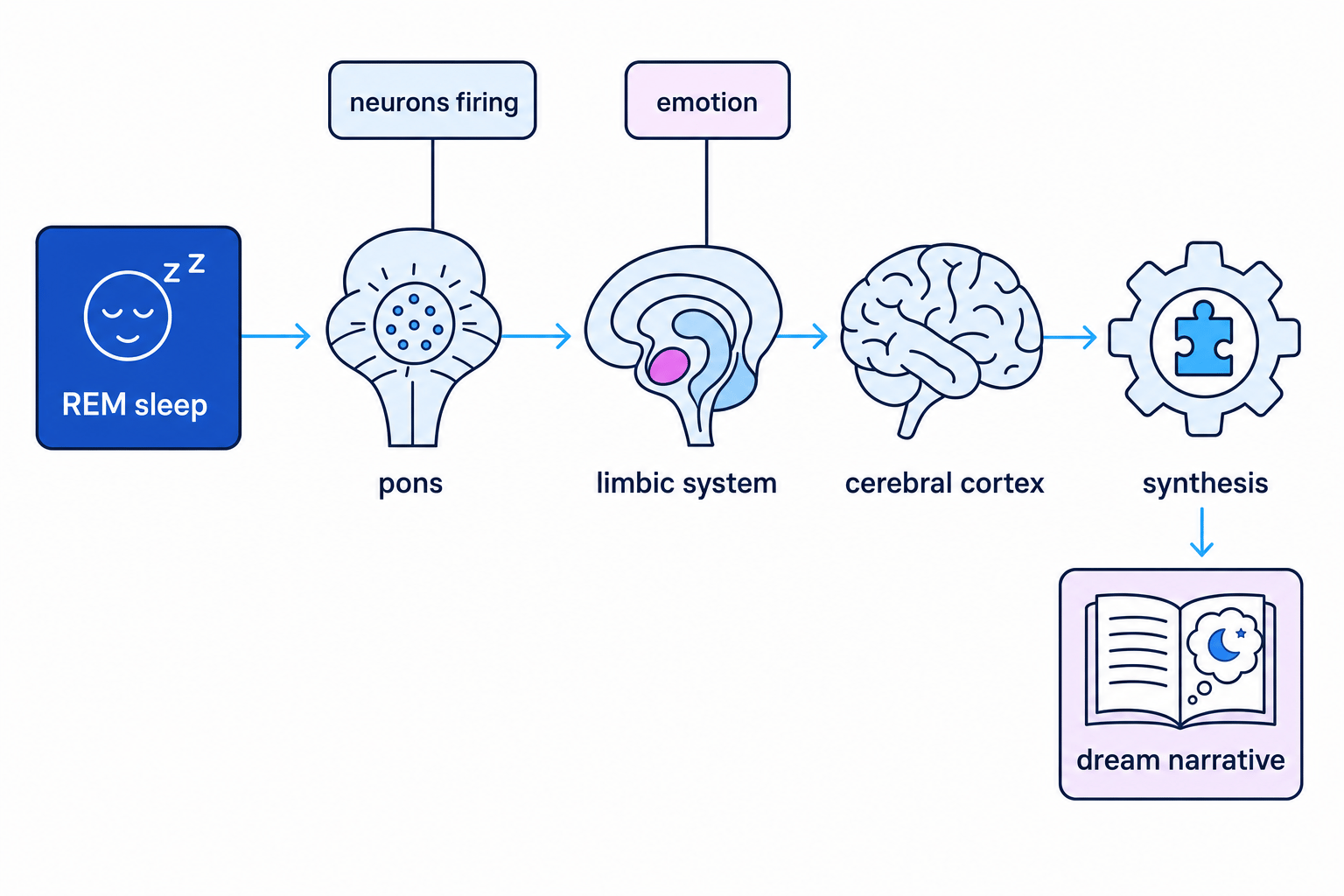
The theory says that during REM sleep, neurons in the pons fire in a random or semi-random way. These signals activate other brain areas, including the limbic system, which helps explain why dreams often feel emotional.
The cerebral cortex then tries to make sense of this activity. It synthesises the random signals into a dream story. This is why dreams can feel meaningful while still being bizarre or illogical.
Key Idea
Activation Synthesis in one sentence
Dreams are the cerebral cortex’s attempt to build a story from brain activity generated during REM sleep.
Applying Activation Synthesis Theory
Example
Explaining a bizarre REM dream
A person is woken from REM sleep and reports dreaming that their classroom turned into a beach, then into a train station, while they felt frightened.
- Link the timing to the theory: because the person was woken from REM sleep, Activation Synthesis Theory would expect vivid dreaming.
- Explain the strange changes: random activity from neurons in the pons could produce disconnected images, such as classroom, beach and train station.
- Explain the emotion: activity in the limbic system could produce the feeling of fear.
- Explain the story-like form: the cerebral cortex synthesises the mixed signals into a dream narrative, even if the result is bizarre.
Common Mistake
Do not stop at the pons
A strong answer does not just say “the pons causes dreams”. You also need the limbic system for emotion and the cerebral cortex for synthesis.
5. Williams et al. (1992): Bizarreness in dreams and fantasies
Background
Williams et al. (1992) investigated differences between the mind when dreaming and when awake. The study tested ideas linked to Activation Synthesis Theory by comparing dream reports with waking fantasies.
Method and procedure
This study used a comparison between reports from sleep and reports from waking imagination. Participants gave accounts of dreams and fantasies, which were then analysed for bizarreness.
The researchers used content analysis, which means turning written or spoken material into categories. For example, a report could be coded for sudden scene changes, impossible events or unusual combinations.
Results and conclusion
Dream reports tended to contain bizarre features, such as discontinuities and unlikely events. Waking fantasies could also be strange, but dream material was useful for studying how the sleeping brain differs from the waking brain.
The findings gave some support to Activation Synthesis Theory because bizarre dream content fits the idea that the cortex is trying to organise unusual brain activity during REM sleep. However, because waking fantasies can also be bizarre, the study does not prove that random brain activation is the only cause of dream bizarreness.
Evaluation of Williams et al. (1992)
A strength is that the study is more scientific than Freud’s case study because it compares conditions and uses categories to analyse dream content. This makes the explanation easier to test.
However, content analysis can still involve some subjectivity. Researchers must decide what counts as “bizarre”, so different coders might not always agree. Dream reports also depend on memory, because the researcher only knows what the participant can remember and describe.
There are also ecological validity issues. If participants sleep in a laboratory or know their reports will be analysed, their sleep and reporting may not be fully natural.
Ethically, this study is usually less sensitive than Freud’s case, but BPS issues still matter: informed consent, right to withdraw, confidentiality, protection from harm, and debriefing. Waking people from sleep could cause tiredness or discomfort, so participants should be protected.
6. Comparing the two explanations
Freud’s theory is mainly psychological: it explains dreams through unconscious wishes, repression and hidden meaning. Activation Synthesis Theory is mainly biological: it explains dreams through REM sleep, the pons, the limbic system and the cerebral cortex.
The key AO3 debate for Activation Synthesis Theory is reductionism versus holism.
Definition
Reductionism and holism
Reductionism explains behaviour by breaking it down into small parts, such as neurons or brain areas. Holism explains behaviour by looking at the whole person, including meaning, emotions, memories and social context.
Activation Synthesis Theory is reductionist because it reduces dreaming to brain activity. This is a strength because it is scientific and links to measurable processes in the brain. But it is also a weakness because it may ignore the personal meaning of dreams.
Freud is more holistic because he considers the dreamer’s life history and emotions. However, this makes the theory harder to test objectively.
Tip
Quick comparison
If the question mentions hidden meaning, repression or wish fulfilment, think Freud. If it mentions REM sleep, pons, limbic system, cortex or random neural activity, think Activation Synthesis Theory.
Exam technique
In the exam
- For AO1, use the correct key terms: manifest content, latent content, repression, REM sleep, pons, limbic system, cerebral cortex and synthesis.
- For AO2, apply the theory directly to the dream scenario rather than describing the theory in general.
- For AO3, evaluate with evidence: Freud (1918) is rich but subjective; Williams et al. (1992) is more scientific but still depends on dream reports and coding.
Self review
Check yourself
- What is the difference between manifest content and latent content?
- How do the pons, limbic system and cerebral cortex each contribute to dreaming in Activation Synthesis Theory?
- Why is subjectivity a problem for Freud’s dream analysis?
Sleep and Dreaming
Guide 2 of 3
You've reached the end
Test yourself on this topic, or move on to the next guide.
How was this guide?