Revision notes for OCR GCSE Psychology Theories and Explanations of Development. Open the guide for explanations and worked examples. Written against the OCR GCSE Psychology (J203) specification, so the content matches what's examinable rather than general Psychology background.
Theories and Explanations of Development
What you'll learn
- How Piaget explained children’s thinking through fixed stages of cognitive development.
- How children change their thinking using assimilation and accommodation.
- How Dweck explains development through fixed and growth mindsets.
- How Willingham challenges learning styles and explains why meaning matters for learning.
Development: the big idea
Development means the way a person changes over time. In this section, we focus mainly on cognitive development, which means changes in thinking, understanding, reasoning and problem-solving.
Definition
Cognitive development
Cognitive development is the development of mental processes such as thinking, memory, reasoning, language and problem-solving.
Piaget’s theory is a cognitive theory because it explains development by looking at how children’s thinking changes as they get older. Dweck and Willingham are learning theories because they focus more on how experience, teaching and beliefs affect development.
Piaget’s Theory of Cognitive Development
Piaget argued that children do not simply know “less” than adults. Instead, he believed children think in qualitatively different ways at different ages.
Definition
Invariant stages
An invariant stage is a stage that happens in a fixed order. Piaget believed all children pass through the same four stages, in the same order, without skipping any.
Piaget’s four stages are usually described as a ladder: children move upwards as their thinking becomes more advanced.
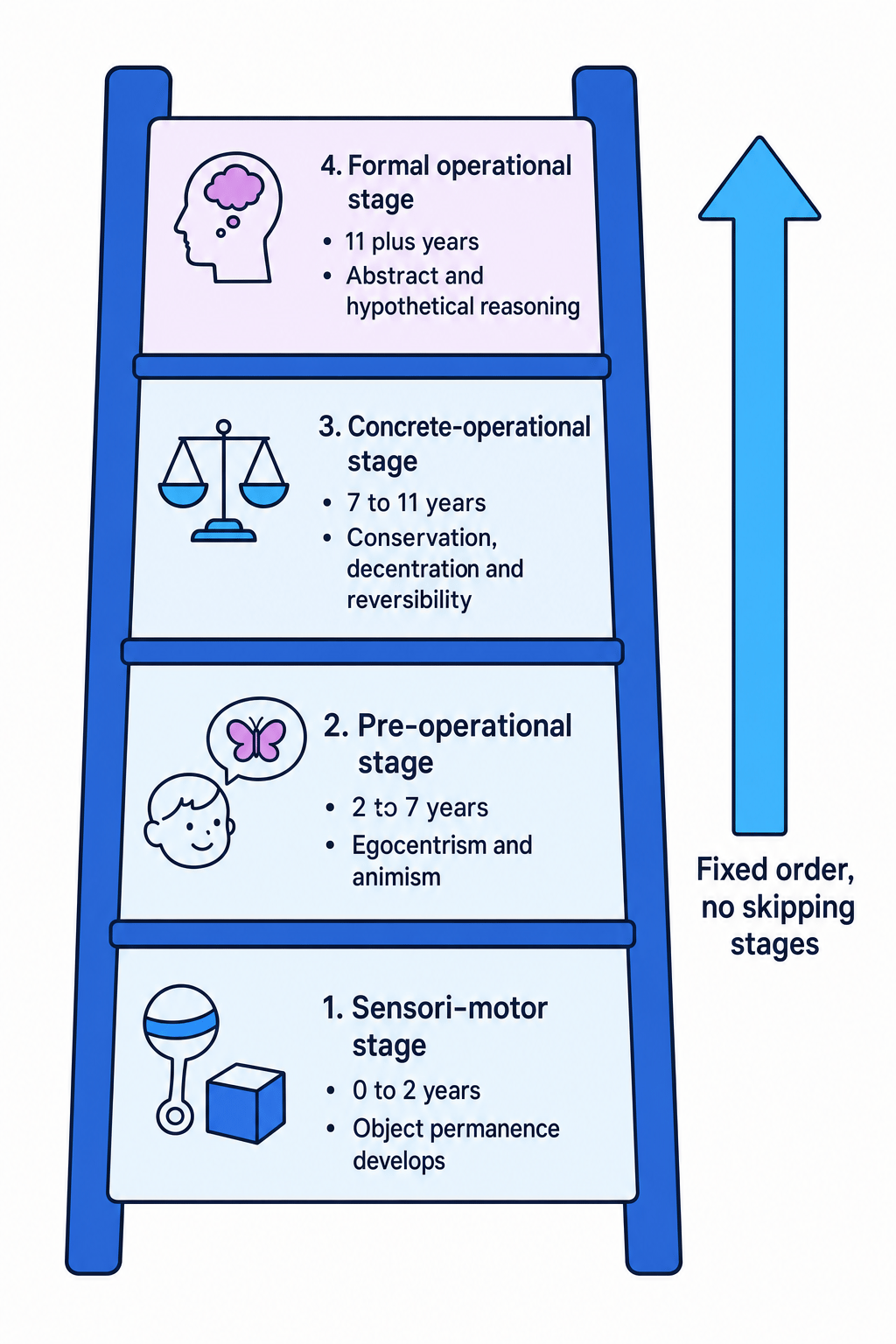
The four stages
| Stage | Approximate age | Key features |
|---|---|---|
| Sensori-motor | 0–2 years | The child learns through senses and actions. Object permanence develops. |
| Pre-operational | 2–7 years | Thinking is symbolic but not yet logical. Children may show egocentrism and animism. |
| Concrete-operational | 7–11 years | Children can think logically about real, physical objects. Conservation, decentration and reversibility develop. |
| Formal operational | 11+ years | Children can use abstract, hypothetical and scientific reasoning. |
Definition
Object permanence, egocentrism and animism
Object permanence means understanding that objects still exist even when they cannot be seen. Egocentrism means finding it difficult to see things from another person’s point of view. Animism means believing that non-living things have feelings or intentions.
Example
Identifying a Piaget stage
A child says, “The moon is following me because it likes me,” and cannot understand that their friend sees a different view of a model village.
- The child is giving a non-living object, the moon, human-like intentions, so this shows animism.
- The child struggles to understand another person’s viewpoint, so this shows egocentrism.
- Animism and egocentrism are both features of the pre-operational stage, so the child is most likely aged around 2–7 years in Piaget’s theory.
Schemas, assimilation and accommodation
Piaget believed children build schemas as they learn about the world.
Definition
Schema
A schema is a mental framework or “packet of knowledge” that helps a person understand something, such as a dog, a classroom, or counting.
Two key processes change schemas:
- Assimilation happens when a child uses an existing schema to understand new information.
- Accommodation happens when a child changes an existing schema, or creates a new one, because the old schema does not fit.
Example
Using assimilation and accommodation
A toddler has a schema for “dog” as a furry animal with four legs. They see a cat and call it “dog”.
- The toddler uses their existing “dog” schema for the cat because it has similar features, such as fur and four legs. This is assimilation.
- An adult explains that this animal is a cat, not a dog, because it meows and behaves differently.
- The toddler changes their understanding and creates or adjusts a “cat” schema. This is accommodation.
Key Idea
Piaget’s view of learning
For Piaget, children actively build understanding. They are not just filled with information by adults; they explore, make mistakes, and adjust their schemas.
Conservation, decentration and reversibility
Piaget believed an important change happens when children enter the concrete-operational stage.
Definition
Conservation
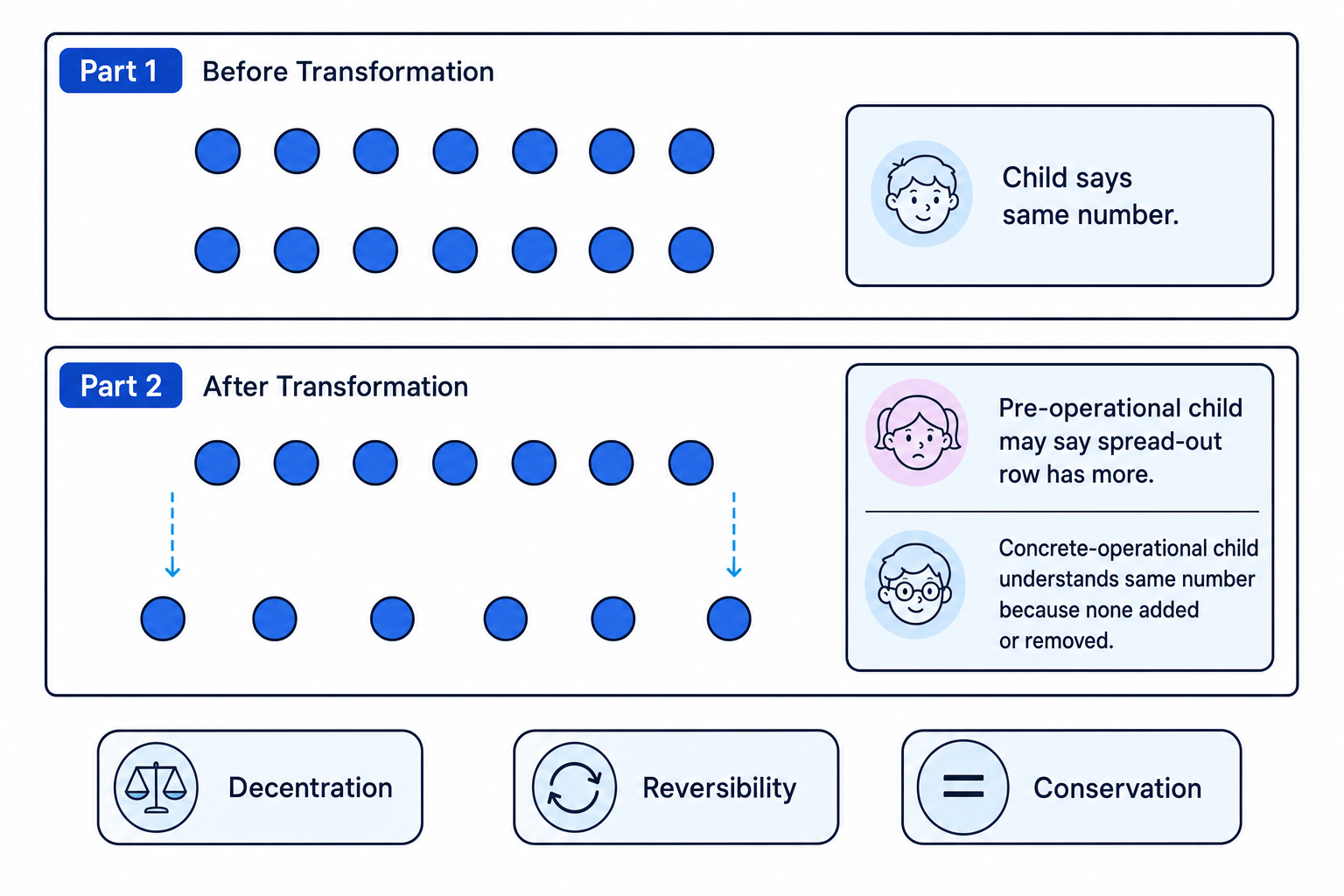
Conservation is the understanding that quantity stays the same even when appearance changes, as long as nothing is added or taken away.
To conserve successfully, a child usually needs:
- Decentration — being able to focus on more than one feature of a situation at the same time.
- Reversibility — understanding that an action can be mentally reversed.
For example, if counters are spread out, a child who can conserve number understands there are still the same number because no counters were added or removed.
Example
Deciding whether conservation has developed
A child sees two equal rows of counters. One row is spread out. The child says the longer row has more counters.
- The child is focusing mainly on the length of the row, not the number of counters, so they are not using decentration.
- The child does not mentally reverse the spreading-out action to realise the counters could be moved back into the original row, so reversibility is not secure.
- Because the child thinks the number changed when only the spacing changed, they have not yet developed conservation of number.
Core study: Piaget (1952) — conservation of number
This prescribed study sits in the developmental area because it investigates how children’s thinking changes with age.
Background and aim
Piaget wanted to test whether children in the pre-operational stage could conserve number. He predicted that younger children would be misled by appearance, while older children would understand that number stays the same.
Method
Piaget used a clinical interview style, where children were asked questions while completing tasks. In the conservation of number task, children were shown two equal rows of counters. After they agreed the rows had the same number, one row was spread out. The child was then asked whether the two rows still had the same number.
Results and conclusion
Younger children, usually in the pre-operational stage, often said the spread-out row had more counters. Older children, usually in the concrete-operational stage, understood the number was still the same.
Piaget concluded that conservation develops as children move into the concrete-operational stage, around age 7.
Evaluation of Piaget’s study and theory
A strength is that Piaget’s work was highly influential. It changed education by encouraging active learning, where children explore and discover rather than just memorise.
However, Piaget may have underestimated children. The task may have confused young children because the adult repeated the question after changing the row. A child might think, “They asked again, so the answer must be different.”
Another weakness is that Piaget’s samples were often small and not very representative. Some of his work involved children from similar cultural backgrounds, so the results may not apply equally to all children.
Common Mistake
Assuming Piaget’s ages are exact
Do not write as if every child suddenly changes on their 7th birthday. Piaget suggested approximate stages, but real children develop at different rates.
Reductionism and holism
Piaget’s theory can be seen as reductionist because it explains complex development mainly through cognitive stages and thinking processes. This may ignore social, emotional, cultural and educational influences.
However, it also has a holistic side because Piaget looked at children as active learners interacting with their environment, not just as passive responders.
Ethics
Using the British Psychological Society’s ethical principles, this kind of study would need parental informed consent, protection from psychological harm, confidentiality, the right to withdraw, and a debrief. The task itself is low risk, but children should not be made to feel embarrassed for giving a “wrong” answer.
Learning theories of development
Learning theories focus on how development is shaped by experience, feedback, teaching and the environment. In this section, the two key theorists are Dweck and Willingham.
Dweck’s Mindset Theory
Dweck argued that a person’s beliefs about intelligence affect their motivation and achievement.
Definition
Fixed and growth mindsets
A fixed mindset is the belief that intelligence and ability are mostly fixed. A growth mindset is the belief that ability can improve through effort, strategies, feedback and persistence.
A student with a fixed mindset may avoid challenges because failure feels like proof they are “not clever”. A student with a growth mindset is more likely to treat mistakes as useful feedback.
Praise for effort
Dweck argued that praise should focus on effort, strategies and improvement, not fixed traits.
Saying “You’re so clever” can encourage a fixed mindset because it links success to a stable trait. Saying “Your revision strategy worked well” encourages the student to repeat useful behaviours.
Example
Choosing helpful praise
A teacher wants to encourage a student after they improve their test score.
- Praise such as “You’re naturally brilliant” focuses on a fixed trait, so it may encourage a fixed mindset.
- Praise such as “Your practice and correction of mistakes helped you improve” focuses on controllable behaviour, so it supports a growth mindset.
- The better praise is the second version because it encourages the student to use effort and strategies again in future.
Common Mistake
Thinking growth mindset means effort alone
Growth mindset is not just “try harder”. It means using effective strategies, learning from feedback and persisting when work is difficult.
Core study: Blackwell et al. (2007) — fixed and growth mindsets
This prescribed study is linked to the developmental area because it investigates how beliefs about intelligence affect students’ academic development over time.
Background and aim
Blackwell, Trzesniewski and Dweck wanted to investigate whether students’ mindsets predicted achievement, and whether teaching a growth mindset could improve motivation and grades.
Method
The research involved school students in the United States, including students making the difficult transition into secondary-level schooling. In one part of the research, students’ beliefs about intelligence were measured and compared with achievement over time.
In the intervention part, one group was taught that the brain can develop and intelligence can grow through learning. A control group received study skills information without the same growth-mindset message.
Results and conclusion
Students with a growth mindset were more likely to show positive motivation and better achievement patterns. In the intervention, the growth-mindset group showed improved motivation and a better pattern of maths grades than the control group.
The researchers concluded that beliefs about intelligence can affect learning, and that teaching a growth mindset can support development.
Evaluation
A strength is that the study has real-world application. It suggests schools can improve motivation by changing the way they talk about learning, effort and mistakes.
Another strength is that it used real school settings and achievement data, which improves ecological validity.
A weakness is that the findings may not generalise to all students, schools or cultures. Also, achievement is affected by many factors, such as teaching quality, home environment, prior knowledge and stress, not only mindset.
Ethics
Using BPS principles, researchers should gain informed consent from students and parents, keep grades and questionnaire answers confidential, allow withdrawal, avoid harm or pressure, and debrief students. The intervention is low risk, but students should not be blamed if their grades do not improve.
Willingham’s Learning Theory
Willingham is a cognitive psychologist who argues that learning depends on how the mind processes information. Two key ideas are especially important for GCSE Psychology: the myth of learning styles and the importance of meaning.
The myth of learning styles
Definition
Learning styles
Learning styles are the idea that students learn best when teaching matches a preferred style, such as visual, auditory or kinaesthetic learning.
Willingham argues that there is not good evidence that teaching students according to a preferred learning style improves learning. A student may prefer videos, discussion or movement, but preference is not the same as effective learning.
Instead, the best method depends on the meaning of the material. For example, learning a map is likely to need a visual format, while learning pronunciation needs sound.
The importance of meaning
Willingham argues that memory is shaped by what you think about. You are more likely to remember material when you understand its meaning and connect it to what you already know.
Key Idea
Meaning matters
According to Willingham, students remember what they think about. Good learning makes students think about the meaning of the material, not just its surface features.
Example
Choosing a learning method by meaning
A student says, “I’m a visual learner, so I’ll only revise Dweck using colourful posters.”
- The topic is about explaining beliefs, motivation and behaviour, so the student needs to think about meaning, not just appearance.
- A poster may help organise the ideas, but it will not be enough if the student only decorates it and does not explain the theory.
- A stronger method would be to make the poster, then add scenario examples showing fixed mindset, growth mindset and effort praise.
Criticisms of learning theories
Learning theories are useful because they have clear applications in schools. Dweck suggests changing praise and feedback. Willingham suggests teaching for meaning rather than matching learning styles.
However, learning theories can overemphasise nurture, meaning the role of experience and environment. They may underplay nature, such as brain development, temperament, inherited ability and biological maturation.
Definition
Nature and nurture
Nature refers to biological and inherited influences. Nurture refers to environmental influences, such as education, parenting, culture and experience.
The best answer is often interactionist: development is shaped by both nature and nurture. For example, a student’s brain development and prior ability matter, but so do feedback, teaching, practice and beliefs about learning.
Exam technique
In the exam
- For Piaget, always link the behaviour in the scenario to a named concept, such as egocentrism, animism, conservation, decentration or reversibility.
- For Dweck, avoid vague answers like “growth mindset is good”. Explain how beliefs affect challenge, effort, feedback and achievement.
- For evaluation, name the debate clearly: Piaget often links to reductionism/holism, while learning theories often link to nature/nurture.
Self review
Check yourself
- What is the difference between assimilation and accommodation?
- Why might a pre-operational child fail a conservation of number task?
- How are Dweck’s and Willingham’s explanations different from Piaget’s?
You've reached the end
Test yourself on this topic, or move on to the next guide.
How was this guide?