Revision notes for OCR GCSE Psychology The Changing Role of Education. Open the guide for explanations and worked examples. Written against the OCR GCSE Psychology (J203) specification, so the content matches what's examinable rather than general Psychology background.
The Changing Role of Education
What you'll learn
- How Piaget’s theory influenced school organisation, teaching methods and ideas about children’s intelligence.
- What key stages, readiness and active learning mean in education.
- How Dweck’s growth mindset and Willingham’s learning theory affect modern teaching.
- How to apply and evaluate these ideas in GCSE Psychology answers.
The big idea: education is not just “telling facts”
In older, more traditional education, the teacher’s role was often seen as passing knowledge to pupils, who memorised and repeated it. Developmental psychology changed this by suggesting that children’s thinking develops over time, so teaching should match how children are able to think.
Key Idea
The changing role of education
Psychology has helped shift education towards lessons that consider the child’s stage of development, motivation, effort, understanding and active involvement in learning.
Piaget’s influence on education
Jean Piaget (1952) argued that children do not simply know “less” than adults. Instead, they think in qualitatively different ways at different ages.
Definition
Qualitatively different
If something is qualitatively different, it is different in type or kind, not just different in amount. Piaget thought a younger child’s thinking works differently from an older child’s thinking.
Piaget’s theory is in the developmental core area because it focuses on how children’s thinking changes with age. His ideas were based on observations and interviews with children, including his own children.
Schemas and intelligence
Definition
Schema
A schema is a mental framework that helps a person organise and understand information, such as a child’s idea of “dog” or “number”.
For Piaget, intelligence was not just a fixed score on a test. It was the child’s ability to adapt to the world by building and changing schemas through experience.
Children develop intelligence by interacting with their environment. This is why Piaget’s theory supports practical, exploratory learning rather than pupils only listening to explanations.
Piaget’s stages and key stages
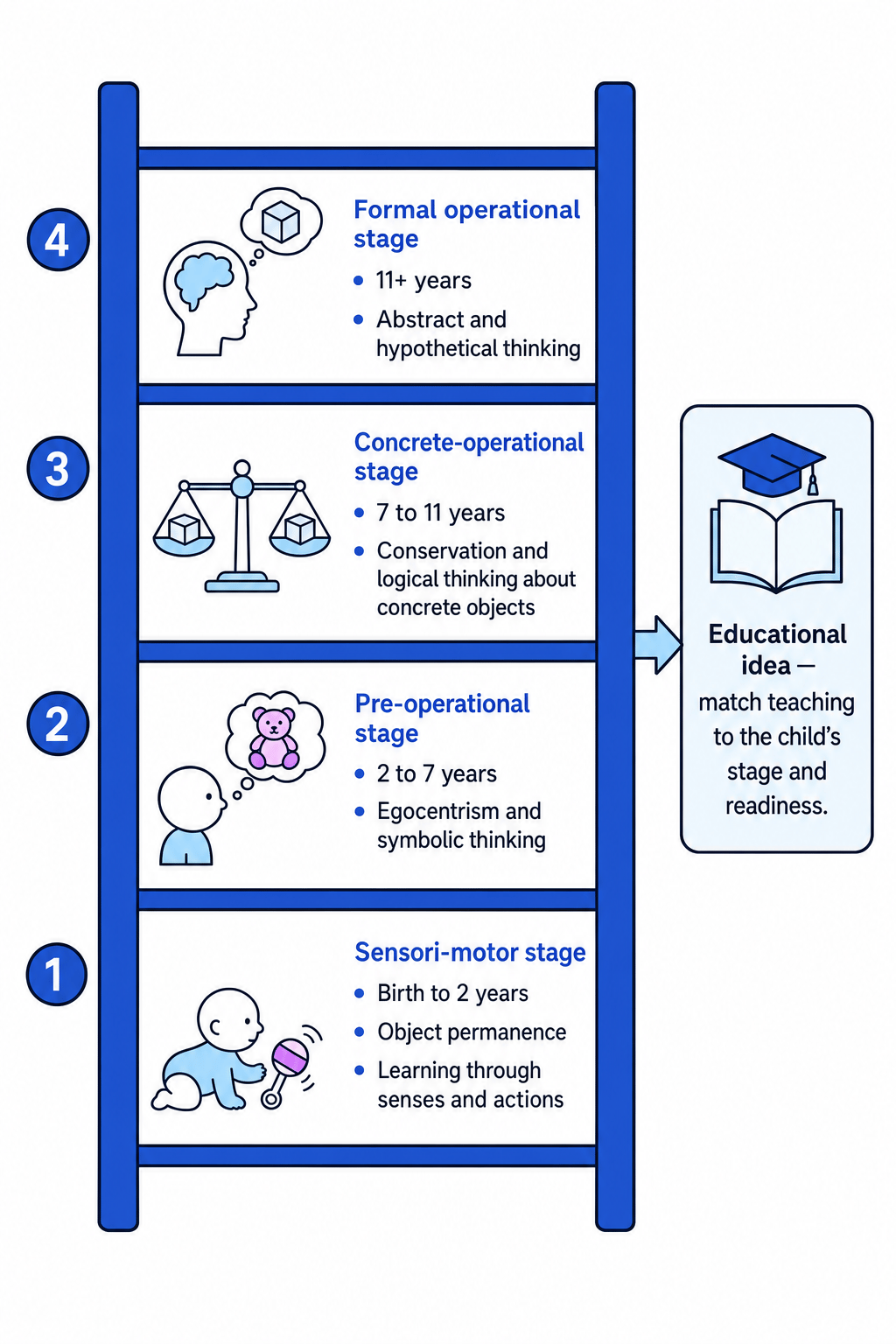
Piaget proposed four invariant stages of cognitive development. Invariant means the stages happen in the same order for everyone, although children may move through them at slightly different speeds.
Definition
Key stage
A key stage is an age-based section of schooling in the National Curriculum, with teaching and assessment expectations designed for that age range.
Piaget did not create the UK key stages, but his theory supports the idea that education should be organised around broad developmental ages. For example, younger children may need concrete, hands-on materials, while older students can handle more abstract thinking.
Readiness
Definition
Readiness
Readiness is the idea that a child is more likely to learn a concept successfully when their cognitive development has prepared them for it.
In Piagetian teaching, a teacher should not force very abstract ideas too early. Instead, they should check what pupils can already understand and then build from there.
For example, a child in the concrete-operational stage can usually reason logically about real objects, but may struggle with abstract ideas that are not linked to examples.
Active learning
Definition
Active learning
Active learning means pupils learn by doing, exploring, questioning and thinking, rather than only receiving information passively from the teacher.
Piaget’s approach encourages discovery tasks, practical equipment, discussion and problem-solving. The teacher becomes more like a guide who sets up experiences that help pupils construct understanding.
Common Mistake
Active does not always mean moving around
Active learning is not just “busy” learning. A quiet pupil solving a problem and explaining their reasoning can be actively learning because they are mentally engaged.
Example
Choosing a Piaget-informed lesson
A teacher wants to teach 6-year-olds that the amount of water stays the same when it is poured into a taller, thinner glass.
- Identify the likely stage: At age 6, many children are in the pre-operational stage, so they may be influenced by appearance and may struggle with conservation.
- Apply readiness: The teacher should not begin with an abstract rule such as “volume is conserved”. The pupils may not yet be ready for that wording.
- Use active learning: The teacher could let pupils pour the same water between containers, compare what changes and discuss what stays the same.
- Link to intelligence: This treats intelligence as developing through experience and schema-building, not as pupils passively copying the teacher’s answer.
Strengths and weaknesses of Piaget’s application
A major strength is that Piaget encouraged child-centred education. This means lessons are planned around the learner’s developmental needs, rather than assuming all pupils can learn in the same way.
It also supports practical classroom strategies: use real objects, allow exploration, and avoid teaching ideas that are too abstract too early.
However, Piaget may have underestimated children’s abilities. Some children can perform better when tasks are explained more clearly or made more familiar. This means using age-based stages too rigidly can be a weakness.
Common Mistake
Treating key stages as exactly Piaget’s stages
Key stages and Piaget’s stages are linked by the idea of age-related development, but they are not the same system. Key stages are part of schooling; Piaget’s stages are a psychological theory.
Learning theories and education
Definition
Learning theory
A learning theory is an explanation of how people acquire knowledge, skills or behaviours.
For this application, you need to know how learning theories affect education through:
- growth mindsets, linked to Dweck
- teaching through meaning, not learning styles, linked to Willingham
Dweck: fixed and growth mindsets
Carol Dweck’s mindset theory argues that people have beliefs about intelligence that affect motivation and achievement.
Definition
Fixed mindset
A fixed mindset is the belief that intelligence is stable and cannot be changed much.
Definition
Growth mindset
A growth mindset is the belief that intelligence can develop through effort, strategies, feedback and learning from mistakes.
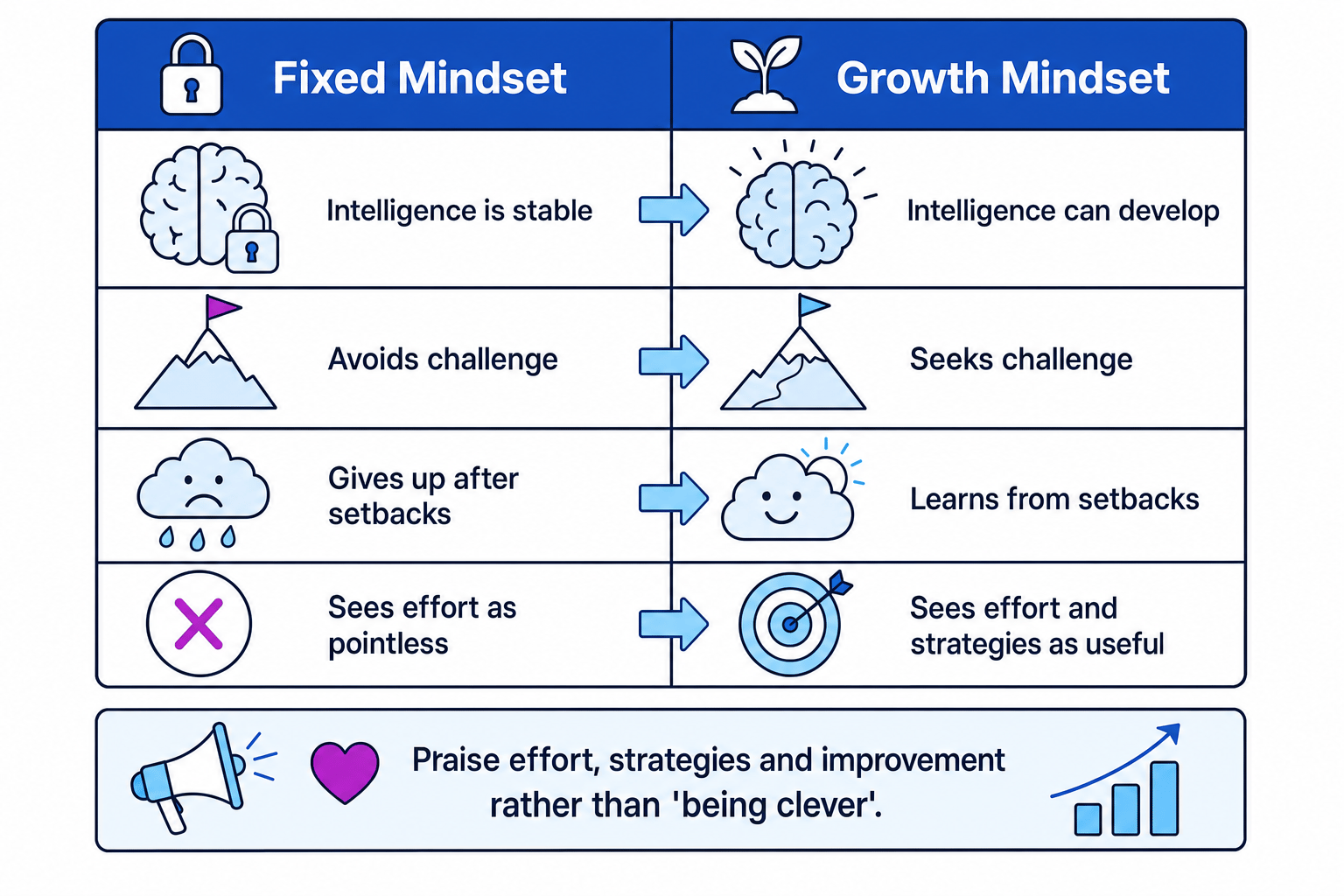
In education, this changes the teacher’s role. Teachers should avoid only praising pupils for “being clever”, because this may encourage fear of failure. Instead, they should praise effort, useful strategies, persistence and improvement.
Research anchor: Blackwell et al. (2007)
Blackwell, Trzesniewski and Dweck (2007) studied students during an important school transition. They found that students with a more growth-based view of intelligence showed better motivation and achievement patterns, especially in maths.
In an intervention, some students were taught that the brain can develop through learning. This supported the use of growth mindset ideas in real classrooms.
A strength is that this has clear real-world application: it can influence feedback, marking and classroom culture. A weakness is that achievement is not caused by mindset alone. Teaching quality, home support, confidence, poverty, special educational needs and school resources also matter.
Common Mistake
Growth mindset is not just ‘try harder’
A good growth mindset message is not “effort magically fixes everything”. It should combine effort with better strategies, feedback, practice and support.
Willingham: teaching through meaning, not learning styles
Daniel Willingham (2009) argued that students learn best when they think about the meaning of material.
Definition
Teaching through meaning
Teaching through meaning means designing lessons so pupils understand ideas, links, reasons and examples, rather than only memorising isolated facts.
Willingham is associated with the phrase: memory is the residue of thought. In simple terms, you tend to remember what you have really thought about.
Learning styles
Definition
Learning styles
Learning styles are the idea that pupils learn best when teaching matches a preferred style, such as visual, auditory or kinaesthetic learning.
Willingham argues that learning styles are not a strong basis for teaching. It is not helpful to label a student as only a “visual learner” or only a “kinaesthetic learner”.
This does not mean teachers should never use diagrams, speech, practical tasks or movement. It means they should choose methods because they fit the content and help pupils understand meaning, not because a pupil has been labelled with a fixed style.
Tip
How to remember Willingham
Use the phrase meaning, not matching: teach the meaning of the topic, rather than trying to match each pupil to a learning-style label.
Example
Choosing feedback and teaching method
A Year 9 student says, “I’m just bad at science, and I’m a visual learner, so written explanations won’t help me.”
- Apply Dweck: The phrase “I’m just bad at science” suggests a fixed mindset, so the teacher should challenge the idea that ability cannot improve.
- Improve the feedback: Instead of saying “You’re clever”, the teacher could say, “Your comparison of the two examples improved because you checked the key differences.”
- Apply Willingham: The teacher should not accept “visual learner” as a fixed label. The issue is whether the method helps the student understand the concept.
- Teach through meaning: A useful lesson might combine a diagram, explanation and practice questions, all focused on why the scientific idea works.
Evaluation and debates
Nature and nurture
Piaget includes both nature and nurture. Maturation of the child’s brain is important, but children also learn through interacting with their environment.
Dweck and Willingham place more emphasis on nurture, because teaching, feedback, effort and classroom experiences can affect learning.
Reductionism and holism
Definition
Reductionism
Reductionism is explaining something complex using one simple factor or process.
A reductionist weakness is that education might be oversimplified if we explain achievement only through stages, mindset or meaningful teaching.
A more holistic view considers the whole child: development, motivation, teaching quality, family background, peer relationships, mental health and school resources.
Free will and determinism
Growth mindset supports free will because it suggests pupils can choose strategies, practise and improve. However, a fully free-will explanation would be too simple because students do not all have the same opportunities, support or confidence.
Ethics in the research evidence
When discussing studies, link to the British Psychological Society’s Code of Ethics and Conduct.
For Piaget (1952), child participants needed protection from harm and adult consent. Modern psychologists might also question how far young children can fully understand consent or the right to withdraw.
For Blackwell et al. (2007), schools and parents would need informed consent, confidentiality and protection from psychological harm. Researchers should also consider fairness if one group receives a potentially helpful mindset intervention and another group does not.
Bringing it together
The changing role of education is about moving from “one-size-fits-all teaching” towards psychology-informed teaching.
Piaget suggests teachers should consider developmental stage, readiness and active learning. Dweck suggests teachers should build growth mindsets through feedback and challenge. Willingham suggests teachers should focus on meaning and understanding, not unsupported learning-style labels.
Exam technique
In the exam
- Name the theory clearly: Use Piaget for key stages, readiness and active learning; Dweck for growth mindset; Willingham for meaning rather than learning styles.
- Apply to the classroom scenario: Say exactly what the teacher should do differently, such as using concrete materials, praising strategies, or teaching the meaning of a concept.
- Evaluate with balance: Give one benefit and one limitation, such as child-centred learning versus rigid stages, or growth mindset benefits versus oversimplifying achievement.
Self review
Check yourself
- How could Piaget’s idea of readiness affect the way a teacher introduces a new topic?
- Why is praising “being clever” different from praising effort, strategy and improvement?
- What does Willingham mean by teaching through meaning rather than learning styles?
You've reached the end
Test yourself on this topic, or move on to the next guide.
How was this guide?