Revision notes for OCR GCSE Psychology Theories and Explanations of Criminal Behaviour. Open the guide for explanations and worked examples. Written against the OCR GCSE Psychology (J203) specification, so the content matches what's examinable rather than general Psychology background.
Theories and Explanations of Criminal Behaviour
What you'll learn
- How Social Learning Theory explains criminal and anti-social behaviour.
- How Eysenck’s Criminal Personality Theory links personality, brain systems and offending.
- What Cooper and Mackie (1986) and Heaven (1996) found.
- How to evaluate these explanations using debates, methods and ethics.
First: what is being explained?
In this topic, psychologists are trying to explain why some people show criminal behaviour or anti-social behaviour. These theories are explanations, not excuses: they help us understand possible causes so that prevention and rehabilitation can be improved.
Definition
Criminal and anti-social behaviour
Criminal behaviour means behaviour that breaks the law. Anti-social behaviour means behaviour that harms, upsets or disrupts other people, even if it is not always a crime.
Social Learning Theory of Criminality
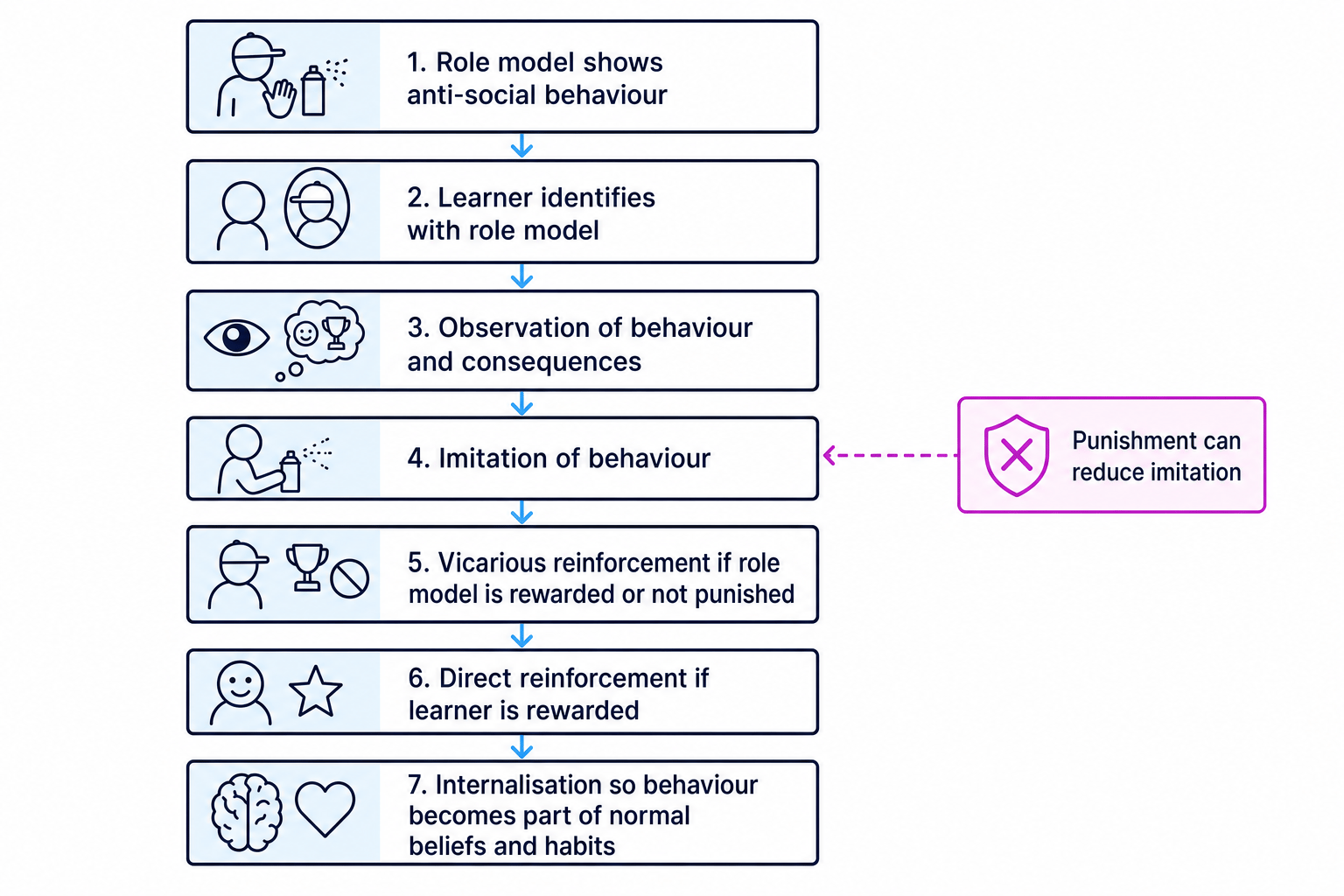
Social Learning Theory, often shortened to SLT, says people can learn behaviour by watching others and noticing what happens to them. In criminal psychology, this means a person may learn offending by observing criminal or anti-social role models.
Definition
Social Learning Theory
Social Learning Theory explains behaviour as learned through identification, observation, imitation, vicarious reinforcement, direct reinforcement and internalisation.
Identification with role models
A role model is someone whose behaviour a person pays attention to and may copy. Identification means feeling similar to, connected to, or impressed by that model.
A teenager may identify with an older sibling, a peer group leader, a celebrity, or a game character. Identification is more likely if the model has status, power, popularity, or appears similar to the observer.
Observation and imitation
Observation means watching what the model does. Imitation means copying that behaviour.
For example, if a young person watches a respected friend shoplift and later tries it themselves, SLT would describe this as imitation after observation.
Vicarious reinforcement
Vicarious reinforcement means seeing someone else rewarded for a behaviour, which makes you more likely to copy it. The reward might be money, praise, popularity, excitement, or simply getting away without punishment.
If the model is punished, imitation may be less likely.
Direct reinforcement and internalisation
Direct reinforcement happens when the person is rewarded for their own behaviour. If they steal and gain money or peer approval, the behaviour may be repeated.
Internalisation means the behaviour becomes part of the person’s normal beliefs and habits. They may start to see anti-social behaviour as acceptable.
Example
Applying social learning to a theft scenario
A student starts stealing from shops after spending time with an older cousin who steals and is admired by friends.
- Identify the role model: the older cousin has status and social approval, so the student may identify with them.
- Apply observation and imitation: the student has watched the cousin steal and then copies the same behaviour.
- Use vicarious reinforcement: the cousin gains admiration and is not punished, so stealing appears rewarding.
- Add direct reinforcement and internalisation: if the student also gains approval or items, stealing may become a repeated habit.
Cooper and Mackie (1986): video games and aggression
Cooper and Mackie’s study is the prescribed research study for SLT in this topic. It belongs mainly to the social area because it investigates how behaviour may be influenced by observed models and social learning.
Background and aim
The researchers wanted to investigate whether playing an aggressive video game would increase aggression in children. In SLT terms, a video game character can act as a symbolic model, meaning a model seen through media rather than in real life.
Method
This was a controlled experiment with children, commonly reported as involving American schoolchildren aged around 9–10. Children were placed into different conditions, such as playing an aggressive video game, playing a non-aggressive video game, or completing a non-game control task.
Afterwards, their behaviour was measured using tasks such as toy choices and observations of aggressive or non-aggressive play.
Results and conclusion
The findings were mixed. There was some evidence that exposure to an aggressive game affected aggressive play, particularly for girls in some measures, but there was not a simple “violent game causes aggression in all children” result.
The study gives some support to SLT because children may copy aggression from media models, but it also shows that individual factors, gender, previous experience and context matter.
Evaluation and ethics
A strength is that the experiment had control over conditions, making it easier to compare the effect of different types of game. A weakness is that playing with toys in a research setting may not represent real criminal behaviour, so ecological validity may be limited.
Ethically, because children were involved, the British Psychological Society’s Code of Ethics and Conduct is important: informed consent from parents/school, protection from psychological harm, confidentiality, the right to withdraw and debriefing should all be considered.
Common Mistake
Not everyone copies what they see
Do not write that SLT says watching aggression automatically causes crime. SLT says imitation is more likely when there is identification and reinforcement.
Criticisms of Social Learning Theory
SLT is useful because it explains why offending may be more common in certain peer groups, families, neighbourhoods or media environments. It also has real-world applications: changing role models and rewards can help reduce anti-social behaviour.
However, SLT is mainly a nurture explanation because it focuses on learning from the environment. In the nature/nurture debate, critics argue that it underestimates biological factors such as temperament, brain functioning or inherited personality traits.
It also struggles with individual differences: two people may see the same aggressive model, but only one copies it.
Eysenck’s Criminal Personality Theory
Hans Eysenck proposed Criminal Personality Theory in 1964 and developed it further in 1992. His Biological Basis of Personality from 1967 argued that personality has a biological basis in the nervous system.
Definition
Personality
Personality means a person’s fairly stable pattern of thinking, feeling and behaving. Eysenck believed some personality traits make criminal behaviour more likely, especially when combined with poor socialisation.
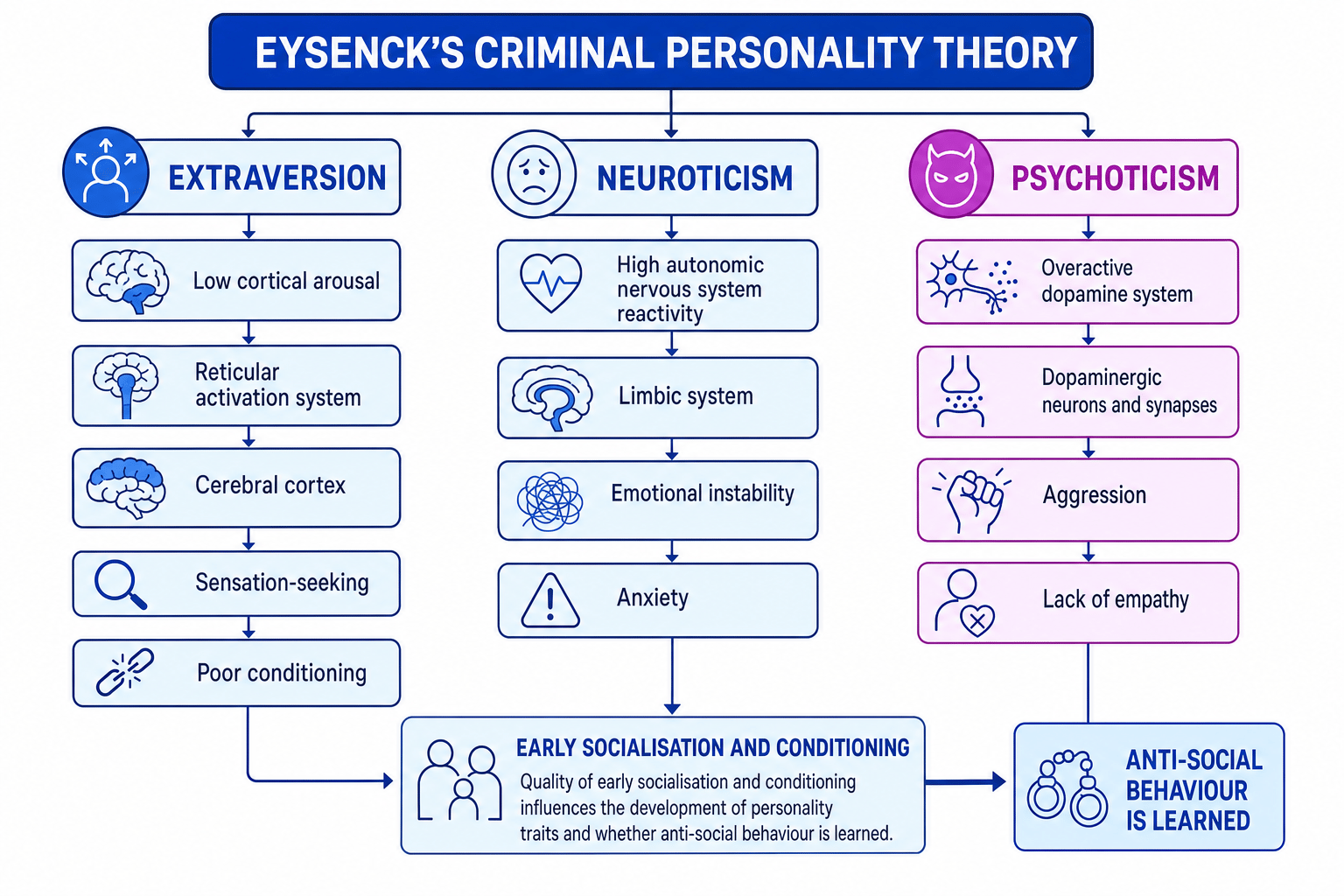
Eysenck focused on three dimensions: extraversion, neuroticism and psychoticism. You may also see extraversion spelt as extroversion.
The biological basis: brain, arousal and behaviour
The central nervous system, or CNS, is made up of the brain and spinal cord. Eysenck argued that CNS arousal affects cognitions, meaning mental processes such as attention, decision-making and learning from consequences.
Arousal level means how alert or activated the nervous system is. Eysenck thought people with a “criminal personality” may be harder to condition because their nervous system responds differently to punishment and reward.
Extraversion and low arousal
An extravert is outgoing, sensation-seeking and sociable. Eysenck linked extraversion to low arousal in the cerebral cortex, the outer part of the brain involved in thinking and awareness.
The reticular activation system helps regulate alertness. If this system leaves the cortex under-aroused, the person may seek excitement and stimulation. This could make risky or anti-social behaviour more tempting.
Neuroticism, the ANS and the limbic system
Neuroticism means emotional instability, anxiety and strong reactions to stress.
The autonomic nervous system, or ANS, controls automatic bodily responses such as heart rate and sweating. The limbic system is involved in emotion. Eysenck argued that highly neurotic people have a reactive ANS and emotional system, so they may respond strongly to fear, anger or frustration.
Psychoticism, synapses and dopamine
Psychoticism means traits such as aggression, coldness, impulsiveness and lack of empathy. Eysenck linked high psychoticism to a higher risk of criminal behaviour.
A synapse is the gap between two neurons, where chemical messages are passed. Dopamine is a neurotransmitter involved in reward and motivation. Dopaminergic neurons are neurons that use dopamine.
In psychoticism, an overactive dopamine system may make rewards feel especially powerful, increasing the chance that risky or aggressive behaviour is repeated.
Key Idea
Eysenck’s main claim
Eysenck argued that people high in extraversion, neuroticism and especially psychoticism may be more likely to offend because their biology makes them harder to condition and more drawn to reward or risk.
Early socialisation and conditioning
Socialisation is the process of learning society’s rules and expectations. Conditioning is learning through association and consequences, such as rewards and punishments.
Eysenck believed children develop a conscience through conditioning. If anti-social behaviour is consistently punished and pro-social behaviour is rewarded, the child learns guilt and self-control. But if a child is hard to condition, or early discipline is inconsistent, they may not internalise social rules effectively.
Example
Using personality traits to explain offending
A teenager often takes risks, gets into fights, shows little guilt and does not seem to learn from detentions.
- Link risk-taking to extraversion: low cortical arousal may lead them to seek excitement and stimulation.
- Link fighting and lack of guilt to psychoticism: aggression and low empathy fit this trait.
- Link repeated behaviour to poor conditioning: punishments like detentions may not strongly shape their behaviour.
- Keep the explanation balanced: Eysenck would see personality as a risk factor, not proof that the person must become criminal.
Heaven (1996): delinquency, personality and self-esteem
Heaven’s study is the prescribed research study for Eysenck’s theory. It belongs mainly to the individual differences area because it investigates how people differ in personality and delinquent behaviour.
Background and aim
Delinquency means minor or youth offending, often measured through self-report. Heaven investigated links between delinquency, extraversion, psychoticism and self-esteem in adolescents.
Method
The study used questionnaires with school-age participants, including measures of personality traits, self-esteem and self-reported delinquent acts. This is a correlational method, meaning it looks for relationships between variables but cannot prove cause and effect.
Results and conclusion
Heaven found that higher psychoticism was linked with higher self-reported delinquency. Extraversion and self-esteem were also considered, with self-esteem helping to explain some differences in delinquency.
This supports Eysenck’s view that personality is related to offending, especially psychoticism. However, it does not prove that personality causes crime.
Evaluation and ethics
A strength is that questionnaires can collect data from many participants fairly efficiently. A weakness is that self-report data may be affected by lying, exaggeration or embarrassment, especially when asking about delinquency.
Ethically, confidentiality and anonymity are very important because participants may report rule-breaking. Informed consent, right to withdraw, protection from psychological harm and debriefing should also be considered.
Criticisms of Eysenck’s theory
A strength of Eysenck’s theory is that it connects personality to biological systems, making it more scientific and testable. Heaven (1996) gives some support, especially for psychoticism.
However, the theory can be criticised for being reductionist because it may reduce complex crime to personality and biology. It can also sound deterministic, as if people with certain traits are destined to offend.
The issue of individual differences is important: many people high in extraversion or neuroticism never become criminals, and many offenders may not fit Eysenck’s personality profile. Social factors such as poverty, peer pressure, family life and opportunity also matter.
Common Mistake
Personality is not a verdict
Do not say “high extraversion means someone is a criminal.” A personality trait may increase risk in Eysenck’s theory, but it does not guarantee offending.
Exam technique
In the exam
- For AO1, use the named terms: identification, imitation, vicarious reinforcement, direct reinforcement, internalisation, extraversion, neuroticism and psychoticism.
- For AO2, link the scenario directly to the theory: explain who the role model is, what reward is seen, or which personality trait is being shown.
- For AO3, evaluate with evidence and debates: Cooper and Mackie supports SLT partly, Heaven supports Eysenck partly, but both theories have limits such as individual differences, ethics and nature/nurture issues.
Self review
Check yourself
- How does vicarious reinforcement make imitation more likely?
- Which brain systems did Eysenck link to extraversion, neuroticism and psychoticism?
- Why does Heaven (1996) support Eysenck’s theory only partly?
You've reached the end
Test yourself on this topic, or move on to the next guide.
How was this guide?