Revision notes for OCR GCSE Psychology The Changing Nature of Punishment. Open the guide for explanations and worked examples. Written against the OCR GCSE Psychology (J203) specification, so the content matches what's examinable rather than general Psychology background.
The Changing Nature of Punishment
What you'll learn
- How punishment, deterrence and rehabilitation are different aims of the justice system.
- How restorative justice and positive role models can reduce offending and increase pro-social behaviour.
- The effects of prisons, community sentences and fines on criminal and anti-social behaviour.
- How to evaluate punishments using strengths, weaknesses and real-world application.
The big picture: why punishment has changed
In the past, punishment was often mainly about making offenders “pay” for what they had done. Modern criminal justice still includes punishment, but it increasingly asks a psychological question:
What is most likely to stop this person offending again?
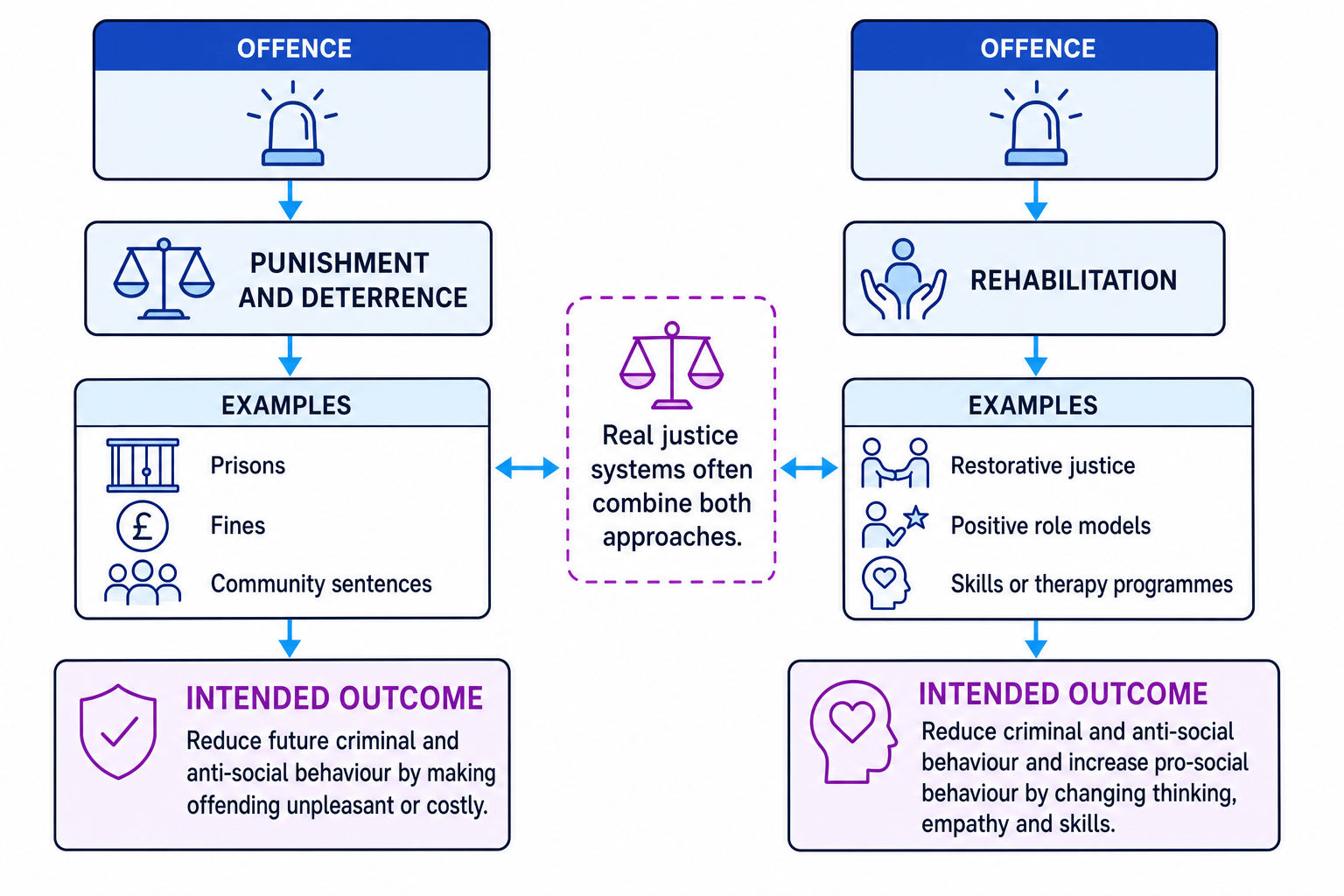
That means GCSE Psychology looks at two broad approaches:
- Punishment and deterrence: making crime unpleasant, costly or risky.
- Rehabilitation: changing the offender’s behaviour, thinking and social influences so they are less likely to reoffend.
The key change is not that punishment has disappeared. It is that modern systems often combine punishment with rehabilitation.
Definition
Key terms
Criminal behaviour is behaviour that breaks the law. Anti-social behaviour is behaviour that harms, disrupts or upsets other people or the wider community, such as vandalism or threatening behaviour. Pro-social behaviour is helpful, responsible or socially positive behaviour, such as cooperating, apologising, repairing harm or obeying rules.
Punishment and deterrence
What is punishment?
Punishment is a consequence given after an offence to reduce the chance of that behaviour happening again. In criminal justice, this might mean prison, a fine or unpaid work.
Punishment can have several aims:
- Retribution: society says the offender deserves a penalty.
- Protection of the public: stopping the offender harming others, especially through prison.
- Deterrence: discouraging future offending.
Definition
Deterrence
Deterrence means discouraging crime by making the costs of offending seem greater than the benefits. Specific deterrence targets the individual offender. General deterrence aims to warn other people not to offend.
When might deterrence work best?
Deterrence is more likely to work when the punishment is:
- Certain: the person believes they are likely to be caught.
- Swift: the punishment follows soon after the offence.
- Proportionate: the punishment seems fair for the offence.
- Meaningful: the consequence matters to the offender.
Deterrence may work less well if the offence is impulsive, influenced by peers, linked to addiction, or if the offender does not believe they will be caught.
Key Idea
Punishment alone has limits
Punishment can tell someone what not to do, but it does not always teach them what to do instead. That is why rehabilitation focuses on changing future behaviour, not just punishing past behaviour.
Prisons
A prison sentence, also called a custodial sentence, removes an offender’s freedom by placing them in prison.
How prisons may reduce offending
Prisons can reduce criminal or anti-social behaviour in several ways:
- Incapacitation: while in prison, the offender cannot commit crimes in the community.
- Specific deterrence: prison may be unpleasant enough to discourage that person from reoffending.
- General deterrence: seeing that crime can lead to prison may deter others.
- Rehabilitation programmes: prisons may offer education, drug treatment, anger management or therapy.
Evaluation of prisons
A strength of prison is that it can protect the public from dangerous offenders. This is especially important for serious violent offences.
However, prison can also have weaknesses. Offenders may meet other criminals and learn more anti-social behaviour. Prison can also damage family relationships, employment chances and mental health, which may make life after release harder. If the causes of offending are not addressed, the person may reoffend.
Common Mistake
Assuming prison is only punishment
Prison is not only about punishment. It can also protect the public and provide rehabilitation. In evaluation answers, explain both the intended benefits and the possible negative effects.
Community sentences
A community sentence is a punishment served in the community rather than in prison. It may include unpaid work, curfews, supervision by probation services, treatment programmes or rehabilitation activities.
Community sentences are usually used when the offence is not serious enough for prison, or when the court believes the person can be managed safely in the community.
How community sentences may reduce offending
Community sentences can reduce criminal and anti-social behaviour because they combine consequences with support. For example, an offender might have to complete unpaid work to make amends, attend drug treatment, and meet regularly with a probation officer.
They can also increase pro-social behaviour because the offender may practise responsibility, punctuality, cooperation and repairing harm.
Evaluation of community sentences
A strength is that they can target the causes of offending while allowing the person to keep a job, education or family support. This may make rehabilitation more realistic.
A weakness is that they require monitoring. If the offender does not comply, the sentence may be less effective. Some members of the public may also see community sentences as “too soft”, even though they can be demanding and restrictive.
Fines
A fine is a financial penalty. The offender has to pay money as punishment for breaking the law.
Fines are often used for less serious offences. They can be quick, simple and cheaper than prison. They may deter people because offending becomes financially costly.
However, fines have limitations. They may not address the psychological or social causes of offending. A wealthy offender may not be strongly deterred by a small fine, while a poorer offender may be heavily affected. This creates a fairness issue.
Tip
Evaluating fines
A good evaluation point is inequality: the same fine may not have the same psychological impact on different offenders. Always link this to deterrence.
Rehabilitation
What is rehabilitation?
Rehabilitation focuses on changing the offender so they are less likely to offend again. It tries to reduce criminal and anti-social behaviour by addressing causes such as poor problem-solving, negative peer influence, lack of empathy, addiction, anger or low educational skills.
Definition
Rehabilitation
Rehabilitation means helping an offender change their behaviour, thinking or circumstances so they are less likely to reoffend and more likely to show pro-social behaviour.
Rehabilitation does not mean “letting offenders off”. The offender can still receive a punishment, but the system also tries to prevent future harm.
How rehabilitation increases pro-social behaviour
Rehabilitation can teach and encourage behaviours such as:
- Taking responsibility for harm caused.
- Understanding victims’ feelings.
- Managing anger or impulses.
- Solving problems without aggression.
- Building work skills or education.
- Choosing friends and role models who support lawful behaviour.
This links to social learning theory, which says behaviour can be learned by observing and imitating others. In the Criminal Psychology topic, social learning ideas connect to research such as Cooper and Mackie (1986), where exposure to aggressive media was studied as a possible influence on children’s aggression. The application here is positive: if people can learn anti-social behaviour, they may also learn pro-social behaviour from better models and rewards.
Example
Applying rehabilitation to vandalism
A teenager has repeatedly vandalised bus shelters with friends. A rehabilitation plan could include restorative justice, unpaid repair work and a mentor.
- Identify the behaviour that needs changing: the criminal behaviour is vandalism, and the anti-social behaviour includes damaging public property and gaining approval from peers.
- Choose interventions that target the causes: restorative justice can help the teenager understand the effect on local people, while a positive mentor can model better ways to gain status.
- Explain the likely psychological effect: if the teenager feels empathy, takes responsibility and receives approval for repairing harm, pro-social behaviour becomes more rewarding than vandalism.
- Evaluate the limitation: if the teenager returns to the same peer group and is rewarded for offending, the rehabilitation may be less effective unless peer influence is also addressed.
Restorative justice
Restorative justice is a rehabilitation approach where the offender is encouraged to understand and repair the harm caused by their offence. This may involve a meeting with the victim, a written apology, reparation work, or an agreement about how to put things right.
Definition
Restorative justice
Restorative justice is a process that brings together the offender, victim and sometimes the community to discuss the harm caused and agree how the offender can make amends.
How restorative justice may reduce offending
Restorative justice can reduce reoffending because it encourages the offender to:
- Face the real impact of their behaviour.
- Develop empathy for the victim.
- Take responsibility instead of minimising the offence.
- Repair harm through apology, repayment or useful action.
It can also help victims because they may be able to ask questions, explain the impact of the offence, and regain some control.
Ethical issues in restorative justice
Restorative justice must be handled carefully. Victims should not be pressured to take part. Offenders should not be forced into a meeting without proper preparation. A trained facilitator should reduce the risk of psychological harm.
This links to the British Psychological Society’s ethical principles, especially informed consent, protection from harm, right to withdraw, confidentiality and debriefing.
Common Mistake
Restorative justice is not suitable for every case
Restorative justice may be inappropriate if there is a high risk of intimidation, trauma or further harm. It works best when participation is voluntary, safe and carefully managed.
Positive role models
A role model is someone whose behaviour is observed and may be imitated. A positive role model demonstrates pro-social behaviour, such as self-control, responsibility, empathy and respect for rules.
Positive role models might include mentors, youth workers, sports coaches, older peers, family members, ex-offenders who have changed their lives, or staff in rehabilitation programmes.
Why role models matter
If an offender has mainly seen anti-social behaviour rewarded, they may learn that aggression, theft or rule-breaking brings status. A positive role model can show a different pattern: cooperation, effort and lawful behaviour can also bring approval and success.
This is especially useful for young offenders because peer approval and identity can strongly influence behaviour.
Key Idea
Role models change what gets rewarded
Positive role models are not just “nice people”. They provide examples of pro-social behaviour and show that responsibility, self-control and cooperation can lead to approval and success.
Comparing the approaches
Punishment and rehabilitation are not opposites. A court might give a community sentence that includes punishment, unpaid work, supervision and rehabilitation. A prison sentence may also include education or therapy.
The best response depends on:
- The seriousness of the offence.
- The risk to the public.
- The offender’s age and needs.
- The victim’s safety and wishes.
- Whether the sentence is likely to reduce reoffending.
Example
Matching a response to the offence
Two offenders have broken the law. Person A has committed repeated shoplifting linked to drug use. Person B has committed a serious violent assault and is considered a danger to the public.
- Compare the level of harm and risk: Person B presents a higher immediate risk to public safety, while Person A’s offending seems linked to an underlying problem.
- Choose a likely response: Person B may require prison for protection and deterrence; Person A may benefit from a community sentence with drug treatment and supervision.
- Link the response to behaviour change: prison can incapacitate Person B, while treatment may reduce Person A’s reason for stealing.
- Evaluate both choices: prison may not rehabilitate unless support is offered, and community treatment may fail if Person A does not comply.
AO3 evaluation: debates and wider issues
Reductionism and holism
A punishment-only approach can be reductionist if it treats crime as simply a choice that needs a penalty. A more holistic approach considers wider influences such as learning, peers, addiction, mental health, poverty, education and family background.
However, a holistic approach can be harder to apply because different offenders need different support.
Free will and determinism
Punishment often assumes free will: the offender chose to commit the crime and deserves a consequence. Rehabilitation often recognises deterministic influences: behaviour may be shaped by environment, learning, addiction or poor role models.
A balanced answer should say that offenders can be held responsible while still receiving help to change.
Real-world application
This topic is very applied. The justice system must make practical decisions about safety, fairness, cost and reoffending. Strong exam answers avoid saying one approach is always best. Instead, explain when and why an approach may work.
Exam technique
In the exam
- Define the key term first: punishment, deterrence, rehabilitation, restorative justice, community sentence or fine.
- For AO2 scenarios, link the sentence to the offender’s behaviour: explain how it would reduce criminal or anti-social behaviour or increase pro-social behaviour.
- For AO3, give a balanced judgement: include at least one strength, one limitation and a clear link to reoffending, public safety or fairness.
Self review
Check yourself
- How is rehabilitation different from punishment?
- Why might restorative justice increase empathy and responsibility?
- What is one strength and one weakness of prisons, community sentences and fines?
You've reached the end
Test yourself on this topic, or move on to the next guide.
How was this guide?