Revision notes for OCR GCSE Psychology The Development of Treatments. Open the guide for explanations and worked examples. Written against the OCR GCSE Psychology (J203) specification, so the content matches what's examinable rather than general Psychology background.
The Development of Treatments
What you'll learn
- How antipsychotics and antidepressants can reduce symptoms by changing communication between neurons.
- How psychotherapy helps people with schizophrenia and clinical depression through thoughts, behaviour, coping and support.
- How neuropsychology uses tests and brain imaging to study mental health problems.
- How to evaluate treatments using strengths, weaknesses, ethics and the key debates.
Big picture: what is a treatment?
A treatment is an intervention used to reduce symptoms, improve daily functioning, or help someone manage a mental health problem. In GCSE Psychology, you need to know treatments for schizophrenia and clinical depression.
A diagnosis is the process of deciding which disorder best matches a person’s symptoms. Doctors may use the ICD, the International Classification of Diseases, which is a manual for classifying physical and mental health conditions.
Definition
Mental health treatment
A mental health treatment aims to reduce psychological symptoms and improve wellbeing, for example by changing brain chemistry, changing unhelpful thoughts and behaviours, or improving coping and support.
The two disorders in this section
Schizophrenia
Schizophrenia is a serious mental disorder involving a loss of contact with reality, often called psychosis. It can include:
- Positive symptoms: experiences added to normal functioning, such as hallucinations or delusions.
- Negative symptoms: reductions in normal functioning, such as low motivation, social withdrawal or flat emotion.
- Cognitive difficulties: problems with attention, memory, planning or decision-making.
Clinical depression
Clinical depression is more than ordinary sadness. It involves persistent low mood and/or loss of pleasure, usually with changes in sleep, appetite, energy, concentration, self-worth and daily functioning.
Key Idea
Treatment depends on the problem
Drug treatments are usually linked to biological explanations, while psychotherapy is linked to psychological explanations. In real life, people often receive a combination.
Brain basics: neurons, synapses and neurotransmitters
A neuron is a nerve cell that carries messages around the brain and nervous system. A synapse is the tiny gap between two neurons. A neurotransmitter is a chemical messenger that crosses the synapse and attaches to receptor sites on the next neuron.
This matters because drug treatments for schizophrenia and depression work by changing how neurotransmitters act at synapses.
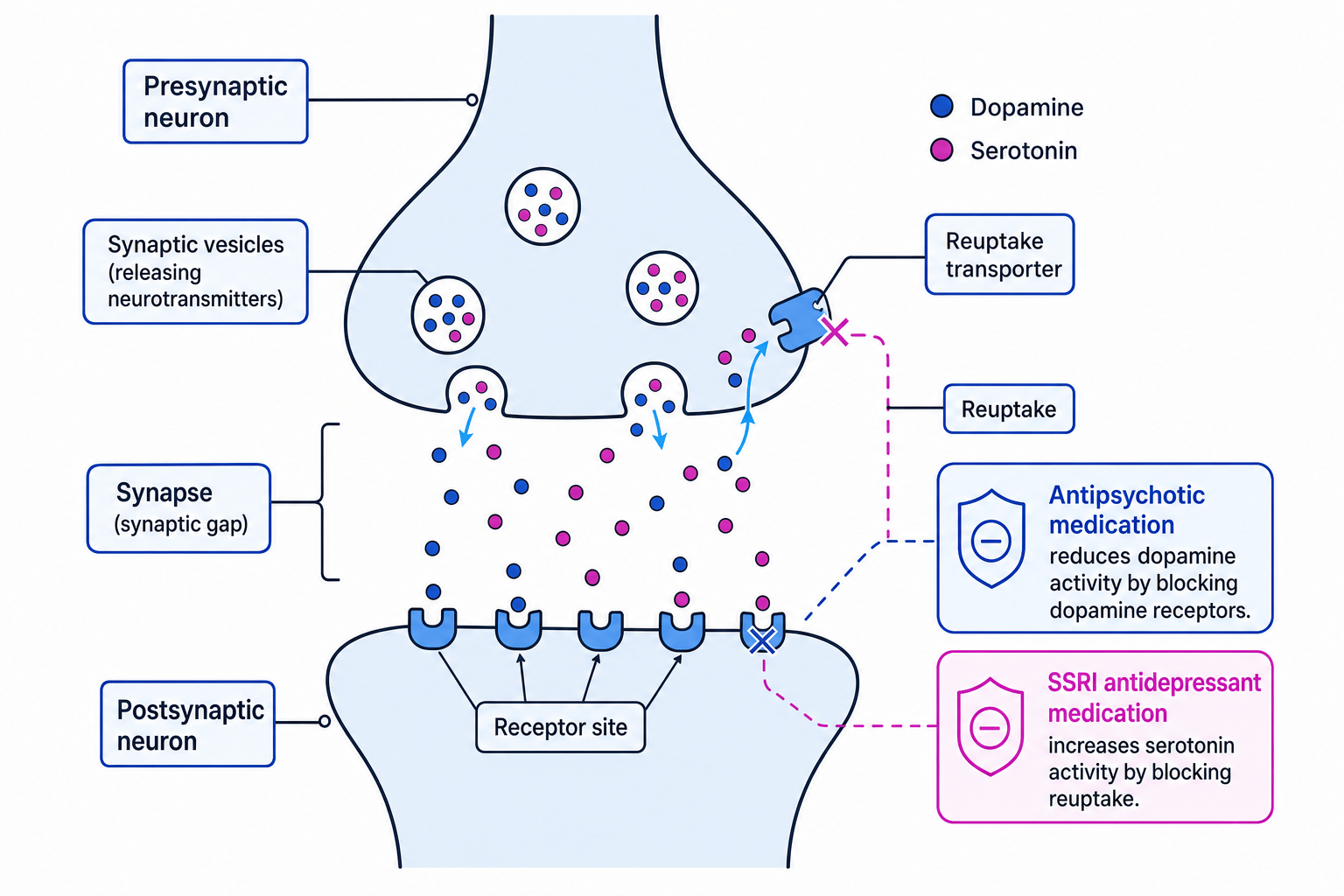
How a synapse works
- The first neuron releases neurotransmitters into the synapse.
- The neurotransmitters fit into receptor sites on the second neuron.
- This affects whether the next neuron passes on the message.
- Some neurotransmitters are taken back into the first neuron; this is called reuptake.
Drug treatments
Antipsychotics for schizophrenia
Antipsychotics are drugs used to reduce psychotic symptoms, especially hallucinations and delusions. Many antipsychotics reduce the action of dopamine, a neurotransmitter involved in motivation, reward and movement.
One biological explanation of schizophrenia is that some symptoms are linked to overactivity in dopamine systems. Antipsychotics can block dopamine receptor sites, so dopamine has less effect on the postsynaptic neuron.
This can reduce the intensity of hallucinations and delusions, making it easier for the person to function and engage with other support.
Antidepressants for clinical depression
Antidepressants are drugs used to reduce symptoms of clinical depression. A common type is an SSRI, which stands for selective serotonin reuptake inhibitor.
Serotonin is a neurotransmitter involved in mood regulation, sleep and emotion. SSRIs block serotonin reuptake, so more serotonin remains available in the synapse for longer. This can gradually improve mood and motivation.
Antidepressants do not usually work instantly. They often take time, and the person may need monitoring for side effects.
Example
Choosing a drug treatment
- A scenario says that Maya hears voices and believes strangers are sending her secret messages. These are positive symptoms of schizophrenia, not just ordinary worry or sadness.
- Because schizophrenia is linked to abnormal dopamine activity, an antipsychotic is the relevant drug treatment rather than an antidepressant.
- The antipsychotic would reduce dopamine’s effect at receptor sites, so messages linked to hallucinations and delusions may become less intense.
- A balanced answer would add that side effects should be monitored and that medication may work best alongside psychotherapy or social support.
Evaluating drug treatments
Strengths:
- Drugs can reduce severe symptoms, sometimes allowing the person to return to school, work or relationships.
- They are based on biological evidence about neurotransmitters and the brain.
- They can be combined with psychotherapy.
Weaknesses:
- They can have side effects, such as tiredness, weight change, nausea or movement problems.
- They may treat symptoms without addressing life events, thoughts or relationships.
- Some people stop taking medication because of side effects or because they feel better.
Common Mistake
Medication is not a cure button
Do not write that antipsychotics “cure schizophrenia” or antidepressants “make someone happy instantly”. They aim to reduce symptoms and improve functioning, but effects vary between individuals.
Psychotherapy
Psychotherapy means treatment using psychological methods, usually through talking with a trained therapist. It aims to improve mental health by changing thoughts, behaviours, coping strategies and relationships.
Psychotherapy for clinical depression
A common psychotherapy for depression is CBT, or cognitive behavioural therapy. CBT is based on the idea that thoughts, feelings and behaviours influence each other.
For depression, CBT may help a person:
- identify negative automatic thoughts, such as “I always fail”;
- challenge these thoughts using evidence;
- develop more balanced thoughts;
- increase helpful behaviours, such as exercise, social contact or routine.
This can improve mental health because the person learns skills that reduce low mood and avoidance.
Psychotherapy for schizophrenia
For schizophrenia, psychotherapy does not simply “talk someone out of” hallucinations or delusions. Instead, it can help the person understand and manage symptoms.
Examples include:
- CBT for psychosis: helps the person examine beliefs, reduce distress and develop coping strategies.
- Family therapy: helps relatives communicate calmly, reduce stress and support treatment.
- Psychoeducation: teaches the person and family about symptoms, relapse warning signs and coping.
Psychotherapy can help people stay engaged with medication, manage stress and reduce relapse risk.
Example
Applying CBT to depression
- A scenario says that Sam has stopped seeing friends, avoids schoolwork and thinks, “I’m useless at everything.” This shows a link between negative thoughts and withdrawn behaviour.
- CBT would target the belief by helping Sam test the evidence for and against it, rather than accepting it as fact.
- The therapist might also use behavioural activation, such as planning one manageable activity, to break the cycle of avoidance and low mood.
- Improvement would be shown by better daily functioning, not just by Sam saying one positive sentence in a session.
Evaluating psychotherapy
Strengths:
- It can give people long-term coping skills.
- It is more holistic than drug treatment because it considers thoughts, behaviour, family and social life.
- It avoids direct biological side effects.
Weaknesses:
- It can take time and requires motivation, trust and regular attendance.
- During severe psychosis or very severe depression, the person may find therapy hard to engage with.
- Access can be limited by waiting lists or availability of trained therapists.
Neuropsychology: studying the brain and behaviour
Neuropsychology is the study of the relationship between the brain and behaviour. In schizophrenia and clinical depression, neuropsychologists study how brain differences may relate to symptoms, thinking skills and treatment needs.
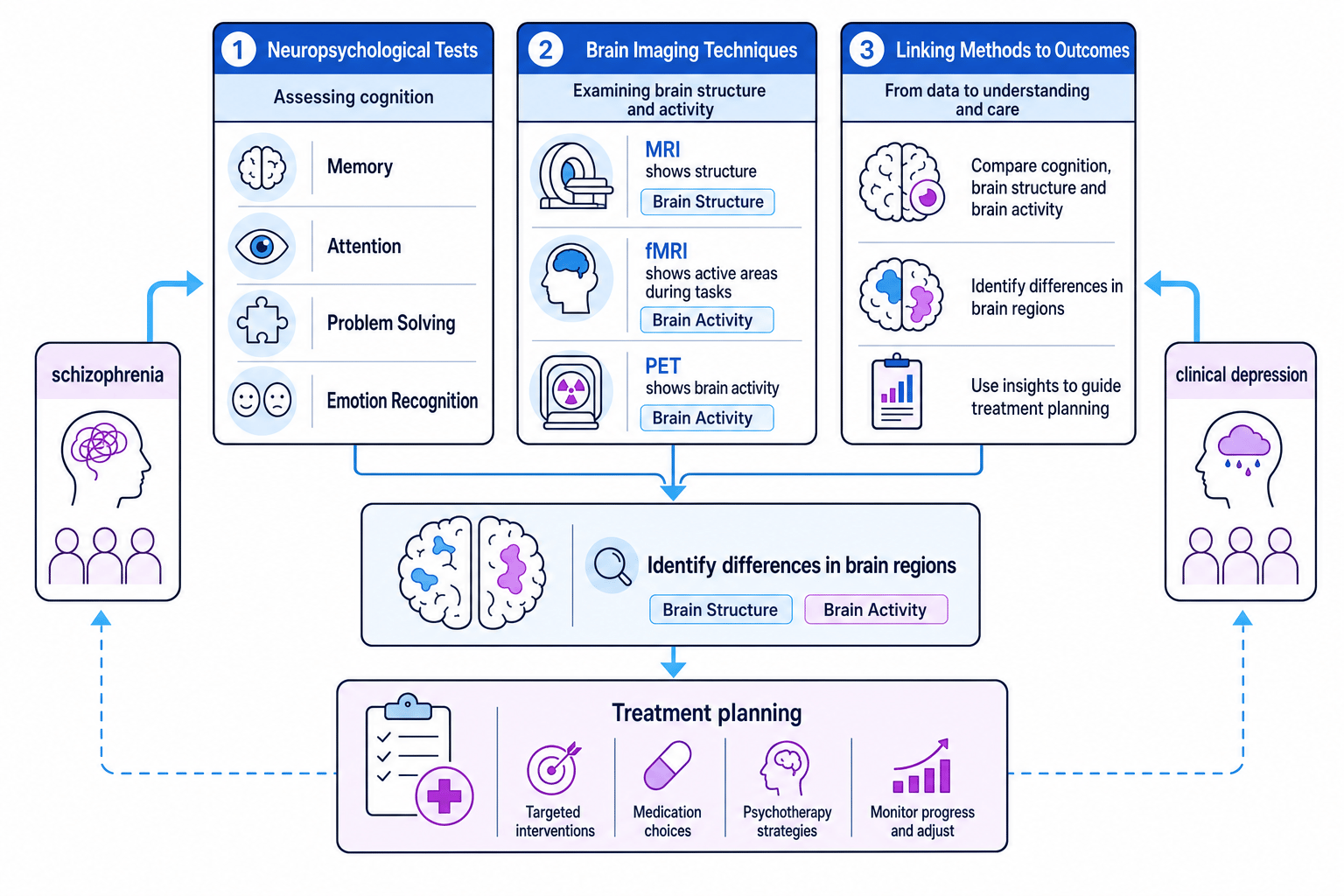
A visual overview of neuropsychology methods helps you see how tests and scans work together.
Neuropsychological tests
Neuropsychological tests are tasks used to measure thinking skills. They might assess:
- memory;
- attention;
- problem-solving;
- planning;
- emotion recognition;
- decision-making.
For schizophrenia, tests may show difficulties with executive functions, such as planning and flexible thinking. For clinical depression, tests may show problems with concentration, memory or negative bias in interpreting information.
These tests can help professionals plan treatment. For example, if a person has attention difficulties, therapy may need shorter tasks, written reminders or extra repetition.
Brain imaging techniques
Brain imaging means using technology to create pictures of brain structure or brain activity.
- MRI shows brain structure, such as the size and shape of brain areas.
- fMRI shows which brain areas are more active during a task by tracking blood flow changes.
- PET scans show brain activity using a tracer and can be used to study chemical activity or metabolism.
In schizophrenia, imaging may be used to study areas linked with thinking, emotion and dopamine pathways. In clinical depression, imaging may be used to study areas involved in mood regulation and emotional processing.
Tip
Structure versus activity
If the question says structure, think MRI. If it says activity during a task, think fMRI or PET.
Research link: Daniel, Weinberger, Jones et al. (1991)
Daniel, Weinberger, Jones et al. (1991) is useful here because it links schizophrenia, cognitive testing and brain imaging. The study used brain-imaging methods while people with schizophrenia completed cognitive tasks, showing how neuropsychology can connect symptoms with patterns of brain functioning.
Ethically, research like this must follow the British Psychological Society’s Code of Ethics and Conduct: informed consent, protection from harm, right to withdraw, confidentiality and debriefing are all important, especially when participants may be vulnerable.
Overall evaluation and debates
Reductionism and holism
Reductionism means explaining a complex behaviour using one narrow level of explanation. Drug treatment can be criticised as reductionist because it focuses heavily on neurotransmitters.
Holism means considering the whole person. Psychotherapy is more holistic because it can include thoughts, emotions, relationships and coping skills.
Nature and nurture
Nature refers to biological influences, such as genes and brain chemistry. Nurture refers to experience and environment. Drug treatments focus more on nature, while psychotherapy often focuses more on nurture. A balanced view says both can matter.
Free will and determinism
Determinism is the idea that behaviour is controlled by factors outside the person’s choice, such as brain chemistry. Drug treatments can seem deterministic. Psychotherapy gives more room for free will, because it helps people make choices and practise coping skills, although symptoms can still limit how much control someone feels.
Key Idea
Best evaluation point
The strongest answers usually avoid saying one treatment is simply “best”. Instead, explain that effectiveness depends on the disorder, symptom severity, side effects, access to therapy and the individual person.
Exam technique
In the exam
- For AO1, name the treatment and describe how it works: antipsychotics affect dopamine, antidepressants affect serotonin, psychotherapy changes thoughts, behaviour and coping.
- For AO2, apply the treatment to the symptoms in the scenario: hallucinations suggest schizophrenia; persistent low mood and loss of pleasure suggest clinical depression.
- For AO3, give a balanced evaluation: include effectiveness, side effects, individual differences, ethics, and whether the approach is reductionist or holistic.
Self review
Check yourself
- How do antipsychotics and SSRIs affect communication across a synapse?
- Why might psychotherapy be useful for both clinical depression and schizophrenia?
- What is the difference between neuropsychological tests and brain imaging techniques?
Psychological Problems
Guide 4 of 4
You've reached the end
Test yourself on this topic, or move on to the next guide.
How was this guide?