Revision notes for OCR GCSE Psychology Key Concepts. Open the guide for explanations and worked examples. Written against the OCR GCSE Psychology (J203) specification, so the content matches what's examinable rather than general Psychology background.
Key Concepts
What you'll learn
- What social influence means in GCSE Psychology.
- How conformity and majority influence affect behaviour.
- How collective and crowd behaviour can be pro-social or anti-social.
- How obedience involves following orders from authority figures.
Big picture: what is social influence?
Social influence is about how other people affect what you think, feel or do. Sometimes the influence comes from a group, sometimes from a crowd, and sometimes from a person with authority.
Definition
Social influence
Social influence is the effect that other people have on an individual’s behaviour, thoughts or emotions.
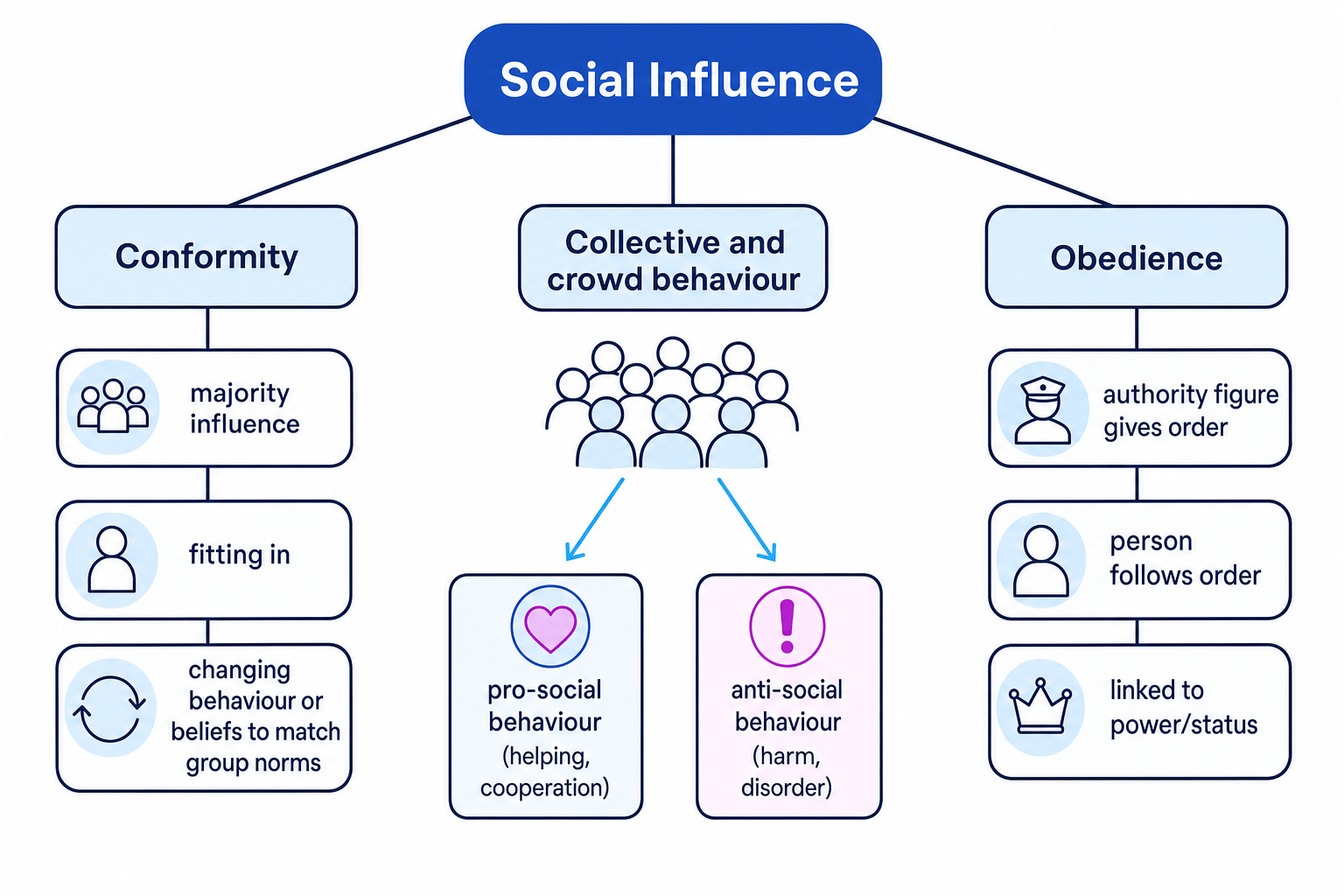
In this topic, you need to be able to describe three key forms of social influence:
- Conformity — changing behaviour to fit in with a group.
- Collective and crowd behaviour — people behaving as part of a larger group or crowd.
- Obedience — following an order from an authority figure.
Key Idea
The core difference
Ask: where is the pressure coming from?
If it is from a group, think conformity. If it is from a crowd situation, think collective/crowd behaviour. If it is from an authority figure giving an order, think obedience.
Conformity
What is conformity?
Conformity happens when a person changes their behaviour, opinions or beliefs so they fit in with a group.
Definition
Conformity
Conformity is changing behaviour, attitudes or beliefs to match those of a group or social norm.
A social norm is an unwritten rule about what is seen as normal or acceptable in a group or society. For example, waiting quietly in a queue is a social norm in many situations.
Conformity can be obvious, such as wearing the same style of clothing as your friends. It can also be more subtle, such as laughing at a joke you do not find funny because everyone else is laughing.
Majority influence
Majority influence is a type of conformity where the pressure comes from the larger number of people in a group.
Definition
Majority influence
Majority influence is when a person changes their behaviour, view or decision because most people in the group behave, think or decide differently from them.
The majority does not have to physically force the person. The pressure can simply come from not wanting to stand out, look foolish or be rejected.
Why conformity matters
Conformity is not always negative. It can help groups run smoothly. For example, if everyone follows classroom expectations, lessons are calmer and safer.
However, conformity can become harmful if someone goes along with behaviour they know is wrong, such as bullying another student because a friendship group expects it.
Example
Identifying conformity
A student called Aisha privately thinks a film is boring. In a group chat, six of her friends say it is amazing. Aisha then posts, “Yes, it was brilliant!” because she does not want to be the only one disagreeing.
- Identify the source of pressure: the pressure comes from Aisha’s friendship group, especially because most people in the group agree.
- Check whether there is an order: nobody directly commands Aisha to agree, so this is not obedience.
- Decide whether her behaviour changes to match the group: Aisha changes her public response from “boring” to “brilliant”.
- Conclude that this is conformity, specifically majority influence, because she goes along with the group view.
Common Mistake
Conformity is not just copying
Do not call every similar behaviour conformity. If two people independently choose the same answer, that is not necessarily conformity. You need evidence that the person was influenced by the group.
Collective and crowd behaviour
What is collective behaviour?
Collective behaviour refers to behaviour that happens when people act as part of a group.
Definition
Collective behaviour
Collective behaviour is behaviour shown by people acting together as part of a group, crowd or mass social situation.
A crowd is a gathering of people in the same place. Crowd behaviour is a type of collective behaviour where people’s actions are influenced by being in that crowd.
Examples include:
- fans cheering at a football match
- people clapping at a concert
- protesters marching together
- shoppers rushing during a sale
- people helping each other after an accident
Pro-social behaviour
Pro-social behaviour is helpful behaviour that benefits others or society.
Definition
Pro-social behaviour
Pro-social behaviour is behaviour intended to help, support or benefit other people.
Examples include:
- helping someone who has fallen over in a crowd
- cooperating during an evacuation
- donating supplies after a disaster
- standing up against unfair treatment
Pro-social crowd behaviour is important because it shows that crowds are not automatically dangerous or irrational. A crowd can encourage cooperation, kindness and shared responsibility.
Anti-social behaviour
Anti-social behaviour harms, disrupts or threatens others.
Definition
Anti-social behaviour
Anti-social behaviour is behaviour that causes harm, distress, disruption or damage to other people or the wider community.
Examples include:
- vandalism
- violence
- intimidation
- throwing objects at an event
- joining in with looting or disorder
Anti-social crowd behaviour may happen when people feel less personally responsible, when strong emotions spread through the crowd, or when the group norm becomes aggressive.
Example
Classifying crowd behaviour
At a busy train station, a passenger collapses. Several strangers form a space around the person, one calls emergency services, and another gives first aid.
- Decide whether this is a crowd situation: the behaviour happens in a busy public place with many people present.
- Look at the direction of the behaviour: the strangers are helping and protecting the passenger.
- Compare it with the definitions: helping and cooperation fit pro-social behaviour, not anti-social behaviour.
- Conclude that this is pro-social crowd behaviour because people in the crowd act together in a helpful way.
Common Mistake
Crowds are not always anti-social
A common weak answer says crowds “make people behave badly”. That is too simple. Crowd behaviour can be pro-social or anti-social, depending on the situation, group norms and behaviour being encouraged.
Obedience
What is obedience?
Obedience happens when a person follows a direct order from someone with authority.
Definition
Obedience
Obedience is following an order or command from an authority figure.
An authority figure is someone who has power, status or control in a situation. This could be a teacher, police officer, parent, employer, doctor or military officer.
Definition
Authority figure
An authority figure is a person who is seen as having legitimate power to give instructions or make decisions in a particular situation.
Obedience can be useful. For example, following a fire officer’s instructions during an emergency can keep people safe.
But obedience can also be dangerous if people follow harmful or unethical orders without questioning them.
Obedience and authority
The key feature of obedience is that the person is responding to an order. This makes it different from conformity, where the pressure usually comes from a group rather than a direct command.
For example:
- If your friends all choose one answer and you change yours to match, that is conformity.
- If a teacher tells you to move seats and you do, that is obedience.
In the wider Social Influence topic, you will see how authority can be strengthened by factors such as uniform and status. The core study by Bickman (1974) is linked to obedience and authority, but the key concept for now is simple: obedience involves following an order from someone seen as having power.
Example
Distinguishing obedience from conformity
A security guard tells a group of shoppers to leave an area because the shop is closing. One shopper was planning to stay longer, but leaves after the guard’s instruction.
- Identify the source of pressure: the pressure comes from the security guard, not from the other shoppers.
- Check whether the person has authority: a security guard has a recognised role linked to rules and safety in that setting.
- Decide whether there is a direct order: “leave this area” is an instruction, not just a group norm.
- Conclude that this is obedience because the shopper follows an order from an authority figure.
Tip
Quick test for obedience
Use the question: “Was there a direct order from someone with authority?” If yes, obedience is likely. If no, consider conformity or crowd behaviour instead.
Comparing the three key concepts
These concepts can overlap in real life, but for GCSE answers you need to separate them clearly.
| Concept | Main source of influence | What happens? | Simple example |
|---|---|---|---|
| Conformity | A group or majority | A person changes behaviour to fit in | Agreeing with friends even though you privately disagree |
| Collective/crowd behaviour | A crowd or large group situation | People act together in a shared context | Fans chanting together at a match |
| Pro-social crowd behaviour | A crowd encouraging helpful action | People cooperate or help others | Strangers helping during an emergency |
| Anti-social crowd behaviour | A crowd encouraging harmful action | People cause harm or disruption | People vandalising property during disorder |
| Obedience | An authority figure | A person follows an order | Following a police officer’s instruction |
Key Idea
AO2 application shortcut
In scenario questions, do not just name the concept. Link your answer to the details: who influenced whom, how the influence happened, and what behaviour changed.
AO3: Thinking critically about social influence
Social influence can be useful
Social influence helps society function. Conformity can support shared rules, crowd behaviour can produce cooperation, and obedience can help people respond safely in emergencies.
For example, if people obey evacuation instructions during a fire alarm, this can prevent panic and reduce harm.
Social influence can be harmful
The same processes can also lead to negative outcomes. Conformity may make someone join in with bullying. Crowd behaviour may become anti-social. Obedience may lead someone to follow an unfair or harmful order.
This is why psychologists are interested in the conditions that make people resist pressure as well as the conditions that make people give in.
The freewill/determinism debate
Social influence is linked to the freewill/determinism debate.
Definition
Freewill and determinism
Freewill means people can make their own choices. Determinism means behaviour is caused by factors outside the person’s control, such as social pressure, authority or group norms.
A deterministic explanation might say a person behaved badly because the crowd influenced them or because an authority figure told them to. However, people are not robots. They can sometimes resist pressure, question orders and make independent choices.
A balanced GCSE answer can say that social influence affects behaviour, but it does not remove all personal responsibility.
Common Mistake
Forgetting individual choice
Avoid writing as if people automatically obey or conform every time. Social influence increases pressure, but individuals may still resist, especially if they have confidence, support from others, or believe the order is wrong.
Real-world applications
Understanding social influence can help in real life. Schools, police, event organisers and public health campaigns can use this knowledge to encourage safer and more helpful behaviour.
For example:
- encouraging positive group norms can reduce bullying
- clear authority in emergencies can improve safety
- promoting pro-social crowd behaviour can support cooperation at large events
Exam technique
In the exam
- Define the key term first if the question asks you to describe conformity, obedience or crowd behaviour.
- Use the source of pressure to tell concepts apart: group pressure means conformity, a crowd setting means collective behaviour, and a direct order from authority means obedience.
- For AO2 scenarios, quote or paraphrase details from the situation and explain why they match the concept.
- For AO3, give a balanced point: social influence can be helpful, but it can also lead to harmful behaviour.
Self review
Check yourself
- What is the difference between conformity and obedience?
- How can crowd behaviour be pro-social as well as anti-social?
- Why is majority influence a type of conformity?
You've reached the end
Test yourself on this topic, or move on to the next guide.
How was this guide?