Revision notes for OCR GCSE Psychology Key Concepts. Open the guide for explanations and worked examples. Written against the OCR GCSE Psychology (J203) specification, so the content matches what's examinable rather than general Psychology background.
Key Concepts
What you'll learn
- How psychologists define mental health, including the mental health continuum.
- The difference between prevalence and incidence, with current patterns by age, gender and sexual orientation.
- How attitudes to mental health in the UK have changed since the 1959 Mental Health Act.
- How significant mental health problems can affect individuals and wider society.
What is mental health?
Mental health is about more than “not having a disorder”. It includes how you think, feel, cope with stress, form relationships and manage everyday life.
A person can have good mental wellbeing while still facing difficulties, and someone may have a diagnosis but be coping well with support. This is why psychologists often avoid a simple “ill or well” view.
Definition
Mental health
Mental health refers to a person’s emotional, psychological and social wellbeing: how they think, feel, behave, cope with stress and interact with others.
Ways of defining mental health
There are several ways mental health can be defined:
- Absence of mental illness: a person is mentally healthy if they do not meet the criteria for a mental health disorder.
- Positive wellbeing: a person has self-esteem, emotional balance, purpose and satisfying relationships.
- Ability to function: a person can manage everyday demands such as school, work, sleep, hygiene and relationships.
- The mental health continuum: mental health is seen as a range, not a fixed category.
Key Idea
Not a simple label
Mental health is not just “normal” versus “abnormal”. People can move along a continuum depending on stress, support, life events, treatment and coping strategies.
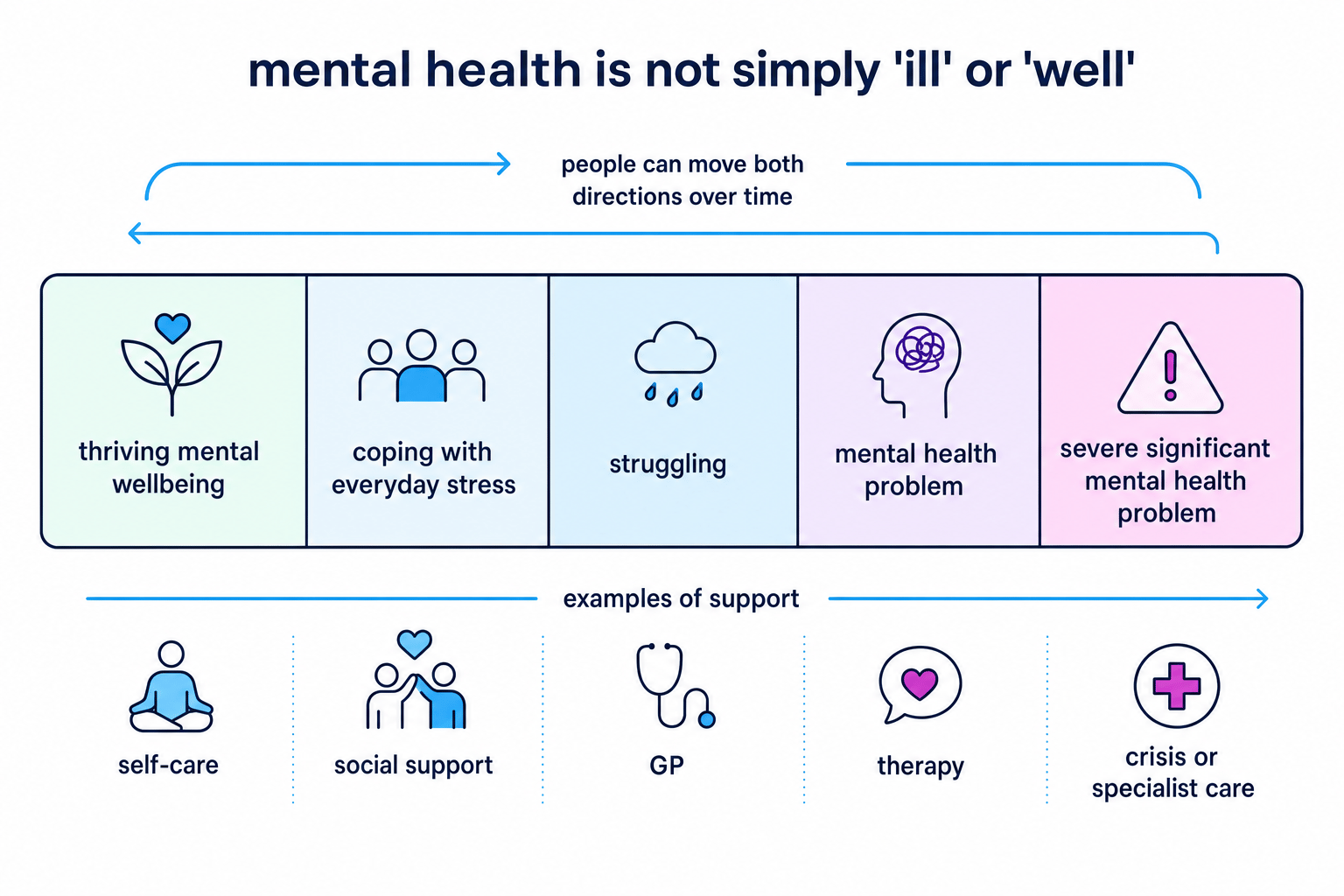
The mental health continuum
The mental health continuum places people somewhere between positive mental wellbeing and severe/significant mental health problems. It is useful because it shows that mental health can change over time.
For example, a student may usually cope well, then move towards “struggling” during exams, then return to better wellbeing after rest, support and reduced pressure.
Example
Placing someone on the continuum
A student called Maya is sleeping badly, avoiding friends and feeling anxious most days, but she still attends school and completes most work.
- Compare Maya’s difficulties with ordinary stress. Her anxiety, sleep problems and withdrawal are lasting “most days”, so this is more than a normal short-term bad mood.
- Check her level of functioning. She is still attending school and completing most work, so she is not at the most severe end of the continuum.
- Place her in a balanced position. Maya may be best described as struggling or possibly experiencing a mental health problem, depending on how long the symptoms continue and how much distress they cause.
Common Mistake
Thinking diagnosis is the whole story
Do not assume that a diagnosis automatically means a person cannot function. Many people with mental health problems live, study and work successfully, especially with support.
Prevalence and incidence
You need to understand two key measurement terms.
Definition
Prevalence and incidence
Prevalence means how common a mental health problem is in a population at a particular time or over a period. Incidence means the number of new cases appearing over a period of time.
A simple way to remember it:
- Prevalence = how widespread it is.
- Incidence = how many new cases occur.
Current prevalence of mental health problems
Statistics vary depending on the survey, age group, questions asked and definition used. For GCSE, focus on the overall patterns rather than memorising too many exact numbers.
Useful current patterns include:
- Around 1 in 4 adults in the UK are often estimated to experience a mental health problem in a given year.
- Around 1 in 6 adults in England report symptoms of a common mental health problem, such as anxiety or depression, in a typical week.
- NHS England data for children and young people has shown high levels of probable mental disorder: in 2023, around 1 in 5 children and young people aged 8 to 25 had a probable mental disorder.
Differences by age
Mental health problems can occur at any age, but patterns differ:
- Children and teenagers may show anxiety, low mood, eating difficulties, self-harm or school refusal.
- Young adults often show high rates of anxiety and depression, partly because of transitions such as exams, work, university, relationships and independence.
- Older adults may experience depression, loneliness, bereavement, dementia-related difficulties or anxiety linked to health and isolation.
Differences by gender
Gender patterns are not identical for all disorders.
- Females are generally more likely to report anxiety and depression.
- Young women and teenage girls have shown particularly high rates of emotional problems in recent UK surveys.
- Males are less likely to seek help for some mental health problems and are more likely to die by suicide.
Tip
Use cautious wording with statistics
In an exam, phrases like “around”, “approximately” and “surveys suggest” are sensible unless the question gives you exact figures. Mental health statistics change over time.
Differences by sexual orientation
People who identify as lesbian, gay, bisexual or another minority sexual orientation often show higher rates of mental health problems than heterosexual people.
This does not mean sexual orientation causes mental illness. A better explanation is often minority stress: extra stress caused by prejudice, bullying, discrimination, fear of rejection or lack of acceptance.
Definition
Minority stress
Minority stress is the additional pressure experienced by people from stigmatised minority groups, caused by prejudice, discrimination, exclusion or fear of negative treatment.
Example
Interpreting a prevalence pattern
A survey finds that anxiety is reported by 30% of bisexual young adults and 15% of heterosexual young adults.
- Identify what is being compared. The survey compares the prevalence of reported anxiety between two sexual-orientation groups.
- Describe the pattern without blaming the group. Bisexual young adults report anxiety at about twice the rate of heterosexual young adults in this survey.
- Give a careful psychological explanation. The difference may be linked to minority stress, discrimination, bullying or reduced social support, rather than sexual orientation itself causing anxiety.
Incidence over time: has mental health changed?
It can look as if mental health problems have increased over time, especially among young people. However, you must be careful: changes in statistics can be caused by several things.
Changing classification
A classification system is a formal system used to organise and diagnose mental health disorders. Two important systems are the DSM and the ICD, though you do not need A-level detail here.
When classification changes, incidence and prevalence figures can change too. This may happen because:
- a disorder is renamed;
- symptoms needed for diagnosis are changed;
- several diagnoses are merged;
- a behaviour is no longer classified as a disorder;
- professionals become better at recognising a problem.
For example, homosexuality used to be treated as a mental disorder in some classification systems, but it is no longer classified that way. This reflects a major change in scientific understanding and social attitudes.
Key Idea
Statistics do not speak for themselves
A rise in diagnosis may mean more people are struggling, but it may also mean better awareness, less shame about reporting symptoms, improved screening or changed diagnostic rules.
Similarities and differences over time
Some things have stayed similar:
- Anxiety and depression have remained common mental health problems.
- Severe disorders affect a smaller proportion of the population.
- Poverty, trauma, discrimination and social isolation remain risk factors.
Some things have changed:
- People are more likely to talk openly about mental health.
- Children and young people are more often screened and referred.
- Treatment has moved away from long-stay institutions towards support in the community.
- Online life and social media may create new pressures, although they can also provide support.
Changing attitudes since the 1959 Mental Health Act
Before the mid-20th century, people with significant mental health problems were often placed in large psychiatric hospitals, sometimes for long periods. Mental illness was heavily stigmatised, and patients often had limited rights or independence.
The Mental Health Act 1959 was important because it helped shift UK attitudes and services away from “asylum” care and towards treatment as part of ordinary health and social care. It encouraged more voluntary treatment and support outside hospital.
Since then, attitudes have continued to change:
- Mental health is discussed more openly in schools, workplaces and the media.
- Campaigns have challenged stigma and encouraged help-seeking.
- Legal protections, such as equality law, aim to reduce discrimination.
- NHS services include GPs, talking therapies, crisis teams and community mental health teams.
Common Mistake
Assuming stigma has disappeared
Attitudes have improved since 1959, but stigma and discrimination still exist. A strong answer should show change over time while recognising that problems remain.
Effects on the individual: stigma and discrimination
Stigma
Definition
Stigma
Stigma is a negative social label or stereotype attached to a person or group, such as believing people with mental health problems are “dangerous”, “weak” or “attention-seeking”.
Stigma can affect people before diagnosis because they may fear being judged. This can stop them telling family, friends, teachers, employers or doctors what is happening.
After diagnosis, stigma can continue. Other people may treat the diagnosis as the person’s whole identity, rather than seeing them as a full person with strengths, preferences and goals.
Effects of stigma may include:
- shame and low self-esteem;
- hiding symptoms;
- delay in seeking help;
- isolation from friends or family;
- self-stigma, where the person starts to believe negative stereotypes about themselves.
Discrimination
Definition
Discrimination
Discrimination is unfair behaviour towards a person because of a characteristic or label, such as refusing opportunities because someone has a mental health diagnosis.
Discrimination is the action that can follow stigma.
Before diagnosis, a person may be treated unfairly because their symptoms are misunderstood. For example, depression might be seen as laziness, or anxiety might be seen as being rude or difficult.
After diagnosis, discrimination might include:
- being excluded from social activities;
- being bullied or mocked;
- being treated unfairly at school or work;
- being denied responsibility or opportunities;
- not being taken seriously when reporting physical health symptoms.
Example
Separating stigma and discrimination
Leo tells his manager he has depression. The manager thinks, “People with depression are unreliable,” and then removes Leo from a training opportunity.
- Identify the belief. The idea that “people with depression are unreliable” is a negative stereotype, so it is stigma.
- Identify the behaviour. Removing Leo from training is an unfair action based on that stereotype, so it is discrimination.
- Consider the effect. Leo may feel ashamed, lose confidence and be less likely to disclose difficulties or ask for support in future.
Effects on wider society
Significant mental health problems do not only affect the individual. They can affect families, communities, workplaces and public services.
Wider effects may include:
- increased demand for NHS services, including GPs, therapy, medication, crisis support and hospital care;
- pressure on families and unpaid carers;
- absence from school or work;
- reduced productivity;
- increased need for benefits, housing support or social care;
- links with homelessness, substance misuse or contact with the criminal justice system for some vulnerable people.
Care in the community
Definition
Care in the community
Care in the community means supporting people with mental health problems outside long-stay hospitals, using local services such as GPs, community mental health teams, social workers, crisis teams, supported housing and voluntary organisations.
Care in the community can be positive because it allows people to stay connected to family, education, work and ordinary life. It can support independence and reduce the harms of long-term institutional care.
However, it only works well if services are properly funded and coordinated. If support is too limited, people may experience crisis, repeated hospital admissions, homelessness or pressure on families.
Key Idea
Balanced evaluation
Care in the community is not automatically good or bad. It can protect dignity and independence, but it needs enough staff, funding, housing and crisis support to be effective.
Applying this topic in GCSE answers
For AO1, you should be able to describe key terms such as mental health, continuum, prevalence, incidence, stigma, discrimination and care in the community.
For AO2, you may need to apply these ideas to a scenario. For example, decide whether a person is experiencing stigma or discrimination, or explain where someone might fit on the mental health continuum.
For AO3, you may need to evaluate definitions, statistics or social responses. Strong evaluation often says that statistics are useful but affected by classification changes, reporting differences and social attitudes.
Exam technique
In the exam
- If a question gives a scenario, use the person’s actual behaviour and feelings in your answer rather than writing a general paragraph.
- For statistics, focus on patterns: age, gender and sexual orientation differences are usually more important than memorising lots of exact figures.
- When evaluating change over time, mention both real change and measurement issues such as classification, awareness and willingness to report symptoms.
Self review
Check yourself
- What is the difference between prevalence and incidence?
- How can stigma affect someone before and after diagnosis?
- Why might mental health statistics appear to change over time even if people’s actual experiences have not changed as much?
You've reached the end
Test yourself on this topic, or move on to the next guide.
How was this guide?