Revision notes for OCR GCSE Psychology Key Concepts. Open the guide for explanations and worked examples. Written against the OCR GCSE Psychology (J203) specification, so the content matches what's examinable rather than general Psychology background.
Key Concepts
What you'll learn
- How psychologists divide development into pre-natal, childhood, adolescence and adulthood.
- How the nervous system, neurons and synapses help the brain develop.
- What IQ tests measure — and why they are useful but limited.
- How to apply these key concepts to short GCSE scenarios and evaluate them.
1. Development: change across the lifespan
In psychology, development means the way people change over time. These changes can be physical, cognitive, emotional or social.
Physical changes include growth and puberty. Cognitive changes are changes in thinking, memory, language and problem-solving. Emotional and social changes include how you understand feelings, relationships and other people.
Definition
Development
Development is the process of change across a person’s life, including changes in the body, brain, thinking, emotions and behaviour.
A stage of development is a period of life where typical changes tend to happen. Stages are useful because they give psychologists a way to describe patterns, but real people do not all develop at exactly the same speed.
Key Idea
Stages are guides, not fixed boxes
Developmental stages help you organise knowledge, but the boundaries are approximate. A person may show behaviours from more than one stage at the same time.
2. The four main stages of development
Pre-natal development
Pre-natal means before birth, from conception to birth. During this stage, the basic body systems form, including the early nervous system.
The brain begins developing very early. Cells that will become neurons are produced, move into place and start forming connections. This matters because the brain’s structure is being prepared before the baby is born.
Childhood
Childhood is the stage from birth to around puberty. It is a period of very rapid development.
Children develop movement, language, memory, problem-solving and social understanding. Their brains form many connections, and repeated experiences can strengthen useful pathways.
For example, a child who practises reading often is repeatedly using brain pathways linked with recognising words, sounds and meaning.
Adolescence
Adolescence is the stage between childhood and adulthood. It includes puberty, which is the set of biological changes that makes the body sexually mature.
Adolescents often show big changes in identity, emotions, peer relationships and decision-making. The prefrontal cortex, the front area of the brain involved in planning, self-control and weighing up consequences, continues developing into early adulthood.
This helps explain why teenagers may sometimes take more risks than adults, even when they can understand the rules.
Adulthood
Adulthood is the stage after adolescence. Adults are often expected to take on more independent roles, such as work, long-term relationships or caring responsibilities.
Brain development does not simply “stop” in adulthood. The adult brain can still change through learning and experience. This ability to change is called plasticity.
Common Mistake
Treating stages as exact age labels
Do not write as if every person changes on their birthday from one stage to the next. In psychology, stages describe typical patterns, not strict cut-off points.
Example
Applying a developmental stage
A scenario says: Sam is 15, has started puberty, cares a lot about friends’ opinions, and is beginning to think about future career choices.
- The reference to puberty suggests Sam is no longer in early childhood, because puberty is a key biological marker of adolescence.
- The focus on friends and identity fits adolescence, where social relationships and self-image often become especially important.
- Thinking about future career choices suggests developing more advanced thinking, but Sam is still 15, so the best stage is adolescence, not adulthood.
3. Brain development: structures and functions
A brain structure is a part of the brain. A function is what that part does.
The brain is part of the nervous system, which carries messages around the body and helps coordinate behaviour.
Definition
Nervous system
The nervous system is the body’s communication network. It includes the brain, spinal cord and nerves, and it sends messages that control thoughts, movement, sensations and body functions.
The brain and spinal cord make up the central nervous system. The nerves outside the brain and spinal cord connect the rest of the body to this central system.
The diagram below links the main development stages with the brain, neurons, synapses and key processes such as pruning and myelination.
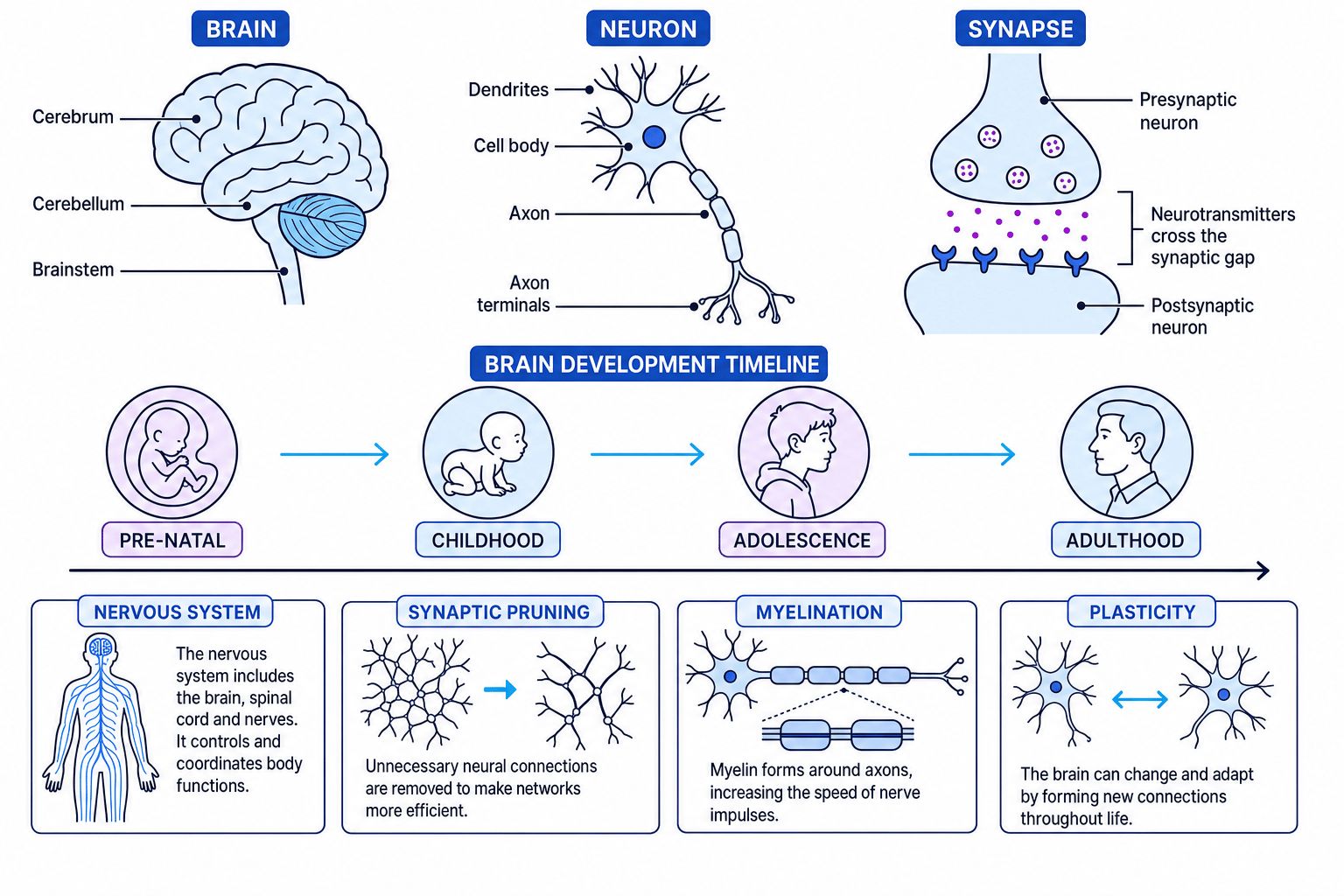
Main brain structures
The cerebrum is the large upper part of the brain. It is involved in higher mental processes such as thinking, language, memory and decision-making.
The cerebellum is involved in balance, coordination and some forms of learning.
The brainstem controls basic automatic functions such as breathing, heart rate and levels of alertness.
The prefrontal cortex is especially important in development because it is linked to planning, impulse control and decision-making. It continues maturing through adolescence and into early adulthood.
4. Neurons and synapses
A neuron is a nerve cell. Neurons carry information using electrical and chemical signals.
A neuron usually has:
- Dendrites, which receive messages from other neurons.
- A cell body, which contains the nucleus and keeps the cell working.
- An axon, which carries the message along the neuron.
- Axon terminals, which pass the message on to other neurons.
Definition
Neuron
A neuron is a specialised nerve cell that transmits information around the nervous system.
A synapse is the tiny gap between two neurons. Messages cross this gap using chemicals called neurotransmitters.
When a message reaches the end of one neuron, neurotransmitters are released into the synapse. They cross the gap and attach to receptors on the next neuron. This can make the next neuron more or less likely to send its own message.
Definition
Synapse
A synapse is the gap between neurons where chemical messages are passed from one neuron to another.
5. How neurons and synapses interact in brain development
Brain development is not only about the brain getting bigger. It is also about the brain becoming better organised.
During development, the brain makes many neural connections. Some are strengthened because they are used often. Others are weakened or removed. This removal of less-used connections is called synaptic pruning.
Myelination is another important process. Myelin is a fatty coating around some axons. It helps messages travel faster and more efficiently.
Plasticity means the brain can change by forming, strengthening or reorganising connections. Plasticity is strongest in childhood, but it continues throughout life.
Key Idea
Experience shapes the developing brain
Brain development involves an interaction between biology and experience. Genes help build the nervous system, but learning, practice, relationships and the environment can shape neural connections.
Example
Applying synapses to learning a skill
A child practises playing the piano every day for a year.
- Repeated practice activates neural pathways involved in hearing notes, moving fingers and reading music, so those pathways are used again and again.
- Frequently used connections are likely to strengthen, making the skill feel smoother and more automatic over time.
- Myelination can improve the speed and efficiency of messages along relevant neurons, helping faster coordination.
- Less-used connections may be pruned, so the brain becomes more efficient rather than simply having more connections.
Common Mistake
Saying the brain is finished in childhood
Childhood is very important for brain development, but the brain remains plastic. Adolescents and adults can still learn, adapt and form new connections.
6. IQ tests as a measure of intelligence
Intelligence means the ability to learn, reason, solve problems and adapt to new situations. Psychologists do not all agree on one perfect definition.
An IQ test is a standardised test designed to measure intelligence. Standardised means the test is given and scored in the same way for everyone, so scores can be compared fairly.
Definition
IQ test
An IQ test is a standardised assessment that produces a score intended to measure intelligence by comparing a person’s performance with others of a similar age.
Most modern IQ tests are designed so that the average score is 100. Many people score close to the average, and fewer people score at the very low or very high ends. This pattern is called a normal distribution.
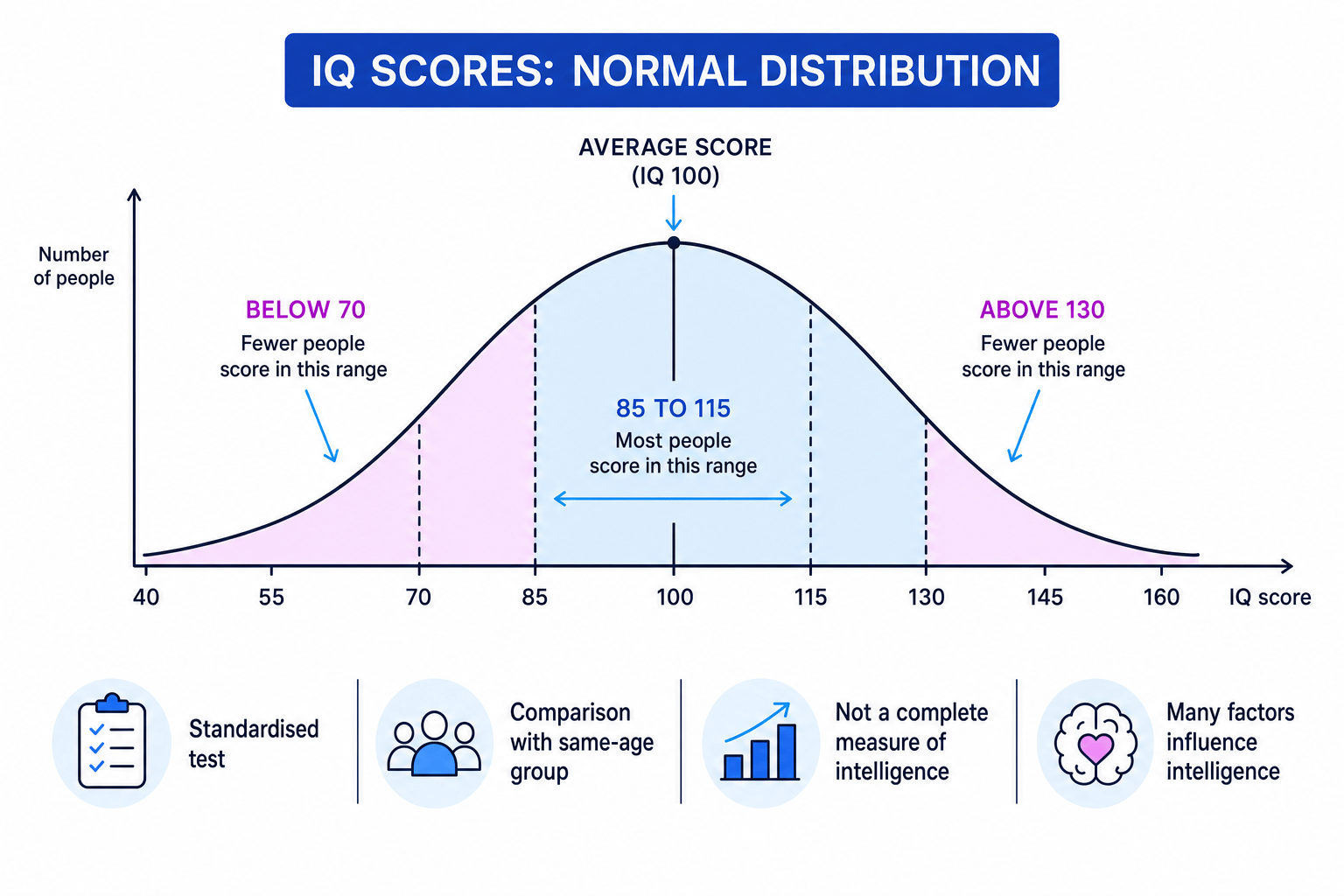
What IQ tests can be useful for
IQ tests can help identify people who may need extra educational support. They can also be useful in research when psychologists want a standard measure of cognitive ability.
Because IQ tests are standardised, they can be more reliable than an informal opinion such as “this person seems clever”.
Limitations of IQ tests
IQ tests do not measure every kind of ability. For example, they may not fully measure creativity, emotional understanding, motivation, practical problem-solving or social skills.
They may also be affected by education, language, culture, test anxiety and familiarity with the test format. This means IQ tests can raise questions about validity, which means whether a test really measures what it claims to measure.
There are also ethical issues. If children are given IQ labels, this could affect their confidence or how teachers treat them. Psychologists using IQ tests should consider informed consent, confidentiality, protection from psychological harm, the right to withdraw and debriefing.
Tip
Evaluating IQ tests
A strong GCSE evaluation often separates reliability from validity: an IQ test may give consistent scores, but that does not automatically prove it measures all of intelligence.
Example
Interpreting an IQ test result
A student scores 112 on an IQ test.
- The score is above the average of 100, so it suggests the student performed better than average on that test.
- The score still falls within the broad common range shown around the centre of the distribution, so it should not be treated as an extreme result.
- The conclusion should be cautious: the score gives information about performance on a standardised intelligence test, but it does not prove the student is “better” in every type of intelligence.
- A good answer would also mention possible influences such as education, motivation, language, culture or test anxiety.
Common Mistake
Confusing IQ with all-round intelligence
Do not write that IQ “is intelligence”. It is better to say IQ is a measure of some aspects of intelligence, especially reasoning and problem-solving under test conditions.
7. Key debates in this topic
Nature and nurture
Nature means biological influences, such as genes and brain maturation. Nurture means environmental influences, such as education, parenting, culture and practice.
Development clearly involves both. For example, the nervous system develops biologically, but experience shapes synaptic connections.
Reductionism and holism
A reductionist explanation breaks behaviour down into one simple cause, such as brain structure or IQ score. A holistic explanation considers the whole person and their environment.
Brain development and IQ tests can be useful, but they should not be used as the only explanation for a person’s behaviour or potential.
Freewill and determinism
A deterministic view suggests development is fixed by earlier causes, such as biology or childhood experience. However, plasticity shows that people can change and learn, so development is not completely fixed.
Exam technique
In the exam
- Define key terms clearly before explaining them: for example, development, neuron, synapse, plasticity and IQ test.
- For scenario questions, link the evidence in the scenario to the correct concept, such as adolescence, synaptic pruning or limitations of IQ.
- For evaluation, use balanced points: explain why a concept is useful, then add a limitation such as individual differences, cultural bias, reductionism or ethical concerns.
Self review
Check yourself
- What is the difference between childhood and adolescence as stages of development?
- How do neurons communicate across a synapse?
- Why might an IQ test be useful but still not be a complete measure of intelligence?
You've reached the end
Test yourself on this topic, or move on to the next guide.
How was this guide?