Revision notes for OCR GCSE Psychology Social Influence. Open the guide for explanations and worked examples. Written against the OCR GCSE Psychology (J203) specification, so the content matches what's examinable rather than general Psychology background.
Social Influence
What you'll learn
- How conformity, obedience and crowd behaviour are different types of social influence.
- Why people may change their behaviour because of group norms, authority cues or anonymity.
- The two OCR core studies: Bickman (1974) and NatCen / Morrell et al. (2011).
- How to evaluate social influence using methods, ethics, debates and real-world applications.
The big idea: other people affect behaviour
In Psychology, social influence is about how your thoughts, feelings and actions can be affected by other people. This can happen when people are physically present, but also when you simply imagine what others would think.
Definition
Social influence
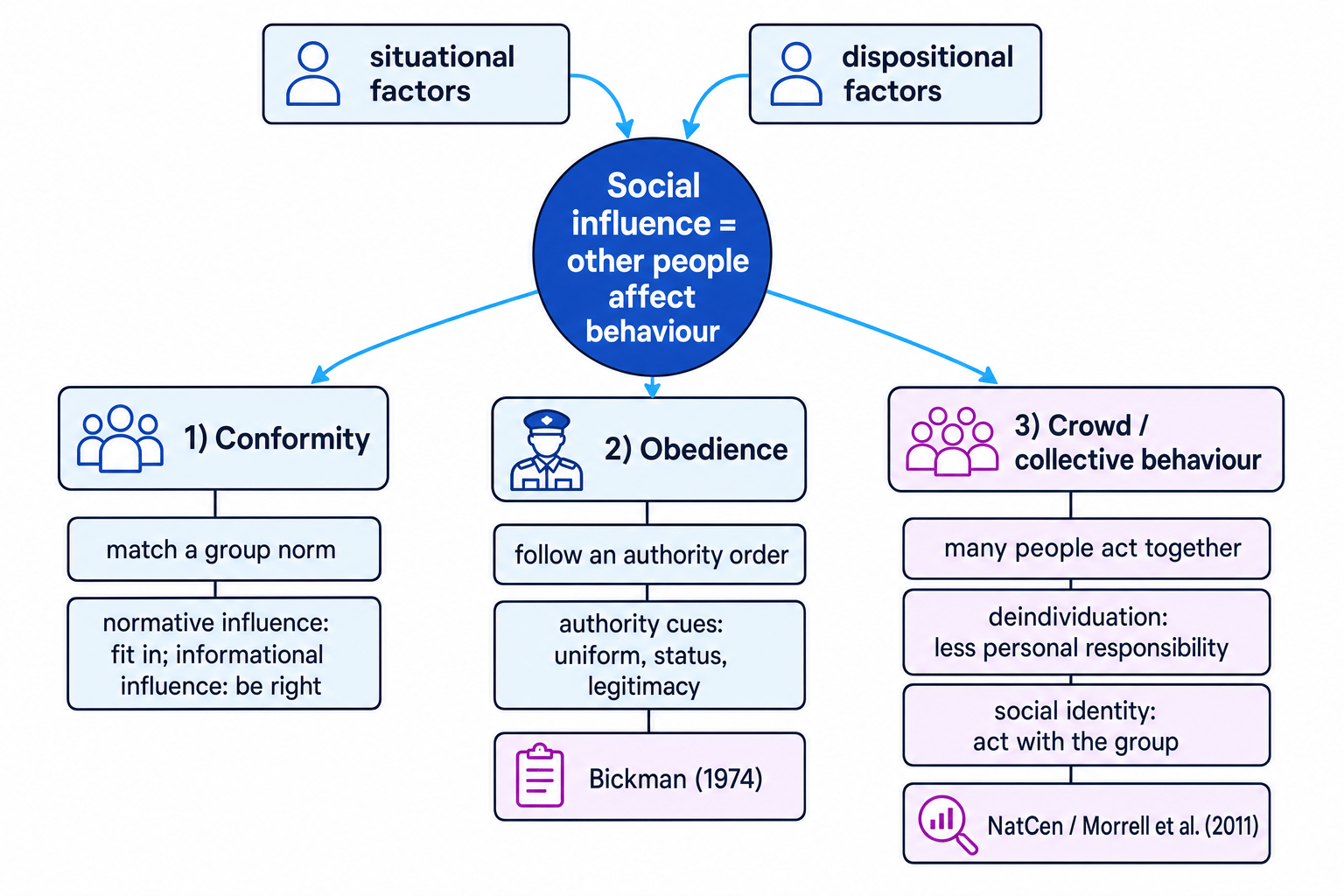
Social influence means a change in a person’s behaviour, thoughts or feelings because of the real or imagined presence of other people.
Social influence belongs mainly to the social area of Psychology, because it focuses on how behaviour is shaped by social situations, relationships, groups and culture.
Conformity: going along with the group
Definition
Conformity
Conformity is changing your behaviour or beliefs to fit in with a group or to match a group norm, which is an expected way of behaving in that group.
For example, if everyone in a group chat starts using the same slang and you begin using it too, that is a small everyday example of conformity.
There are two useful reasons why conformity happens:
- Normative social influence: you conform because you want to be liked, accepted or not rejected.
- Informational social influence: you conform because you think the group may be right, especially when the situation is unclear.
You may also see these terms:
- Compliance: you publicly go along with the group, but privately you may disagree.
- Internalisation: you genuinely accept the group’s view as your own.
- Identification: you adopt the behaviour of a group you value because you want to be part of it.
Key Idea
Conformity in one sentence
Conformity is about pressure from a group, not a direct order from an authority figure.
Example
Identifying conformity in a scenario
A student laughs at a joke they do not find funny because all their friends are laughing.
- The student is not being directly ordered by a teacher or leader, so this is not obedience.
- The student is matching the behaviour of the friendship group, so the best concept is conformity.
- Because the student does not really find the joke funny, the change is probably public rather than private, so it is best described as compliance.
- The most likely explanation is normative social influence, because the student wants acceptance from friends.
Obedience: following an authority figure
Definition
Obedience
Obedience is following a direct instruction or order from someone who is seen as having authority.
An authority figure is someone believed to have the right to give instructions, such as a police officer, teacher, parent, judge or security guard.
Obedience is influenced by situational factors, which are features of the environment. One important situational factor is a uniform. A uniform can signal status, expertise and legitimate power.
Obedience can also be affected by dispositional factors, which are features within the person, such as confidence, personality, previous experiences or attitudes to authority.
Common Mistake
Conformity vs obedience
Do not call every group effect “obedience”. Obedience needs a direct instruction from an authority figure. Conformity is pressure from a group norm.
Core study: Bickman (1974)
Bickman (1974), “The Social Power of a Uniform”, tested whether people are more likely to obey someone wearing a uniform. This is a core study for the social area because it investigates how an authority cue in the environment affects behaviour.
Background
Bickman wanted to find out whether a uniform itself gives a person social power. In everyday life, people often obey police officers, guards or officials quickly, even if they do not know them personally.
Method
Bickman carried out a field experiment, which is an experiment in a real-world setting rather than a laboratory.
- The participants were pedestrians in New York.
- The experimenters were dressed in different outfits, such as a guard-style uniform, a milkman-style uniform or ordinary civilian clothing.
- They gave passers-by simple instructions, such as asking them to pick something up, move position or help with a parking meter.
- The main measure was whether the person obeyed the request.
Results and conclusions
People were generally more likely to obey when the person giving the instruction wore a guard-style uniform. This suggested that uniforms can act as a powerful cue of authority.
Bickman concluded that obedience can be increased by symbols of legitimate authority, even when the person giving the order is a stranger.
Evaluation of Bickman
A major strength is ecological validity, meaning the study took place in a realistic setting. Pedestrians were behaving naturally, so the findings may reflect everyday obedience better than a laboratory study.
Another strength is that the behaviour was easy to measure: the person either obeyed or did not obey.
However, the study had ethical issues. Participants did not give informed consent before taking part, and they were deceived because they did not know they were in a psychology study. Their right to withdraw was also limited because they were unaware the study was happening.
The study may also have cultural bias. It took place in one city at one time, so obedience to uniforms might be different in other cultures, places or historical periods.
Crowd and collective behaviour
Definition
Collective behaviour
Collective behaviour happens when many people act together, often in a crowd or group situation.
Crowds can influence behaviour in several ways. Sometimes crowds are positive, such as people cheering at a charity event. Sometimes they can become anti-social, such as during riots or vandalism.
Definition
Deindividuation
Deindividuation is a state where people feel less individually identifiable and less personally responsible, often because they are part of a group or crowd.
If someone feels anonymous in a crowd, they may do things they would not normally do alone. This links to diffusion of responsibility, where responsibility feels spread across the group.
Another useful idea is social identity. This means the part of your identity that comes from belonging to a group. In a crowd, people may act according to what they think “people like us” should do.
Example
Explaining behaviour in a crowd
During a protest, a few people begin damaging shop windows. Others join in after seeing the crowd cheering and realising the police cannot identify everyone.
- The cheering creates a group norm that makes the behaviour seem more acceptable within that crowd.
- People who join in may be conforming because they want approval or do not want to stand out.
- The large crowd reduces personal identifiability, so deindividuation may increase risk-taking.
- If people see themselves as part of the same angry group, social identity may make them feel the action represents “us” against “them”.
Core study: NatCen / Morrell et al. (2011)
NatCen / Morrell et al. (2011) investigated the August 2011 riots in England and tried to understand why young people became involved. This is also part of the social area because it studies how social situations, groups and communities affect behaviour.
Background
The riots followed the police shooting of Mark Duggan in London and spread to several English cities. The research was important because politicians, communities and police needed to understand why some young people joined in.
Method
This was not a laboratory experiment. It was real-world social research using methods such as interviews with young people in affected areas. The sample included young people with different levels of involvement, including those who had taken part, watched events or lived nearby.
The researchers looked for themes in what young people said about their experiences, motives and views.
Results and conclusions
Morrell et al. found that involvement was not explained by one simple cause. Important factors included:
- excitement and the thrill of being involved
- opportunity to get goods or money
- peer influence and wanting to be with friends
- anger at police or authority
- feeling that there was little chance of being caught
- wider social issues, such as deprivation or feeling excluded
- use of social media to share information, although social media alone did not cause the riots
The conclusion was that riot behaviour is multi-causal, meaning it has several causes working together. Immediate crowd factors mattered, but so did longer-term social and community factors.
Evaluation of Morrell et al.
A strength is real-world relevance. The study helped explain an important social event and could inform policies for preventing future disorder.
Another strength is that qualitative interviews gave detailed insight into young people’s own views. This can be richer than simply counting arrests.
However, the study relied partly on self-report, so participants may have forgotten details, exaggerated or hidden their real motives. This affects validity, meaning how accurately the research measures what it claims to measure.
There are also ethical issues. The research involved young people discussing sensitive and potentially criminal behaviour, so confidentiality, informed consent, protection from harm and careful debriefing were especially important under the British Psychological Society’s Code of Ethics and Conduct.
Applying social influence to real life
Social influence research can help explain both helpful and harmful behaviour.
Prosocial behaviour means behaviour that benefits others or society, such as helping, cooperating or following safety instructions. Anti-social behaviour means behaviour that harms others, breaks rules or damages communities.
To reduce anti-social crowd behaviour, real-world strategies might include:
- clear and fair communication from police and community leaders
- visible authority that is seen as legitimate, not aggressive
- reducing opportunities for looting or damage
- encouraging prosocial group norms
- supporting young people so they feel included and have future opportunities
Tip
AO2 application shortcut
When applying social influence to a scenario, ask: Is there a group norm, a direct order, or a crowd effect? That usually tells you whether to discuss conformity, obedience or deindividuation.
Debates and criticisms
Social influence links strongly to the freewill and determinism debate. A deterministic explanation suggests behaviour is controlled by social pressure, authority or crowd conditions. However, people can still resist pressure, so free will has not disappeared completely.
It also links to nature and nurture. Social influence explanations are mainly on the nurture side because they focus on learning, culture, groups and environment rather than biology.
Finally, there is a reductionism and holism issue. Bickman’s study could be seen as reductionist because it focuses strongly on one factor: uniform. Morrell et al. is more holistic because it considers many interacting causes, including peers, opportunity, policing, deprivation and emotion.
Exam technique
In the exam
- Define the key term first: conformity, obedience, deindividuation or collective behaviour.
- Use the named study accurately: Bickman for uniforms and obedience; NatCen / Morrell et al. for riots and youth involvement.
- For evaluation, include at least one method point, one ethics point and one debate or real-world application point.
Self review
Check yourself
- What is the difference between conformity and obedience?
- How did Bickman (1974) show the social power of a uniform?
- Why did Morrell et al. (2011) conclude that the August riots had more than one cause?
You've reached the end
Test yourself on this topic, or move on to the next guide.
How was this guide?