Revision notes for OCR GCSE Psychology Memory. Open the guide for explanations and worked examples. Written against the OCR GCSE Psychology (J203) specification, so the content matches what's examinable rather than general Psychology background.
Memory
What you'll learn
- How psychologists describe memory as an information-processing system.
- The Multi-store Model and what sensory, short-term and long-term memory do.
- How the brain is linked to memory, using Wilson, Kopelman and Kapur (2008).
- How memories can be reconstructed, using Braun, Ellis and Loftus (2002).
Memory: the basic idea
Memory is not just “having a good or bad memory”. In psychology, memory means the mental processes involved in taking in information, keeping it, and using it later.
Definition
Memory
Memory is the cognitive process of encoding, storing and retrieving information.
There are three key processes:
- Encoding: changing information into a form the brain can store.
- Storage: keeping information over time.
- Retrieval: accessing stored information when it is needed.
For example, when you learn a phone number, you may encode it by saying it aloud, store it briefly, and retrieve it when typing it into your phone.
Key Idea
Memory is a process
GCSE questions often reward you for showing the sequence: information is encoded, then stored, then retrieved. Forgetting can happen at any stage.
The Multi-store Model of memory
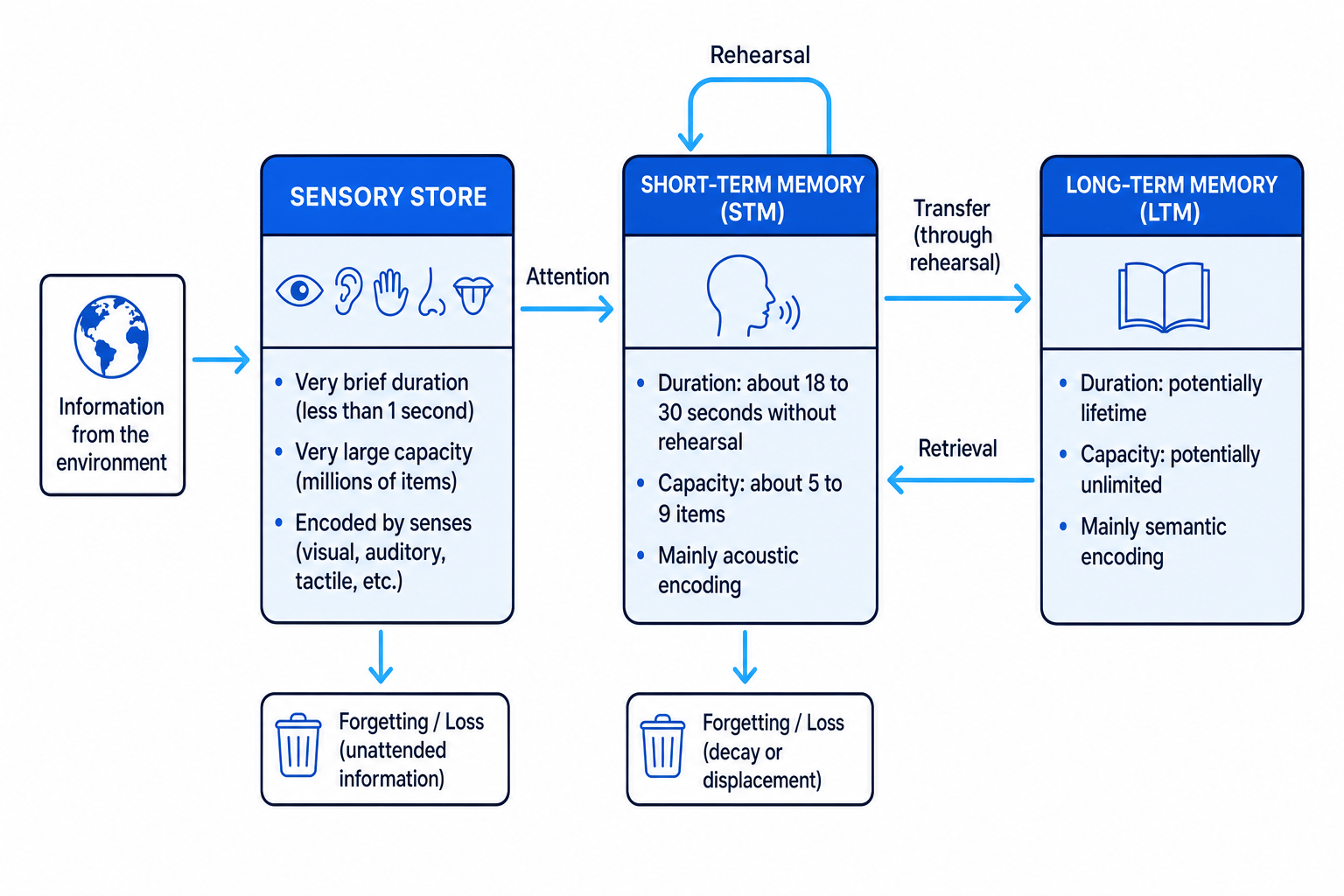
The Multi-store Model is a theory of memory which says memory is made of separate stores. Information moves from one store to the next if attention and rehearsal take place.
Definition
Multi-store Model
The Multi-store Model explains memory as a system of separate stores: the sensory store, short-term memory, and long-term memory.
Sensory store
The sensory store holds information from the senses, such as sights, sounds and smells. It has a very large capacity, but information stays there for a very short time, usually less than a second unless you pay attention to it.
Short-term memory
Short-term memory, often shortened to STM, holds a small amount of information for a short time. It usually lasts about 18 to 30 seconds without rehearsal.
Definition
Rehearsal
Rehearsal means repeating information, either aloud or in your head, to keep it in short-term memory or transfer it to long-term memory.
STM has a limited capacity, often described as about 5 to 9 items. It mainly uses acoustic encoding, meaning information is stored according to sound.
Long-term memory
Long-term memory, often shortened to LTM, stores information for a potentially unlimited length of time. Its capacity is also potentially unlimited. It mainly uses semantic encoding, meaning information is stored according to meaning.
Long-term memory is not just one simple store. Psychologists often describe different types:
- Episodic memory: memory for personal events, such as your last birthday.
- Semantic memory: memory for facts and meanings, such as knowing Paris is the capital of France.
- Procedural memory: memory for skills, such as riding a bike or playing the piano.
Example
Applying the Multi-store Model
A student looks at a revision definition for five seconds, repeats it three times, and later writes it in a test.
- The words first enter the sensory store because the student sees them on the page.
- By paying attention, the student moves the information into short-term memory.
- Repeating the definition is rehearsal, which helps keep it active and may transfer it into long-term memory.
- Writing it in the test shows retrieval, because the stored information is brought back for use.
Common Mistake
Thinking rehearsal is the only way memories form
The Multi-store Model gives rehearsal an important role, but not all long-term memories come from repetition. Some emotional, meaningful or unusual events can be remembered after one experience.
Evaluating the Multi-store Model
A strength is that the model is clear and testable. It separates memory into stores with different durations, capacities and types of encoding. This makes it useful for explaining everyday memory and some cases of amnesia.
A weakness is that it may be too simple. It treats STM and LTM as single stores, even though long-term memory includes episodic, semantic and procedural memory. This links to the debate of reductionism versus holism.
Definition
Reductionism
Reductionism means explaining complex behaviour using smaller, simpler parts. In memory, this could mean reducing memory to separate stores and processes.
The Multi-store Model is partly reductionist because it breaks memory into stores. This is useful for scientific explanation, but it may ignore how emotion, meaning, context and personal experience affect remembering.
Brain areas linked to memory
Memory is also linked to the brain. This is embedded Brain and Neuropsychology content, so it can be assessed as part of Memory or as a brain question.
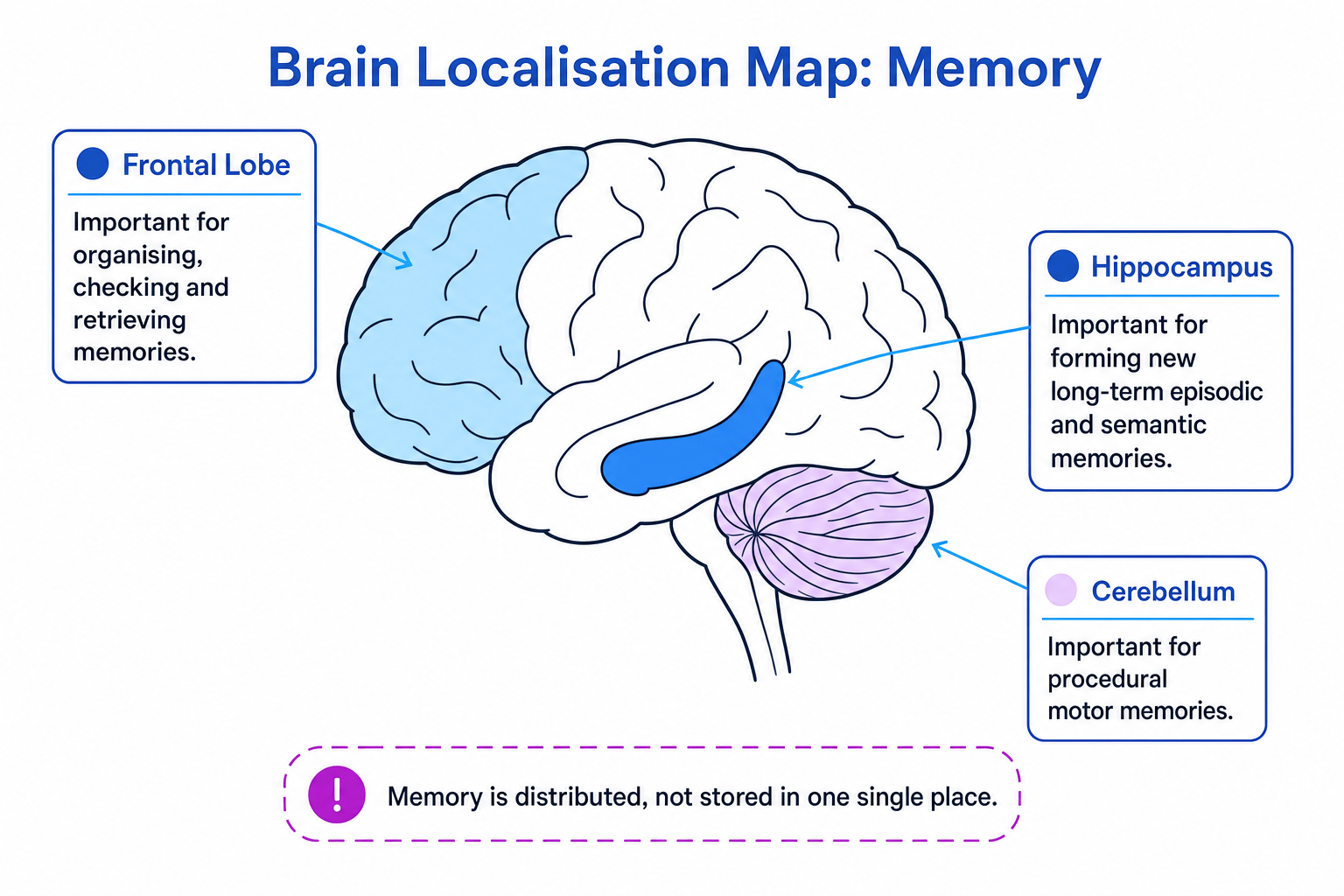
Important areas include:
- Hippocampus: important for forming new long-term episodic and semantic memories.
- Frontal lobe: helps organise, check and retrieve memories.
- Cerebellum: linked to procedural motor memories, such as learned physical skills.
Key Idea
Memory is distributed
Memory is not stored in one single “memory box” in the brain. Different brain areas contribute to different memory functions.
This links to the nature/nurture debate. Brain damage shows the role of biological nature, but what people remember also depends on experience, learning and environment.
Core study: Wilson, Kopelman and Kapur (2008)
Wilson, Kopelman and Kapur (2008) studied a famous case of severe amnesia. This study is mainly in the cognitive core area, because it investigates memory, but it also has a strong biological link because it involves brain damage.
Definition
Amnesia
Amnesia is memory loss. Anterograde amnesia is difficulty forming new memories after damage or illness. Retrograde amnesia is loss of memories from before the damage or illness.
Background
The study focused on a man with very severe memory problems after brain damage caused by illness. He had major difficulty forming new memories and showed a striking loss of awareness of his own past. However, some abilities, such as language and musical skill, were better preserved.
Method
This was a case study, meaning an in-depth investigation of one individual. The researchers used information such as observations, interviews, memory testing and evidence from everyday behaviour.
Results
The patient showed severe memory impairment. He often acted as if he had only just become conscious and could not consistently remember recent events. However, some procedural abilities remained, showing that not all types of long-term memory were damaged equally.
Conclusions
The study supports the idea that memory is not one single system. It also supports brain localisation because damage to areas involved in memory can lead to specific memory problems.
Example
Using Wilson et al. to support memory theory
A question asks why Wilson, Kopelman and Kapur (2008) supports the idea that long-term memory has different types.
- The patient had severe problems with personal past awareness and forming new memories, showing damage to episodic memory and new long-term learning.
- Some learned skills were still present, showing procedural memory was not affected in the same way.
- Therefore, the study suggests long-term memory is not one single store; different types of memory can be damaged separately.
Criticisms
A strength is the detail. Case studies can give rich, real-life evidence that would be difficult to collect in a laboratory.
A weakness is low generalisability. Because the study focused on one unusual case, we must be careful about applying the findings to everyone.
There are also ethical issues. The researchers needed to consider informed consent, protection from psychological harm, confidentiality, and respectful reporting, especially because the participant had serious memory difficulties.
Tip
Evaluation shortcut
For Wilson et al., remember: rich detail, real brain damage, low generalisability, important ethics.
Reconstructive memory
The Multi-store Model can make memory sound like a recording. But many psychologists argue memory is more active than that.
Definition
Reconstructive memory
Reconstructive memory is the idea that remembering involves rebuilding information, rather than playing back an exact copy of the past.
When you remember, your brain may combine:
- what actually happened,
- what you already believe,
- what you expected,
- what other people later told you,
- and what seems logical or familiar.
A key term here is schema.
Definition
Schema
A schema is a mental framework of knowledge and expectations that helps you organise and interpret information.
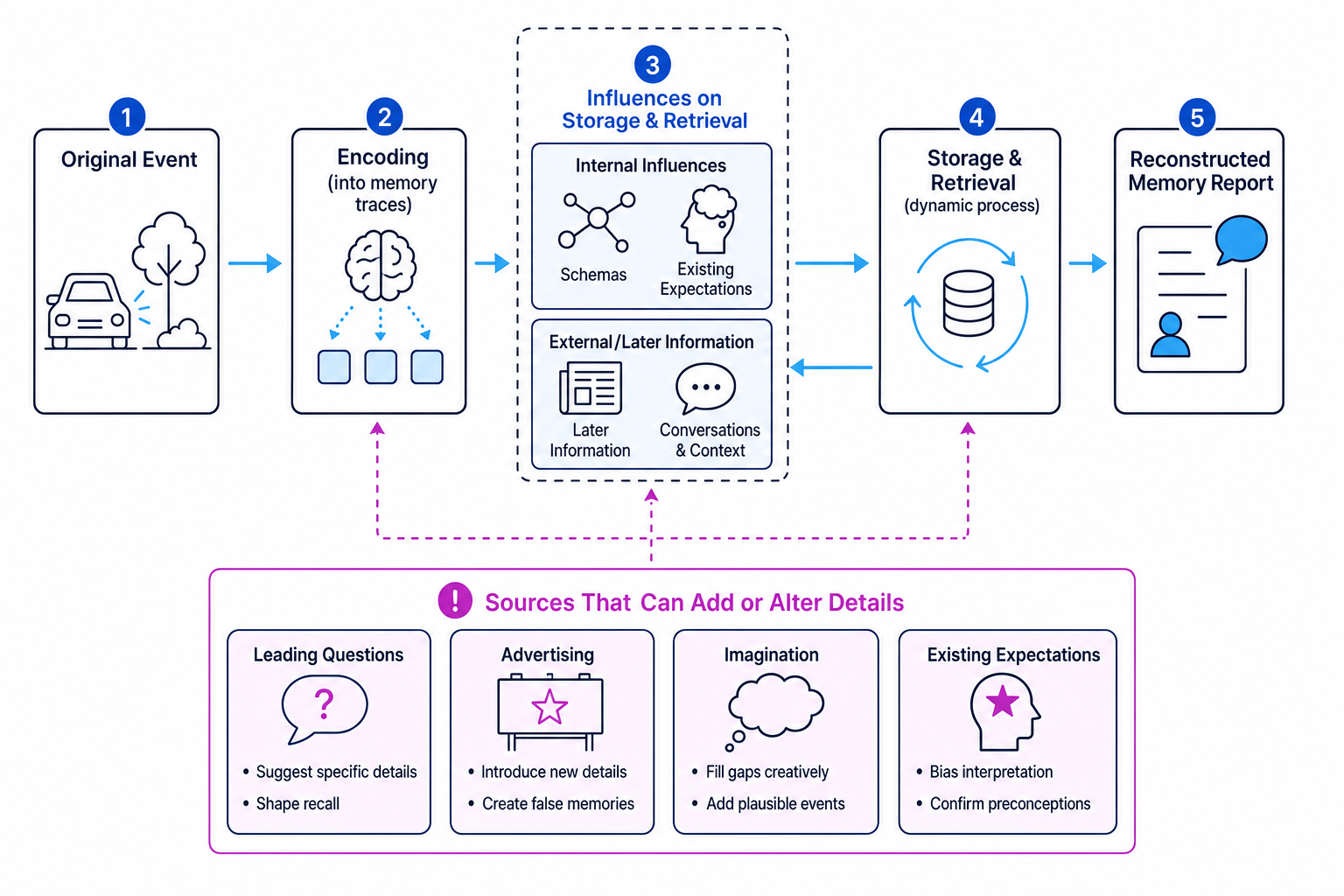
Schemas are useful because they help you make sense of the world quickly. However, they can also distort memory. For example, if you expect a classroom to have desks, you might later “remember” desks even if the room was unusual.
Example
Explaining a distorted memory
A child later says they remember seeing a clown at a birthday party, but photos show there was no clown. They had only seen a clown on the party invitation.
- The original event was the birthday party, but the child also saw later information on the invitation.
- Their schema for children’s parties may include entertainment, costumes and clowns.
- At retrieval, the child reconstructs the memory using the real party, the invitation and their party schema.
- This can create a false memory that feels real to the child.
Core study: Braun, Ellis and Loftus (2002)
Braun, Ellis and Loftus (2002) investigated whether advertising could change people’s memories of childhood experiences. This study belongs to the cognitive core area because it studies memory reconstruction.
Background
Previous research by Loftus and others showed that misleading information can affect memory. Braun et al. wanted to see whether a fake advertisement could make people believe they had experienced something in the past.
Method
Participants were exposed to advertising material about a childhood trip to a theme park. Some material suggested an impossible or unlikely event, such as meeting a character associated with a different company. Participants were later asked about their childhood memories and confidence.
Results
Participants who saw the misleading advertising were more likely to report memories or increased confidence for events they had not really experienced. This showed that advertising could influence autobiographical memory.
Conclusions
The study supports reconstructive memory. Memories can be altered by later information, especially when the information is vivid, plausible and linked to personal experience.
Example
Using Braun et al. to explain advertising effects
A scenario says an adult sees a holiday advert showing children feeding dolphins, then later becomes more confident that they fed dolphins on holiday as a child.
- The advert is later information because it appears after the original childhood event.
- The person may use a holiday schema involving beaches, animals and family activities.
- When retrieving the childhood memory, they reconstruct it using both real memories and the advert.
- This fits Braun, Ellis and Loftus (2002), because advertising can increase false memories or false confidence.
Criticisms
A strength is real-world application. The study helps us understand how advertising, media and leading information may influence memory.
A weakness is that the task may not fully represent everyday remembering. Participants were in a research situation, so demand characteristics may have affected responses.
Ethically, deception was involved because participants were exposed to misleading material. Researchers needed to debrief participants, protect them from harm, and make sure they had the right to withdraw.
Common Mistake
Saying false memory means lying
A false memory is not the same as lying. In reconstructive memory, a person may honestly believe the memory is real.
Comparing the two core studies
Wilson, Kopelman and Kapur (2008) shows how brain damage can affect memory systems. Braun, Ellis and Loftus (2002) shows how memory can be changed by later information.
Together, they show that memory is both:
- biological, because brain areas support memory;
- cognitive, because memory involves encoding, storage, retrieval and reconstruction;
- influenced by experience, because schemas and advertising can shape recall.
Exam technique
In the exam
- For AO1, use accurate terms such as encoding, storage, retrieval, STM, LTM, schema, amnesia and reconstructive memory.
- For AO2, link the scenario directly to the theory: attention and rehearsal for the Multi-store Model; schemas and later information for reconstructive memory.
- For AO3, evaluate with a balanced point: for example, Wilson et al. gives rich detail but low generalisability, while Braun et al. has real-world relevance but uses deception.
Self review
Check yourself
- What are the three stores in the Multi-store Model, and how does information move between them?
- How does a schema affect reconstructive memory?
- What is one strength and one weakness of each core study: Wilson et al. (2008) and Braun et al. (2002)?
You've reached the end
Test yourself on this topic, or move on to the next guide.
How was this guide?