Revision notes for OCR GCSE Psychology Psychological Problems. Open the guide for explanations and worked examples. Written against the OCR GCSE Psychology (J203) specification, so the content matches what's examinable rather than general Psychology background.
Psychological Problems
What you'll learn
- How psychologists define mental health and use a continuum rather than “healthy/unhealthy” labels.
- The key symptoms and explanations for depression and schizophrenia.
- How the core studies Daniel, Weinberger, Jones et al. (1991) and Tandoc, Ferrucci and Duffy (2015) support the topic.
- How to evaluate explanations using debates such as nature/nurture, reductionism/holism and freewill/determinism.
Starting point: what is mental health?
Mental health is not just “not having a disorder”. It includes how well you cope, think, feel, form relationships and manage everyday life.
Definition
Mental health
Mental health is a person’s emotional, psychological and social wellbeing, including how they think, feel, behave, cope with stress and relate to others.
A psychological problem is a difficulty involving thoughts, emotions or behaviour that causes distress or affects daily functioning. Psychologists often think of mental health as a continuum: people can move along it over time, depending on stress, support, sleep, relationships and life events.
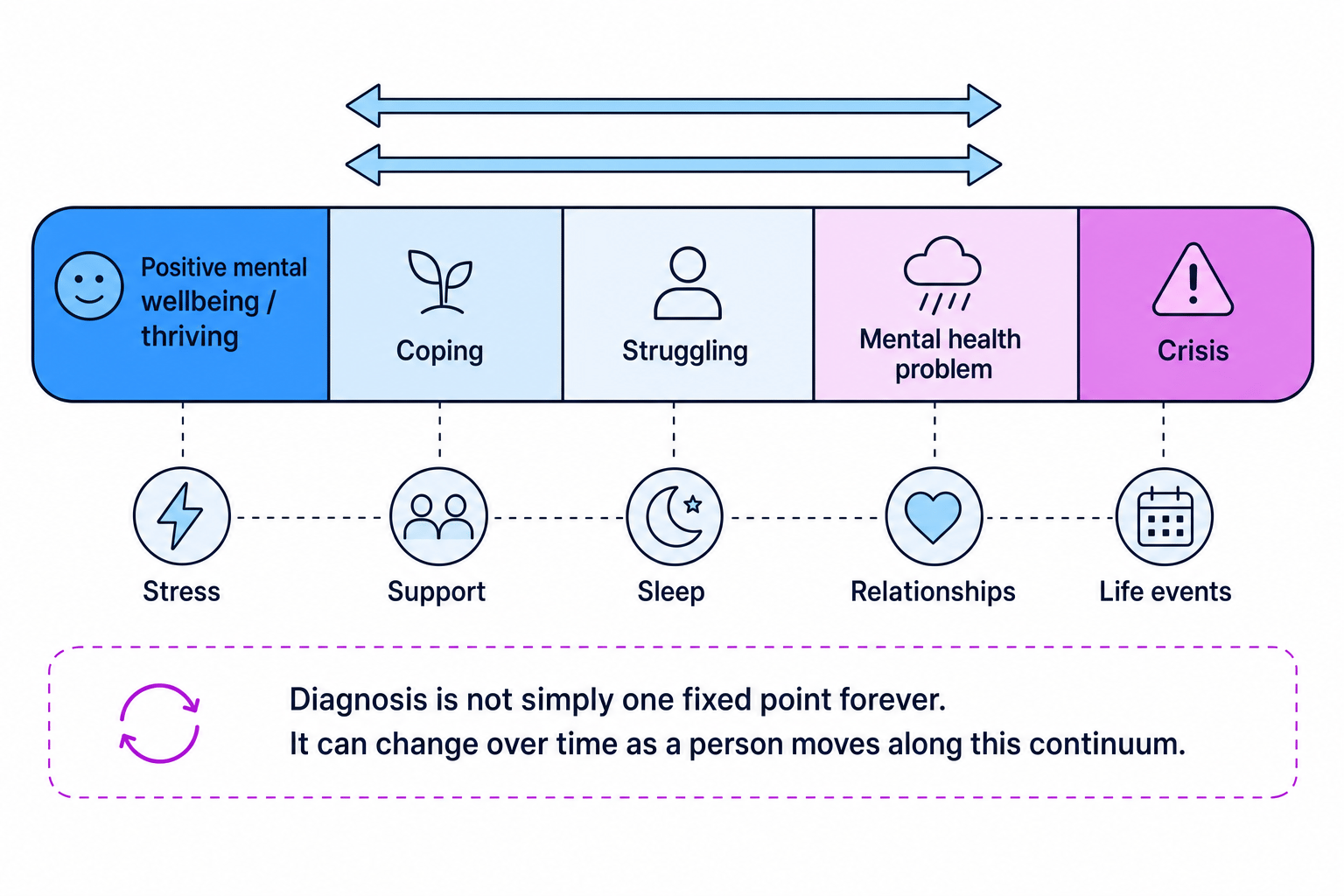
Key Idea
Continuum, not a fixed label
Mental health can change. A diagnosis can help someone access support, but it should not be treated as their whole identity.
Effects of mental health problems
Significant mental health problems can affect:
- The individual: distress, low motivation, difficulty studying or working, relationship problems, reduced quality of life.
- Society: pressure on health services, lost work or school time, need for support from families, schools and employers.
Stigma is also important. Stigma means negative attitudes or labels attached to a group. If people fear being judged, they may delay asking for help.
Example
Placing a person on the mental health continuum
A student has been sleeping badly for weeks, has stopped seeing friends, feels hopeless and is finding schoolwork very hard.
- The student is not just having one difficult day; the problems have lasted for weeks and affect daily life.
- The symptoms include emotional distress, behaviour change and reduced functioning, so this is beyond ordinary stress.
- On the continuum, the student would likely be nearer the “mental health problem” end than the “coping” end, and should be encouraged to seek support.
Depression
Depression is a mood disorder involving persistent low mood and/or loss of interest or pleasure. At GCSE, you should be able to describe symptoms and explain depression using both biological and psychological ideas.
Definition
Depression
Depression is a psychological disorder where a person experiences persistent low mood and/or loss of pleasure, often with changes in thinking, behaviour, sleep, appetite and motivation.
Symptoms of depression
Symptoms can be grouped into:
- Emotional symptoms: sadness, hopelessness, guilt, loss of enjoyment.
- Cognitive symptoms: negative thoughts, poor concentration, low self-esteem.
- Behavioural/physical symptoms: withdrawal, crying, reduced activity, sleep or appetite changes.
Common Mistake
Depression is not just sadness
Sadness is a normal emotion. Clinical depression is more persistent, more disruptive and affects several areas of life.
The ABC model of depression
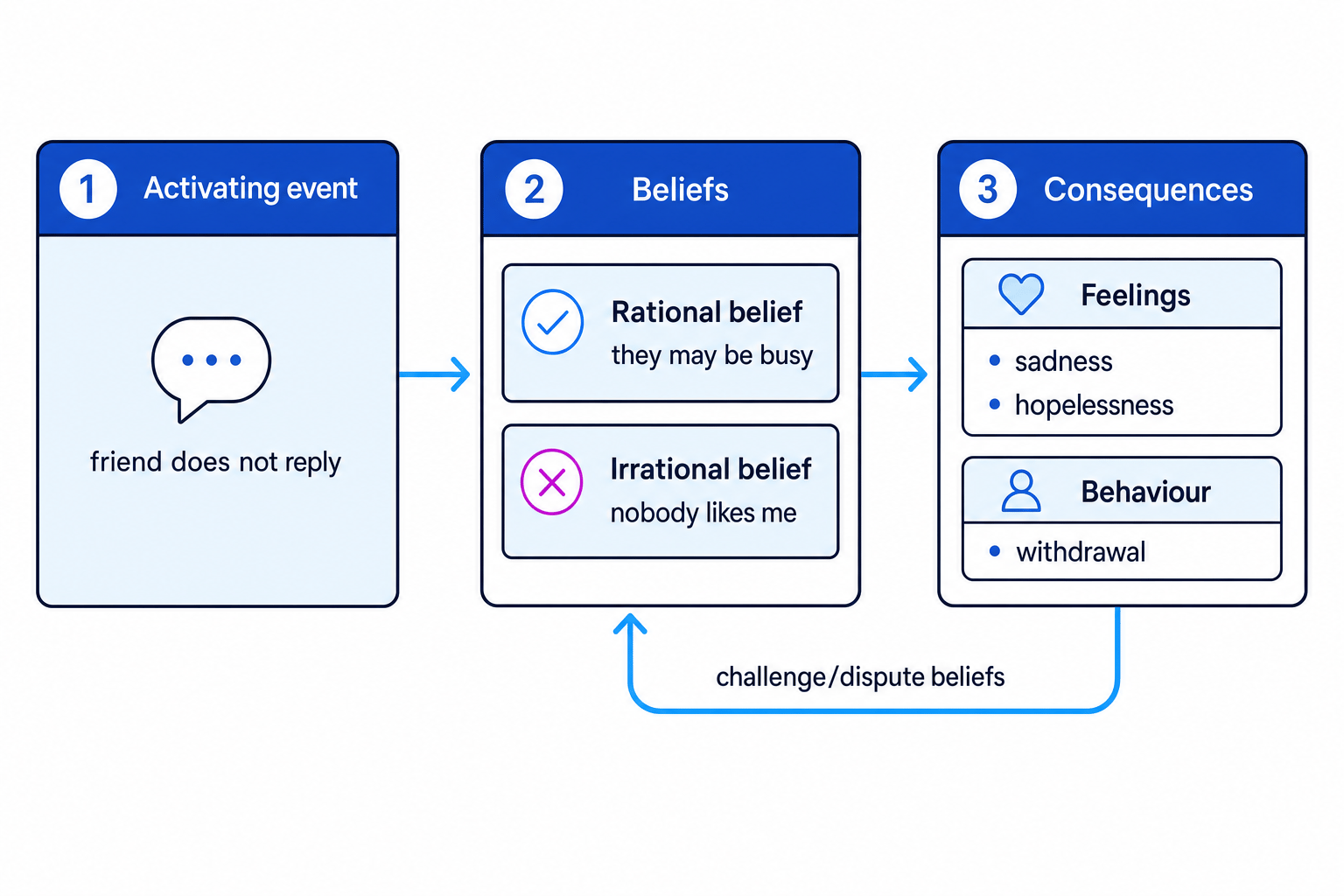
The ABC model is a psychological explanation linked to cognitive ideas. Cognition means mental processes such as thinking, interpreting and believing.
In the ABC model:
- A = Activating event: something happens.
- B = Beliefs: the person interprets what happened.
- C = Consequences: emotional and behavioural effects follow.
The important point is that the event does not directly cause the consequence. The person’s beliefs about the event matter.
Example
Applying the ABC model
A friend does not reply to your message. You think, “They hate me; nobody wants me around,” and then you feel worthless and avoid everyone.
- The activating event is the friend not replying.
- The belief is the interpretation: “They hate me; nobody wants me around.” This is an irrational or overly negative belief because there are other possible explanations.
- The consequence is feeling worthless and withdrawing, which could maintain low mood.
Evaluating the ABC model
A strength is that it explains why two people can react differently to the same event. It also has a useful real-world application: therapies such as cognitive behavioural therapy, or CBT, try to challenge unhelpful beliefs.
A weakness is that it can be reductionist, meaning it may oversimplify depression by focusing mainly on thoughts and not enough on biology, relationships or life circumstances.
Definition
Reductionism
Reductionism means explaining a complex behaviour or experience using only one narrow factor, such as thoughts or brain chemistry.
Tandoc, Ferrucci and Duffy (2015): Facebook, envy and depression
The prescribed OCR study for depression is Tandoc, Ferrucci and Duffy (2015), titled Facebook use, envy, and depression among college students: Is Facebook depressing?
Background
The study investigated whether Facebook use is linked with depressive symptoms. The researchers were especially interested in envy, because seeing other people’s “highlight reels” online may encourage social comparison.
Method
- Design: correlational survey study.
- Sample: college students who used Facebook.
- Materials: questionnaires measuring Facebook use, Facebook envy and depressive symptoms.
- Procedure: participants completed self-report measures, allowing the researchers to look for relationships between the variables.
Results and conclusion
The key finding was that Facebook use was linked to depression mainly through Facebook envy. In other words, simply using Facebook was not the whole issue; feeling envious after comparing yourself with others was important.
This supports a psychological explanation of depression because it shows how beliefs, comparisons and interpretations can relate to low mood.
Evaluation
A strength is that the study has good real-world relevance because social media is part of many people’s everyday lives. It also collected quantitative data, so patterns could be analysed clearly.
A weakness is that it was correlational. This means it cannot prove that Facebook envy causes depression. Depression might make people use Facebook differently, or another factor might affect both.
Ethically, the study needed informed consent, confidentiality and care over psychological harm, because questions about envy and depression may make some participants uncomfortable. It fits mainly in the social area of psychology because it studies social comparison, but it also links to individual differences in mental health.
Exam technique
Cause and correlation
If a study is correlational, avoid writing “this proves X causes Y”. Say “this suggests a relationship between X and Y”.
Schizophrenia
Schizophrenia is a severe psychological disorder involving major changes in thinking, perception, emotion and behaviour.
Definition
Schizophrenia
Schizophrenia is a psychological disorder involving symptoms such as hallucinations, delusions, disorganised thinking, reduced motivation and flattened emotional expression.
Positive and negative symptoms
Schizophrenia symptoms are often divided into two types.
Positive symptoms are experiences added to normal functioning:
- Hallucinations: sensing something that is not there, such as hearing voices.
- Delusions: strongly held false beliefs, such as believing you are being controlled.
Negative symptoms are reductions or losses of normal functioning:
- Avolition: lack of motivation.
- Flat affect: reduced emotional expression.
- Social withdrawal: reduced interaction with others.
Example
Classifying schizophrenia symptoms
A person hears voices commenting on their actions, believes spies are watching them, and has stopped showing much emotion.
- Hearing voices is a hallucination, so it is a positive symptom.
- Believing spies are watching them is a delusion, so it is also a positive symptom.
- Showing little emotion is flat affect, so it is a negative symptom.
Biological explanation: dopamine and brain functioning
A key biological explanation of schizophrenia is the dopamine hypothesis. Dopamine is a neurotransmitter, which means a chemical messenger that helps neurons communicate.
Definition
Neurotransmitter
A neurotransmitter is a chemical that carries signals across the synaptic gap between neurons.
The dopamine hypothesis suggests that unusually high dopamine activity in some brain pathways is linked to positive symptoms such as hallucinations and delusions. This is why some antipsychotic drugs work by blocking dopamine receptors.
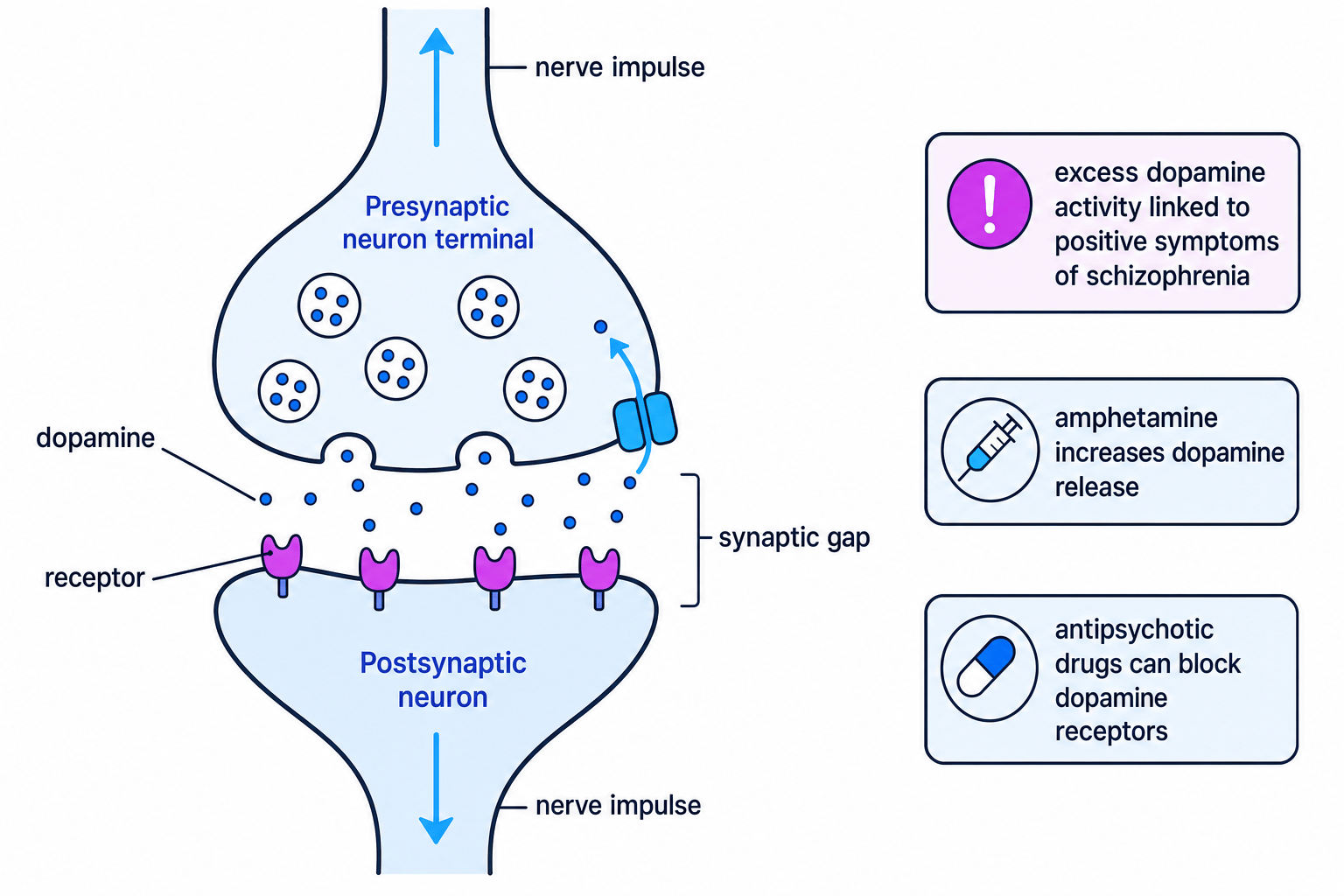
This explanation is part of the biological area because it focuses on brain activity, neurotransmitters and physical processes.
Key Idea
Dopamine hypothesis
The dopamine explanation links schizophrenia to abnormal dopamine activity, especially when explaining positive symptoms.
Evaluating the biological explanation
A strength is that it is scientific and supported by evidence from brain scans and drug research. For example, drugs that affect dopamine can affect psychotic symptoms.
A weakness is that it can be biologically reductionist. Schizophrenia is complex, and dopamine alone may not explain negative symptoms, life triggers, family stress or individual experiences.
This explanation leans towards nature in the nature/nurture debate because it focuses on biology. However, a more holistic view would include both inherited vulnerability and environmental stress.
Daniel, Weinberger, Jones et al. (1991): amphetamine and schizophrenia
The prescribed OCR study for schizophrenia is Daniel, Weinberger, Jones et al. (1991), titled The effect of amphetamine on regional cerebral blood flow during cognitive activation in schizophrenia. This study is also useful for the embedded Brain and Neuropsychology content because it links mental disorder to brain functioning.
Background
Amphetamine is a drug that increases dopamine activity. If dopamine is involved in schizophrenia, then giving amphetamine and measuring brain activity can help psychologists understand the disorder.
Regional cerebral blood flow means the amount of blood flowing to particular brain regions. More blood flow usually suggests that a brain area is more active.
Method
- Design: laboratory-based biological study.
- Sample: people with schizophrenia and comparison participants.
- Materials/apparatus: brain-imaging methods to measure regional cerebral blood flow, an amphetamine condition, and cognitive tasks to activate brain areas.
- Procedure: participants completed cognitive tasks while researchers measured blood flow in different brain regions after amphetamine.
Results and conclusion
The study found differences in brain blood flow patterns in participants with schizophrenia, especially during cognitive activation. This supported the idea that schizophrenia is linked to abnormal brain functioning, including systems affected by dopamine.
The study therefore supports a biological explanation of schizophrenia and fits clearly in the biological area of psychology.
Evaluation
A strength is the use of objective biological measures rather than only self-report. Brain blood flow is more scientific than simply asking someone how they feel.
A weakness is that the study involved a small and specialised sample, so it may not represent all people with schizophrenia. It also cannot explain the whole disorder on its own.
Ethically, this study required careful protection from harm because participants included people with a mental health disorder and amphetamine can affect mood and behaviour. The researchers needed informed consent, right to withdraw, confidentiality, debriefing and medical monitoring.
Common Mistake
Do not overclaim brain evidence
Brain differences can support a biological explanation, but they do not automatically prove that biology is the only cause of schizophrenia.
Comparing depression and schizophrenia
Depression and schizophrenia are both psychological disorders, but they are not the same.
Depression mainly involves persistent low mood, loss of pleasure and negative thinking. Schizophrenia involves symptoms such as hallucinations, delusions and reduced motivation.
In explanations, depression in this topic is strongly linked to cognitive and social factors through the ABC model and Tandoc et al. (2015). Schizophrenia is strongly linked to biological factors through dopamine and Daniel et al. (1991).
Tip
Quick comparison
For depression, think beliefs and mood. For schizophrenia, think dopamine and psychosis.
Debates you can use in evaluation
Nature versus nurture
Biological explanations of schizophrenia focus on nature: brain chemistry and inherited vulnerability. Tandoc et al. (2015) focuses more on nurture, because social media experiences and envy are environmental/social influences.
Reductionism versus holism
A reductionist answer explains a disorder using one factor, such as dopamine or irrational beliefs. A holistic answer combines biological, cognitive and social influences.
Freewill versus determinism
Biological explanations can sound deterministic because they suggest brain chemistry controls symptoms. Cognitive explanations allow more room for freewill because beliefs can be challenged, although it is still important not to blame people for their disorder.
Exam technique
In the exam
- For AO1, define the disorder clearly and use accurate terms such as hallucination, delusion, dopamine or ABC model.
- For AO2, apply the theory directly to the scenario: identify the symptom, belief, neurotransmitter or social comparison shown.
- For AO3, make a balanced judgement: give one strength, one weakness and link to a debate or ethical issue.
Self review
Check yourself
- How does the ABC model explain why the same event can lead to different emotional consequences?
- What is the difference between a positive and a negative symptom of schizophrenia?
- Why can Tandoc et al. (2015) show a relationship between Facebook envy and depression, but not prove causation?
You've reached the end
Test yourself on this topic, or move on to the next guide.
How was this guide?