Revision notes for OCR GCSE Psychology Sleep and Dreaming. Open the guide for explanations and worked examples. Written against the OCR GCSE Psychology (J203) specification, so the content matches what's examinable rather than general Psychology background.
Sleep and Dreaming
What you'll learn
- How sleep moves through NREM and REM stages across the night.
- How Freud’s dream theory explains dreams as disguised unconscious wishes.
- How activation-synthesis theory explains dreams as the brain making sense of random activity.
- How to use the two prescribed studies: Freud (1918) and Williams et al. (1992) for AO1, AO2 and AO3.
The starting point: what is sleep?
Sleep is an altered state of consciousness, which means your awareness of the outside world is reduced and your body follows a different pattern of brain activity from when you are awake.
A dream is a sequence of thoughts, images, emotions or sensations that happens during sleep. Dreams can occur in different stages, but vivid dreaming is especially linked with REM sleep.
Definition
REM and NREM sleep
REM sleep means rapid eye movement sleep: the eyes move quickly, brain activity is high, muscles are very relaxed, and vivid dreaming is common. NREM sleep means non-rapid eye movement sleep: this includes lighter sleep and deeper, more restorative sleep.
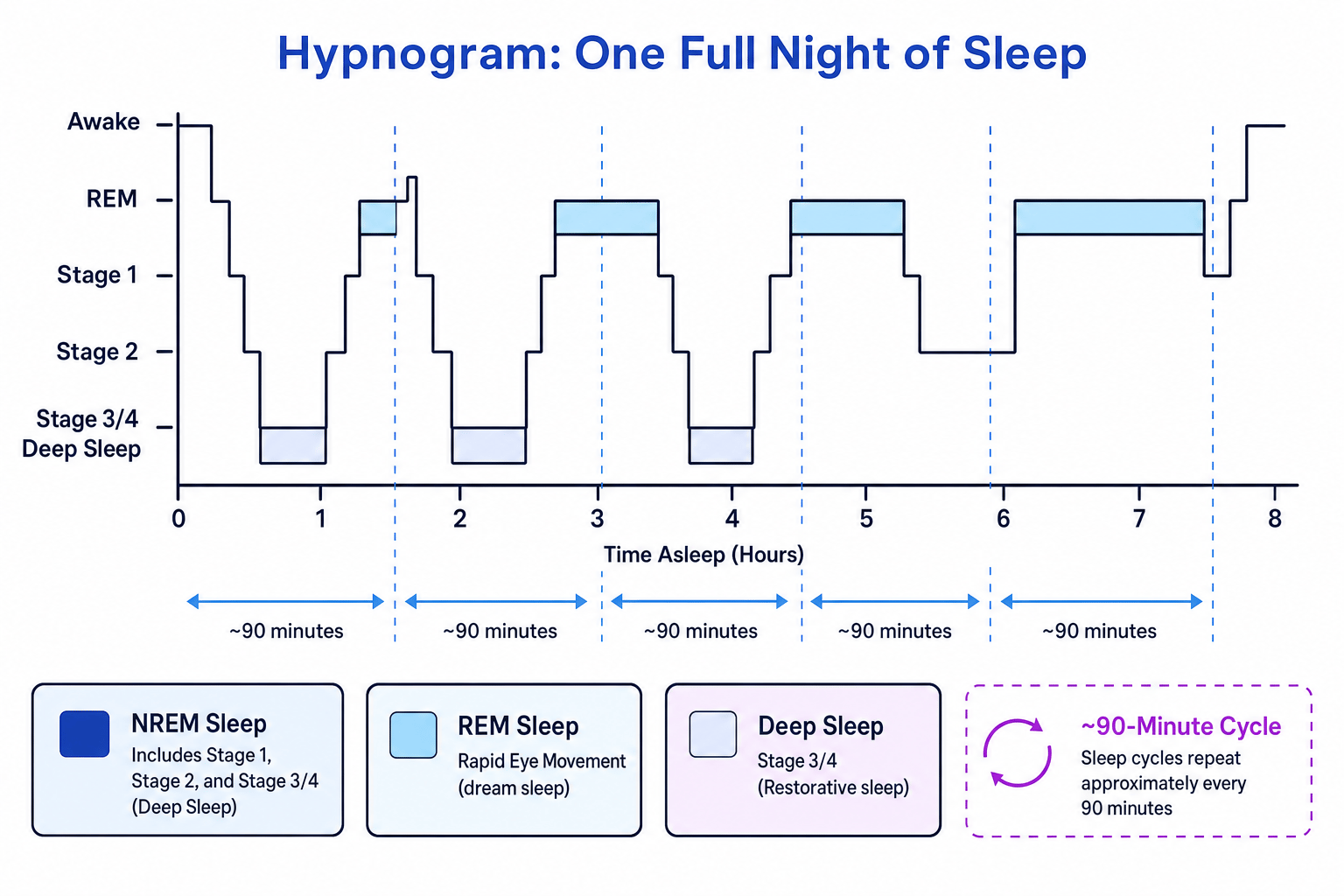
Sleep is not one long, flat state. You cycle through stages roughly every 90 minutes, moving down into deeper NREM sleep and then back up towards REM sleep. Early in the night, deep sleep is usually longer. Later in the night, REM periods usually become longer.
Key Idea
The sleep cycle
A normal night of sleep is made of repeated cycles. NREM sleep is linked with physical restoration, while REM sleep is strongly linked with vivid dreaming.
Example
Reading a hypnogram
A student sees a hypnogram where the sleeper reaches deep sleep in the first hour, then enters REM after about 90 minutes. Later REM periods last longer.
- Identify the pattern over time: the sleeper is not staying in one stage; they move through repeated sleep cycles.
- Link the early part of the night to deep NREM sleep: because the graph drops into stage 3/4, this suggests deeper restorative sleep.
- Link the later part of the night to REM sleep: because REM sections become longer towards morning, vivid dreams are more likely to be reported if the person wakes then.
Biological rhythms: why sleep follows a pattern
A circadian rhythm is a biological rhythm that follows roughly a 24-hour cycle, such as the sleep-wake cycle.
An endogenous pacemaker is an internal body clock. An exogenous zeitgeber is an external cue that resets or influences that clock. The most important zeitgeber for sleep is usually light.
Your brain uses light information to help regulate sleep. The pineal gland, a small gland in the brain, releases melatonin, a hormone that helps make you feel sleepy. In darkness, melatonin release increases; in bright light, it is reduced.
Tip
Remembering the rhythm words
Endogenous means “from inside”. Exogenous means “from outside”. Zeitgeber means a time-giver, such as daylight.
Common Mistake
REM is not the whole of sleep
Do not write as if people are only asleep during REM. REM is one stage within the wider sleep cycle. NREM stages are also important.
Why do we dream? Two explanations
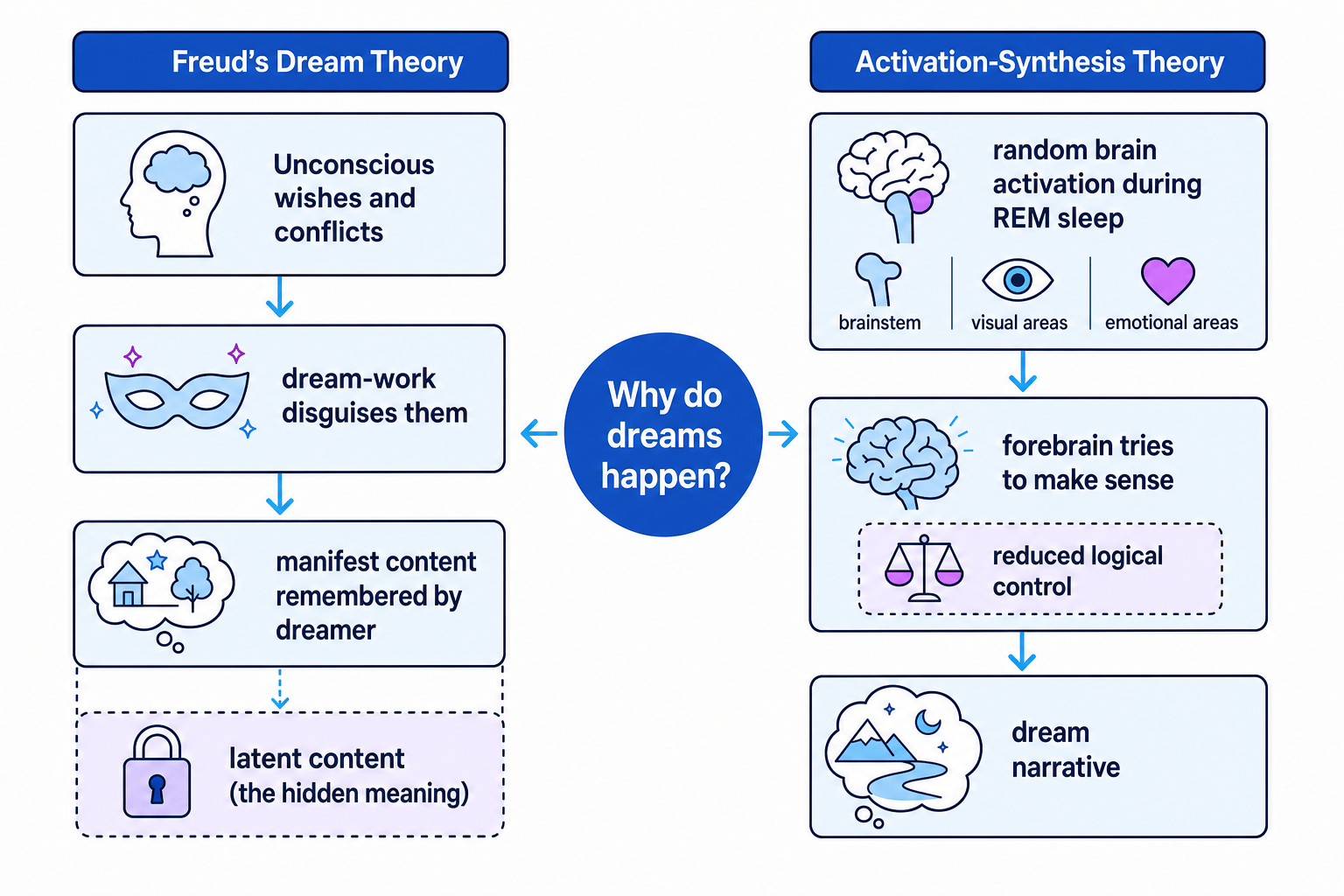
GCSE Psychology focuses on two very different explanations of dreaming. Freud’s theory is a psychological explanation based on unconscious meaning. Activation-synthesis theory is a biological explanation based on brain activity during REM sleep.
Freud’s dream theory
Sigmund Freud developed a psychodynamic theory, which means it explains behaviour using unconscious thoughts, wishes and conflicts.
Freud argued that dreams are a form of wish fulfilment. This means dreams express hidden desires, often linked to childhood experiences or unacceptable feelings. Because these wishes may be threatening or embarrassing, the mind disguises them.
Definition
Manifest and latent content
Manifest content is the dream as the dreamer remembers it, such as the people, objects and events. Latent content is the hidden meaning Freud believed was underneath the dream.
Freud also described dream-work, the mental process that turns hidden latent content into the safer manifest content. For example, a frightening animal in a dream might symbolise a feared person or conflict.
Key Idea
Freud’s main claim
For Freud, dreams are not random. They are meaningful clues to the unconscious mind, but their true meaning is disguised.
Core study: Freud (1918), The Wolfman
Background
Freud’s famous case study was about a Russian man often called the Wolfman. A case study is an in-depth investigation of one person or a very small group.
The Wolfman reported a childhood dream in which white wolves were sitting in a tree outside his bedroom window and staring at him. Freud believed this dream was important evidence of hidden childhood conflict.
Method
Freud used psychoanalysis, a therapy method that tries to uncover unconscious thoughts. He used techniques such as dream analysis and free association, where the patient says whatever comes to mind.
- Design: longitudinal case study, because Freud worked with the patient over a long period.
- Sample: one adult male patient.
- Materials: the patient’s dream reports, memories, symptoms and Freud’s notes.
- Procedure: Freud listened to the patient’s accounts and interpreted the dream symbols using psychodynamic theory.
Results and conclusions
Freud interpreted the wolves as symbols connected to the patient’s childhood fears and family relationships. He concluded that the dream’s manifest content hid a deeper latent meaning.
This study supports Freud’s view that dreams can reveal unconscious conflicts. It fits best in the individual differences core area because it focuses closely on one unusual individual, although it also links to childhood development.
Evaluation and ethics
A strength is that the case study produced rich, detailed qualitative data. This means Freud could explore the patient’s experiences in depth rather than reducing them to numbers.
However, the study has low generalisability, meaning the findings may not apply to other people. It is also difficult to test Freud’s interpretations scientifically. Another psychologist might interpret the same dream differently, so there is a risk of researcher bias.
Ethically, modern psychologists would consider the British Psychological Society Code of Ethics and Conduct. Issues include informed consent, protection from psychological harm, confidentiality, the right to withdraw and debriefing. Freud used a disguised name, but the case was very detailed, so confidentiality is still a concern.
Common Mistake
Freud is not just ‘dreams have meanings’
Freud’s theory is more specific: dreams disguise unconscious wishes or conflicts, so you need to mention manifest content, latent content or dream-work.
Activation-synthesis theory
Activation-synthesis theory explains dreams biologically. Activation means the brain is stimulated during REM sleep. Synthesis means the brain tries to organise this activity into a story.
During REM sleep, areas linked with emotion and visual experience may be active, while areas linked with logical control are less active. This helps explain why dreams can feel emotional, vivid and bizarre.
Definition
Activation-synthesis theory
Activation-synthesis theory says dreams happen because the sleeping brain receives random neural activity during REM sleep and then tries to make sense of it by creating a dream narrative.
This theory is more reductionist than Freud’s. Reductionism means explaining a complex behaviour using a simpler level of explanation, such as brain activity.
Core study: Williams et al. (1992), dream bizarreness
Background
Williams, Merritt, Rittenhouse and Hobson (1992) investigated whether dreams are more bizarre than waking fantasies. This matters because activation-synthesis theory predicts that dreams should contain strange jumps, odd images and illogical events.
Method
The researchers used self-report dream and fantasy accounts, then carried out content analysis. Content analysis means researchers code written or spoken material into categories.
- Design: comparison of dream reports and waking fantasy reports.
- Sample: a small volunteer sample.
- Materials: recorded or written accounts of dreams and fantasies, plus a coding system for bizarreness.
- Procedure: participants gave accounts of dreams and waking fantasies. Researchers coded the reports for bizarre features, such as discontinuities, incongruities and vague or impossible elements.
Results and conclusions
Dream reports contained more bizarre features than waking fantasies. This supported activation-synthesis theory because dreams seemed less logical and more fragmented than normal waking thought.
The study fits best in the biological core area because it links dreaming to brain activity during REM sleep, although it also uses cognitive evidence from dream reports.
Evaluation and ethics
A strength is that Williams et al. were more scientific than Freud because they used a coding system to compare dream content. If more than one researcher coded the reports, this could improve inter-rater reliability, which means checking whether different researchers agree.
A weakness is that dream reports rely on memory. People may forget parts of a dream or change details when describing it. Coding “bizarreness” can also be subjective.
Ethical issues are fairly mild, but researchers still need informed consent, confidentiality, the right to withdraw and debriefing. If participants were woken during sleep, protection from harm matters because sleep disruption could cause tiredness or discomfort.
Tip
Freud versus activation-synthesis
Freud asks: “What hidden meaning does this dream reveal?” Activation-synthesis asks: “How did the sleeping brain turn random activity into a dream?”
Example
Choosing the best explanation for a dream report
A student dreams they are in their school hall, then suddenly underwater, then talking to a giant clock before an exam.
- Apply Freud’s theory by looking for possible latent content: the exam setting could suggest hidden anxiety about performance or pressure.
- Apply activation-synthesis by focusing on bizarreness: the sudden jump from school to underwater and the giant clock fit the idea that the brain is stitching random activity into a narrative.
- Compare the explanations: Freud is stronger if the answer focuses on personal meaning, while activation-synthesis is stronger if the answer focuses on illogical dream features and REM brain activity.
The debates
Freud’s theory is deterministic, meaning it suggests dreams are shaped by unconscious forces outside conscious control. It is also more on the nurture side because it emphasises childhood experiences.
Activation-synthesis is also deterministic because dreams are caused by brain activity rather than free choice. It is strongly nature-based because it focuses on biological processes.
The two theories also differ on reductionism. Activation-synthesis reduces dreams to brain activity. Freud is broader because it considers emotions, childhood and unconscious conflict, but it can still be criticised for reducing many dreams to hidden wishes.
Exam technique
In the exam
- For AO1, name the theory and use precise terms: manifest content, latent content, REM sleep, activation and synthesis.
- For AO2, link details from the scenario to the theory rather than writing everything you know.
- For AO3, evaluate using evidence, method, ethics and debates; include the researcher and year for the two core studies.
Self review
Check yourself
- How does REM sleep differ from NREM sleep?
- What did Freud think the Wolfman’s dream showed about the unconscious mind?
- How did Williams et al. (1992) test the idea that dreams are bizarre?
You've reached the end
Test yourself on this topic, or move on to the next guide.
How was this guide?