Revision notes for OCR GCSE Psychology Development. Open the guide for explanations and worked examples. Written against the OCR GCSE Psychology (J203) specification, so the content matches what's examinable rather than general Psychology background.
Development
What you'll learn
- How Piaget explained children’s cognitive development through schemas, stages and conservation.
- What Piaget (1952) found in The Child’s Conception of Number.
- How Dweck’s fixed and growth mindsets can affect learning.
- What Blackwell, Trzesniewski and Dweck (2007) found about mindset, motivation and achievement.
Why these two texts matter
For OCR GCSE Psychology J203, the Development topic is anchored in two prescribed research texts:
- Piaget (1952), The Child’s Conception of Number, Chapter 4.
- Blackwell, Trzesniewski and Dweck (2007), “Implicit Theories of Intelligence Predict Achievement Across an Adolescent Transition”.
Both studies sit mainly in the developmental core area, because they investigate how thinking, learning and achievement change with age and experience.
Definition
Development
Development means the way people change over time. In this topic, you mainly look at cognitive development, meaning changes in thinking, reasoning, understanding and problem-solving.
Piaget: children build their understanding
Jean Piaget argued that children are not just “less clever adults”. He believed children think in qualitatively different ways at different ages — meaning the type of thinking changes, not just the amount they know.
Schemas, assimilation and accommodation
A schema is a mental framework that helps you understand the world. For example, a young child might have a schema for “dog” as “small furry animal with four legs”.
Definition
Schema
A schema is a mental structure or pattern of knowledge that helps a person organise and interpret information.
Piaget said children adapt their schemas in two main ways:
- Assimilation: fitting new information into an existing schema.
- Accommodation: changing a schema because new information does not fit.
- Equilibration: the process of restoring mental balance when new experiences challenge old schemas.
Example
Classifying schema change
A child sees a zebra for the first time and says, “Horse!”
- The child uses their existing “horse” schema because the zebra has four legs, a mane-like shape and is a similar size. This is assimilation.
- An adult explains that a zebra has stripes and is a different animal from a horse. The old schema is not enough, so the child must change their understanding.
- The child creates or adjusts a schema for “zebra”. This is accommodation, because their mental framework has changed.
Piaget’s invariant stages
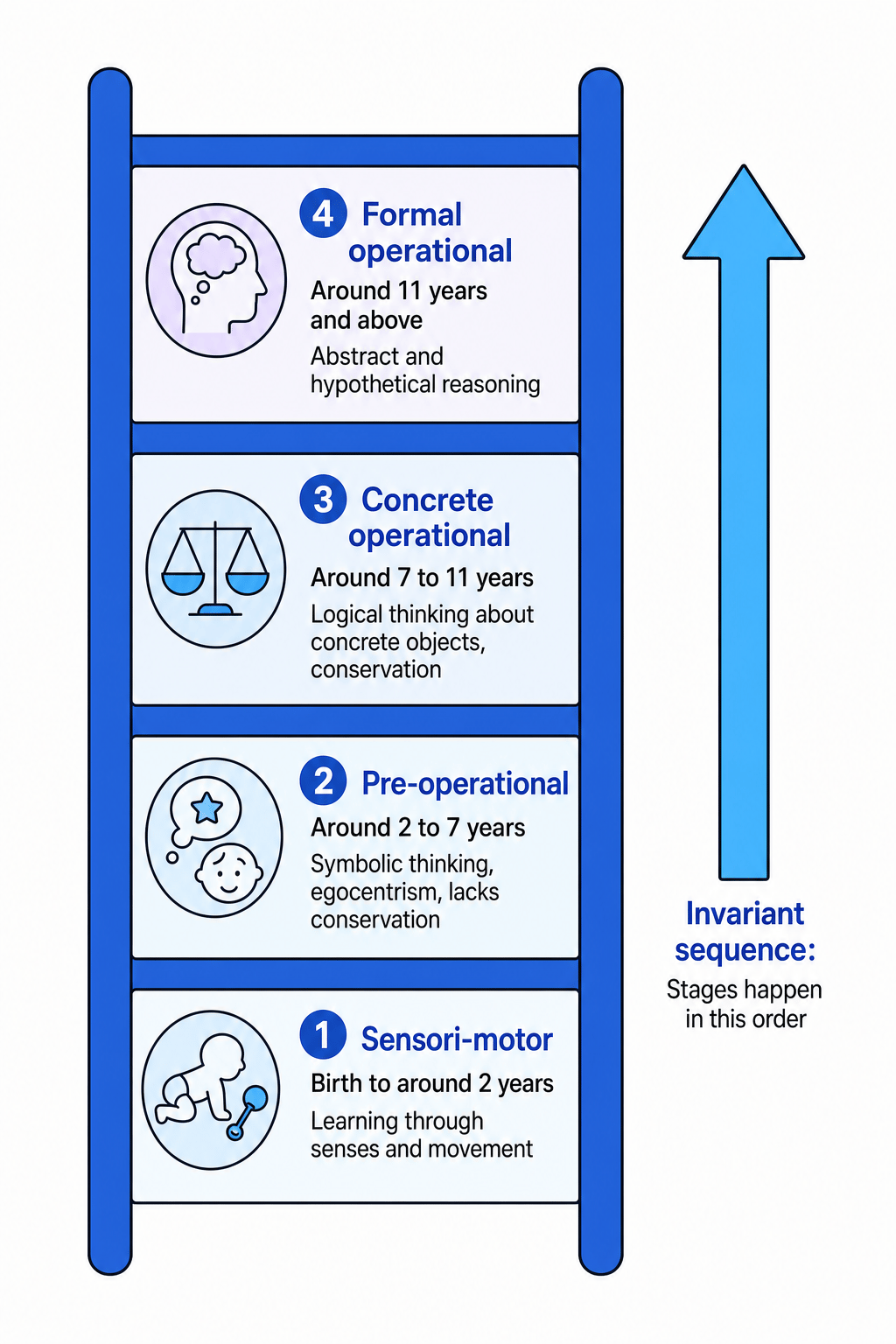
Piaget believed children move through four invariant stages. Invariant means the stages happen in the same order for everyone, although children may move through them at slightly different speeds.
The four stages are:
- Sensori-motor stage: birth to about 2 years; learning through senses and movement.
- Pre-operational stage: about 2 to 7 years; symbolic thinking develops, but reasoning is still limited.
- Concrete operational stage: about 7 to 11 years; children can reason logically about real, concrete objects.
- Formal operational stage: about 11 years and above; abstract and hypothetical thinking develops.
Key Idea
Piaget’s big idea
Piaget believed children’s thinking develops through active discovery, as they adapt schemas and move through stages in a fixed order.
Common Mistake
Treating stage ages as exact
Do not write as if every child suddenly changes on their seventh birthday. Piaget’s ages are approximate, and individual children may develop at different rates.
Conservation of number
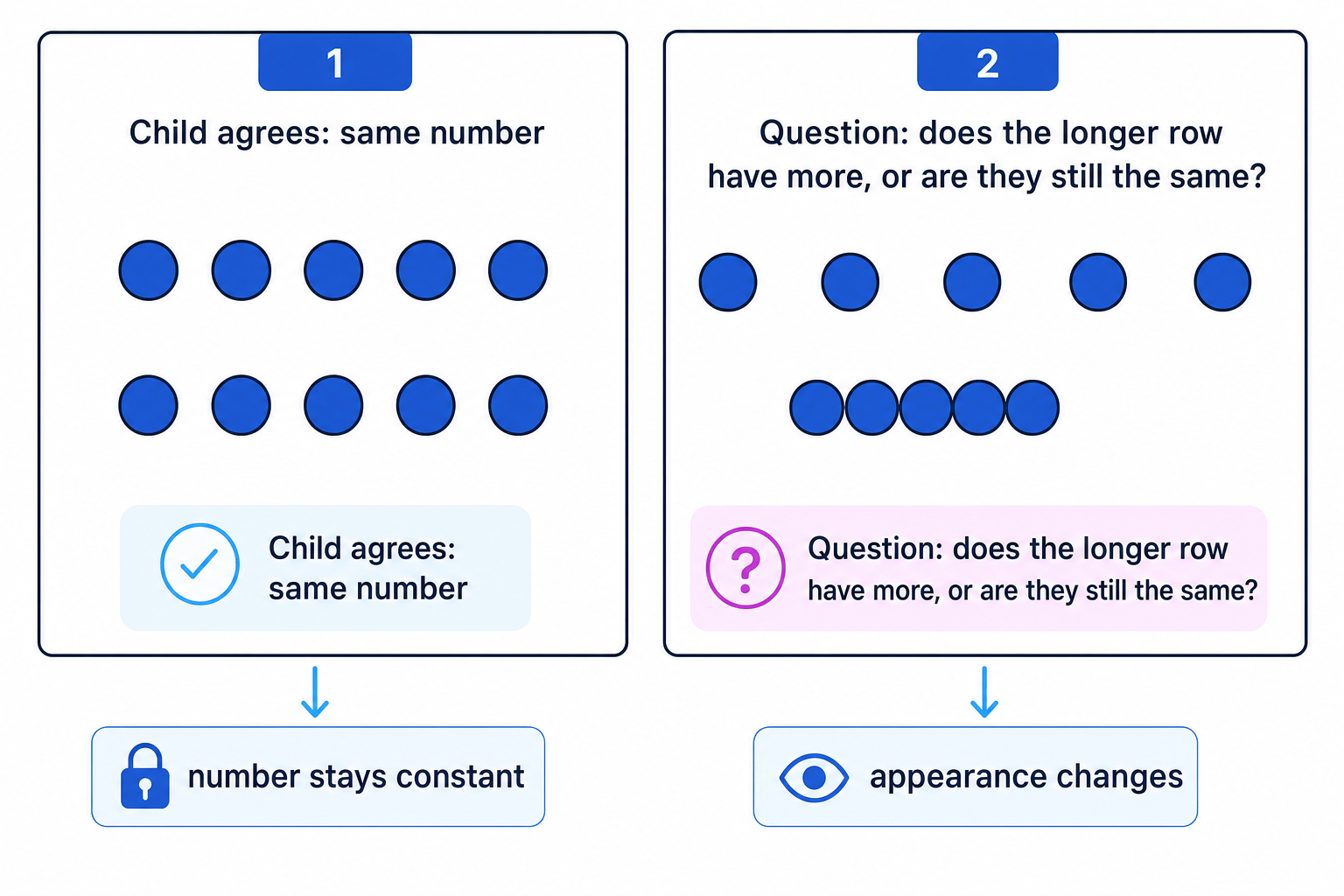
A key idea in Piaget’s work is conservation. This is the understanding that quantity stays the same even when appearance changes.
For example, if two rows both contain five counters, spreading one row out does not create more counters. The number is still five.
You also need these terms:
- Centration: focusing on one feature of a situation, such as length, and ignoring others.
- Reversibility: understanding that an action can be mentally reversed.
- Compensation: understanding that one change can be balanced by another, such as a row being longer but more spaced out.
Example
Inferring a child’s stage from a conservation response
Maya is shown two equal rows of counters. One row is spread out. Maya says the spread-out row has more counters “because it is longer”.
- The task is testing conservation of number, because the number of counters stays the same while the appearance changes.
- Maya focuses on the row’s length rather than the unchanged number of counters. This shows centration.
- Maya does not mentally reverse the spreading-out action, so she is not yet using reversibility.
- Piaget would place Maya in the pre-operational stage or a transitional point before concrete operational thinking.
Core study: Piaget (1952)
Piaget’s The Child’s Conception of Number investigated how children develop an understanding of number. Chapter 4 focuses on children’s ability to conserve number.
Background and aim
Piaget wanted to understand when children realise that number stays constant even if objects are rearranged. This was important because it supported his wider theory that children’s reasoning develops in stages.
Method
Piaget used a clinical interview, meaning a flexible questioning method where the researcher asks children questions and follows up their answers to understand their reasoning.
The study used children, mainly young children from Piaget’s own cultural setting, and simple materials such as rows of counters or beads.
A typical procedure was:
- The child was shown two rows with the same number of objects.
- The child agreed the rows had the same number.
- One row was spread out or moved closer together.
- The child was asked whether the rows still had the same number.
Results
Piaget found that younger children often said the longer row had more objects. Older children were more likely to understand that the number stayed the same.
He suggested three broad levels:
- Younger children failed conservation and judged by appearance.
- Some children were in transition and gave mixed answers.
- Older children conserved number and explained using identity, reversibility or compensation.
Conclusions
Piaget concluded that children develop conservation as their thinking becomes more logical. Conservation of number is linked to the move from the pre-operational stage to the concrete operational stage.
Evaluation
A strength is that Piaget’s task was simple and focused closely on children’s reasoning. It produced rich data because he asked children to explain their answers.
However, there are important weaknesses. The sample was small and not very representative, so generalisability — how far findings apply to other people — is limited. The task may also have lacked validity, meaning it might not have measured only conservation. Some children may have thought the repeated question meant their first answer was wrong.
The study also has low ecological validity, meaning it was not very like everyday life. Children do not usually answer formal questions about rows of counters outside a research setting.
Ethically, because children were used, modern researchers would need parental informed consent, protection from psychological harm, the right to withdraw, confidentiality and a debrief. The task itself was low risk, but children should not be made to feel foolish if they answered incorrectly.
Dweck: beliefs about intelligence
Carol Dweck’s theory focuses on mindset, which means a person’s belief about whether intelligence and ability can change.
Definition
Mindset
A mindset is a belief about ability. In Dweck’s theory, a person may see intelligence as fixed or as something that can grow through effort, strategies and learning.
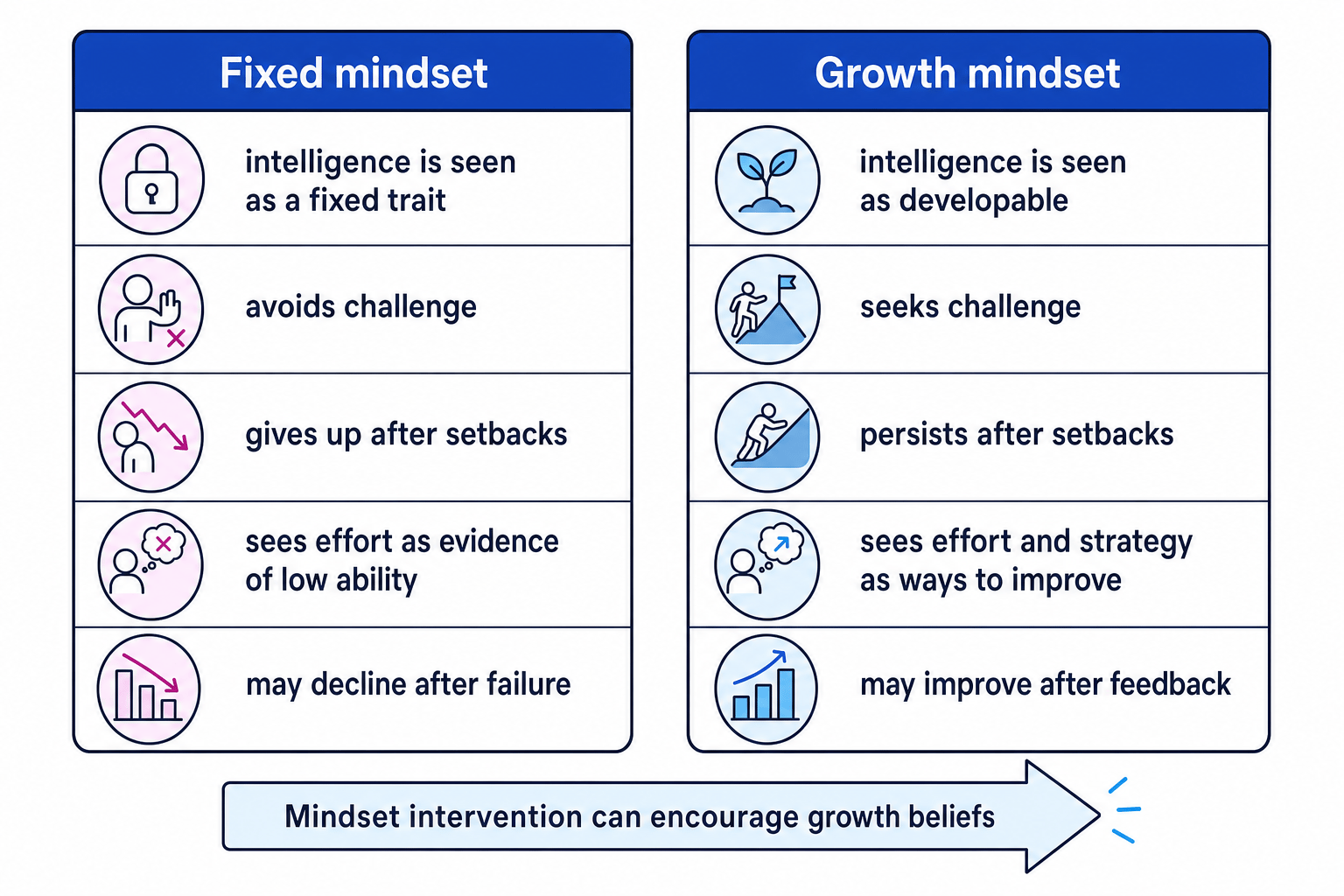
A fixed mindset means believing intelligence is a fixed trait. A student with a fixed mindset may avoid challenge because failure feels like proof they are “not clever”.
A growth mindset means believing intelligence can develop. A student with a growth mindset is more likely to see mistakes as useful feedback.
Common Mistake
Growth mindset is not just “try harder”
Dweck’s theory is not simply telling students to put in more effort. It is about effort plus better strategies, feedback, persistence and the belief that improvement is possible.
Example
Applying mindset theory to feedback
Amir gets a low mark and says, “I’m just bad at maths, so there is no point revising.”
- Amir explains the result as a fixed lack of ability, so this suggests a fixed mindset.
- Because he sees the mark as proof he cannot improve, Dweck would predict avoidance or giving up after setbacks.
- A better teacher response would praise strategy and progress, such as “Your method improved here; now try a different revision technique for the harder questions.”
- This feedback encourages a growth mindset because it links improvement to changeable factors.
Core study: Blackwell, Trzesniewski and Dweck (2007)
Blackwell et al. studied whether beliefs about intelligence predicted achievement during an adolescent school transition.
A longitudinal study follows the same participants over time. An intervention is a planned programme designed to create change.
Background and aim
The researchers wanted to see whether students’ beliefs about intelligence affected motivation and maths achievement. They also wanted to test whether teaching a growth mindset could improve outcomes.
Method
The paper included two linked parts.
In the first part, around 373 seventh-grade students in the USA completed questionnaires measuring their beliefs about intelligence, goals, attitudes to effort and responses to setbacks. Their maths grades were then tracked over time.
In the second part, 91 students took part in an intervention. One group received study skills and a message that intelligence can grow because the brain can form new connections. A comparison control group received study skills without the growth-mindset message.
Results
Students with more of a growth mindset were more likely to show positive motivation and better maths progress. Students with a fixed mindset were more likely to show helpless responses after difficulty.
In the intervention, the group taught that intelligence could grow showed improved motivation and a better pattern of maths grades compared with the control group.
Conclusions
Blackwell et al. concluded that beliefs about intelligence can affect learning behaviour and achievement. Teaching a growth mindset may help students cope better with academic challenge.
Evaluation
A strength is high ecological validity because the research used real students and real school grades. The intervention also has clear real-world application in education.
Another strength is the use of a control group. This helps show that improvement was linked to the growth-mindset message, not just extra attention from adults.
However, the first part was partly correlational. A correlation is a relationship between two variables, but it does not prove that one causes the other. Also, questionnaires can be affected by social desirability, where participants give answers they think sound good.
Generalisability is limited because the sample came from a specific US school context. The findings may not apply equally to all cultures, schools or age groups.
Ethically, school-based research with children needs informed consent from parents or guardians, confidentiality of grades and questionnaire answers, the right to withdraw and protection from harm. The control group still received useful study skills, which helps reduce ethical concerns.
Comparing the theories and debates
Piaget and Dweck both matter for education, but they explain learning differently.
Piaget focuses on children’s stage of cognitive development. His theory supports active learning, discovery and using concrete materials with younger children.
Dweck focuses on beliefs, motivation and response to failure. Her theory supports feedback that praises effort, strategies and improvement rather than fixed talent.
For the nature/nurture debate, Piaget gives some importance to maturation, but also to interaction with the environment. Dweck is more strongly on the nurture side because beliefs can be shaped by feedback and teaching.
For freewill/determinism, Dweck allows more room for change because students can learn new beliefs and strategies. Piaget can sound more deterministic because the stage sequence is fixed.
For reductionism/holism, both theories can be criticised for simplifying learning. Piaget may reduce development to stages, while Dweck may reduce achievement too much to mindset, when factors such as teaching quality, home background and mental health also matter.
Tip
Link AO1, AO2 and AO3
For a strong answer, describe the theory, apply it to the child or student in the scenario, then evaluate using evidence from Piaget (1952) or Blackwell et al. (2007).
Exam technique
In the exam
- Name the researcher and year accurately: Piaget (1952) or Blackwell, Trzesniewski and Dweck (2007).
- For application questions, identify the behaviour first, then link it to the correct term: conservation, centration, fixed mindset or growth mindset.
- For evaluation, include one strength and one weakness, and explain why each affects validity, generalisability, ethics or real-world usefulness.
Self review
Check yourself
- How would Piaget explain a child saying the longer row has more counters?
- What is the difference between assimilation and accommodation?
- Why does Blackwell et al. (2007) support Dweck’s growth mindset theory?
You've reached the end
Test yourself on this topic, or move on to the next guide.
How was this guide?