Revision notes for OCR GCSE Psychology Criminal Psychology. Open the guide for explanations and worked examples. Written against the OCR GCSE Psychology (J203) specification, so the content matches what's examinable rather than general Psychology background.
Criminal Psychology
What you'll learn
- How psychologists define and measure criminal, delinquent and antisocial behaviour.
- How Social Learning Theory explains crime through observing and copying others.
- How Eysenck’s personality theory links delinquency to dispositional traits.
- What Cooper & Mackie (1986) and Heaven (1996) found, plus how to evaluate them for AO3.
The big question in Criminal Psychology
Criminal Psychology asks: why do some people break rules, harm others, or offend? At GCSE, you need to describe explanations, apply them to short scenarios, and evaluate the evidence behind them.
Definition
Key starting terms
- A crime is an act, or failure to act, that breaks the law.
- Delinquency usually means criminal or antisocial behaviour by young people.
- Antisocial behaviour is behaviour that harms, threatens or upsets other people, even if it is not always a criminal offence.
- Aggression is behaviour intended to harm another person physically or psychologically.
Crime is not fixed forever. Laws vary across countries and change over time, so psychologists often study related behaviours such as aggression, rule-breaking and self-reported delinquency.
Common Mistake
Aggression is not automatically crime
Cooper & Mackie (1986) studied aggression after video-game exposure. This can help us understand antisocial behaviour, but it does not prove that video games turn children into criminals.
How criminal behaviour can be measured
Researchers cannot always wait for official convictions, so they use different ways to measure behaviour.
| Method | What it means | Example in this topic | Strength | Weakness |
|---|---|---|---|---|
| Observation | Watching and recording behaviour | Cooper & Mackie observed children’s play | Direct behaviour is measured | May be artificial or open to observer bias |
| Self-report | People answer questions about themselves | Heaven used self-reported delinquency | Can reveal hidden behaviour | People may lie or forget |
| Longitudinal research | Studying people over time | Heaven followed personality and delinquency over time | Helps show patterns across time | Takes longer and may lose participants |
Explanation 1: Social Learning Theory
Definition
Social Learning Theory
Social Learning Theory is the idea that behaviour is learned by observing other people, especially role models, and by seeing the consequences of their behaviour.
This explanation is mainly a nurture explanation because it focuses on learning from the environment: family, friends, media, school and wider society.
The key steps
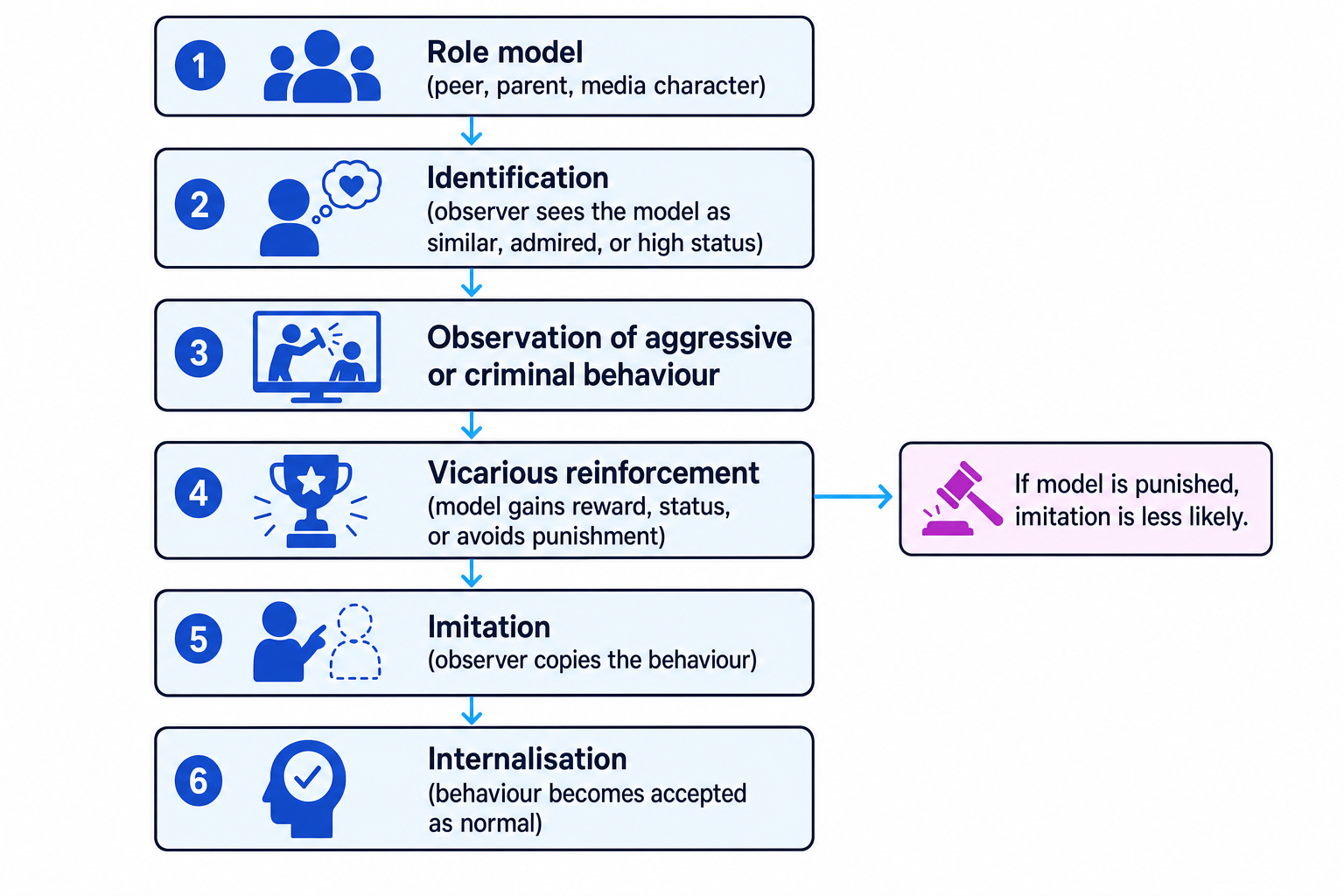
A role model is someone whose behaviour may be copied. This could be a parent, older sibling, peer, celebrity, online influencer or fictional character.
Identification means the observer sees the model as similar, attractive, powerful or high status. This makes copying more likely.
Observation means watching the model’s behaviour.
Imitation means copying the behaviour.
Vicarious reinforcement means learning from the consequences another person receives. If a model is rewarded, admired or gets away with antisocial behaviour, the observer may be more likely to copy it.
Internalisation means the behaviour becomes accepted as normal or part of the person’s own attitudes.
The chain below shows how Social Learning Theory explains antisocial or criminal behaviour.
Key Idea
Social Learning Theory in one sentence
People may learn criminal or antisocial behaviour by watching role models, seeing them rewarded, then copying and internalising that behaviour.
Example
Applying social learning theory to shoplifting
A teenager starts stealing small items after watching an older friend do it.
- The older friend acts as a role model because the teenager admires them and wants their approval.
- The teenager observes the friend shoplifting and notices vicarious reinforcement: the friend gains free items and status without being punished.
- The teenager imitates the behaviour by stealing too, and repeated success may lead to internalisation, where shoplifting starts to feel normal.
Core study: Cooper & Mackie (1986)
Cooper & Mackie’s study, Video Games and Aggression in Children, is the prescribed research study linked to Social Learning Theory. It fits mainly into the social core area because it examines how behaviour may be influenced by the social environment and media.
Aim
The researchers wanted to investigate whether playing an aggressive video game would affect children’s aggressive behaviour afterwards.
Method
This was an experimental study with children. The children were placed into different conditions, such as playing an aggressive video game, playing a non-aggressive game, or completing a non-game control task.
Afterwards, the researchers observed the children’s behaviour during play. They looked for aggressive behaviour, such as aggressive choices or actions during the free-play period.
Results and conclusions
Cooper & Mackie found that exposure to an aggressive video game could influence children’s behaviour, although the effects were not equally strong for all children. The study is often used to support the idea that children can be affected by aggressive models in media.
The conclusion was that media can play a role in aggression, but it is not a simple “video games cause crime” finding.
Evaluation
A strength is that the study used an experimental method, so researchers had control over the type of game children experienced. This makes it easier to compare conditions.
Another strength is that behaviour was observed rather than only asked about. This avoids some problems of self-report, such as children giving socially desirable answers.
A weakness is that aggressive play is not the same as real criminal behaviour. This limits how far the findings can be generalised to actual offending.
There are also ethical issues. Because the study involved children, protection from harm, informed consent from adults, the right to withdraw and debriefing were especially important under the British Psychological Society’s Code of Ethics and Conduct.
Explanation 2: Eysenck’s personality theory
Definition
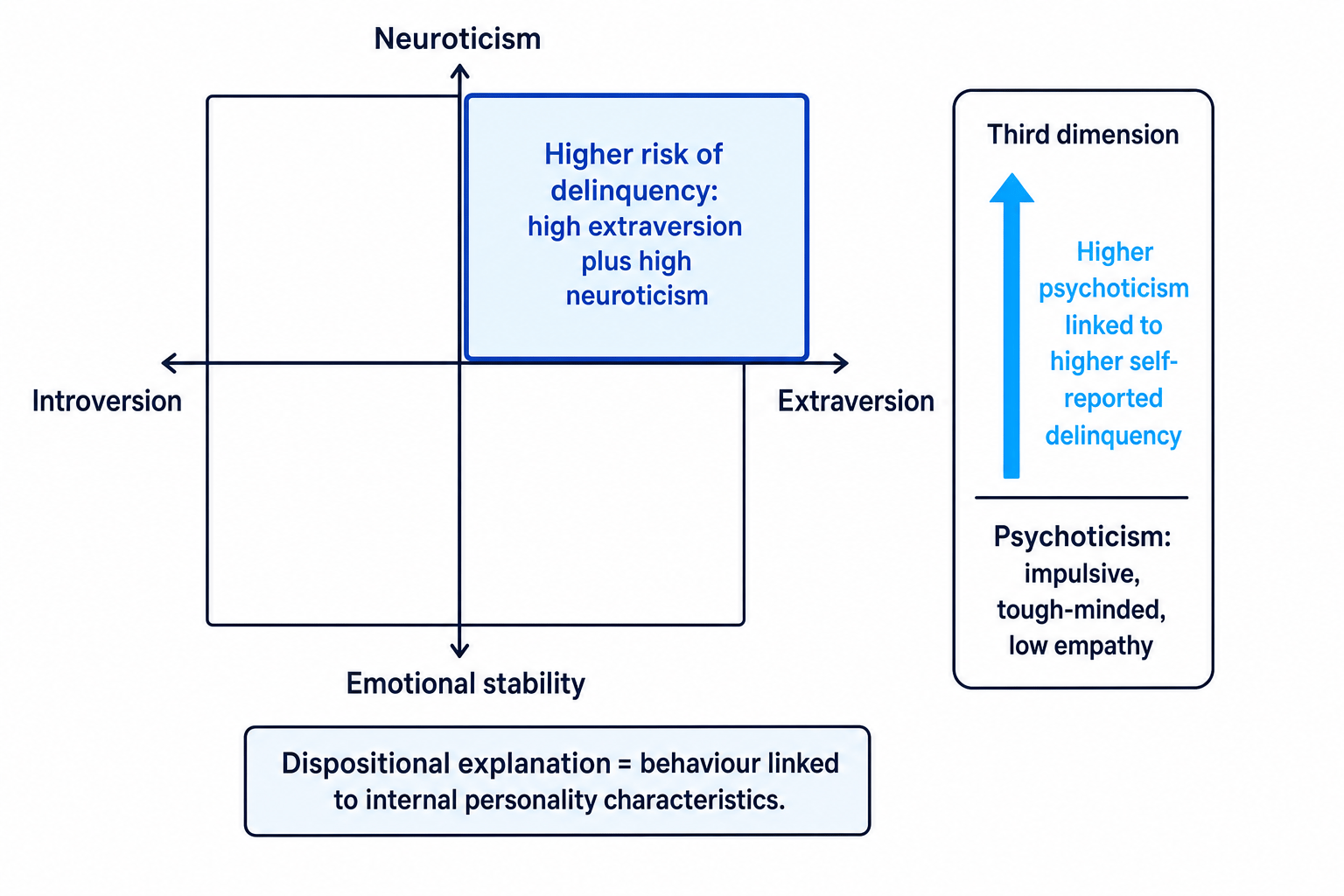
Dispositional explanation
A dispositional explanation says behaviour is caused by internal characteristics of the person, such as personality traits, rather than only by the situation.
Eysenck argued that some people have a criminal personality, meaning a pattern of traits that makes offending more likely. This does not mean someone is guaranteed to offend; it means they may be at higher risk.
The three personality dimensions
Extraversion means being outgoing, sensation-seeking and under-stimulated by the environment. Eysenck suggested extraverts may seek excitement and take risks.
Neuroticism means being emotionally unstable, anxious or reactive. Eysenck suggested highly neurotic people may react strongly and struggle with emotional control.
Psychoticism means being tough-minded, impulsive, aggressive and low in empathy. This dimension is especially linked with rule-breaking and delinquency.
Eysenck suggested that people high in extraversion, neuroticism and psychoticism may be less easily socialised. In other words, they may not develop a strong conscience through punishment and learning as effectively as other people.
Key Idea
Eysenck in one sentence
Eysenck’s theory says delinquency is more likely in people with certain personality traits, especially high psychoticism, high extraversion and high neuroticism.
Example
Applying Eysenck’s theory to a scenario
A student often takes risks, loses their temper quickly and shows little concern when others are upset.
- Risk-taking and seeking excitement suggest high extraversion, because the student appears to need stimulation.
- Losing their temper quickly suggests high neuroticism, because their emotional reactions seem unstable.
- Showing little concern for others suggests high psychoticism, which Eysenck linked most strongly to delinquent behaviour.
Core study: Heaven (1996)
Heaven’s study, Personality and Self-Reported Delinquency: A Longitudinal Analysis, is the prescribed research study linked to Eysenck’s theory. It fits mainly into the individual differences core area because it looks at how people differ in personality and delinquency.
Aim
Heaven wanted to investigate whether personality traits were related to self-reported delinquency over time.
Method
This was a longitudinal study, meaning participants were studied across a period of time rather than only once.
Participants completed personality questionnaires, including measures linked to Eysenck’s dimensions. They also completed self-report measures of delinquency, where they reported their own rule-breaking or antisocial behaviour.
Results and conclusions
Heaven found a relationship between personality and self-reported delinquency. In particular, psychoticism was an important predictor of delinquency.
The conclusion supports Eysenck’s idea that personality traits are linked to criminal or delinquent behaviour. However, it does not mean personality is the only cause of crime.
Evaluation
A strength is that the study was longitudinal. This is useful because it looks at whether personality is related to delinquency across time, rather than just taking a one-off snapshot.
A weakness is that delinquency was self-reported. Participants may have exaggerated, forgotten incidents, or hidden behaviour because they were embarrassed or worried about consequences.
Another weakness is that the study shows a relationship, not a definite cause. High psychoticism may be linked with delinquency, but this does not prove it directly causes offending.
Ethically, confidentiality was very important because participants were reporting sensitive information about possible rule-breaking. Researchers also needed informed consent, the right to withdraw, protection from psychological harm and debriefing.
Comparing the two explanations
| Explanation | Main focus | Nature or nurture? | Best supporting study | Key criticism |
|---|---|---|---|---|
| Social Learning Theory | Learning from role models and rewards | Mostly nurture | Cooper & Mackie (1986) | Not everyone copies what they observe |
| Eysenck’s theory | Internal personality traits | More nature, but includes learning | Heaven (1996) | Personality links do not prove causation |
Debates and evaluation themes
Freewill and determinism
Social Learning Theory can be seen as deterministic because it suggests behaviour is shaped by the environment. Eysenck’s theory can also be deterministic because it suggests personality traits make offending more likely.
However, neither theory says people have no choice at all. A balanced answer can say these theories explain risk factors, not certain outcomes.
Nature and nurture
Eysenck’s theory leans towards nature because it links behaviour to personality and biological arousal. Social Learning Theory leans towards nurture because it focuses on observed behaviour, role models and reinforcement.
A strong GCSE answer can argue that criminal behaviour may involve both: personality may make someone more impulsive, while the environment may teach them which behaviours are acceptable.
Reductionism and holism
A reductionist explanation reduces criminal behaviour to one main cause. Eysenck’s theory could be criticised for reducing crime to personality. Social Learning Theory could be criticised for reducing crime to observed learning.
A more holistic view would include personality, family, peers, poverty, media, education, opportunity and personal choice.
Tip
Evaluation shortcut
For AO3, avoid saying “the theory is wrong”. Instead say what it explains well, what it struggles to explain, and what evidence supports or challenges it.
Exam technique
In the exam
- For AO1, use the key terms accurately: identification, imitation, vicarious reinforcement, internalisation, extraversion, neuroticism and psychoticism.
- For AO2, link the scenario directly to the theory: who is the role model, what reward is observed, or which personality trait is shown?
- For AO3, evaluate using evidence, method, ethics and debates — especially nature/nurture, freewill/determinism, and reductionism/holism.
Self review
Check yourself
- How does vicarious reinforcement make imitation more likely?
- Which Eysenck personality dimension is most strongly linked to delinquency in Heaven (1996)?
- Why is it a mistake to treat aggressive play as the same thing as criminal behaviour?
You've reached the end
Test yourself on this topic, or move on to the next guide.
How was this guide?