Revision notes for OCR GCSE Psychology Key Concepts. Open the guide for explanations and worked examples. Written against the OCR GCSE Psychology (J203) specification, so the content matches what's examinable rather than general Psychology background.
Key Concepts
What you'll learn
- Why sleep benefits your brain, body and emotional stability.
- How the sleep cycle works, including when dreaming is most likely.
- How the pineal gland, melatonin, endogenous pacemakers and exogenous zeitgebers help regulate sleep.
- How to tell the difference between sleep onset insomnia and sleep maintenance insomnia.
Sleep: the starting point
Sleep is not just “doing nothing”. Your body is less responsive to the outside world, but your brain and body are still active.
Definition
Sleep
Sleep is a naturally occurring, reversible state where awareness of the environment is reduced and the body follows regular patterns of brain activity, muscle activity and hormone release.
Sleep is reversible because you can be woken up. This separates it from states such as coma. It is also cyclical, meaning you pass through different stages repeatedly during the night.
The functions, features and benefits of sleep
Sleep has several important functions. For GCSE, focus on three main benefits: a healthy brain, physical repair and emotional stability.
A healthy brain
Sleep supports good brain functioning. After enough sleep, you are more likely to concentrate, learn new information, remember material and make sensible decisions.
One important idea is memory consolidation, which means strengthening memories after learning. This is why revising and then sleeping can be more useful than revising all night and staying awake.
Physical repair
Sleep helps the body recover. During deeper sleep, the body is associated with processes such as tissue repair, immune system support and the release of growth hormone.
This does not mean your body only repairs itself during sleep, but sleep gives the body a better chance to recover properly.
Emotional stability
Sleep also helps regulate mood. When you are sleep deprived, you may become more irritable, anxious, tearful or impulsive. Enough sleep helps you cope better with stress and manage emotional reactions.
Key Idea
Why sleep matters
Sleep supports thinking, physical recovery and mood regulation. A good answer should link the benefit to the correct area: brain, body or emotions.
Example
Linking symptoms to sleep functions
A student sleeps for only three hours before school. The next day, they forget parts of a test, snap at a friend and feel physically drained.
- The forgetting in the test links to the healthy brain function because sleep supports attention, learning and memory consolidation.
- Snapping at a friend links to emotional stability because poor sleep can make emotional reactions stronger.
- Feeling physically drained links to physical repair because sleep helps the body recover and restore energy.
The sleep cycle
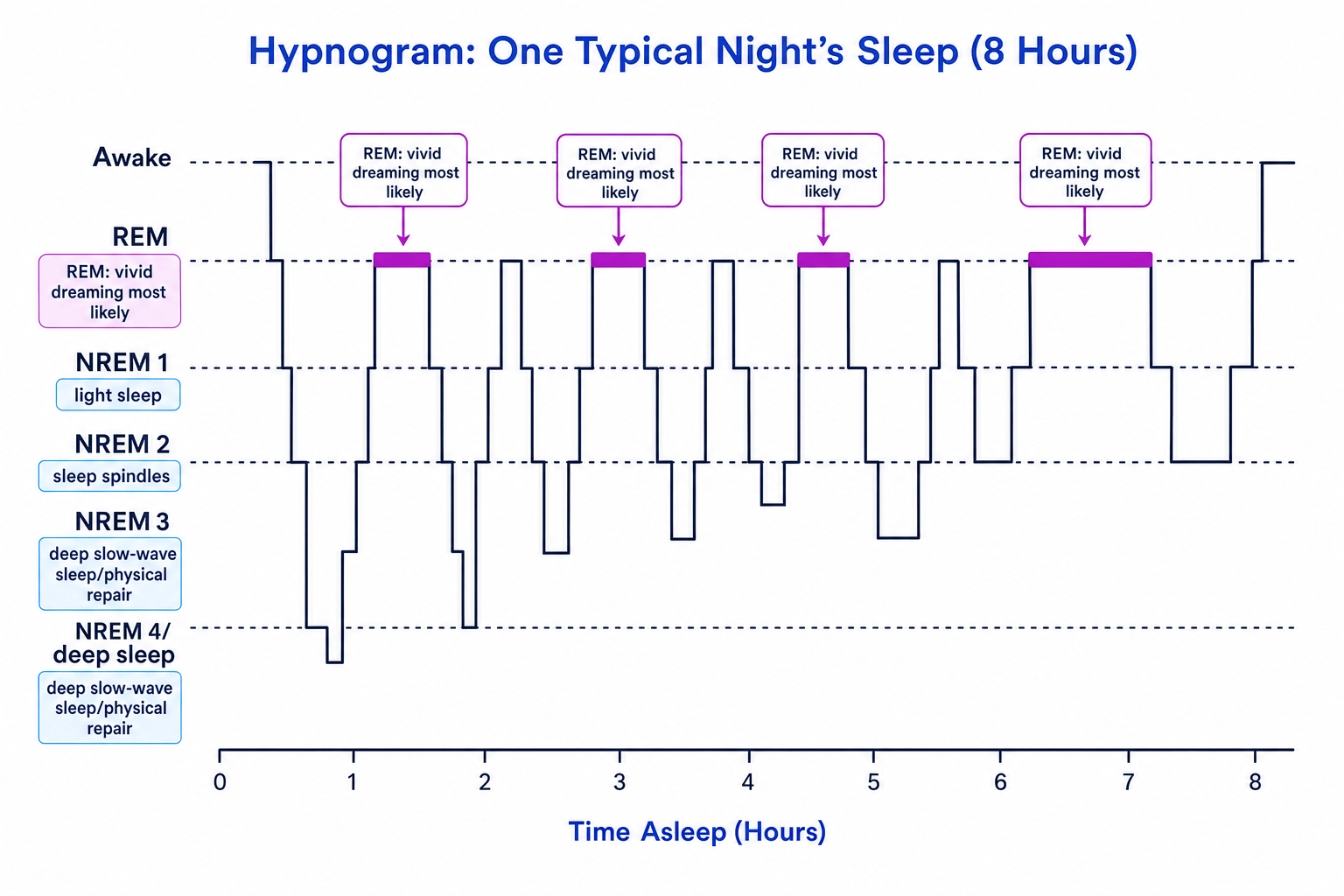
A typical night’s sleep is made up of repeated cycles. Each cycle lasts roughly 90 minutes, although this varies between people.
Definition
Sleep cycle
The sleep cycle is the repeated pattern of sleep stages that a person passes through during the night, including NREM sleep and REM sleep.
NREM sleep
NREM sleep means non-rapid eye movement sleep. It is usually divided into stages from lighter sleep to deeper sleep.
- NREM stage 1: very light sleep; you can be woken easily.
- NREM stage 2: a deeper light sleep; heart rate and body temperature tend to fall.
- NREM stages 3 and 4: deep sleep, also called slow-wave sleep; this is strongly linked to physical restoration.
REM sleep
REM sleep means rapid eye movement sleep. During REM sleep, the brain is active, the eyes move rapidly under the eyelids, and the body’s major muscles are very relaxed.
REM sleep is the stage most strongly associated with vivid dreaming. Dreams can happen in other stages too, but REM dreams are usually more vivid and easier to remember.
Common Mistake
Dreaming only happens in REM
Do not write that dreaming only happens in REM sleep. A safer GCSE answer is: vivid, memorable dreaming is most likely during REM sleep.
Example
Identifying REM sleep
A sleep record shows rapid eye movements, high brain activity and very relaxed muscles. The person later reports a vivid dream.
- Rapid eye movements match REM sleep, because REM stands for rapid eye movement.
- High brain activity also fits REM, because the brain can be active while the body is still.
- Very relaxed muscles and a vivid dream make REM more likely than deep NREM sleep.
The pineal gland and melatonin
The sleep cycle is affected by hormones and brain structures.
Definition
Pineal gland
The pineal gland is a small gland in the brain that releases the hormone melatonin.
Definition
Melatonin
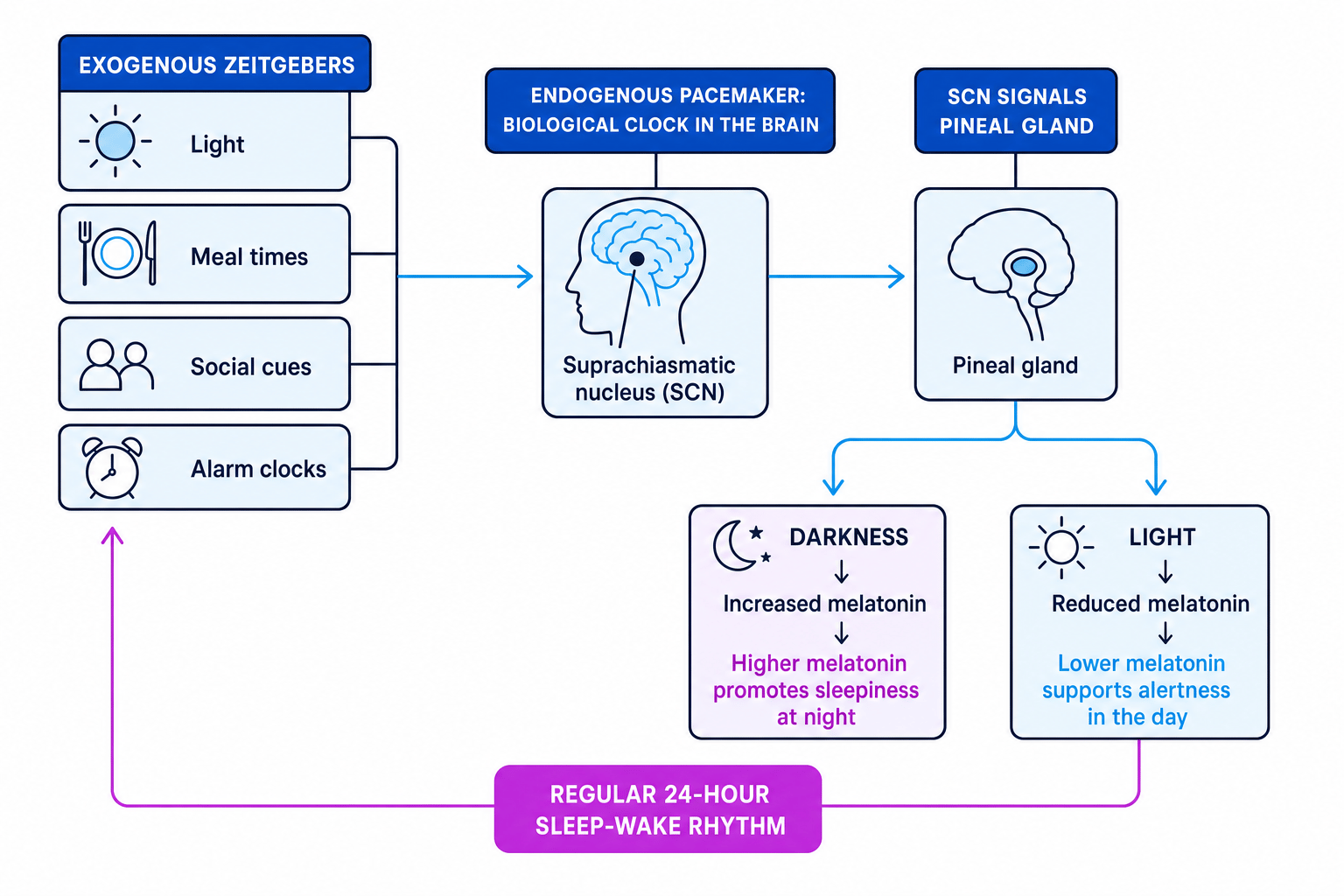
Melatonin is a hormone involved in regulating the sleep-wake cycle. Its release usually increases in darkness and decreases in light.
Melatonin helps signal to the body that it is time to become sleepy. In the evening, lower light levels usually lead to more melatonin release. In the morning, light helps reduce melatonin, supporting alertness.
Common Mistake
Melatonin as an on/off switch
Melatonin does not simply “knock you out”. It is better to describe it as a chemical signal that helps regulate sleepiness and the timing of sleep.
Biological rhythms: circadian rhythm
A biological rhythm is a regular pattern in body processes. The key rhythm for sleep is the circadian rhythm.
Definition
Circadian rhythm
A circadian rhythm is a biological rhythm that lasts about 24 hours, such as the sleep-wake cycle.
Your circadian rhythm helps your body predict when to be awake and when to sleep. It is influenced by internal body clocks and external time cues.
Endogenous pacemakers
Definition
Endogenous pacemaker
An endogenous pacemaker is an internal body clock that helps control biological rhythms, such as the sleep-wake cycle.
The main internal clock involved in sleep is the suprachiasmatic nucleus, often shortened to SCN. It is a small area in the brain’s hypothalamus that helps coordinate the body’s daily rhythm.
The SCN sends signals that influence the pineal gland. This affects melatonin release, which then helps regulate sleepiness and alertness.
Exogenous zeitgebers
Definition
Exogenous zeitgeber
An exogenous zeitgeber is an external time cue that helps reset or adjust the body’s internal clock. “Zeitgeber” means “time giver”.
The most important zeitgeber for sleep is light. Other examples include meal times, school routines, work shifts, social activities and alarm clocks.
Key Idea
Pacemakers and zeitgebers work together
Endogenous pacemakers are internal clocks. Exogenous zeitgebers are external time cues. Together, they help keep the sleep-wake cycle synchronised with the 24-hour day.
Example
Explaining jet lag with pacemakers and zeitgebers
A person flies from the UK to a country where it is night, but their body still feels wide awake.
- Their endogenous pacemaker may still be set to UK time, so their internal clock is not ready for sleep.
- The new environment provides different exogenous zeitgebers, such as darkness, local meal times and social routines.
- The mismatch between the internal clock and external cues can disrupt melatonin timing, causing difficulty sleeping until the rhythm adjusts.
Sleep disorders: insomnia
A sleep disorder is a problem that regularly affects sleep and can interfere with daytime functioning.
Definition
Insomnia
Insomnia is a sleep disorder involving difficulty getting enough good-quality sleep, often causing tiredness, poor concentration or irritability during the day.
For this topic, you need two types: sleep onset insomnia and sleep maintenance insomnia.
Sleep onset insomnia
Sleep onset insomnia means difficulty falling asleep at the start of the night.
Possible causes include:
- Stress, anxiety or racing thoughts.
- Caffeine or other stimulants too late in the day.
- Bright light or screen use delaying melatonin release.
- Irregular routines that confuse the body clock.
- A learned association between bed and being awake.
Sleep maintenance insomnia
Sleep maintenance insomnia means difficulty staying asleep. The person may wake repeatedly or wake too early and struggle to fall asleep again.
Possible causes include:
- Stress or depression causing early waking or night-time rumination.
- Pain, illness or discomfort.
- Alcohol disrupting later parts of sleep.
- Noise, light or temperature changes during the night.
- Disrupted circadian rhythm, such as shift work or jet lag.
Tip
Onset or maintenance?
If the problem is falling asleep, think sleep onset. If the problem is staying asleep, think sleep maintenance.
Example
Classifying insomnia from a scenario
A person goes to bed at 10:30 pm but lies awake until 2:00 am most nights. Once asleep, they usually stay asleep until morning.
- The main problem happens before sleep begins, because they lie awake for hours at the start of the night.
- The scenario says they usually stay asleep afterwards, so the main issue is not sleep maintenance.
- This is best classified as sleep onset insomnia, possibly linked to stress, routine or delayed melatonin release.
Evaluating the key concepts
Strength: useful real-world applications
Understanding pacemakers, zeitgebers and melatonin can help improve sleep routines. For example, reducing bright light before bed, keeping regular wake-up times and using morning light can support a stable sleep-wake rhythm.
This is useful in real life for students, shift workers and people experiencing jet lag.
Weakness: sleep problems are multi-causal
A purely biological explanation can be too simple. Insomnia may involve hormones and body clocks, but also stress, habits, environment, health and emotions.
This links to the reductionism/holism debate. A reductionist explanation focuses on one factor, such as melatonin. A holistic explanation considers several interacting factors.
Debate: nature and nurture
Sleep is influenced by nature because internal biological clocks and hormones affect sleepiness. It is also influenced by nurture because light exposure, work patterns, school routines and technology use can change sleep timing.
A balanced answer often gets more credit than saying sleep is only biological or only environmental.
Ethics and research issues
When psychologists study sleep, they may use sleep monitoring or even sleep deprivation. Ethical issues include informed consent, protection from harm, right to withdraw, confidentiality and debriefing, in line with the British Psychological Society’s Code of Ethics and Conduct.
Exam technique
In the exam
- For AO1, define key terms clearly: REM, NREM, melatonin, endogenous pacemaker and exogenous zeitgeber.
- For AO2, use the scenario details: falling asleep suggests sleep onset insomnia, while waking during the night suggests sleep maintenance insomnia.
- For AO3, give a balanced point: biological explanations are useful, but sleep is also affected by stress, routines and the environment.
Self review
Check yourself
- What are three benefits of sleep, and which one is linked most strongly to deep sleep?
- Why is it more accurate to say vivid dreaming is “most likely” in REM sleep?
- How do endogenous pacemakers and exogenous zeitgebers work together to regulate the sleep-wake cycle?
Sleep and Dreaming
Guide 1 of 3
You've reached the end
Test yourself on this topic, or move on to the next guide.
How was this guide?