Revision notes for OCR GCSE Psychology Situational Factors. Open the guide for explanations and worked examples. Written against the OCR GCSE Psychology (J203) specification, so the content matches what's examinable rather than general Psychology background.
Situational Factors
What you'll learn
- How other people can influence behaviour through conformity, crowds and obedience.
- Why majorities, crowds, culture and authority figures can change how someone acts.
- What Bickman (1974) found about the social power of a uniform.
- How to evaluate situational explanations using the free will/determinism debate.
Starting point: what is a situational factor?
In GCSE Psychology, social influence means the way people’s thoughts, feelings or behaviour are affected by other people.
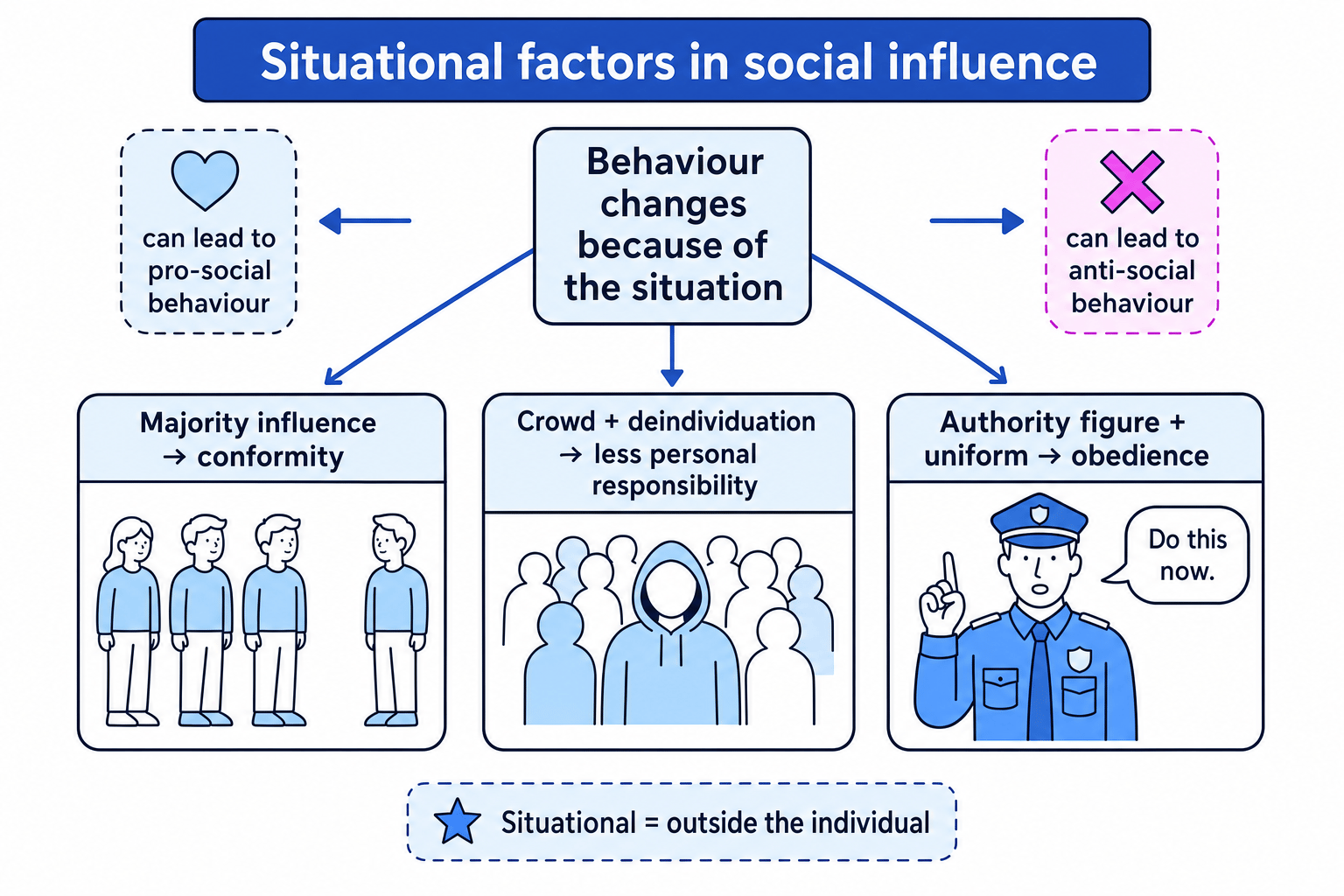
A situational factor is something outside the individual that affects behaviour. This is different from a dispositional factor, which is something inside the person, such as personality, beliefs or temperament.
Definition
Situational factor
A situational factor is an external influence in the environment or social setting that affects how a person behaves, such as a crowd, a majority group, a uniform or an authority figure.
Situational explanations do not say that people have no personality. They simply focus on the situation: Who else is there? What are they doing? What social rules are operating?
Key Idea
The big idea
Situational factors can make certain behaviours more likely, but they do not guarantee that everyone will behave in the same way.
Majority influence and conformity
What is majority influence?
Majority influence happens when a larger group affects the behaviour or beliefs of a smaller number of people, or one individual.
Definition
Conformity
Conformity is changing your behaviour, opinion or attitude to fit in with a group or because of real or imagined group pressure.
For example, if most people in a class laugh at a joke and you laugh too even though you did not find it funny, that could be conformity.
Why do people conform?
There are two common reasons:
- Normative social influence: you conform because you want to be liked, accepted or avoid standing out.
- Informational social influence: you conform because you believe the group may be right, especially if the situation is unclear.
Majority influence is situational because the pressure comes from the social environment, not just from the person’s personality.
Example
Identifying majority influence
A student privately thinks the answer to a quiz question is “A”. Five classmates all confidently say “B”. The student then says “B” too.
- The influence is coming from a group majority, not from one person giving a direct order.
- The student’s public answer changes from their private belief, so this is conformity.
- If the student says “B” mainly to avoid looking different, this is likely normative social influence.
- If the student thinks, “They all seem sure, so maybe I’m wrong,” this is likely informational social influence.
Common Mistake
Conformity is not the same as obedience
Conformity is pressure from a group, often without a direct command. Obedience is following a direct order from an authority figure.
Collective and crowd behaviour
What is collective behaviour?
Collective behaviour is behaviour shown by people acting together as part of a group. Crowd behaviour is a type of collective behaviour that happens when people are physically or psychologically part of a crowd, such as at a protest, concert, football match or online group.
Crowds can affect behaviour because people may feel less personally visible and less individually responsible.
Deindividuation
Definition
Deindividuation
Deindividuation is a psychological state where a person feels less like a separate individual and more like an anonymous member of a group, which can reduce personal responsibility.
When people are deindividuated, they may feel that their actions are hidden in the crowd. This can make behaviour more extreme because the person feels less personally accountable.
However, deindividuation does not automatically mean violence or aggression. It depends on the norms of the crowd.
Pro-social and anti-social behaviour
Definition
Pro-social and anti-social behaviour
Pro-social behaviour helps or benefits other people, such as comforting someone or raising money for charity. Anti-social behaviour harms, upsets or disrupts others, such as vandalism, intimidation or violence.
A crowd can encourage either type of behaviour:
- A charity crowd may encourage cheering, donating and helping.
- A violent crowd may encourage aggression, vandalism or intimidation.
- An online crowd may encourage support, but it may also encourage trolling if people feel anonymous.
The role of culture
Culture means the shared values, beliefs and norms of a group or society. Culture affects what behaviours are seen as acceptable.
For example, in some settings, speaking out loudly in a crowd may be seen as confidence. In another setting, it may be seen as rude. This means crowd behaviour is shaped by the social rules people have learned.
Example
Explaining crowd behaviour
At a charity event, hundreds of people wear matching shirts. When one person starts helping clear litter, many others join in.
- The matching shirts and large group may reduce individual identity, so there is some deindividuation.
- The crowd norm is helpful and positive, so the behaviour encouraged is pro-social, not anti-social.
- The situation changes behaviour because people copy what is normal in that crowd.
- This is a situational explanation because the focus is on the crowd setting, not on each person’s personality.
Tip
Crowds do not always mean chaos
In AO2 scenarios, ask: What is the crowd norm? If the group norm is helping, deindividuation may increase pro-social behaviour. If the group norm is aggression, it may increase anti-social behaviour.
Authority figures and obedience
What is obedience?
Definition
Obedience
Obedience is following a direct order from someone who is seen as having authority.
An authority figure is someone who is perceived to have power, status or the right to give instructions. Examples include police officers, teachers, security guards, managers and doctors.
People may obey authority figures because:
- they have learned that authority should be respected;
- they fear punishment or negative consequences;
- they believe the authority figure has expertise;
- they think responsibility belongs to the authority figure, not themselves.
Uniforms as symbols of authority
A uniform can act as a visual sign of authority. It tells people that the person has a particular role or social power. This can increase obedience, even if the person giving the order is a stranger.
Example
Recognising obedience
A person in a security guard uniform tells shoppers to move away from an entrance. Most shoppers immediately move.
- The shoppers are responding to a direct instruction, not just copying a group.
- The uniform suggests the person has legitimate authority in that setting.
- The behaviour is therefore best described as obedience.
- The situational factor is the authority cue: the uniform changes how powerful the instruction feels.
Bickman (1974): the social power of a uniform
Bickman’s study is the prescribed research study for this sub-topic. It belongs to the social area because it investigates how behaviour is affected by other people and social roles.
Aim
Bickman (1974) aimed to investigate whether people are more likely to obey someone wearing a uniform than someone wearing ordinary clothes.
Method
Bickman carried out a field experiment, meaning the study took place in a real-world setting rather than a laboratory.
Pedestrians in New York were approached by a male researcher or confederate. A confederate is someone who appears to be a normal participant or member of the public but is actually working with the researcher.
The independent variable was the clothing worn by the person giving the order. Conditions included:
- a security guard-style uniform;
- a milkman-style uniform;
- ordinary civilian clothes.
The dependent variable was whether the pedestrian obeyed the instruction.
The instructions were everyday requests, such as asking someone to pick up a bag, give a coin for a parking meter, or move position near a bus stop. The researcher recorded whether the person obeyed.
Results
Bickman found that people were more likely to obey the person dressed as a guard than the person in ordinary clothes. A commonly reported pattern is that obedience was highest in the guard-uniform condition and lower in the civilian condition.
Conclusion
Bickman concluded that a uniform can increase obedience because it gives the person social power. The uniform acts as a situational cue that makes the person seem more legitimate and authoritative.
Key Idea
Bickman’s conclusion
A uniform can make people more obedient because it signals authority, even when the instruction is given in an everyday public setting.
Evaluating Bickman’s study
Strengths
Bickman’s study has good ecological validity because it took place in a real street setting. Participants were behaving naturally and were unlikely to guess the aim of the study.
It also has useful real-world applications. It helps explain why people may obey police, security staff or people in official-looking clothing. This can be useful for understanding public behaviour, but it also warns us that uniforms can be misused.
Weaknesses
There was less control than in a laboratory experiment. Pedestrians may have differed in mood, hurry, confidence, age or past experiences with authority. These extraneous variables could affect whether they obeyed.
The sample was from New York in the 1970s, so the findings may not fully generalise to modern Britain or to cultures where uniforms are viewed differently.
Also, the tasks were fairly low-risk. Picking up a bag or moving position is not the same as obeying a harmful or dangerous order.
Ethics
There are ethical issues under the British Psychological Society’s Code of Ethics and Conduct.
Participants did not give full informed consent because they did not know they were in a study. There was also some deception, because the situation was staged. The right to withdraw was not clearly explained, although people could ignore the request. Protection from harm was likely acceptable because the tasks were brief and low-risk. Confidentiality was protected if no identifying details were recorded, but debriefing would have been difficult in a busy public setting.
Criticisms of situational explanations
Free will and determinism
Definition
Free will and determinism
Free will is the idea that people can make personal choices about their behaviour. Determinism is the idea that behaviour is caused by forces outside a person’s conscious control.
Situational explanations can be seen as deterministic because they suggest behaviour is caused by social pressure, crowds or authority figures.
For example, saying “the uniform made people obey” may sound as if people had no choice. But Bickman’s findings show that not everyone obeyed. This suggests people can resist situational pressure.
A balanced answer should say that situational factors can strongly influence behaviour, but people still vary in how they respond.
Reductionism
A situational explanation can also be reductionist if it explains complex behaviour using only one factor, such as “the crowd caused it” or “the uniform caused it”.
Real behaviour is usually more complex. A person’s actions may be affected by the situation, personality, moral beliefs, past experiences and culture.
Cultural differences
Situational factors may not work the same way in every culture. For example, obedience to authority may be stronger in cultures where respect for hierarchy is strongly encouraged. Crowd behaviour may also differ depending on cultural norms about helping, protesting or emotional expression.
Common Mistake
Do not write that situations control everyone
A stronger AO3 point is: situational factors increase the likelihood of behaviour, but they do not remove individual choice or explain every person’s response.
Applying situational factors in AO2
When you apply this topic to a scenario, look carefully at what is influencing the person:
- If the person changes to match a group, it is likely conformity.
- If the person acts differently because they feel anonymous in a crowd, it is likely deindividuation.
- If the person follows a direct order from someone with status, it is likely obedience.
- If the scenario mentions a uniform, link it to Bickman (1974) and the social power of authority cues.
Exam technique
In the exam
- For AO1, define the key term clearly: conformity, deindividuation or obedience.
- For AO2, use details from the scenario: group pressure, crowd anonymity, culture, direct orders or uniforms.
- For AO3, evaluate with balance: Bickman has ecological validity, but there are ethical issues, control problems and the free will/determinism debate.
Self review
Check yourself
- How is conformity different from obedience?
- Why can deindividuation lead to both pro-social and anti-social behaviour?
- What did Bickman (1974) show about uniforms and obedience?
Social Influence
Guide 2 of 4
You've reached the end
Test yourself on this topic, or move on to the next guide.
How was this guide?