Revision notes for OCR GCSE Psychology Dispositional Factors. Open the guide for explanations and worked examples. Written against the OCR GCSE Psychology (J203) specification, so the content matches what's examinable rather than general Psychology background.
Dispositional Factors
What you'll learn
- What dispositional factors are and how they differ from situational factors.
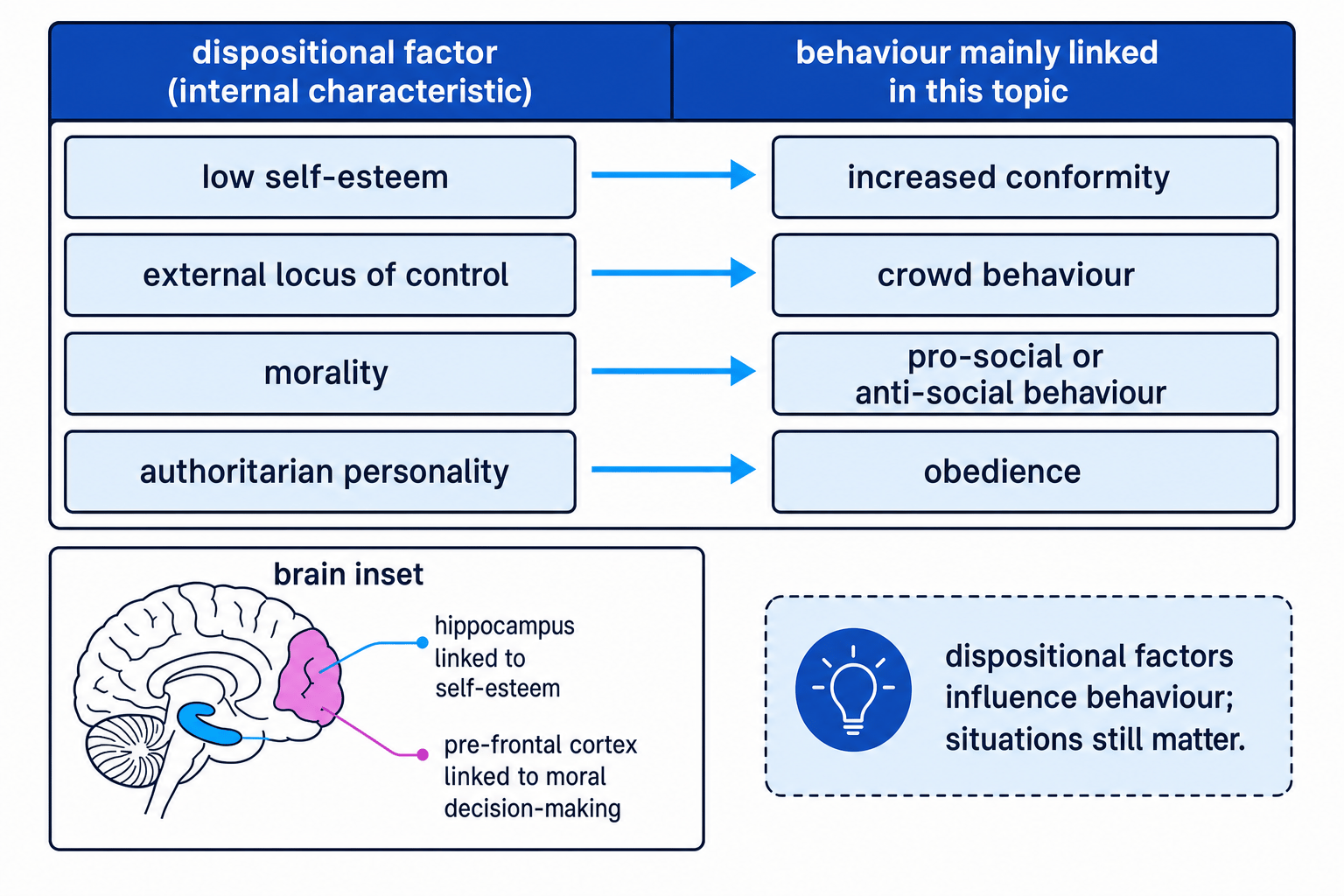
- How self-esteem, locus of control, morality and authoritarian personality can affect social behaviour.
- How the hippocampus and pre-frontal cortex link to personality and moral behaviour.
- How NatCen / Morrell et al. (2011) studied the Tottenham riots and what you can evaluate.
The big idea: personality and social influence
Social influence means the way other people, groups or authority figures affect what you think, feel or do.
A situational factor is an external feature of the environment, such as a crowd, a uniform, peer pressure or an order from someone in authority.
A dispositional factor is different: it comes from inside the person.
Definition
Dispositional factor
A dispositional factor is an internal characteristic, such as a personality trait, belief or emotional tendency, that can influence how someone behaves.
Dispositional factors help explain why two people in the same situation may behave differently. For example, one person may join in with a crowd, while another person may walk away.
Key Idea
Influence, not destiny
Dispositional factors can make a behaviour more likely, but they do not guarantee it. Good GCSE answers usually explain the interaction between the person and the situation.
Self-esteem and conformity
Self-esteem means how much you value and respect yourself. Someone with high self-esteem is usually more confident in their own judgement. Someone with low self-esteem may be more worried about rejection or embarrassment.
Conformity means changing your behaviour, opinion or attitude to fit in with a group.
Low self-esteem can increase conformity because the person may want approval from others. They may think, “If I disagree, people might laugh at me,” so they copy the group even if they privately disagree.
Example
Explaining conformity using self-esteem
A student changes their answer in class after hearing that everyone else chose a different answer.
- Identify the behaviour: the student changes their answer to match the group, so this is conformity.
- Link to the disposition: if the student lacks confidence and fears embarrassment, this suggests low self-esteem.
- Explain the effect: low self-esteem makes group approval feel more important, so the student is more likely to conform to avoid standing out.
Locus of control in crowds
Locus of control means where someone believes control over events comes from.
- An internal locus of control means the person believes their own choices and actions matter.
- An external locus of control means the person believes outside forces, luck, fate or other people control what happens.
In a crowd, responsibility can feel spread out. Someone with an external locus of control may be more likely to say, “The crowd made me do it” or “Everyone else was doing it.” This can make anti-social crowd behaviour more likely.
Someone with an internal locus of control may be more likely to think, “I am still responsible for what I do,” and may resist the crowd.
Common Mistake
Mixing up internal and external
Do not write that an external locus of control means someone is “more controlled” in their behaviour. It means they believe control comes from outside themselves.
Morality and pro-social or anti-social behaviour
Morality means a person’s sense of right and wrong.
Pro-social behaviour is helpful behaviour that benefits others, such as protecting someone, helping a shopkeeper or stopping a friend from stealing.
Anti-social behaviour harms others or breaks social rules, such as vandalism, looting, intimidation or violence.
A person with strong moral beliefs may avoid anti-social behaviour even when others are doing it. They may feel empathy, guilt or responsibility. A person whose moral beliefs are weaker, or who justifies harm, may find it easier to join in with anti-social behaviour.
Authoritarian personality and obedience
Obedience means following a direct order from someone who has authority.
An authoritarian personality is a personality type linked to strong respect for authority, rigid rules, conventional values and a tendency to obey powerful figures. This idea is associated with classic work by Adorno et al. (1950), although the prescribed study for this OCR sub-topic is NatCen / Morrell et al. (2011).
Someone with an authoritarian personality may be more likely to obey a teacher, police officer, manager or other authority figure, especially if the authority seems legitimate.
Example
Choosing a dispositional explanation
Four people behave differently in social situations.
- If someone copies a group because they fear being disliked, the best explanation is low self-esteem increasing conformity.
- If someone says, “The crowd made me do it,” the best explanation is an external locus of control in crowd behaviour.
- If someone refuses to steal because it would hurt the shop owner, the best explanation is morality reducing anti-social behaviour.
- If someone follows an order because they strongly believe authority must be obeyed, the best explanation is authoritarian personality increasing obedience.
Tip
Use the chain
For AO2 application, use this chain: dispositional factor → thought or feeling → behaviour. For example: low self-esteem → fear of rejection → conformity.
Brain influences in dispositional factors
This part is embedded Brain and Neuropsychology content, so it can be assessed as part of Social Influence or as a brain question.
Hippocampal volume and self-esteem
The hippocampus is a brain structure involved in memory and emotion. Hippocampal volume means the size or amount of tissue in the hippocampus.
Research has linked differences in hippocampal volume with self-esteem. A simple GCSE way to understand this is: the hippocampus is involved in emotional memories and stress, which may affect how someone sees themselves. However, this is an association, not proof that hippocampal volume directly causes low or high self-esteem.
Pre-frontal cortex and morality
The pre-frontal cortex is the front part of the brain. It is important for planning, impulse control, decision-making and thinking about consequences.
Regions of the pre-frontal cortex are involved in moral behaviour because they help you weigh up rules, emotions, rewards, punishments and harm to others. If these areas are damaged or not working typically, a person may find it harder to control impulses or make moral decisions.
Common Mistake
Brain explanation = complete explanation
Do not write that the brain “makes” someone conform, riot or obey. Brain regions can influence behaviour, but personality, upbringing, culture and the situation also matter.
Core study: NatCen / Morrell et al. (2011)
The prescribed research study is NatCen / Morrell et al. (2011), a study into the August riots in England. For this topic, you only need to be familiar with the events in Tottenham.
Background
In August 2011, Mark Duggan was shot by police in Tottenham. A protest took place outside Tottenham Police Station. Later, serious disorder developed, including violence, damage to property and looting. This became an example of anti-social collective behaviour, meaning harmful behaviour carried out by people acting as part of a group or crowd.
The researchers wanted to understand why some young people became involved while others did not.
Method
This study belongs mainly to the social core area because it investigates behaviour in crowds and communities. It also links strongly to individual differences because it considers personality and dispositional factors.
The research was mainly qualitative, meaning it collected detailed verbal data rather than numerical scores. NatCen used interviews with young people, including people from areas affected by the riots. The sample included young people who were involved and young people who were not involved.
The researchers asked about experiences of the riots, reasons for taking part or not taking part, attitudes to the police, feelings about the community, and personal circumstances.
Results
Reasons for involvement included:
- excitement and wanting to be part of a major event
- peer influence and fitting in with others
- anger towards the police or wider society
- opportunity to get goods through looting
- feeling that there was little chance of being caught
- feeling that they had little to lose
Reasons for not becoming involved included:
- strong moral beliefs that stealing or violence was wrong
- concern for victims and local businesses
- fear of consequences
- family, religious or community values
- future goals and feeling they had something to lose
Conclusions
NatCen / Morrell et al. (2011) concluded that there was no single cause of the riots. Dispositional factors, such as morality and locus of control, interacted with situational factors, such as being in a crowd, anger at police actions, and opportunities for looting.
Example
Explaining anti-social crowd behaviour in Tottenham
A young person says they joined in because “everyone was doing it” and “the police caused it.”
- Identify the behaviour: joining disorder, damage or looting is anti-social collective behaviour.
- Link to disposition: saying “everyone was doing it” suggests an external locus of control, because the person places responsibility outside themselves.
- Add balance: NatCen / Morrell et al. (2011) would not explain this using personality alone; the crowd situation, anger and opportunity also helped shape the behaviour.
Evaluating dispositional explanations
Strengths
Dispositional explanations are useful because they explain individual differences. In the same crowd, some people riot and others do not. Personality factors such as morality and locus of control help explain this difference.
They also have real-world applications. If low self-esteem, external locus of control or weak community morality increase risk, then schools and youth programmes could build confidence, responsibility, empathy and future goals.
Weaknesses and generalisability
A major criticism is generalisability. Findings from the Tottenham riots may not apply to all crowds, all cultures or all age groups. The August 2011 riots were linked to a specific time, place and relationship with the police.
The study also used self-report data. Participants may have forgotten details, exaggerated, or blamed the crowd to avoid responsibility. This affects validity, meaning whether the study really measures what it claims to measure.
Dispositional explanations can also be reductionist, meaning they oversimplify behaviour by reducing it to one factor, such as personality or the brain. A more holistic explanation considers personality, brain development, peer influence, policing, poverty, opportunity and community relationships together.
Ethics
When studying riots, researchers must follow the British Psychological Society’s Code of Ethics and Conduct. This includes informed consent, protection from harm, confidentiality, right to withdraw and debriefing. Confidentiality is especially important because participants may discuss illegal or distressing events.
Exam technique
In the exam
- Define the dispositional factor first, then link it clearly to the behaviour in the question.
- For NatCen / Morrell et al. (2011), use Tottenham as your key event and remember: personality factors interacted with crowd and social factors.
- For AO3, include at least one balanced criticism, such as limited generalisability, self-report validity, or reductionism.
Self review
Check yourself
- How can low self-esteem increase conformity?
- What is the difference between an internal and external locus of control in a crowd?
- Why is it too simple to explain the Tottenham riots using personality alone?
You've reached the end
Test yourself on this topic, or move on to the next guide.
How was this guide?