Revision notes for OCR GCSE Psychology Explanations of Schizophrenia. Open the guide for explanations and worked examples. Written against the OCR GCSE Psychology (J203) specification, so the content matches what's examinable rather than general Psychology background.
Explanations of Schizophrenia
What you'll learn
- What doctors mean by schizophrenia and its main clinical characteristics.
- Key statistics about prevalence, age, sex, ethnicity and recovery.
- How biological explanations link schizophrenia to dopamine and brain dysfunction.
- How social drift theory explains rejection, disengagement and changes in social position.
1. First: what is schizophrenia?
Definition
Schizophrenia
Schizophrenia is a serious psychological disorder involving psychosis, which means a person may lose touch with reality, for example through hallucinations, delusions or disorganised thinking. The International Classification of Diseases (ICD) is a diagnostic manual used by clinicians to classify disorders.
Schizophrenia is not just “odd behaviour”. It is diagnosed from a pattern of symptoms, how long they have lasted, and whether other explanations, such as substance use or another medical condition, have been ruled out.
Clinical characteristics in the ICD
In the current ICD approach, symptoms usually need to be present for around one month or more. Important characteristics include:
- Hallucinations: perceptions without an external stimulus, such as hearing voices when nobody is speaking.
- Delusions: strongly held false beliefs, such as believing thoughts are being controlled.
- Disorganised thinking or speech: thoughts may jump around or speech may become hard to follow.
- Experiences of control, influence or passivity: feeling that outside forces control your thoughts, feelings or actions.
- Negative symptoms: reductions in normal functioning, such as lack of motivation, reduced speech, social withdrawal or flattened emotion.
- Disorganised or catatonic behaviour: behaviour may appear very confused, or movement may become unusually still or rigid.
Tip
Positive vs negative symptoms
Positive symptoms are additions to normal experience, such as hallucinations and delusions. Negative symptoms are losses or reductions, such as reduced motivation, speech or emotional expression.
Common Mistake
Not “split personality”
Schizophrenia does not mean having multiple personalities. In GCSE answers, focus on psychotic symptoms such as hallucinations, delusions, disorganised thinking and negative symptoms.
Example
Classifying clinical characteristics
- If a person hears voices commenting on their actions, this is a hallucination because they are perceiving something without an external speaker.
- If they believe a TV presenter is sending them secret personal messages, this is a delusion because it is a fixed false belief not shared by others.
- If they stop seeing friends and barely speak, these are negative symptoms because normal social behaviour and speech have reduced.
- A clinician would also consider duration and rule out other causes before diagnosing schizophrenia using the ICD.
2. Key statistics about schizophrenia
Prevalence means how common a disorder is in a population.
For schizophrenia, useful GCSE-level statistics are:
- Prevalence: roughly around 1 in 100 people may experience schizophrenia across their lifetime, though estimates vary.
- Age: onset is most common in late adolescence and early adulthood.
- Sex: it affects all sexes, but males often show earlier onset than females.
- Ethnicity: in the UK, some minority ethnic and migrant groups have higher diagnosis rates. This should not be treated as simple biological ethnicity “causing” schizophrenia; social adversity, discrimination, urban stress, service access and possible diagnostic bias may all matter.
- Recovery rates: recovery varies. Some people recover very well, many have periods of improvement and relapse, and long-term support can make a major difference.
Key Idea
Statistics are patterns, not destiny
Statistics describe group trends. They should never be used to stereotype an individual person with schizophrenia.
3. Biological explanation: dopamine and brain dysfunction
A biological explanation looks for causes in the body, especially the brain, nervous system and genes.
The dopamine hypothesis
A neuron is a nerve cell. A neurotransmitter is a chemical messenger that passes signals between neurons. Dopamine is a neurotransmitter involved in reward, motivation, attention and movement. Dopaminergic neurons are neurons that use dopamine.
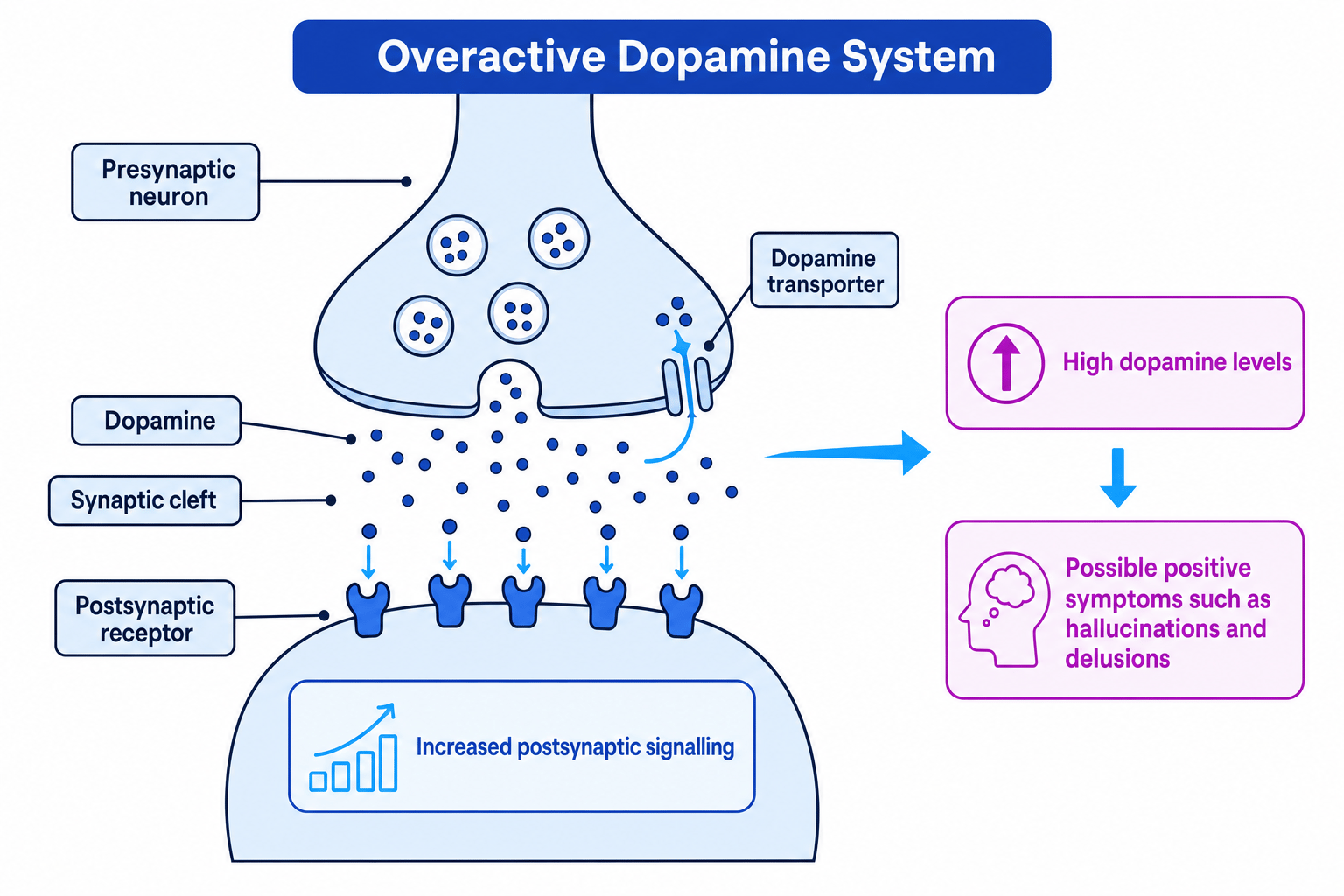
Synaptic transmission is the process where a neurotransmitter travels across the tiny gap between neurons, called the synaptic cleft, and binds to receptors on the next neuron.
The dopamine hypothesis argues that schizophrenia, especially positive symptoms, is linked to an overactive dopamine system. If too much dopamine is released or dopamine receptors are over-stimulated, postsynaptic neurons may fire too strongly. This could make irrelevant thoughts or sensations feel unusually important, contributing to hallucinations and delusions.
Key Idea
Dopamine hypothesis
The core idea is: high dopamine activity can lead to over-signalling in the brain, which may help explain positive symptoms such as hallucinations and delusions.
Brain structure, function and schizophrenia
Cognitions are mental processes such as attention, memory, thinking and decision-making. Brain structure means the physical parts of the brain, including volume. Brain activity means how active brain areas are, often measured indirectly using blood flow or scanning techniques.
In schizophrenia, research has linked symptoms to dysfunction in several areas:
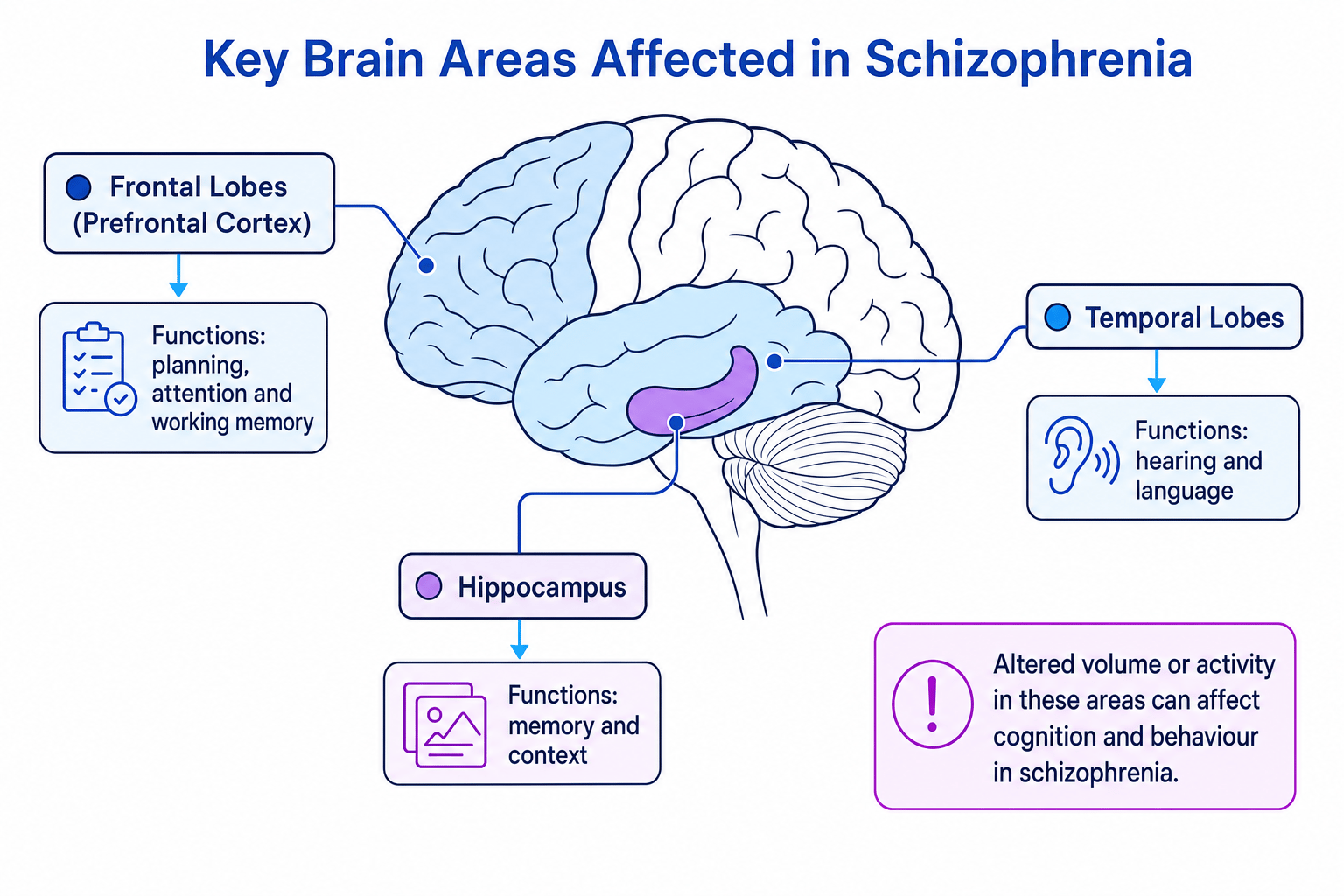
- Frontal lobes / prefrontal cortex: involved in planning, attention, working memory and self-control. Dysfunction may relate to disorganised thinking and poor planning.
- Hippocampus: involved in memory and context. Dysfunction may affect how experiences are remembered and interpreted.
- Temporal lobes: involved in hearing, language and processing sounds. Dysfunction may relate to auditory hallucinations, such as hearing voices.
Neurological damage means harm or abnormal development in the nervous system. In schizophrenia, altered brain volume or unusual activity in these areas may disrupt cognition and behaviour.
Example
Linking biological signs to symptoms
- If a source says a person hears voices, link this to positive symptoms and possible abnormal activity in areas involved in hearing and language, such as the temporal lobes.
- If a source mentions confused planning or poor working memory, link this to dysfunction in the frontal lobes.
- If a source describes an overactive dopamine system, explain that excess dopamine may increase postsynaptic signalling.
- Put the pieces together: altered neurotransmission and altered brain activity can affect cognitions, which then affects behaviour.
Evaluating the biological explanation
A major strength is that the biological explanation is scientific. Brain activity and neurotransmitters can be studied using objective methods, and it has helped develop drug treatments.
However, it can be reductionist, meaning it may reduce a complex disorder to only brain chemicals or brain areas. Schizophrenia is also affected by life experiences, stress, social support and culture.
The nature/nurture debate is important here. Nature means biological influences, such as genes, brain structure and neurotransmitters. Nurture means environmental influences, such as family life, discrimination, poverty or trauma. A balanced answer usually says biology matters, but it is unlikely to be the whole explanation.
Common Mistake
Too biological
Do not write as if dopamine automatically causes every case of schizophrenia. A stronger answer says dopamine and brain dysfunction are linked to schizophrenia, but social and environmental factors may also influence risk and recovery.
4. Psychological explanation: social drift theory
A psychological explanation focuses on thoughts, behaviour and social experience rather than just brain biology.
Social drift theory argues that schizophrenia can lead people to “drift” downwards socially. This means symptoms, stigma and reduced opportunities may make it harder to stay in education, employment, relationships or stable housing.
Rejection by society
Stigma means a negative label or attitude attached to a person or group. People with schizophrenia may be feared, avoided or discriminated against. This rejection can reduce opportunities and support.
Disengagement of individuals
Disengagement means withdrawing from social life. A person may disengage because of paranoia, hallucinations, low motivation, reduced speech or fear of being judged. This can lead to isolation, unemployment and lower social status.
Example
Applying social drift to a life history
- A person develops paranoid delusions and starts missing work because they feel unsafe around colleagues.
- Their employer and friends begin avoiding them, showing rejection by society.
- The person then withdraws further and stops applying for jobs, showing disengagement.
- Over time, they move into less secure housing and have less income, which shows social drift after the disorder has affected their life chances.
Evaluating social drift theory
A strength is that social drift is more holistic than a purely biological explanation. Holistic means it considers the wider person and their environment. It also has useful real-world applications: reducing stigma, improving supported employment and increasing social support may improve outcomes.
A key weakness is the problem of cause and effect, which means working out which factor caused the other. Did schizophrenia lead to poverty and isolation, or did poverty and isolation increase the risk of schizophrenia? Social drift explains what may happen after symptoms begin, but it does not fully explain where hallucinations and delusions come from.
Common Mistake
Drift is not the same as social causation
Social drift says schizophrenia can lead to downward social movement. Social causation would argue that difficult social conditions help cause schizophrenia. Do not mix them up.
5. Core study: Daniel, Weinberger, Jones et al. (1991)
The prescribed study is Daniel, Weinberger, Jones et al. (1991): The effect of amphetamine on regional cerebral blood flow during cognitive activation in schizophrenia.
This study sits in the biological core area because it investigates brain function, neurotransmitters and behaviour. It is also important for the embedded Brain and Neuropsychology material.
Background and aim
Monoamines are a group of neurotransmitters including dopamine, noradrenaline and serotonin. Amphetamine is a stimulant drug that increases monoamine activity, including dopamine activity.
Regional cerebral blood flow means blood flow in specific brain areas. When a brain area is active during a task, it usually needs more oxygen and glucose, so blood flow can increase. Cognitive activation means making a brain area active by giving the participant a thinking task.
The aim was to see how amphetamine affected blood flow in the brain during a prefrontal cognitive task in people with schizophrenia.
Method
Daniel et al. used a controlled laboratory method with adults diagnosed with schizophrenia and a comparison group. The sample was small, which matters for evaluation.
Participants completed a task linked to prefrontal cortex functioning, commonly described as a card-sorting task requiring flexible thinking. Their regional cerebral blood flow was measured. The researchers compared brain activity after amphetamine with a placebo condition.
Results and conclusions
People with schizophrenia showed abnormal patterns of prefrontal brain activation compared with controls. Amphetamine changed cerebral blood flow during the thinking task, suggesting that monoamine activity can influence prefrontal cognitive functioning.
The study supports a biological explanation because it links neurotransmitter activity, brain activity and cognitive behaviour in schizophrenia. However, it does not prove a simple “dopamine alone causes schizophrenia” explanation.
Example
Using Daniel et al. as biological evidence
- Amphetamine affects monoamines, including dopamine, so it is relevant to the dopamine hypothesis.
- Measuring regional cerebral blood flow shows how active particular brain areas are during a cognitive task.
- If people with schizophrenia show abnormal prefrontal activation, this links schizophrenia to brain dysfunction.
- Therefore, the study supports the biological explanation, but only cautiously because amphetamine affects several neurotransmitters and the sample was small.
Criticisms and ethics
Strengths include objective brain measures and a controlled procedure. The study is useful because it connects biology directly to cognition and behaviour.
Weaknesses include the small sample, artificial task, and difficulty proving cause and effect. Brain differences could be a cause of schizophrenia, an effect of having the disorder, or influenced by medication history.
Ethically, the British Psychological Society’s Code of Ethics and Conduct is relevant. Researchers needed informed consent, protection from harm because amphetamine can affect symptoms, the right to withdraw, confidentiality, and a debrief. If a placebo was used, any deception had to be justified and explained afterwards.
Exam technique
In the exam
- For description marks, name the explanation clearly: dopamine hypothesis, brain dysfunction or social drift theory.
- For application marks, match details from the scenario to symptoms, brain areas, dopamine activity, rejection or disengagement.
- For evaluation marks, use a balanced point: biological evidence is scientific, but nature/nurture and cause/effect problems limit simple conclusions.
Self review
Check yourself
- What is the difference between a hallucination, a delusion and a negative symptom?
- How could an overactive dopamine system affect synaptic transmission?
- Why is cause and effect a problem for social drift theory?
You've reached the end
Test yourself on this topic, or move on to the next guide.
How was this guide?