Revision notes for OCR GCSE Psychology Key Concepts. Open the guide for explanations and worked examples. Written against the OCR GCSE Psychology (J203) specification, so the content matches what's examinable rather than general Psychology background.
Key Concepts
What you'll learn
- How information moves through the stages of memory: input, encoding, storage, retrieval and output.
- The three key types of forgetting: decay, displacement and retrieval failure.
- How the hippocampus, frontal lobe and cerebellum support different memory functions.
- How to apply these ideas to GCSE-style scenarios and evaluate them using AO3 points.
The big idea: memory is a process
Memory is not just “having information in your head”. In GCSE Psychology, you need to understand memory as a process: information comes in, is changed into a usable form, is kept for a period of time, and is later brought back and used.
Definition
Memory
Memory is the ability to encode, store and retrieve information so it can be used later.
This topic sits mainly in the cognitive area of psychology because it focuses on internal mental processes, such as remembering, forgetting and thinking.
Stages of information processing
Information processing is a way of describing how the mind deals with information, a bit like a system that receives, changes, stores and produces information.
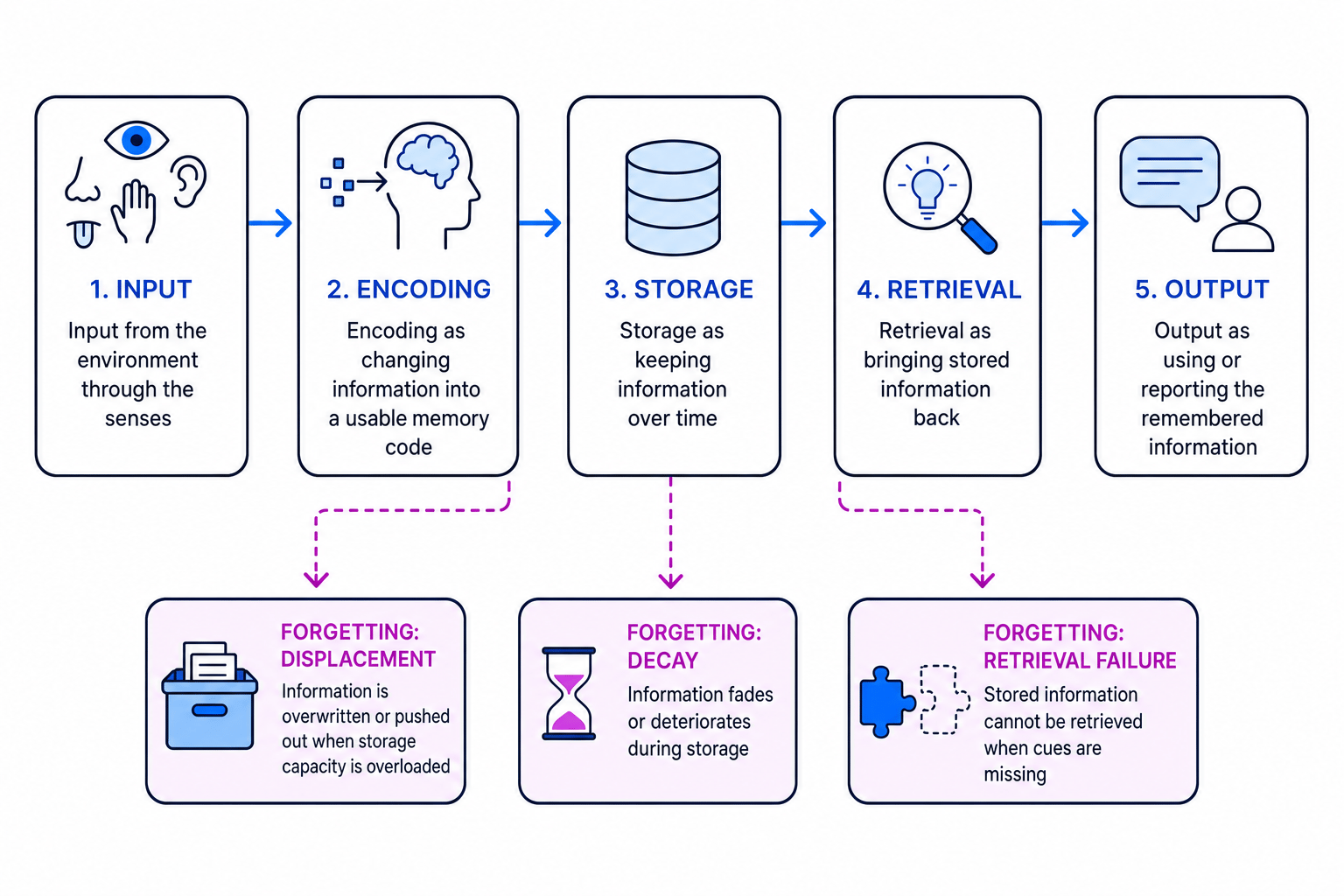
The diagram shows the five stages you need to know, plus the points where different types of forgetting can happen.
1. Input
Input is information entering the memory system through the senses, such as seeing a word, hearing a name, smelling food or feeling pain.
For example, if your teacher says “hippocampus”, the sound enters through your ears. At this point, the information has not necessarily become a memory yet.
2. Encoding
Encoding means changing information into a form that can be stored in memory.
Definition
Encoding
Encoding is the process of converting information into a memory code, such as a sound, image or meaning.
Common forms of encoding include:
- Acoustic encoding — remembering information by sound.
- Visual encoding — remembering information by appearance.
- Semantic encoding — remembering information by meaning.
Semantic encoding is often especially useful because thinking about meaning gives you more links to use later.
3. Storage
Storage is keeping information in memory over time. Some information may be stored only briefly, while other information can last for years.
Definition
Storage
Storage is the retention of encoded information over time.
Storage does not mean the information is always easy to access. You might “know” someone’s name but still be unable to say it at the moment you need it.
4. Retrieval
Retrieval means bringing stored information back into conscious awareness.
Definition
Retrieval
Retrieval is the process of accessing stored information when it is needed.
Retrieval can happen through:
- Recall — producing information yourself, such as writing an answer from memory.
- Recognition — identifying the correct information when it is shown to you, such as choosing from multiple options.
5. Output
Output is the way you use or show the remembered information. This might be speaking, writing, pointing, making a decision or carrying out an action.
Key Idea
Memory as a sequence
For GCSE answers, try to show that memory involves a chain: input → encoding → storage → retrieval → output. Problems can occur at more than one point in the chain.
Example
Following information processing in a scenario
A student hears a new password, repeats it in their head, remembers it until they get home, types it into a website and logs in.
- The input is the sound of the password entering through the student’s hearing.
- The student repeating it in their head shows encoding, because the sound is being converted into a memory code.
- Remembering it until they get home shows storage, because the information is being held over time.
- Typing it into the website requires retrieval, because the student must access the stored password.
- The typed password is the output, because it is the visible use of the remembered information.
Types of forgetting
Forgetting means information is unavailable when it is needed. OCR J203 requires you to know three explanations: decay, displacement and retrieval failure.
Decay
Decay means a memory trace fades or weakens over time, especially if the information is not used or rehearsed.
Definition
Decay
Decay is forgetting because the physical or psychological trace of a memory weakens over time.
For example, you may forget a phone number you heard once because time passed and you did not rehearse it.
A limitation is that decay does not explain all forgetting. Sometimes information seems forgotten but returns when the right cue appears, which fits retrieval failure better.
Displacement
Displacement means old information is pushed out by new information because storage capacity is limited.
Definition
Displacement
Displacement is forgetting because new information replaces or pushes out older information from a limited-capacity store.
This is especially linked to short-term memory. If you are trying to remember a short shopping list, then someone gives you another list of items, the newer items may interfere with the older ones.
Common Mistake
Decay and displacement are not the same
Decay is about information fading over time. Displacement is about information being pushed out by newer information because capacity is limited.
Retrieval failure
Retrieval failure happens when information is stored but cannot be accessed because the right cues are missing.
Definition
Cue
A cue is a trigger or reminder that helps you retrieve a memory, such as a place, smell, word, mood or question.
For example, you might forget the name of a song until someone hums the first few notes. The memory was there, but you needed the cue.
Key Idea
Forgetting can happen for different reasons
If information has faded, think decay. If it has been pushed out by new information, think displacement. If it is stored but inaccessible without a reminder, think retrieval failure.
Example
Choosing the best explanation for forgetting
A student cannot remember a classmate’s name at the supermarket, but remembers it immediately when they see the classmate later in school.
- The memory is unlikely to have fully disappeared, because the student remembers the name later.
- The school setting acts as a cue, because it is linked to where the student usually sees the classmate.
- The best explanation is retrieval failure, because the information was stored but could not be accessed until the right cue was present.
The brain and memory
Memory depends on the brain. Different areas are linked to different memory functions, so damage to one area may affect one type of memory more than another.
Definition
Neurological damage
Neurological damage means injury or disease affecting the brain or nervous system, which can change behaviour, thinking or memory.
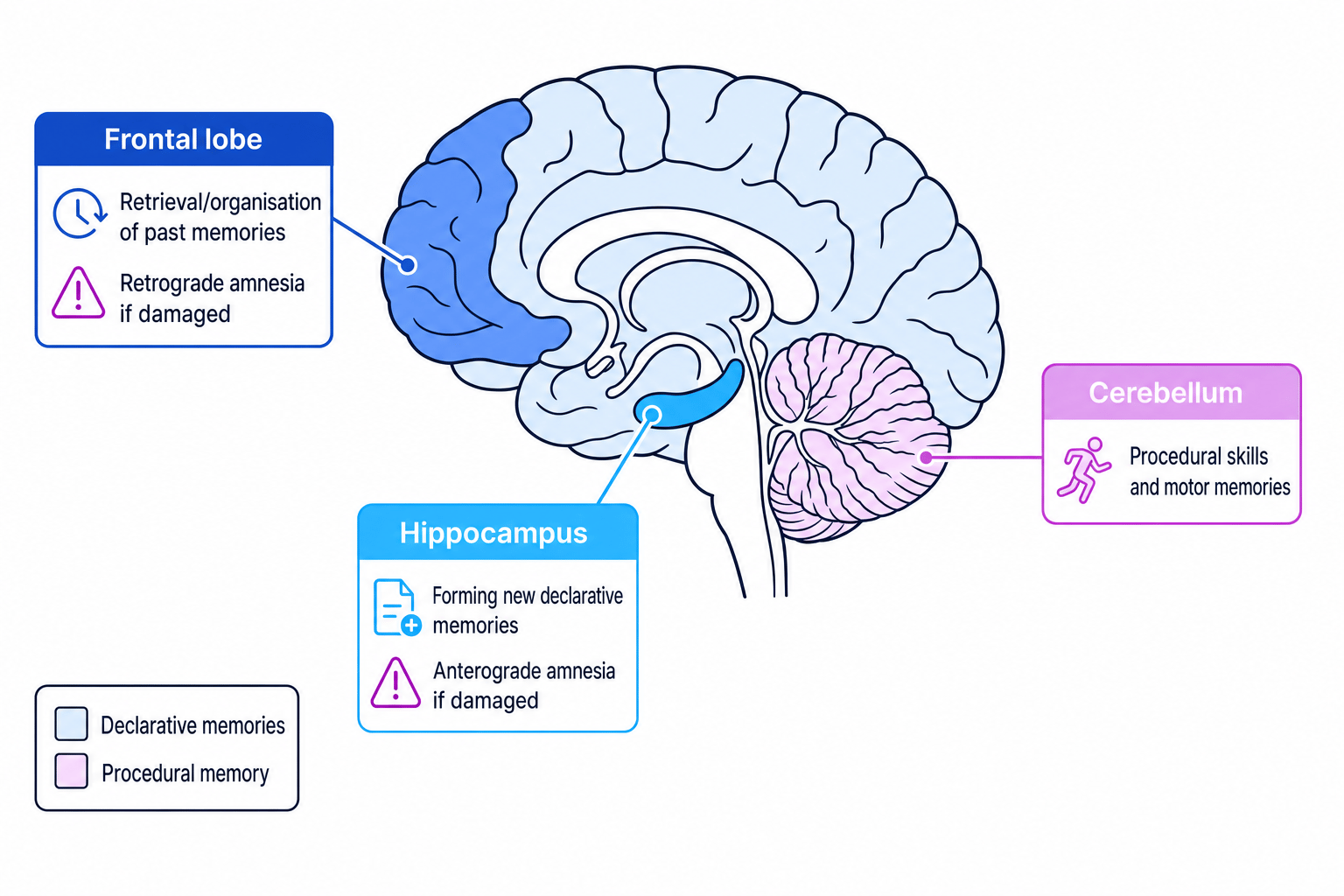
The three key areas for this section are the hippocampus, frontal lobe and cerebellum.
The hippocampus and anterograde amnesia
The hippocampus is a brain structure deep inside the temporal lobe. It is important for forming new long-term memories, especially memories of facts and events.
Definition
Anterograde amnesia
Anterograde amnesia is difficulty forming new memories after brain damage or illness.
If the hippocampus is damaged, a person may remember parts of their life before the damage but struggle to create new memories afterwards. For example, they might repeatedly ask the same question because they cannot store the answer as a new memory.
The frontal lobe and retrograde amnesia
The frontal lobe is the front part of the brain. It is involved in planning, decision-making, organising information and retrieving memories.
Definition
Retrograde amnesia
Retrograde amnesia is loss of memories from before brain damage or illness.
Damage to the frontal lobe may affect the ability to organise and retrieve past memories. A person might struggle to recall events from earlier in life, even if some other abilities remain.
The cerebellum and procedural memory
The cerebellum is at the back and lower part of the brain. It is important for coordination, movement and learned skills.
Definition
Procedural memory
Procedural memory is memory for skills and actions, such as riding a bike, playing an instrument or tying shoelaces.
Procedural memory is often described as “knowing how” rather than “knowing that”. Someone with severe problems forming new factual memories may still be able to perform a learned skill, because procedural memory relies strongly on the cerebellum and related motor systems.
Example
Linking symptoms to brain areas
A person can still play the piano well, but they cannot remember meeting a visitor five minutes ago.
- Playing the piano is a procedural memory, so this ability suggests the cerebellum-linked skill system is still working.
- Not remembering a recent meeting suggests a problem forming new memories after the damage.
- The most likely memory difficulty is anterograde amnesia, linked to damage involving the hippocampus.
Evidence, application and evaluation
Brain-damage cases are useful because they show how memory can be affected when specific areas of the brain are damaged. This gives psychologists evidence that memory is not one single ability.
A key linked study is Wilson, Kopelman and Kapur (2008), which examined a person with severe amnesia following brain damage. It is useful evidence for understanding how damage can affect new learning, past memories and everyday functioning.
AO3 evaluation points include:
- Strength: Case studies of neurological damage provide rich, detailed information about real memory problems.
- Weakness: They often use very small samples, sometimes only one person, so findings may not generalise to everyone.
- Application: Understanding amnesia can help families, clinicians and teachers support people with memory difficulties.
- Ethics: Researchers must consider the British Psychological Society’s principles, including informed consent, protection from psychological harm, confidentiality, the right to withdraw and debriefing. If a participant has memory difficulties, consent and wellbeing need especially careful handling.
Tip
AO2 scenario shortcut
If a question describes someone forgetting new events after damage, think anterograde amnesia and hippocampus. If it describes losing old memories from before damage, think retrograde amnesia and frontal lobe. If skills are spared, think procedural memory and cerebellum.
Named debate: reductionism and holism
A brain-based explanation of memory can be seen as reductionist because it explains memory by breaking it down into brain structures, such as the hippocampus and cerebellum.
This is useful because it is scientific and can link symptoms to specific areas of damage. However, a more holistic view reminds us that memory also involves attention, emotion, language, personal meaning and social context. For example, retrieval failure may depend on environmental cues, not only brain structures.
Exam technique
In the exam
- For AO1, use the correct key term and define it clearly: decay, displacement, retrieval failure, anterograde amnesia, retrograde amnesia or procedural memory.
- For AO2, match the scenario to the process: new memory problem = hippocampus; old memory problem = frontal lobe; skill memory = cerebellum; missing reminder = retrieval failure.
- For AO3, add one precise strength or weakness, such as usefulness of brain-damage evidence, limited generalisability from case studies, or ethical issues with vulnerable participants.
Self review
Check yourself
- What is the difference between encoding, storage and retrieval?
- How would you tell the difference between decay, displacement and retrieval failure in a scenario?
- Which brain area is most linked to anterograde amnesia, retrograde amnesia and procedural memory?
Memory
Guide 1 of 3
You've reached the end
Test yourself on this topic, or move on to the next guide.
How was this guide?