Revision notes for OCR GCSE Psychology Explanations of Clinical Depression. Open the guide for explanations and worked examples. Written against the OCR GCSE Psychology (J203) specification, so the content matches what's examinable rather than general Psychology background.
Explanations of Clinical Depression
What you'll learn
- What clinical depression means and how it is described in the International Classification of Diseases.
- Key patterns in depression statistics: prevalence, age, sex, ethnicity and recovery.
- The social rank theory as a biological/evolutionary explanation.
- The ABC model as a psychological explanation, linked to Tandoc et al. (2015).
Starting point: what is clinical depression?
Clinical depression is more than “feeling sad”. Everyone feels low sometimes, especially after a disappointment or loss. Clinical depression is a mental health condition where symptoms are persistent, serious, and affect everyday functioning such as school, sleep, relationships or self-care.
Definition
Clinical depression
Clinical depression is a diagnosed depressive disorder involving a lasting pattern of low mood and other symptoms that cause distress or impairment in daily life.
The ICD: how depression is classified
The International Classification of Diseases, or ICD, is a diagnostic system published by the World Health Organization. It gives clinicians a shared way to classify physical and mental health conditions.
For depression, the ICD describes key clinical characteristics. These include:
- Low mood for most of the day.
- Loss of interest or pleasure in activities that were usually enjoyable.
- Reduced energy or increased tiredness.
- Poor concentration.
- Low self-esteem or low self-confidence.
- Feelings of guilt or worthlessness.
- Pessimistic thoughts about the future.
- Sleep disturbance.
- Appetite changes.
- Thoughts of self-harm or suicide.
A diagnosis depends on the number, duration and impact of symptoms. Symptoms usually need to last for about two weeks or more and interfere with normal life.
Common Mistake
Sadness is not automatically clinical depression
Do not write that someone has clinical depression just because they are upset. In an exam scenario, look for persistence, several symptoms, and disruption to everyday functioning.
Example
Applying ICD characteristics
A student says: “For the last three weeks I have felt low nearly every day. I have stopped going to football, I sleep badly, and I feel worthless.”
- The low mood has lasted for three weeks, so it is more than a brief reaction lasting a day or two.
- There are several ICD-style symptoms: low mood, loss of interest, sleep disturbance and feelings of worthlessness.
- The symptoms affect functioning because the student has stopped going to football, so it would be reasonable to say this could fit clinical depression and should be assessed by a professional.
Key statistics about clinical depression
Statistics vary depending on the country, survey and definition used, so exam answers should focus on the pattern as well as any figures your teacher gives you.
Prevalence
Prevalence means how common a condition is in a population at a particular time or across a lifetime. Depression is common worldwide and affects millions of people. At any one time, a noticeable minority of adults experience depressive symptoms, and lifetime risk is higher because many people experience depression at some point.
Age
Depression can occur at any age. It often first appears in adolescence or early adulthood, but it is also common among working-age adults. Older adults may be underdiagnosed because symptoms can be mistaken for physical illness, loneliness or “normal ageing”.
Sex
Females are usually diagnosed with depression more often than males. This may reflect a mixture of biological factors, social pressures, life experiences and differences in help-seeking. It does not mean males cannot experience serious depression.
Ethnicity
Rates of diagnosed depression can differ between ethnic groups. This may be affected by discrimination, poverty, cultural stigma, access to healthcare, language barriers and whether people feel able to seek help. Be careful: ethnicity itself should not be treated as a simple biological “cause”.
Recovery rates
Many people recover, especially with support such as therapy, medication, social support or changes to stressful situations. However, depression can be recurrent, meaning it can return after recovery.
Key Idea
Statistics need interpretation
For GCSE, it is usually more important to explain what a pattern means than to memorise one exact figure without context.
Biological explanation: social rank theory
The social rank theory is described as a biological explanation because it is based on evolution: the idea that some behaviours or emotional responses may have developed because they helped our ancestors survive.
Definition
Evolutionary function
An evolutionary function is the survival or reproductive advantage that a behaviour or response may have had in ancestral environments.
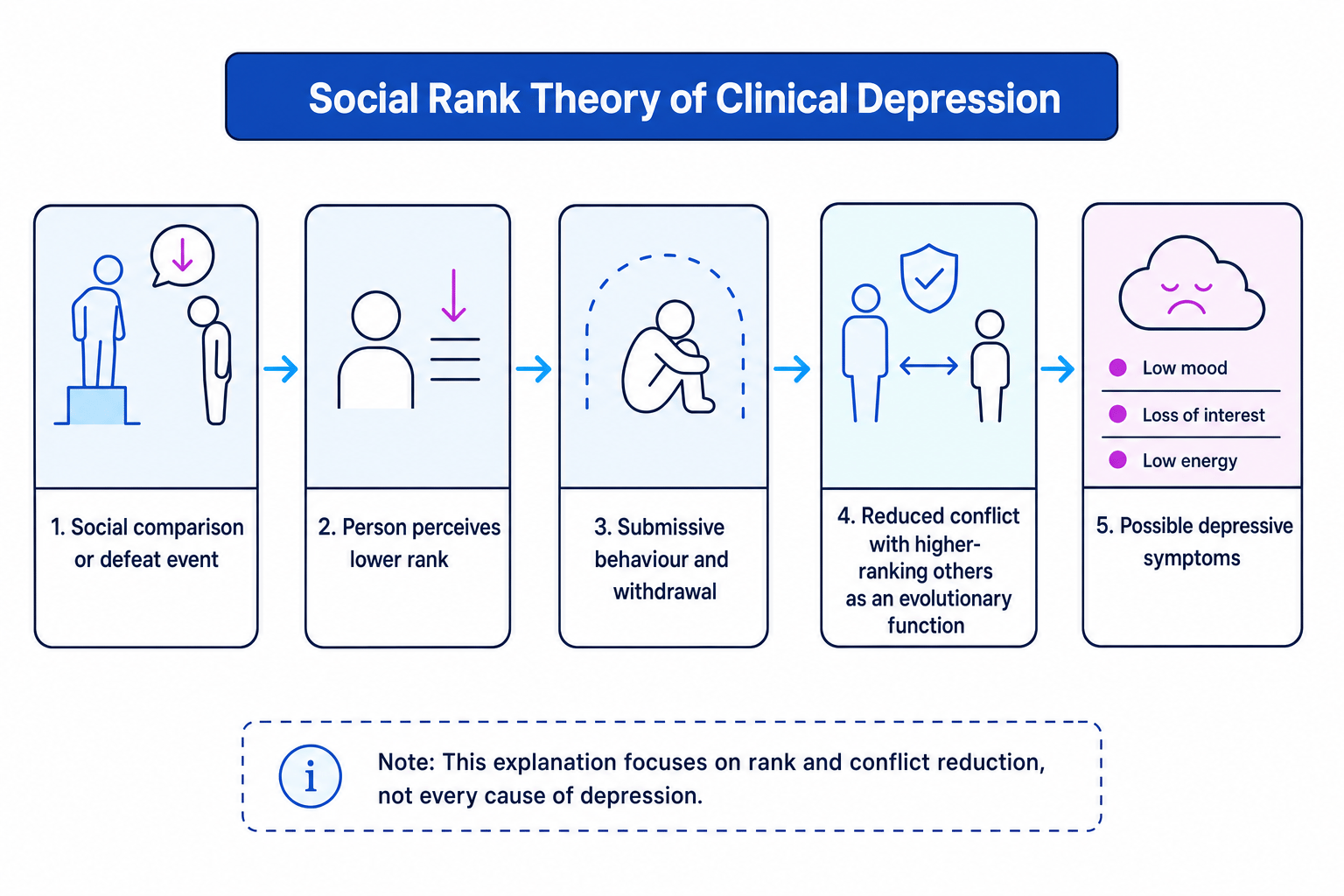
Social rank theory argues that depression may be linked to feeling defeated, inferior or low in a social hierarchy. If an individual sees themselves as lower rank, depressive symptoms such as withdrawal, low motivation and submissive behaviour may reduce conflict with more powerful group members.
In ancestral groups, avoiding conflict with a stronger rival could have been useful. Instead of continuing a fight they were unlikely to win, a person might “back down”, reducing the chance of injury or exclusion.
The role of lower rank
A lower rank means having less status, power or control compared with others. In this theory, depression is linked to accepting a lower position after defeat. Symptoms may act like an involuntary “submission” response.
This can be applied to modern situations too. For example, someone who constantly compares themselves with others online may feel less successful, less attractive or less liked. That perceived low rank could contribute to low mood.
Example
Using social rank theory
A person loses out on a promotion and then avoids colleagues, feels worthless and stops trying for other opportunities.
- The promotion loss can be interpreted as a defeat or loss of status.
- Avoiding colleagues and giving up can be seen as submissive or withdrawal behaviour.
- Social rank theory would explain the depressive symptoms as a response that reduces further competition and conflict, although it may be harmful in modern life.
Evaluation of social rank theory
A strength is that the theory explains why depressive symptoms often involve withdrawal, reduced motivation and low self-worth. These symptoms make sense if depression is linked to defeat and social comparison.
It also has real-world application. It suggests that therapy may help by reducing harmful social comparison and improving confidence, relationships and assertiveness.
However, the theory is reductionist.
Definition
Reductionism
Reductionism means explaining a complex behaviour or mental health condition using one narrow cause or level of explanation.
Social rank theory reduces depression mainly to evolutionary rank and conflict. This can ignore other important influences, such as trauma, thinking patterns, family relationships, culture, poverty, genetics and brain chemistry.
A more holistic explanation would consider many interacting factors.
Definition
Holism
Holism means explaining behaviour by looking at the whole person and the interaction of biological, psychological and social factors.
Common Mistake
Calling social rank theory purely social
Although it involves social status, it is classed here as a biological explanation because it explains depression through evolution and adaptive functions.
Psychological explanation: the ABC model
The ABC model explains depression through the way a person interprets events. It is linked to cognitive approaches because it focuses on beliefs, or thoughts and interpretations.
Definition
ABC model
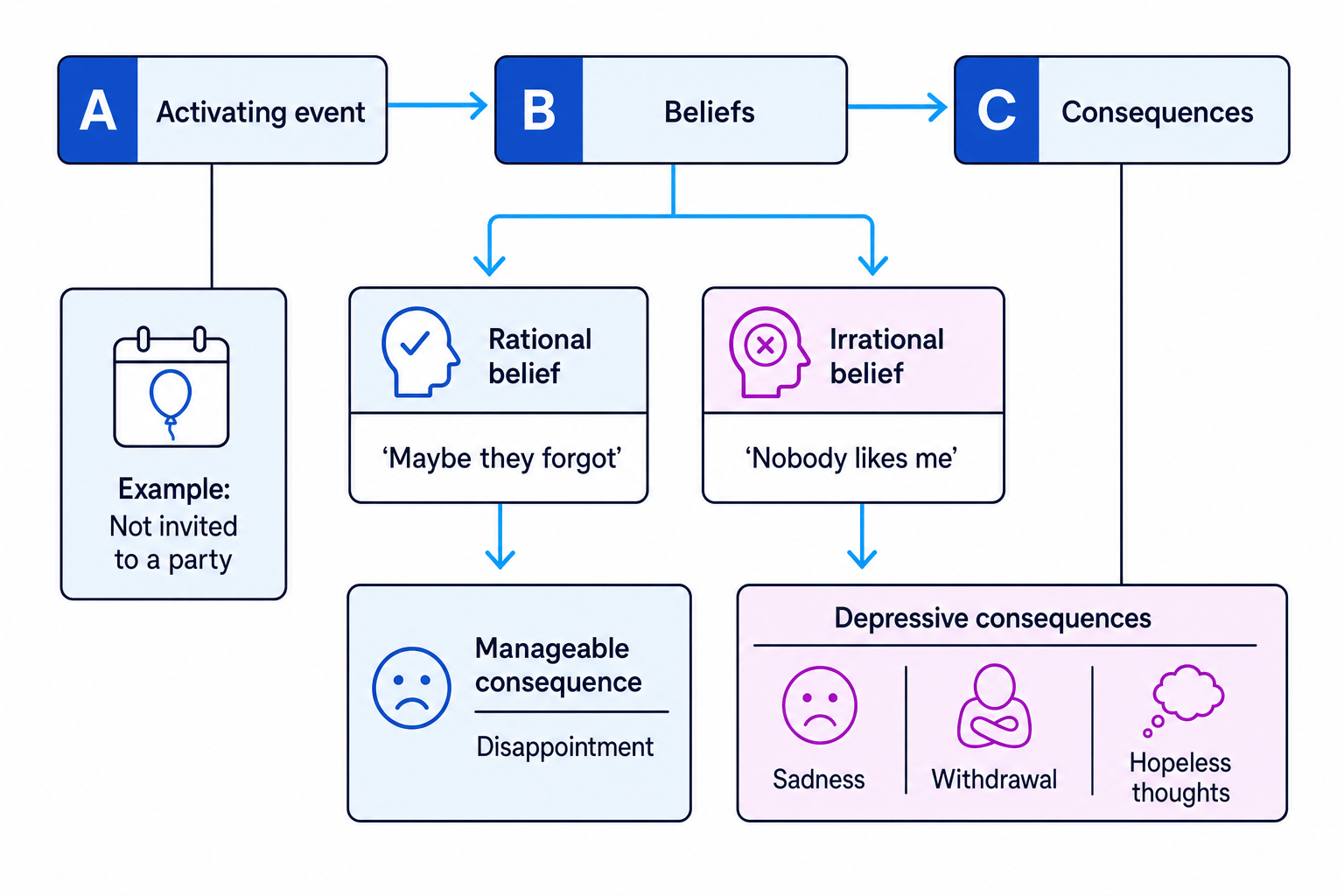
The ABC model says that an Activating event does not directly cause depression. Instead, the person’s Beliefs about the event influence the emotional and behavioural Consequences.
The three parts are:
- A: Activating event — something happens, such as failing a test or being ignored by a friend.
- B: Beliefs — the person interprets the event.
- C: Consequences — the emotional, behavioural and cognitive outcomes.
Rational and irrational beliefs
A rational belief is logical, flexible and based on evidence. It may still lead to sadness, but the reaction is usually manageable.
An irrational belief is unrealistic, extreme or unhelpful. Irrational beliefs often involve words like “must”, “always”, “never” or “everyone”. They may include catastrophising, overgeneralising or blaming the self.
For example:
- Rational belief: “I failed this test, but I can revise differently next time.”
- Irrational belief: “I failed this test, so I am useless and will never succeed.”
Example
Applying the ABC model
A student is not invited to a group chat and starts feeling very low.
- The activating event is being left out of the group chat.
- A rational belief could be: “Maybe they forgot or it was about something specific.” This may lead to disappointment but not severe hopelessness.
- An irrational belief could be: “Nobody likes me and I will always be alone.” This could lead to depressive consequences such as sadness, withdrawal and negative thoughts about the future.
Tip
Remember the key move
In the ABC model, A does not directly cause C. The belief at B is the bridge between the event and the consequence.
Evaluation of the ABC model
A strength is that the ABC model has useful real-world applications. It supports therapies such as cognitive behavioural therapy, where people learn to identify and challenge irrational beliefs.
It also gives people some hope because changing beliefs may reduce depressive consequences.
However, the model can be criticised for being too focused on individual thinking. It may underplay real-life causes of depression such as bereavement, abuse, poverty, discrimination or biological vulnerability.
The ABC model also links to the freewill/determinism debate.
Definition
Freewill and determinism
Freewill is the idea that people can make choices and change their behaviour. Determinism is the idea that behaviour is controlled by factors such as biology, upbringing or environment.
The ABC model supports freewill because it suggests people can challenge irrational beliefs. But it can also seem deterministic if someone’s beliefs are shaped by past experiences, trauma or social conditions. A fair evaluation says the model gives people useful tools, but it should not blame them for being depressed.
Core study: Tandoc et al. (2015)
The prescribed research study is Tandoc et al. (2015), called Facebook use, envy, and depression among college students: Is Facebooking depressing?
This study is especially useful for applying the ABC model and social comparison ideas to modern life.
Background
Facebook allows people to view carefully selected highlights of other people’s lives. This can lead to upward social comparison, where someone compares themselves with people who seem happier, more popular or more successful.
Method
Tandoc et al. used a questionnaire study with college students. Participants answered questions about Facebook use, feelings of envy and depressive symptoms. This produced mainly quantitative data, meaning numerical scores that could be compared.
The study fits mainly into the individual differences area because it investigates differences in depressive symptoms, although it also has a strong social element because it involves social media comparison.
Results and conclusions
The key finding was that Facebook use was linked to depressive symptoms particularly when it triggered envy. It was not simply “more Facebook equals more depression”. The important pathway was that viewing others’ lives could create envy, and envy was associated with depression.
This supports the idea that beliefs and interpretations matter. Seeing a photo of someone at a party is just the activating event. Thinking “everyone has a better life than me” is the kind of belief that may lead to depressive consequences.
Common Mistake
Facebook does not prove causation
Tandoc et al. found an association between Facebook envy and depression. Because the study was correlational, it cannot prove that Facebook envy directly causes clinical depression.
Evaluation of Tandoc et al. (2015)
A strength is that the study has real-world relevance. Social media is a normal part of many people’s lives, so the findings can help explain everyday risks linked to comparison and envy.
Another strength is that questionnaires allow data from many participants to be collected efficiently and standardised questions make responses easier to compare.
However, there are weaknesses. The sample was college students, so the findings may not generalise to older adults, younger teenagers or people from different cultures. The study also relied on self-report, so participants may have misunderstood questions or answered in a socially desirable way.
Ethically, researchers need informed consent, confidentiality and the right to withdraw. Because depression questions can be sensitive, participants should be protected from psychological harm and debriefed with information about support if needed.
Bringing the explanations together
Social rank theory and the ABC model explain depression from different angles.
- Social rank theory asks: How might defeat and low status have evolved to reduce conflict?
- The ABC model asks: How do beliefs turn events into emotional and behavioural consequences?
- Tandoc et al. (2015) connects well to both because Facebook envy involves social comparison and personal interpretation.
Key Idea
Best exam answers compare explanations
A strong answer does not just describe one theory. It explains what the theory claims, applies it to a scenario, and then evaluates what it explains well and what it misses.
Exam technique
In the exam
- For AO1, name the explanation clearly and use the correct terms: ICD, social rank, evolutionary function, activating event, beliefs and consequences.
- For AO2, apply the theory to the exact scenario rather than writing a general description.
- For AO3, give a balanced evaluation: include one strength, one weakness, and link to a debate such as reductionism/holism or freewill/determinism.
Self review
Check yourself
- What ICD symptoms would help distinguish clinical depression from ordinary sadness?
- How does social rank theory explain withdrawal and low motivation?
- In the ABC model, why do two people react differently to the same activating event?
Psychological Problems
Guide 3 of 4
You've reached the end
Test yourself on this topic, or move on to the next guide.
How was this guide?