Revision notes for OCR GCSE Psychology Changing Attitudes. Open the guide for explanations and worked examples. Written against the OCR GCSE Psychology (J203) specification, so the content matches what's examinable rather than general Psychology background.
Changing Attitudes
What you'll learn
- What psychologists mean by attitudes, stigma, discrimination and social change.
- How minority influence can slowly change attitudes towards mental health.
- How majority influence can make anti-stigma behaviour feel normal and expected.
- How to apply and evaluate these ideas in GCSE Psychology answers.
The big picture: attitudes can be changed
In Social Influence, you study how other people affect what you think, feel and do. This topic applies that idea to changing attitudes towards mental health.
Mental health stigma can make people feel ashamed, hide their difficulties, avoid asking for help, or be treated unfairly. Psychology can help explain how societies move from stigma to greater awareness and acceptance.
Definition
Key terms
- An attitude is a belief, feeling or evaluation about a person, group, issue or behaviour.
- Mental health stigma means attaching a negative label or stereotype to people with mental health difficulties.
- Discrimination means unfair behaviour towards someone because of a characteristic, such as a mental health problem.
- Social change means a change in the attitudes, beliefs or behaviour of a whole group or society over time.
- Awareness means people know more about an issue and can recognise it more accurately.
In this topic, the goal is not just for people to say kinder things. The aim is for attitudes and behaviour to change: more understanding, less blaming, fewer insults, fairer treatment, and more support for people experiencing mental health problems.
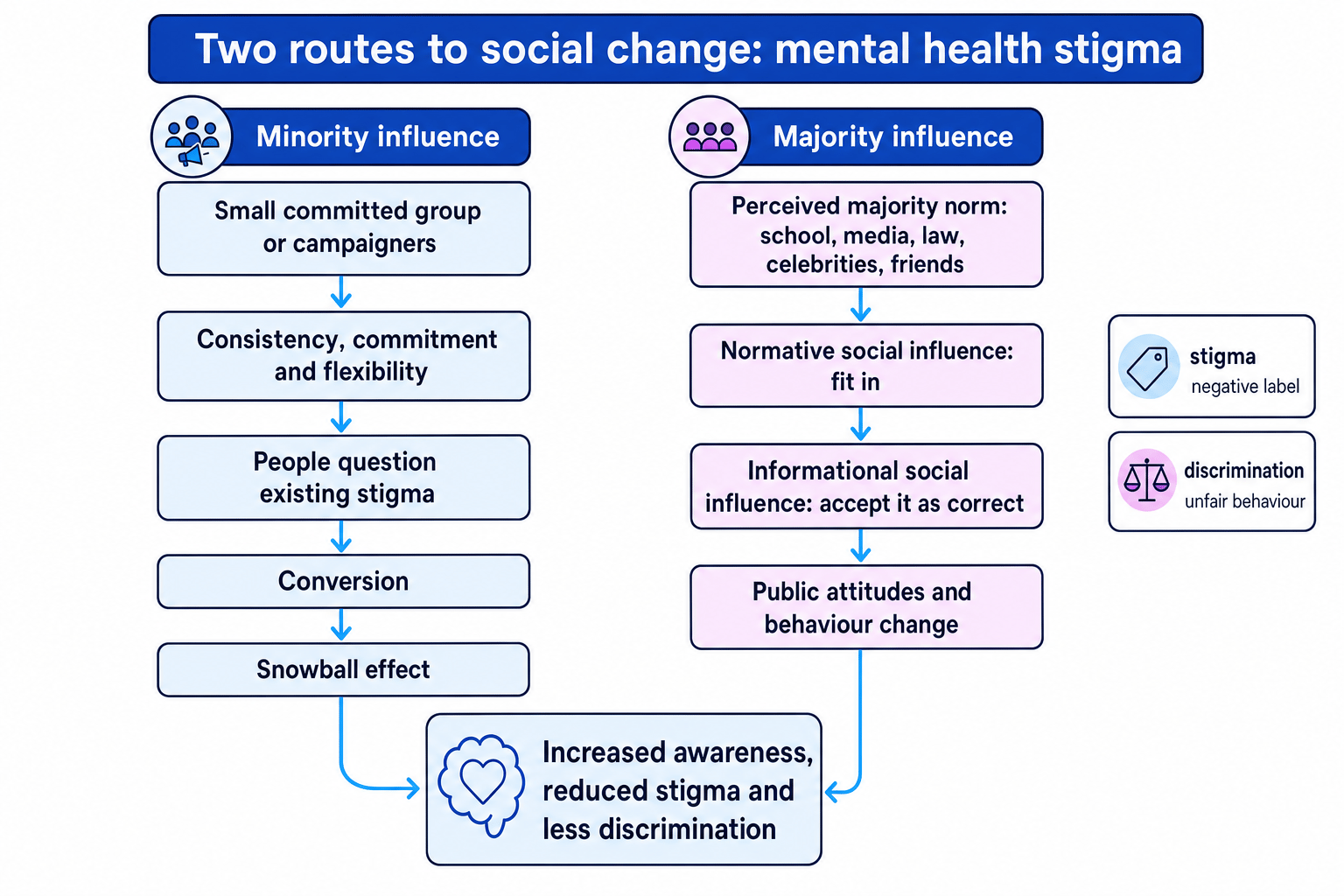
Attitudes and behaviour are linked — but not identical
An attitude is internal: it is what someone thinks or feels. Behaviour is observable: it is what someone actually does.
For example, a student might privately believe that depression is “just laziness”. That is a stigmatising attitude. If they mock someone for needing support, that becomes discriminatory behaviour.
Key Idea
The target of change
Changing mental health stigma usually involves three connected goals: increase awareness, change attitudes, and reduce discriminatory behaviour.
Common Mistake
Mixing up stigma and discrimination
Stigma is the negative label or judgement. Discrimination is the unfair action that can follow from it.
Minority influence: a small group changes the majority
Minority influence happens when a smaller group persuades the larger group to change its attitudes, beliefs or behaviour.
At first, the minority view may seem unusual or unpopular. In mental health, this could be a small group of campaigners saying that panic attacks, depression, eating disorders or schizophrenia should not be mocked or blamed.
Definition
Minority influence
Minority influence is a form of social influence where a smaller group changes the attitudes, beliefs or behaviour of the majority.
How minority influence works
A minority is most persuasive when it shows:
- Consistency: the message stays the same over time.
- Commitment: the group appears dedicated, even when it is difficult.
- Flexibility: the group listens and adapts, rather than seeming extreme or unreasonable.
These qualities make the majority think more deeply. This can lead to conversion, which means a private, genuine change in belief.
Over time, more people may join the minority. This is called the snowball effect: support grows gradually until the minority view becomes much more common.
Minority influence and mental health stigma
A small group might challenge stigma by:
- sharing lived experiences of mental health problems;
- correcting myths, such as “people with mental illness are always dangerous”;
- campaigning for better school or workplace support;
- encouraging respectful language;
- asking media organisations to avoid harmful stereotypes.
This can change attitudes because people start to question what they previously accepted as “normal”.
Example
Applying minority influence
A small group of students starts a campaign saying, “Anxiety is not attention-seeking — it is a real mental health difficulty.”
- The group is a minority because only a few students are openly challenging the wider school’s negative attitudes.
- Their message shows consistency if they repeat the same key idea in assemblies, posters and discussions over several weeks.
- They show commitment if they keep campaigning even when some students laugh or disagree, which may make others take the issue more seriously.
- They show flexibility if they invite questions and listen to concerns, rather than simply accusing everyone of being wrong.
- Some students may experience conversion: they privately change their belief and stop seeing anxiety as “attention-seeking”.
- If more students join in, the snowball effect can make the anti-stigma attitude spread across the school.
Key Idea
Minority influence is slow but deep
Minority influence often takes time, but it can lead to genuine internal attitude change because people think carefully about the minority’s arguments.
Majority influence: the power of the bigger group
Majority influence happens when people change their attitudes or behaviour because of pressure from the larger group.
This is closely linked to conformity, which means changing behaviour or beliefs to fit in with a group.
Definition
Majority influence
Majority influence is a form of social influence where the larger group affects the attitudes, beliefs or behaviour of individuals or smaller groups.
Two main routes: normative and informational influence
Normative social influence means conforming because you want to be liked, accepted or not rejected.
In mental health, this might happen when most people in a school stop using insulting language about mental illness. A student may also stop using those words because they do not want others to disapprove.
Informational social influence means conforming because you believe the group has accurate information.
For example, if teachers, health professionals, trusted websites and peers all explain that depression is a recognised mental health condition, a student may accept this as correct information.
Definition
Normative and informational influence
- Normative social influence is changing to fit in or gain approval.
- Informational social influence is changing because you believe others are right.
Majority influence and mental health stigma
Majority influence can reduce stigma when anti-stigma attitudes become the visible social norm.
This could happen through:
- national mental health campaigns;
- school policies against discriminatory language;
- celebrities or influencers speaking openly about mental health;
- teachers and peers consistently challenging stereotypes;
- laws and workplace rules supporting fair treatment.
When most people appear to accept a more supportive attitude, individuals may feel pressure to act in line with it.
Example
Applying majority influence
A school introduces mental health awareness week. Most students wear badges saying “It’s okay to ask for help”, and teachers challenge jokes about mental illness.
- This is majority influence because the anti-stigma message is now supported by a large, visible group in the school.
- Normative social influence may occur if students stop making jokes because they want to fit in and avoid disapproval.
- Informational social influence may occur if students learn accurate facts from assemblies and accept that mental health difficulties are real.
- The behaviour change reduces discrimination if students become less likely to mock, exclude or blame people with mental health problems.
- The attitude change is stronger if students privately believe the message, not just follow it in public.
Common Mistake
Assuming majority influence always creates real belief change
Majority influence can sometimes produce only public compliance. A person may behave differently in public but privately keep the same stigmatising attitude.
Minority and majority influence often work together
Real social change often uses both types of influence.
A small minority may begin by challenging stigma. For example, people with lived experience of mental health difficulties might speak publicly and campaign for change. At first, their view may be unpopular.
If the message spreads, schools, workplaces, celebrities, health services and the media may support it. Then the anti-stigma message becomes a majority norm. At that point, majority influence helps maintain the new attitude.
Key Idea
The full route to social change
A minority can start the change by challenging old attitudes. A majority can strengthen the change by making the new attitude seem normal, accepted and expected.
Research link: NatCen / Morrell et al. (2011)
A useful OCR Social Influence research link is NatCen / Morrell et al. (2011), which studied public attitudes towards mental illness using survey methods.
The study is useful here because changing attitudes towards mental health needs to be measured. Researchers can ask people about their knowledge, attitudes and intended behaviour towards people with mental health problems.
This kind of research usually produces quantitative data, such as percentages or scale scores, because many participants answer the same questions. It may also show whether attitudes are becoming more positive over time.
However, surveys have limits. People may give socially acceptable answers because they do not want to appear prejudiced. This is called social desirability bias.
Tip
Using NatCen / Morrell et al. (2011)
Use this study as evidence that attitudes towards mental illness can be measured in society, but be careful: survey data can show patterns in attitudes, not prove exactly what caused the change.
Ethics in attitude research
Research into mental health attitudes should follow the British Psychological Society’s Code of Ethics and Conduct.
Researchers should consider:
- informed consent, so participants know what the study involves;
- confidentiality, because views and experiences about mental health can be sensitive;
- right to withdraw, so participants can leave the study;
- protection from harm, especially if questions remind someone of distressing experiences;
- debriefing, so participants understand the purpose and know where to get support if needed.
Evaluation: strengths and weaknesses
Strengths
Changing attitudes through social influence has strong real-world value. It can help schools, workplaces and media campaigns reduce stigma and discrimination.
Minority influence is useful because it explains how social change can start even when most people disagree. This is hopeful: a committed group can challenge harmful beliefs.
Majority influence is useful because it explains how new social norms spread quickly. Once respectful attitudes become normal, people may be less willing to discriminate openly.
Weaknesses
One weakness is that attitude change does not always lead to behaviour change. Someone might say they support mental health awareness but still avoid or exclude someone with a mental health problem.
Another weakness is that majority influence may lead to compliance rather than genuine belief. People may follow the anti-stigma norm in public but not privately accept it.
Research into changing attitudes can also be difficult. Mental health stigma is sensitive, so people may hide their true attitudes in questionnaires. This reduces validity, because the study may not measure what it is supposed to measure.
Debate links
This topic links strongly to the nature/nurture debate because it suggests attitudes are learned and shaped by the social environment.
It also links to freewill and determinism. Social influence explanations can sound deterministic because they suggest people are pushed by group pressure. However, people still have some free will: they can reflect, question stigma, and choose to support change.
It can also be reductionist to explain mental health stigma only through majority or minority influence. A more holistic explanation would include education, personal experience, culture, media, laws and contact with people who have lived experience.
Exam technique
In the exam
- Decide whether the scenario shows minority influence or majority influence, and use evidence from the scenario.
- Explain the process, not just the label: use consistency, commitment, flexibility and conversion for minority influence, or normative and informational influence for majority influence.
- Link your answer clearly to mental health stigma, awareness and discrimination.
- For AO3, evaluate depth and speed of change: minority influence may be slower but deeper, while majority influence may be quicker but sometimes only public compliance.
Self review
Check yourself
- How can a small minority group help reduce mental health stigma over time?
- What is the difference between normative social influence and informational social influence?
- Why might a survey overestimate how much people’s real attitudes towards mental illness have changed?
Social Influence
Guide 4 of 4
You've reached the end
Test yourself on this topic, or move on to the next guide.
How was this guide?