Revision notes for OCR GCSE Psychology Key Concepts. Open the guide for explanations and worked examples. Written against the OCR GCSE Psychology (J203) specification, so the content matches what's examinable rather than general Psychology background.
Key Concepts
What you'll learn
- The main types of crime used in GCSE Criminal Psychology.
- Why criminal behaviour can be seen as a social construct.
- How social norms and culture affect what counts as criminal or anti-social.
- How crime is measured using official statistics and self-report, plus the strengths and weaknesses of each.
Starting point: what counts as “crime”?
Before you can explain why people commit crime, you need to be clear about what “crime” actually means.
Crime is not just “bad behaviour”. It is behaviour that breaks a law. Some behaviour may be rude, upsetting or unusual without being criminal. Other behaviour may be criminal even if some people do not see it as especially wrong.
Definition
Crime and offence
- A crime is behaviour that breaks the law and can be punished by the legal system.
- An offence is a specific criminal act, such as theft, assault or possession of an illegal drug.
A person who commits an offence may be called an offender. The person harmed by the offence may be called a victim.
Different types of crime
Crimes can be grouped into categories. These categories help psychologists, police, courts and governments describe patterns of offending.
Violent offences
Violent offences involve physical force, threats of force, or serious harm to another person.
Examples include assault, murder, manslaughter and some forms of domestic abuse. Violence does not always have to cause visible injury; threatening someone can still be part of a violent offence.
Drug-related offences
Drug-related offences involve illegal drugs. This can include possessing, producing, supplying or trafficking controlled drugs.
Some crimes are directly drug-related, such as selling illegal substances. Other crimes may be linked to drugs indirectly, such as stealing money to buy drugs, but that would also fit another category.
Acquisitive offences
Acquisitive offences involve gaining property, money or goods.
Examples include theft, burglary, robbery, shoplifting and fraud. “Acquisitive” comes from the idea of acquiring something — getting something for yourself.
Sexual offences
Sexual offences involve illegal sexual behaviour, often because there is no valid consent, because force or coercion is used, or because the law gives special protection to children and vulnerable people.
Examples include rape, sexual assault and sexual exploitation. In exam answers, keep your wording careful and respectful: focus on the legal and psychological concepts rather than graphic detail.
Anti-social offences
Anti-social offences or anti-social behaviours involve behaviour that causes harassment, alarm, distress, nuisance or disorder in a community.
Examples can include vandalism, threatening behaviour, repeated noisy behaviour, harassment, or public disorder. Some anti-social behaviour is dealt with through criminal law, while some may be dealt with through local rules, warnings or civil orders.
Key Idea
Crime categories can overlap
One action can fit more than one type of crime. For example, robbery is acquisitive because property is taken, but it can also involve violence or threats.
Example
Classifying overlapping offences
A person grabs a stranger’s phone, pushes them over, and runs away.
- The person takes the phone, so the behaviour involves gaining property. That makes it an acquisitive offence.
- The person pushes the victim over, so physical force is used. That also gives the offence a violent element.
- A strong answer would explain the overlap: it is not just “theft” in a simple sense, because the use of force matters when classifying the behaviour.
Common Mistake
Forcing every crime into only one box
Do not assume each offence has only one possible category. In Criminal Psychology, it is often better to explain the features of the behaviour and show why a category fits.
Criminal behaviour as a social construct
Now we need to go a step deeper. Psychology does not only ask “what law was broken?” It also asks “who decided this behaviour should be criminal, and why?”
Definition
Social construct
A social construct is an idea or category created and maintained by society. It is not fixed in nature in the same way everywhere; it depends on shared beliefs, laws, values and expectations.
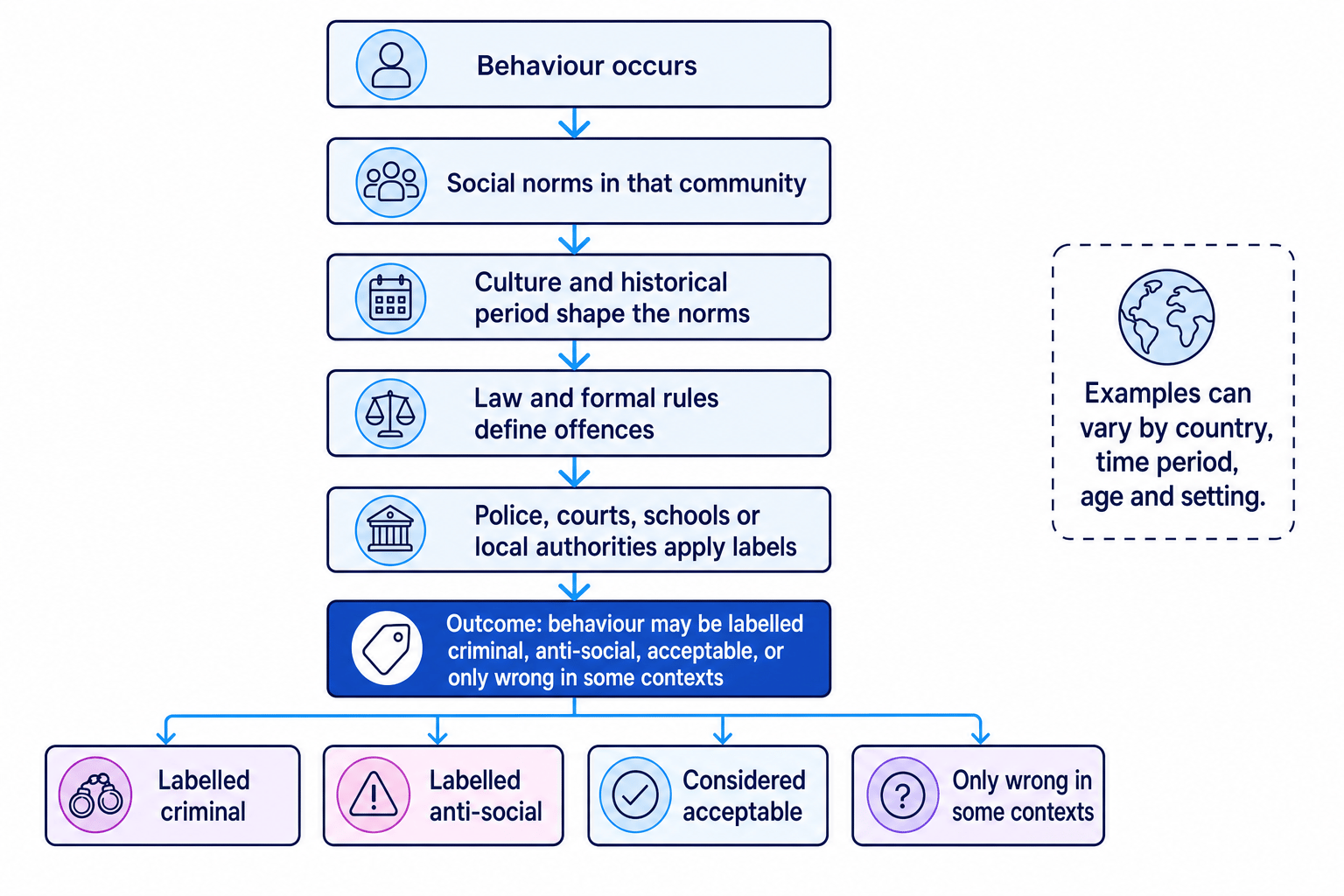
Criminal behaviour can be seen as a social construct because societies create laws. What counts as criminal may change depending on the country, the historical period, the age of the person, and the setting.
The flow diagram below shows how a behaviour can become labelled as criminal, anti-social or acceptable depending on law, norms and culture.
Deviation from norms
A norm is an expected standard of behaviour in a group or society. Deviation from norms means behaving in a way that goes against those expectations.
For example, shouting loudly in a library breaks a social norm, but it is not usually a crime. By contrast, theft is both a crime and a deviation from most social norms.
This distinction is important: deviant does not always mean criminal.
The role of culture
Culture means the shared values, beliefs, customs and rules of a group or society.
Different cultures may define behaviour differently. For example, laws about alcohol, drugs, public behaviour or punishment can vary between countries. Behaviour that is legal in one place may be illegal in another.
Definitions also change over time. Some behaviours that were criminal in the past are no longer criminal, and some behaviours become criminal because society’s values change.
Example
Applying social construction to a scenario
In Country A, a 19-year-old can legally buy alcohol. In Country B, the same behaviour is illegal until age 21.
- The behaviour itself is the same: a 19-year-old buying alcohol.
- The legal and cultural context is different: Country A allows it, while Country B defines it as against the law.
- This shows criminal behaviour as a social construct, because the label “criminal” depends on the rules and norms of that society.
Evaluating the social construction view
A strength of seeing crime as socially constructed is that it helps explain why crime differs across cultures and historical periods. It also encourages a more holistic view, because it looks at the wider social context rather than only blaming the individual.
A weakness is that it may not fully explain why one person commits crime while another person in the same culture does not. It can also risk underplaying the real harm caused to victims. Saying crime is socially constructed does not mean it is imaginary or unimportant.
Common Mistake
Thinking social construct means ‘not real’
A social construct can have very real consequences. Laws, arrests, victims’ experiences and punishments are real, even if definitions of crime vary between societies.
How crime is measured
Psychologists need ways to measure crime so they can study patterns, compare groups and evaluate explanations of criminal behaviour.
The two measures you need here are official statistics and self-report.
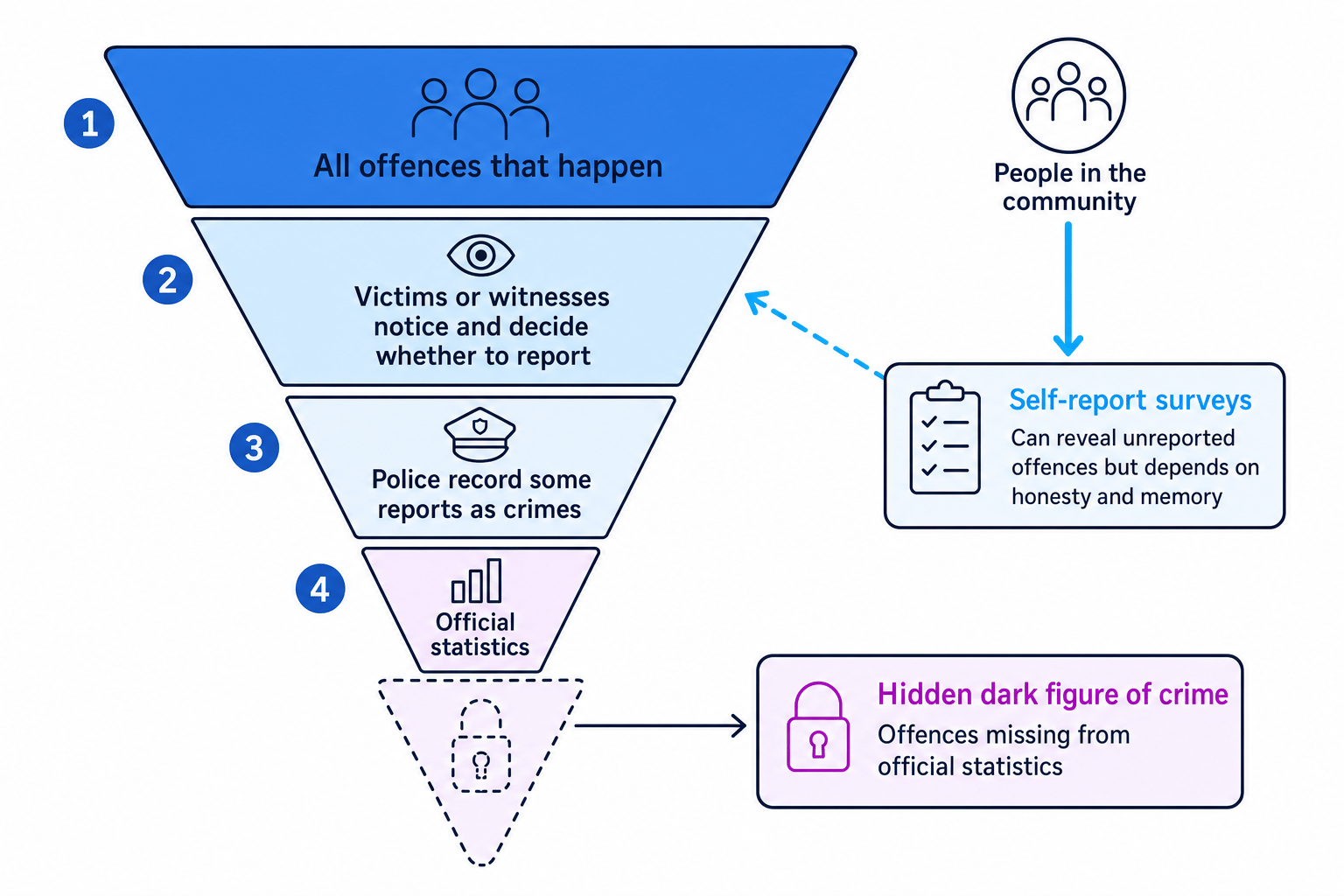
Official statistics
Official statistics are crime figures collected and published by official organisations, such as the police, courts or government bodies.
They usually show crimes that have been reported, recorded and processed by the criminal justice system.
Strengths of official statistics
Official statistics are useful because they are large-scale and collected regularly. This makes it easier to compare crime rates across different areas or over time.
They are also based on real records rather than just people’s opinions. Governments can use them to decide where resources, policing and prevention programmes may be needed.
Weaknesses of official statistics
Official statistics do not include every crime that happens. Some victims do not report crimes. Some offences are not detected. Some reports may not be recorded as crimes.
Definition
The dark figure of crime
The dark figure of crime means the offences that happen but are missing from official statistics because they are not reported, detected or recorded.
Official statistics can also be affected by changes in policing priorities, recording rules or public willingness to report. For example, an increase in recorded crime might mean more crime is happening, but it might also mean more people are reporting it.
Self-report
A self-report is a method where people provide information about themselves, usually through a questionnaire or interview.
In Criminal Psychology, self-report often means asking people whether they have committed offences. It may also involve people reporting crimes they have experienced.
Strengths of self-report
Self-report can reveal offences that never appear in official statistics. This is especially useful for crimes that are hidden, embarrassing or unlikely to be reported.
Self-report can also give more detail about motives, frequency and circumstances. For example, a questionnaire might ask how often someone has shoplifted and why they did it.
Weaknesses of self-report
Self-report depends on honesty and memory. People may lie, exaggerate, forget, or avoid admitting behaviour that makes them look bad. This is called social desirability bias, meaning people answer in a way that presents themselves more positively.
The results also depend on the sample, which is the group of people who take part. If the sample is not representative, the findings may not reflect the wider population.
Ethics of self-reporting crime
Self-report research about crime can be sensitive. Psychologists should follow the British Psychological Society’s Code of Ethics and Conduct.
Participants should give informed consent, meaning they know what the research involves. They should have the right to withdraw, be protected from psychological harm, and be debriefed afterwards. Researchers should keep responses confidential and anonymous where possible, but they must be clear about any limits to confidentiality, especially if serious harm or safeguarding issues are disclosed.
Comparing the two measures
Definition
Reliability and validity
- Reliability means a measure is consistent.
- Validity means a measure really measures what it claims to measure.
Official statistics can be fairly reliable because they are collected in a structured way each year. However, they may lack validity as a measure of total crime because of the dark figure.
Self-report can improve validity by uncovering hidden crime, but it may be less reliable if people answer dishonestly or remember events inaccurately.
Example
Choosing between official statistics and self-report
A psychologist wants to study minor shoplifting by teenagers.
- Minor shoplifting may often be unnoticed, unreported or dealt with informally, so official statistics are likely to underestimate it.
- An anonymous self-report questionnaire may reveal more hidden offending because teenagers can report behaviour even if they were never caught.
- A balanced conclusion would use both: official statistics show recorded crime patterns, while self-report may give a fuller picture of hidden behaviour.
Tip
Strong AO3 comparison
A good evaluation does not just say “official statistics are accurate” or “self-report is unreliable”. Compare them directly: official statistics may be more standardised, but self-report may uncover crimes missing from official records.
Bringing it together
For this Key Concepts section, you need to be able to:
- Describe different types of crime using accurate terms.
- Apply those terms to short scenarios.
- Explain how crime can be a social construct because laws and norms vary.
- Evaluate official statistics and self-report as ways of measuring crime.
This topic is the foundation for later Criminal Psychology work. Once you understand what crime means and how it is measured, you can judge explanations of offending much more carefully.
Exam technique
In the exam
- Start classification answers by identifying the behaviour: violence, drugs, gaining property, sexual behaviour, or anti-social harm to the community.
- For social construction questions, mention norms, culture and laws — and explain that definitions can change across time and place.
- For measurement questions, always balance one strength with one weakness, especially the dark figure of crime for official statistics and honesty issues for self-report.
Self review
Check yourself
- Why can the same behaviour be criminal in one culture but not in another?
- What is the difference between a violent offence and an acquisitive offence?
- Why might official statistics underestimate the true amount of crime?
You've reached the end
Test yourself on this topic, or move on to the next guide.
How was this guide?