The activation synthesis theory
Definition
Activation-synthesis theory
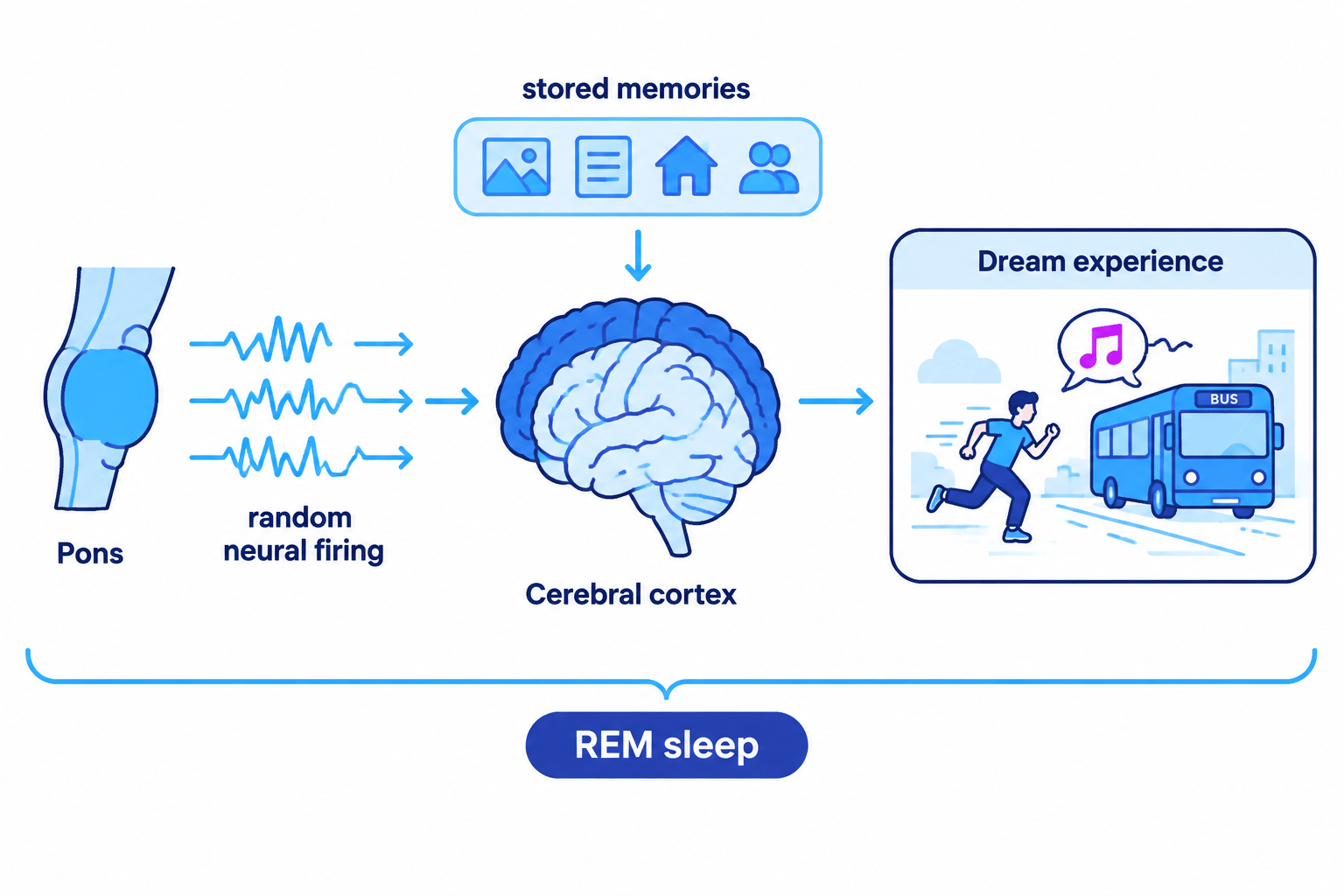
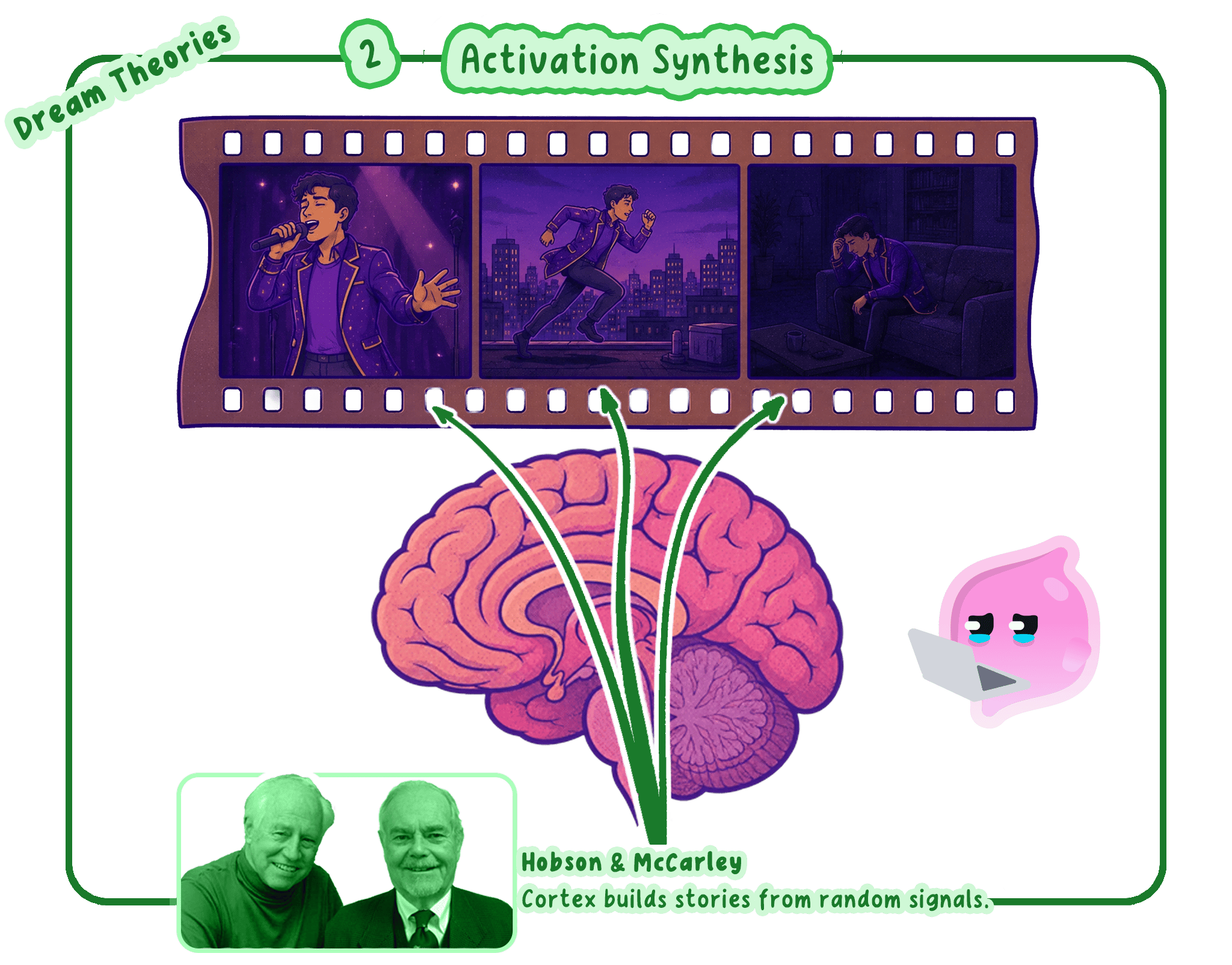
Activation-synthesis theory is Hobson and McCarley's explanation of dreaming. It says a dream is the cortex's attempt to make sense of random neural activity produced during REM sleep.
- Hobson and McCarley (1977) put forward activation synthesis, which explains a dream in two stages.
- Activation is the random neural firing the brain produces during REM sleep.
- Synthesis is the cerebral cortex making sense of that firing as though it were real experience.
- Both stages happen inside REM sleep, the stage where the brain is at its busiest and where most dreaming occurs.
- The two stages are one process seen at two levels, since the firing and the interpreting are going on at the same time through a REM period.
Key Idea
- Neurons in the pons fire in irregular bursts once REM sleep starts, and nothing outside the body sets them off.
- The cerebral cortex takes those bursts as though they were real sensory input, labels each one from stored memories, and arranges them into a sequence.
- The dream you wake up with is that arrangement, which is why it can run like one event after another while making no sense.
Activity of neurons in the pons
Definition
Pons
The pons is a small structure in the brainstem. During REM sleep it fires bursts of random neural signals that the rest of the brain then tries to interpret.
- When you enter REM sleep, neurons in the pons become intensely active.
- They fire in irregular bursts, with no steady pattern behind them.
- Nothing outside the body triggers these bursts, so each one arrives with no built-in meaning.
- One burst might be tied to movement and the next to a sound, in no particular order.
- The pons sits in the brainstem, one of the brain's three main divisions alongside the cerebrum and the cerebellum.
Common Mistake
- The pons supplies the bursts of activity, and the cerebral cortex is what builds the storyline from stored memories.
- The pons sits in the brainstem, not in the cerebrum.
Synthesis in the cerebral cortex
Definition
Cerebral cortex
The brain's wrinkled outer layer, responsible for higher mental functions such as thinking, perception, language and voluntary movement.
- The cerebral cortex is the outer layer of the cerebrum, and it receives these scattered bursts as though they were real sensory input.
- It draws on your stored memories and expectations to label each burst.
- It then arranges the labelled bursts into a sequence that feels like one event following another.
- That building of a coherent dream out of random signals is what synthesis means.
- The cortex has only your own memories to work with, so a dream is built from familiar material even when the sequence makes no sense.
Example
- A burst tied to movement lands in a cortex full of memories of your morning routine.
- It gets built into a dream of sprinting down the road after the bus, because that is a familiar story the cortex can slot the signal into.
Criticisms
Definition
Reductionism
Explaining a complex behaviour by reducing it to one simple cause or process, rather than looking at the whole person and the range of factors involved.
- Strengths
- It rests on real, observable brain activity during REM sleep.
- Williams et al. (1992) found REM dream reports were more bizarre than waking fantasies, which is what random activation predicts.
- It makes testable predictions, so it counts as a scientific account of dreaming.
- Weaknesses, and the reductionism and holism debate
- The theory is reductionist because it explains a rich experience through random brainstem firing alone.
- A holistic view says a dream can be meaningful and tied to the dreamer's waking life.
- Someone who dreams of missing the bus the night before every exam is describing a pattern that mirrors a real worry.
- It explains where dreams come from without saying what they are for.
Common Mistake
- Random activation does not make the content of a dream random, because the cortex builds that content out of your own memories.
- The theory does not deny that dreams feel meaningful, because its claim is that the meaning is added by the cortex.
Turning this into marks
- When a strength and a weakness are both asked for, make them genuinely separate rather than giving two versions of reductionism.
- Name the pons and the cerebral cortex, because writing that the brain produces signals and then interprets them does not secure the knowledge mark.
- The mark most often lost is naming reductionism without saying what a holistic view adds, which is that a dream can be meaningful and tied to waking life.
Self review
- How do neurons in the pons fire during REM sleep?
- Which part of the brain carries out synthesis?
- What does synthesis mean in this theory?
- Which debate sits at the heart of the criticisms of this theory?
- What did Williams et al. (1992) find about dream reports?