Endogenous pacemakers
Definition
Endogenous pacemaker
An internal body clock that controls biological rhythms from inside the body, such as the suprachiasmatic nucleus in the brain.
- Endogenous pacemakers are internal body clocks that control biological rhythms, including the sleep-wake cycle, from inside the body.
- Endogenous means coming from inside, so the clock carries on ticking even in constant darkness.
- Left to itself the human clock runs slightly longer than 24 hours, so it slowly drifts out of step with the day.
- For sleep, the pacemaker works as a chain of three parts: the suprachiasmatic nucleus, the pineal gland and melatonin.
Key Idea
- Light reaching the retina is sent straight to the suprachiasmatic nucleus in the hypothalamus, which reads the time of day from how much of it arrives.
- When the SCN reads darkness it signals the pineal gland to release melatonin, the level in the blood climbs, and sleep follows.
- The SCN would run slightly long on its own, so the morning light cue is what holds the whole cycle to a 24-hour day.
The SCN, the pineal gland and melatonin
Definition
Suprachiasmatic nucleus (SCN)
A tiny region in the brain's hypothalamus that acts as the body's master clock, using light information from the eyes to control the sleep-wake cycle.
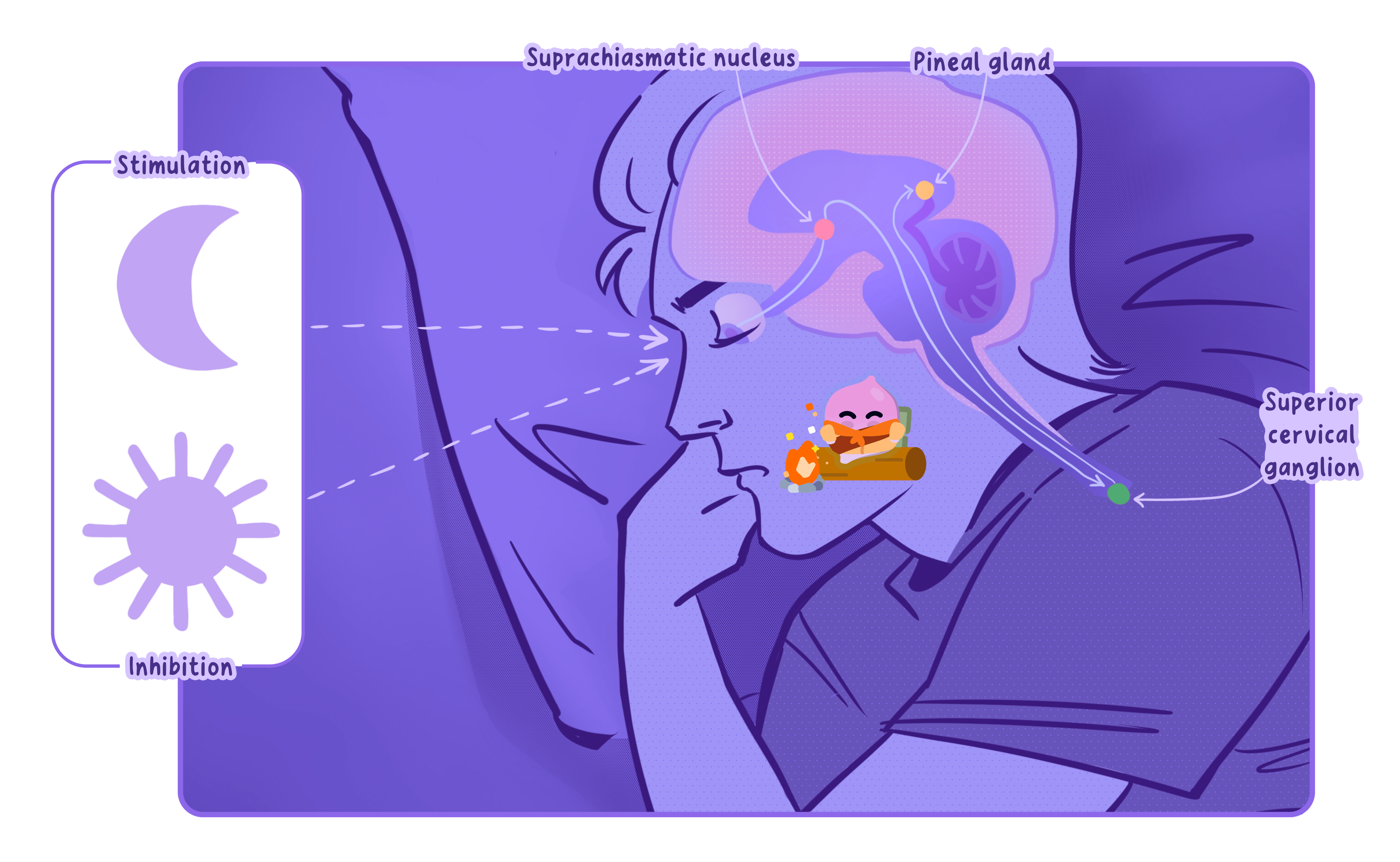
- Suprachiasmatic nucleus (SCN)
- A tiny area in the hypothalamus that acts as the master clock and receives information about light directly from the eyes.
- Pineal gland
- A small gland in the brain that releases melatonin when the SCN signals that it is dark.
- Melatonin
- The hormone that builds up in the blood during darkness and makes you feel sleepy.
Example
- On a bright June morning light floods your eyes. The SCN reads daytime and holds the pineal gland back, so melatonin stays low and you wake easily.
- On a dark December evening the SCN reads night, melatonin climbs, and you feel ready for bed much earlier.
How light sets the body clock
Definition
Pineal gland
A small gland in the brain that releases the hormone melatonin in response to signals from the suprachiasmatic nucleus.
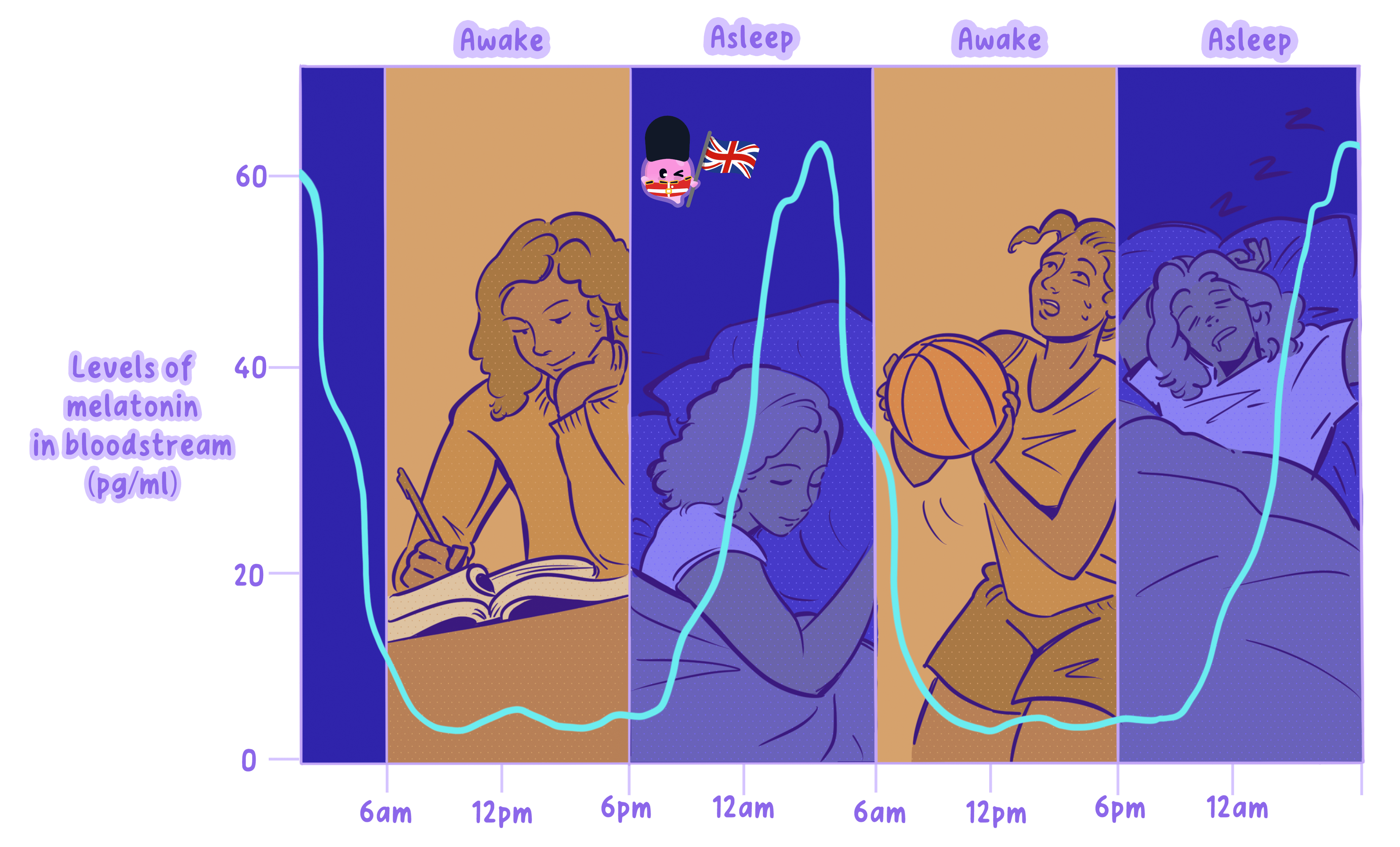
- Light enters your eyes and the retina sends that information straight to the SCN, which reads how much there is and works out the time of day.
- As the light fades through the evening the SCN signals the pineal gland to release more melatonin, the level in your blood climbs, and you feel sleepy.
- When light returns in the morning the SCN tells the pineal gland to cut melatonin right back, so you wake and alertness climbs again.
- That cue arrives every morning, so it pulls a slightly long internal clock back into line with the 24-hour day.
Common Mistake
- The SCN is the clock, and the pineal gland is the part that releases the melatonin.
- The internal clock is not sealed off from the world, because without a daily light cue it drifts.
Exogenous zeitgebers
Definition
Exogenous zeitgeber
An external cue, such as light or a set mealtime, that resets the body clock and keeps it in time with the outside world.
- Exogenous zeitgebers are cues from outside the body that reset your biological rhythms.
- Exogenous means coming from outside, and zeitgeber is German for time-giver.
- Light
- Bright daylight signals that it is time to be awake.
- Light is the strongest zeitgeber, so a bright phone screen late at night can push your clock later.
- Social cues
- Fixed routines such as mealtimes, school hours and bedtimes also nudge the clock, and they matter most when light is unreliable on dark winter mornings.
Example
- Fly to Spain for a summer holiday and the later sunset keeps you up, and a week of that new light pattern shifts your body clock across.
- Back home, a pitch-dark 7am start in December makes it hard to wake, so your alarm and breakfast routine become the cues doing the work.
When the clock and the outside day disagree
- The pacemaker sets the rhythm and the zeitgebers correct it.
- Fly from London to New York and your SCN still keeps London time, so melatonin climbs in the middle of a New York afternoon and drops away hours before you want to wake.
- The new pattern of light drags the clock round by roughly an hour a day, so a short trip is nearly over before sleep feels normal.
- Night shifts are harder still, because bright light at work and daylight on the journey home both signal daytime.
- A steady wake time with daylight soon after it gives the SCN the same cue at the same hour every day.
Note
- A clock that runs slightly long behaves like a watch gaining a few minutes each day, and the morning light is the correction that resets it.
- Light is much the stronger cue, so mealtimes and school hours hold a settled routine in place but move a badly mistimed clock only slowly.
- Someone with no light perception at all still has a working SCN, though with no light cue to reset it their sleep can drift later day by day.
Turning this into marks
- When a pacemaker and a zeitgeber are both asked for, make them genuinely separate rather than describing the same light cue twice.
- Name the suprachiasmatic nucleus, because writing that a part of the brain keeps time does not secure the knowledge mark.
- The mark most often lost is stopping at melatonin without saying that the pineal gland releases it on a signal from the SCN.
Self review
- What is an endogenous pacemaker?
- Name two exogenous zeitgebers.
- Which gland releases melatonin?
- Trace how light reaching the eyes leads to sleep.
- Why does the body clock drift without a daily light cue?
