What sleep is
- Sleep is a natural, reversible state in which your awareness of the world outside drops away and your body goes still.
- Brain activity carries on right through the night, and in some stages it runs almost as high as it does when you are wide awake.
- Sleep has three benefits: a healthy brain, physical repair and emotional stability.
Key Idea
- Awareness of the world outside drops away in sleep while brain activity carries on, and in REM it runs almost as high as it does when you are awake.
- The night is spent looping through a 90 minute cycle four or five times, with deep sleep filling the early loops and longer REM periods coming towards morning.
- The three benefits are earned inside that cycle: the day's learning settles into long-term storage, growth hormone released in deep sleep repairs cells, and the brain areas that handle emotion get a chance to settle.
The three benefits of sleep
- A healthy brain
- While you sleep the brain consolidates what you took in during the day, so it settles into long-term storage instead of fading.
- Waste products that build up in brain tissue while you are awake are cleared out overnight.
- After a full night you can hold attention through a lesson and recall what you revised the evening before.
- Physical repair
- Growth hormone is released during the deep stages of sleep.
- Growth hormone drives the repair of damaged cells and the growth of muscle and bone.
- Energy stores are topped back up and the immune system works better, so you pick up fewer infections.
- Emotional stability
- Sleep gives the brain areas that handle emotion a chance to settle, so feelings are easier to keep in proportion the next day.
- After a short night people are quicker to lose their temper and slower to shake off a setback.
Example
- You stay up until 1am watching one more episode, then sit down to an 8:40 registration.
- By third period you have read the same page twice and none of it has stuck, because the consolidation never happened.
- Your legs feel heavy in PE, since you missed most of the deep sleep that repairs muscle.
- At lunch you snap at a friend over nothing.
Stages of the sleep cycle
Definition
Sleep cycle
A repeating pattern of sleep stages, lasting about 90 minutes, that you move through several times a night, ending each time with a burst of REM sleep.
- Stage 1: drifting off
- Muscles relax and you are woken by the slightest noise, so you may not be sure you were asleep at all.
- Stage 2: light sleep
- Heart rate and breathing slow, body temperature drops, and more of the night is spent here than in any other stage.
- Stages 3 and 4: deep sleep
- Brain activity slows right down and you are very hard to wake, so being woken here leaves you groggy.
- Growth hormone is released in these stages, so physical repair is concentrated in deep sleep.
- REM sleep
- The eyes dart about under the lids, the brain is nearly as active as it is when you are awake, and the muscles of the body stay limp.
- Most dreaming occurs in REM sleep, and someone woken out of REM will usually be able to report a dream.
- One full loop through these stages takes roughly 90 minutes, and you repeat it four or five times a night.
- Deep sleep fills the early cycles and REM periods get longer towards morning, so the dream you remember is usually one from just before you woke.
Common Mistake
- The brain does not shut down during sleep, and it stays active right through the night, reaching its busiest in REM.
- Dreaming does not run steadily all night, and it is concentrated in the REM stage of each cycle.
- REM is not the deepest sleep, and the deepest stages are 3 and 4.
The pineal gland and melatonin
Definition
Melatonin
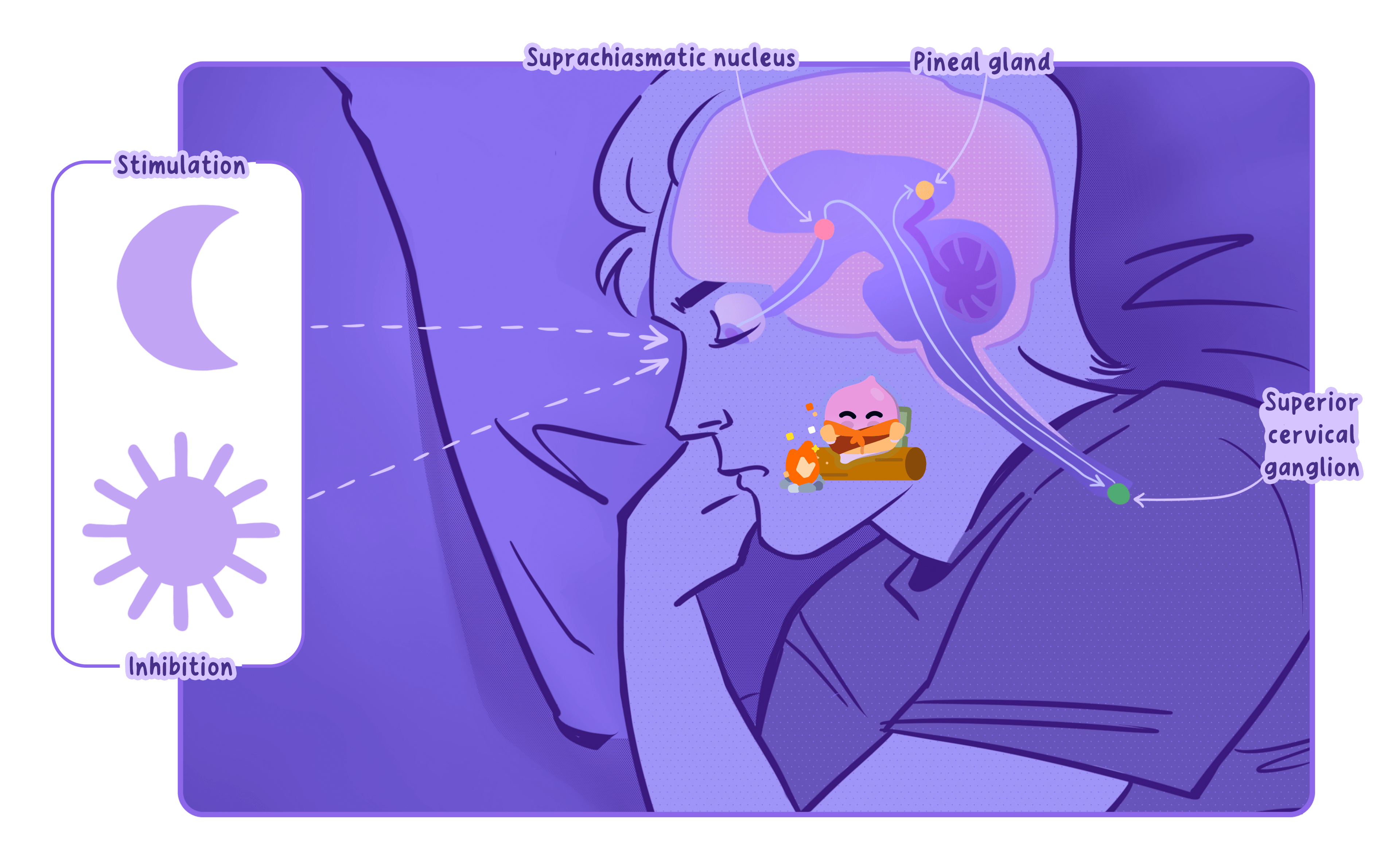
A hormone released by the pineal gland when it gets dark, which makes you feel sleepy and helps control the sleep-wake cycle.
- The pineal gland is a small gland buried deep in the brain, about the size of a grain of rice.
- As light levels fall in the evening, the pineal gland secretes the hormone melatonin into the bloodstream.
- Rising melatonin lowers alertness and body temperature, and that is the feeling of becoming sleepy.
- Bright light in the morning switches melatonin release off, so alertness climbs again and you wake properly.
- A bright screen held close to your face at 11pm slows that rise in melatonin, so sleep starts later than it otherwise would.
- A clock deeper in the brain tracks the light and dark outside and tells the pineal gland when to start releasing melatonin.
- A run of late nights under bright light shifts the timing of that release across several days.
Note
- Melatonin sets the timing of sleepiness rather than forcing sleep, so a rising level can be overridden by a late night out.
- A short night trims the stages unevenly, because deep sleep is taken early and the long REM periods lost are the ones nearest morning.
- How much sleep a person needs changes with age, and in the teenage years it is typically around 8 to 10 hours a night.
Turning this into marks
- When two benefits of sleep are asked for, make them genuinely separate rather than one benefit described twice.
- Name the pineal gland and melatonin, because saying that the brain gets you ready for sleep does not secure the knowledge mark.
- The mark most often lost is giving the length of the sleep cycle without saying that most dreaming happens in REM sleep.
Self review
- Name the three benefits of sleep.
- What does the brain do with the day's learning while you sleep?
- Which stages of the cycle is growth hormone released in?
- About how long is one sleep cycle, and in which stage does most dreaming occur?
- Which gland releases melatonin, and what makes it release more?
