Neuropsychology and memory
Definition
Neuropsychology
The study of how the brain and its workings are linked to behaviour and mental processes such as memory.
- Neuropsychology studies how the brain is linked to behaviour, including memory.
- It treats memory as several separate functions.
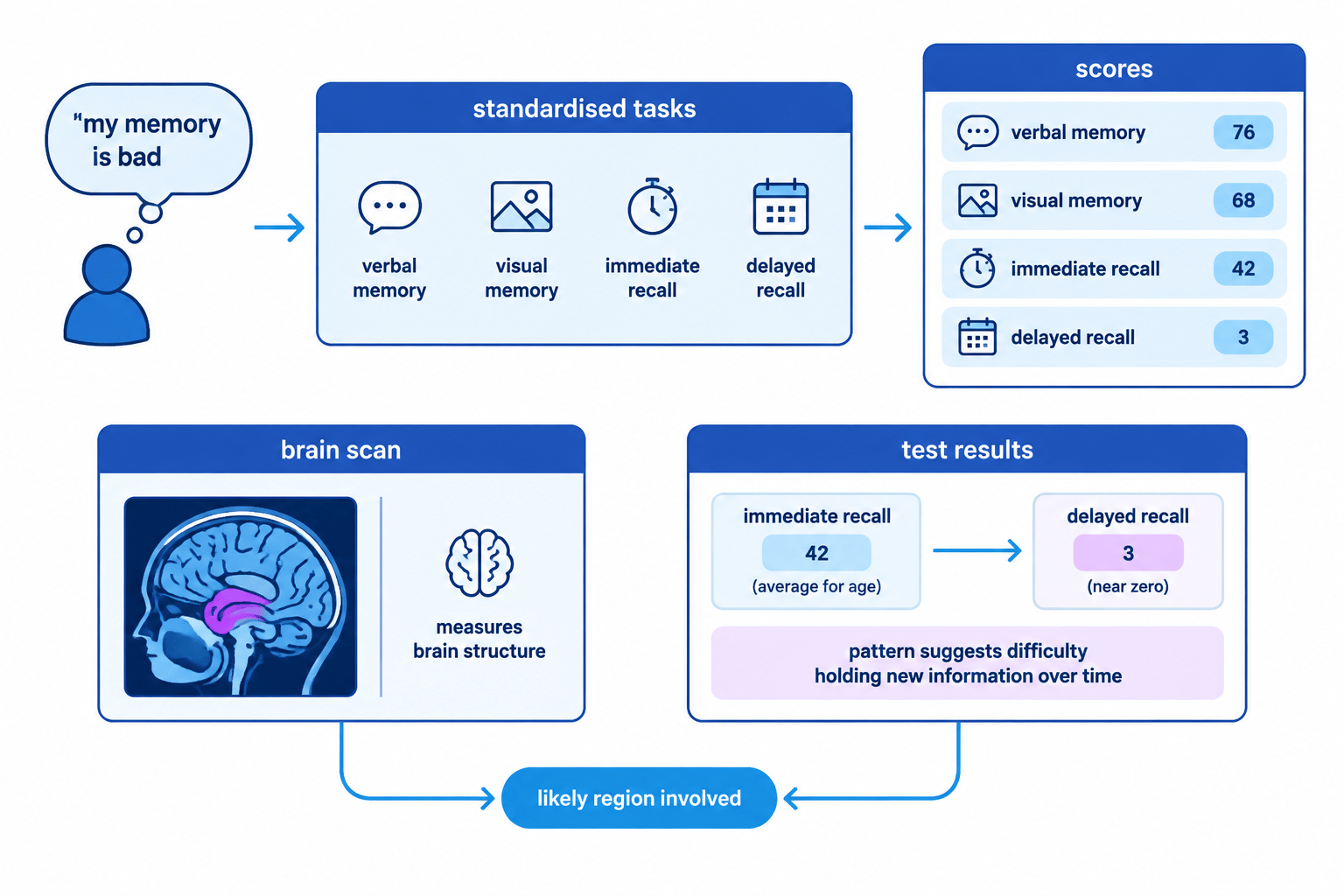
- A person may be able to say only that their memory is bad, which does not identify which function has been affected.
- Measuring each function on its own turns that complaint into a pattern of scores that points to a particular deficit.
- Different tasks probe different parts of memory, from word lists to visual designs.
Key Idea
- Memory is several functions rather than one ability, so testing each function on its own turns a vague complaint into a pattern that points at the deficit.
- Someone can retell a story perfectly on the spot and score close to zero twenty minutes later, and that gap is the finding a clinician needs.
- Because the tasks are given and scored the same way every time, one person's scores can be set against the typical scores for their age.
The development of memory testing
Definition
Standardised test
A test given and scored in exactly the same way every time, so that one person's results can be compared fairly with others.
- At first a memory problem could be judged only from what the person said they could remember, which was subjective and hard to compare between people.
- Studies of people with neurological damage then showed that memory functions can fail separately, so separate scores are needed for separate functions.
- Psychologists built batteries of tasks that are given and scored in exactly the same way for everyone, so one person's results can be set against typical results.
- Brain imaging was later used alongside those tests, so a low score could be tied to a damaged region.
- The measurement of memory therefore developed in three steps: from what the person reports, to standardised tests, to tests combined with brain imaging.
- Wilson, Kopelman and Kapur (2008) used that combination with Clive Wearing, repeating standardised tests of intelligence and memory alongside brain scans over many years.
Note
- There is no reliable figure for how long Clive Wearing could hold information, so his case is described through his test scores rather than a number of seconds.
- A test and a scan answer different questions, since one measures what a person can do and the other shows the structure of the brain.
The Wechsler Memory Scale
Definition
Wechsler Memory Scale
A standardised set of memory tasks that gives separate scores for different memory functions, such as verbal memory, visual memory and delayed recall. A person's scores are compared with the typical scores for their age group.
- The Wechsler Memory Scale is the best known of those batteries.
- It is a standardised battery of memory tasks, given in the same order with the same wording and scored the same way each time.
- It gives a separate score for verbal memory, tested with short stories and word lists, and for visual memory, tested with designs and faces.
- It also separates immediate recall from delayed recall, which shows whether new information is being held over time.
- Each score is compared with the typical scores for the person's age, so an unusually low result on one function stands out.
Example
- At an NHS memory clinic a person may be asked to retell a short story straight away and then again twenty minutes later.
- The gap between those two scores shows how well new memories are being formed and held.
- Clive Wearing scored in the average range on intelligence tests and scored zero on delayed recall, which showed which function had been affected.
Using the scores in a clinic
- The tests show which memory functions have been affected after an injury or illness.
- That helps doctors diagnose conditions such as dementia and tell them apart from other causes of poor memory.
- The pattern of scores also guides support, since a person whose new learning is affected may be helped by diaries, alarms and written routines.
- Giving the same test again months later tracks whether memory is improving or declining, which is how rehabilitation is judged.
- Because the test is standardised, that comparison is a fair one.
Common Mistake
- Memory is not one single thing, because these tools exist to measure several functions apart.
- The Wechsler Memory Scale is not a brain scan, because one measures behaviour and the other shows structure.
Interpreting the pattern of scores
- A low score can have several causes, including tiredness, anxiety, low mood and medication.
- The pattern across the functions therefore carries more weight than any single number.
- A person whose immediate recall is normal for their age and whose delayed recall is close to zero shows a failure to hold new material over time.
- Pairing that pattern with a brain scan allows a clinician to identify the region likely to be involved.
Turning this into marks
- Name the Wechsler Memory Scale, because writing that psychologists use memory tests does not secure the knowledge mark.
- Give two functions it scores separately, such as verbal memory and visual memory, or immediate and delayed recall, and keep them as two distinct points.
- Say what standardisation adds, because scores are comparable only when a test is given and scored the same way every time.
- The mark most often lost is treating memory as a single ability, so describe the separate functions the tests measure.
Self review
- What is neuropsychology?
- Outline the three steps by which the measurement of memory developed.
- Name two memory functions the Wechsler Memory Scale scores separately.
- Why are memory tests standardised?
- Why does the difference between immediate and delayed recall matter in a clinic?