The structure of the multi-store model
- Atkinson and Shiffrin set out the multi-store model in 1968.
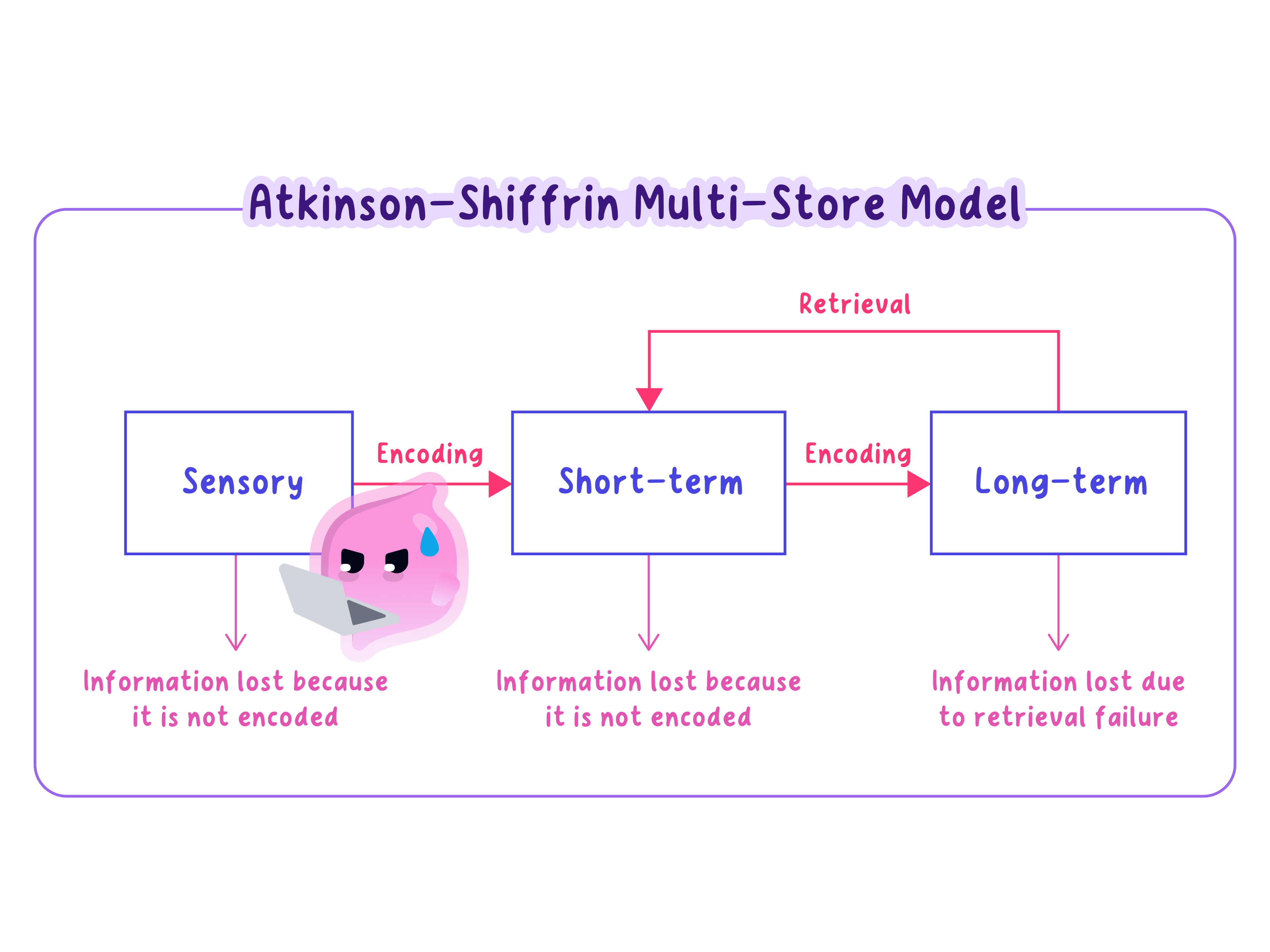
- Information flows through three separate stores, one after another.
- The three stores are the sensory store, short-term memory and long-term memory.
- Information reaches long-term memory by passing through the two stores in front of it, so the order is fixed.
- Two named processes move it along: attention and rehearsal.
Key Idea
- Information has to pass through each store in turn, so anything that misses attention or rehearsal never reaches long-term memory at all.
- Attention is the gate out of the sensory store, and rehearsal is the gate into long-term memory.
- That is why a number read out in a corridor is gone in seconds while your own number has been available for years.
The sensory store
Definition
Sensory register
The memory store that holds a brief snapshot of everything the senses take in, lasting a fraction of a second unless attention moves it on.
- Everything the eyes, ears and other senses pick up arrives in the sensory store first.
- It holds a brief copy of that raw input, which gives the brain a moment to select what matters.
- The name to use is the sensory store, which is also called the sensory register.
- Information that is not attended to is lost almost at once, so most of what reaches the senses is never remembered.
Common Mistake
- Not everything a person sees or hears gets remembered, because almost all of it leaves the sensory store in an instant.
- Information does not pass straight from the sensory store to long-term memory, because the model has no such route.
Short-term memory
Definition
Short-term memory
The store that briefly holds the small amount of information you are working with now, for around 15 to 30 seconds unless you rehearse it.
- Short-term memory holds the handful of items a person is consciously working with.
- It is a limited store, so only a few items can be held at any moment.
- Material stays there while it is being worked on, and it fades once rehearsal stops.
- Rehearsed material passes on into long-term memory.
Note
- Sensory store and sensory register are two names for the same store, and sensory store is the primary term here.
- The figures for this store are approximate, so around seven items and roughly 15 to 30 seconds are rough guides rather than fixed limits.
- Rehearsal here means plain repetition, which is why the model says so little about the meaning of what you are learning.
Long-term memory
Definition
Long-term memory
The store that holds information over long periods, from hours to potentially a lifetime, with no known limit on how much it can hold.
- Long-term memory holds information over long periods, and the model puts no known limit on how much it can take.
- Stored information is retrieved back into short-term memory to be used, which is the arrow running back from long-term memory in the diagram.
- In this model long-term memory is treated as a single store.
Attention and rehearsal
Definition
Rehearsal
Repeating or actively thinking about information so that it passes from short-term memory into long-term memory.
- Attention means focusing on part of what the sensory store is holding, and that is what pulls it into short-term memory.
- A person hears their own name across a crowded room because attention selects it out of everything else arriving.
- Rehearsal means repeating information or thinking it over while it is in short-term memory, and enough rehearsal transfers it into long-term memory.
- Rehearsal also keeps an item alive in short-term memory while it is still in use.
Example
- A friend reads out their number in the corridor, and every sound around you enters the sensory store together.
- You attend to their voice, so the digits reach short-term memory while the rest fades.
- You hold them just long enough to tap them in and then lose them, because they were never rehearsed into long-term memory.
- Your own number stays available, because years of repeating it have moved it into long-term memory.
Turning this into marks
- Name the three stores in order and label the two arrows attention and rehearsal, because a description of memory in general does not secure the knowledge mark.
- Say what each process does at its boundary, because a process named without its effect gains no development mark.
- Sketch three boxes joined by forward arrows, with a retrieval arrow running back from long-term to short-term memory, before writing a longer answer.
- The mark most often lost is putting rehearsal at the first boundary, because attention moves information out of the sensory store and rehearsal moves it from short-term into long-term memory.
Self review
- Name the three stores of the multi-store model in order.
- Who proposed the model, and in which year?
- Which process moves information from the sensory store into short-term memory?
- Which process moves information from short-term into long-term memory?
- Why does most of what the senses take in never get remembered?
