The dopamine hypothesis
Definition
Dopamine hypothesis
The idea that schizophrenia is linked to an overactive dopamine system, with high dopamine activity in parts of the brain contributing to symptoms.
- The dopamine hypothesis is the biological explanation of schizophrenia, and it ties the condition to one neurotransmitter.
- Its central claim is that the dopamine system is overactive, producing high dopamine levels in the brain.
- That excess activity is linked most strongly to the positive symptoms, such as hallucinations and delusions.
- The explanation covers the neurons involved, how they pass a signal, and what happens when the system is overactive.
Key Idea
- An overactive dopamine system leaves too much dopamine crossing the synapse, and that excess is what the hallucinations and delusions are traced back to.
- Receiving neurons then fire when nothing real has triggered them, which is heard as a voice or felt as a meaning attached to something ordinary.
- The explanation is strongest on the positive symptoms and weakest on the negative ones.
Dopaminergic neurons
Definition
Dopamine
A neurotransmitter involved in movement, motivation and processing information; unusual levels of activity are linked to several conditions.
- Dopaminergic neurons are the brain cells that use dopamine as their chemical messenger.
- Like any neuron, each one has a cell body, branching dendrites that receive signals, and a long axon that carries a signal away.
- Dopamine is made inside the neuron and stored in tiny sacs called vesicles at the end of the axon.
- These neurons run in pathways deep inside the brain, and those pathways are involved in movement, motivation and deciding what deserves attention.
Note
- The same pathways carry movement, which is why drugs that block dopamine receptors can cause stiffness and tremor as a side effect.
- Only some of these pathways are involved, so the claim is about activity in particular routes rather than about the whole brain.
Synaptic transmission
Definition
Synaptic transmission
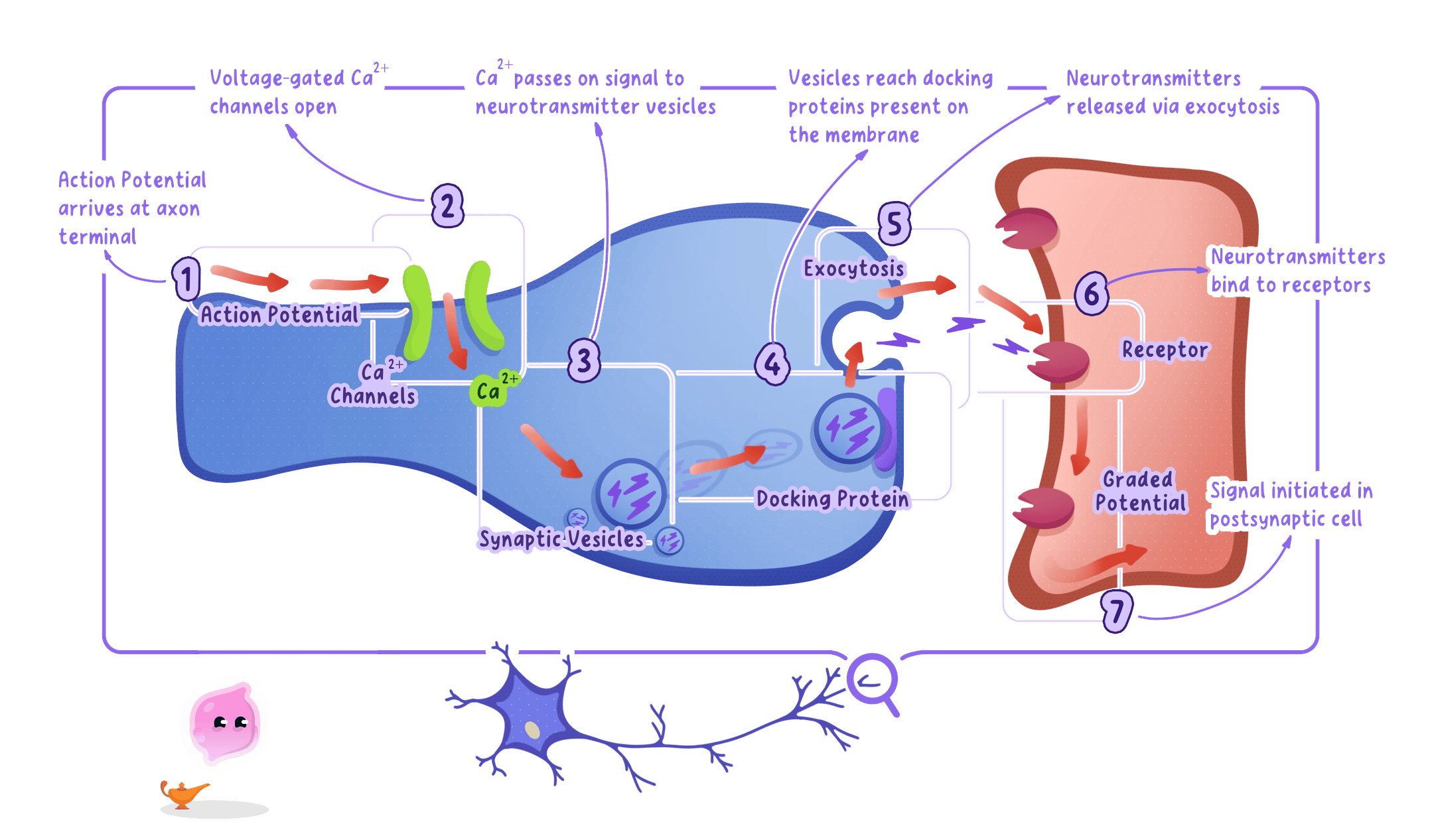
The way a message passes from one neuron to the next across the synapse, the tiny gap between them. A neurotransmitter is released into the gap and binds to receptors on the receiving neuron.
- An electrical impulse travels down the axon of the sending neuron to the axon terminal.
- The impulse pushes the vesicles against the membrane and they burst open.
- Dopamine spills into the synapse, the microscopic gap between the two neurons.
- It diffuses across, so this part of the message is chemical.
- On the other side it binds to receptors on the dendrites of the receiving neuron, and only a receptor of the matching shape will accept it.
- Once enough receptors are occupied, the receiving neuron fires its own impulse.
- Whatever dopamine is left in the gap gets cleared away, either broken down by enzymes or pulled back into the sending neuron by reuptake.
- Clearing the gap is what stops the signal, so both the amount of dopamine and how long it lingers there matter.
Example
- Think of a microphone with the gain wound far too high, so ordinary sounds screech and feed back.
- An overactive dopamine system amplifies signals in the same way, until the brain treats noise as something real.
How the system becomes overactive
- In schizophrenia the dopaminergic neurons are thought to fire more often than they should.
- Each extra firing releases more dopamine into the synapse.
- Some brains also appear to have more dopamine receptors, so the same amount of dopamine produces more binding.
- If reuptake is slower, dopamine sits in the gap for longer and keeps stimulating the receiving neuron.
- Together these produce high dopamine activity, with receiving neurons firing when nothing real has triggered them.
- In the pathways that handle sound and speech, that misfiring is experienced as a voice, which is an auditory hallucination.
- Dopamine also flags what is important, so too much of it makes ordinary events feel loaded with meaning.
- A car parked outside starts to feel like surveillance, and the belief that grows around that feeling becomes a delusion.
Common Mistake
- Dopamine is a neurotransmitter, not a hormone and not a gene.
- The claim is about how active the system is, so dopamine itself is not a harmful chemical.
- High dopamine belongs with the positive symptoms, because it explains those far better than the negative ones.
Evidence for the dopamine hypothesis
- Drugs that raise dopamine activity, such as amphetamines and cocaine, can produce hallucinations and delusions in people who have never had schizophrenia.
- The same drugs can make existing symptoms worse in a person who has been diagnosed.
- L-dopa, given to raise dopamine in Parkinson's disease, can produce similar symptoms as a side effect.
- Anti-psychotic drugs block dopamine receptors so that less binding takes place, and they reduce the positive symptoms.
- The more strongly a drug blocks dopamine receptors, the better it tends to work on those symptoms.
- In Daniel et al. (1991), amphetamine given to ten in-patients raised activity in the prefrontal area and improved their scores on a card sorting task.
- That supports the theory by showing dopamine activity and thinking move together.
Note
- All of this evidence is indirect, because dopamine activity in a living brain cannot be read off as simply as blood pressure.
- Anti-psychotic drugs act on the positive symptoms and do far less for the negative ones, which is why the hypothesis is treated as incomplete.
- Daniel and colleagues tested only ten in-patients, so a sample that small limits how far the finding can be generalised.
Turning this into marks
- When two parts of the explanation are asked for, make them genuinely separate rather than one part rephrased.
- Name dopamine, the dopaminergic neuron and the synapse, because a general reference to brain chemistry does not secure the knowledge mark.
- The mark most often lost is describing the symptoms without saying what happens at the synapse.
Self review
- What does the dopamine hypothesis claim about the dopamine system?
- Outline the process of synaptic transmission at a dopamine synapse.
- Give three ways a dopamine system can become overactive.
- How does high dopamine activity lead to a hallucination?
- How does the effect of anti-psychotic drugs support the hypothesis?
